
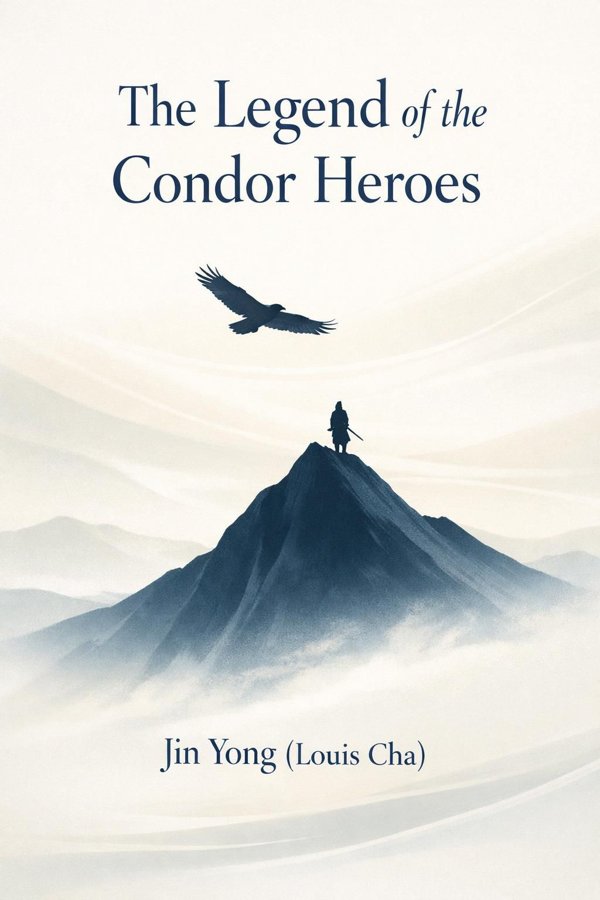
The Legend of the Condor Heroes: Summary & Key Insights
 10 min9 chaptersAudio available
Key Takeaways from The Legend of the Condor Heroes
A great adventure becomes unforgettable when private choices are shaped by public catastrophe.
The most surprising kind of hero is often the one who does not look exceptional at first.
A hero becomes deeper when matched with someone who sees the world differently.
In Jin Yong’s world, kung fu is never just combat technique.
Stories of destiny often become excuses for passivity, but The Legend of the Condor Heroes treats fate differently.
What Is The Legend of the Condor Heroes About?
The Legend of the Condor Heroes by Jin Yong (Louis Cha) is a classics book spanning 5 pages. The Legend of the Condor Heroes is one of the defining achievements of modern Chinese literature and the work that introduced countless readers to the grandeur of wuxia. Set against the turbulence of the Southern Song dynasty and the rising power of the Jin and Mongols, the novel follows Guo Jing, a plainspoken, slow-learning young man raised on the grasslands, as he matures into a martial artist of rare integrity. Along the way, Jin Yong combines historical conflict, sect rivalries, romance, mentorship, and moral testing into a story that feels both epic and deeply human. What makes the novel endure is not just its action, but its vision of character. Guo Jing is not brilliant in the usual sense; his greatness comes from sincerity, loyalty, patience, and the willingness to keep learning. Through him, Jin Yong asks what truly makes a hero in a corrupt and violent age. Louis Cha, better known by his pen name Jin Yong, is the most influential wuxia novelist of the twentieth century, and this book remains one of his most beloved masterpieces because it turns adventure into a meditation on honor, nation, love, and destiny.
This FizzRead summary covers all 9 key chapters of The Legend of the Condor Heroes in approximately 10 minutes, distilling the most important ideas, arguments, and takeaways from Jin Yong (Louis Cha)'s work. Also available as an audio summary and Key Quotes Podcast.
The Legend of the Condor Heroes
The Legend of the Condor Heroes is one of the defining achievements of modern Chinese literature and the work that introduced countless readers to the grandeur of wuxia. Set against the turbulence of the Southern Song dynasty and the rising power of the Jin and Mongols, the novel follows Guo Jing, a plainspoken, slow-learning young man raised on the grasslands, as he matures into a martial artist of rare integrity. Along the way, Jin Yong combines historical conflict, sect rivalries, romance, mentorship, and moral testing into a story that feels both epic and deeply human.
What makes the novel endure is not just its action, but its vision of character. Guo Jing is not brilliant in the usual sense; his greatness comes from sincerity, loyalty, patience, and the willingness to keep learning. Through him, Jin Yong asks what truly makes a hero in a corrupt and violent age. Louis Cha, better known by his pen name Jin Yong, is the most influential wuxia novelist of the twentieth century, and this book remains one of his most beloved masterpieces because it turns adventure into a meditation on honor, nation, love, and destiny.
Who Should Read The Legend of the Condor Heroes?
This book is perfect for anyone interested in classics and looking to gain actionable insights in a short read. Whether you're a student, professional, or lifelong learner, the key ideas from The Legend of the Condor Heroes by Jin Yong (Louis Cha) will help you think differently.
- ✓Readers who enjoy classics and want practical takeaways
- ✓Professionals looking to apply new ideas to their work and life
- ✓Anyone who wants the core insights of The Legend of the Condor Heroes in just 10 minutes
Want the full summary?
Get instant access to this book summary and 100K+ more with Fizz Moment.
Get Free SummaryAvailable on App Store • Free to download
Key Chapters
A great adventure becomes unforgettable when private choices are shaped by public catastrophe. That is one of the central powers of The Legend of the Condor Heroes. Jin Yong does not place Guo Jing in an abstract fantasy world; he places him inside the fractured political reality of the Song, Jin, and Mongol struggle. Wars, betrayals, shifting loyalties, and the fear of invasion are not background decoration. They are the furnace in which character is tested.
The novel opens with a chain of causes that links family fate to national disorder. Oaths between men, acts of treachery, exile, and displacement all emerge from a world where political instability reaches into ordinary lives. Guo Jing and Yang Kang, born under dramatically different conditions yet tied by their fathers’ brotherhood, become parallel answers to the same historical pressure. One grows toward integrity; the other bends toward ambition and self-preservation. Their contrast suggests that history does not automatically create heroes or villains, but it does reveal what people value when survival is at stake.
This idea has practical force beyond fiction. In real life, difficult environments often expose our priorities more clearly than comfortable ones do. Work crises, family conflict, social upheaval, and sudden opportunity can all show whether we serve principle or convenience. Jin Yong’s historical setting reminds us that character is easiest to praise in peace and hardest to preserve in danger.
The novel also argues that patriotism is not loud rhetoric. It is disciplined responsibility toward something larger than the self. Guo Jing’s moral growth matters because he learns to connect personal loyalty with public duty.
Actionable takeaway: When facing pressure, ask not only what is safest or smartest, but what kind of person your decision reveals you to be.
The most surprising kind of hero is often the one who does not look exceptional at first. Guo Jing enters the story without dazzling brilliance. He is slow to understand, awkward beside sharper minds, and often underestimated by nearly everyone around him. Yet Jin Yong turns those apparent weaknesses into the foundation of a rare kind of strength.
Guo Jing’s growth depends less on talent than on steadiness. He learns slowly, but once he learns, he does not forget. He is not manipulative, which means people can trust him. He is not driven by vanity, so he can submit to hard instruction. In a martial world full of ego, intrigue, and performance, his honesty becomes revolutionary. This is especially striking when compared with cleverer characters who use intelligence to dominate, deceive, or gain status. Guo Jing’s sincerity does not make him naive forever; rather, it gives him a moral center that keeps skill from turning into corruption.
This lesson applies widely. Many people assume success belongs to the quickest thinker, the most charismatic speaker, or the most strategically ruthless competitor. But long-term excellence often comes from consistency, reliability, and the ability to endure frustration without losing direction. Students who review patiently, professionals who build trust over years, and leaders who stay clear in their values often outperform flashier rivals in the long run.
Guo Jing also shows that humility accelerates learning. Because he does not cling to appearing clever, he can absorb teachings from different masters. His simplicity is not emptiness; it is receptivity. He grows because he is teachable.
Actionable takeaway: If you feel outmatched by more gifted or more polished people, focus on traits that compound over time: honesty, patience, disciplined practice, and the courage to keep improving.
A hero becomes deeper when matched with someone who sees the world differently. Huang Rong is one of Jin Yong’s most brilliant creations because she is not merely the hero’s love interest; she is a force of wit, improvisation, emotional intelligence, and strategic vision. Where Guo Jing is straightforward, she is layered. Where he advances through perseverance, she often wins through insight. Together, they form one of the great partnerships in adventure fiction.
Huang Rong’s intelligence is practical rather than abstract. She reads people, notices hidden motives, and turns disadvantage into opportunity. She can be playful, deceptive, compassionate, stubborn, and deeply loyal, sometimes within the same scene. That complexity prevents the novel from becoming morally simplistic. Through her, Jin Yong suggests that goodness does not always look solemn. It may arrive through humor, adaptation, and the refusal to let rigid rules defeat living judgment.
Her relationship with Guo Jing also reveals an important truth about compatibility. Great partnerships do not require sameness; they require complementarity rooted in trust. Guo Jing stabilizes Huang Rong when emotion or mischief could run too far. Huang Rong protects Guo Jing from being crushed by a world more cunning than he is. Each makes the other more capable.
In ordinary life, this is a powerful model for teamwork and relationships. The best collaborator may not be the person most like you, but the person whose strengths cover your blind spots. A methodical planner and a creative improviser, for example, can accomplish more together than either could alone if mutual respect is present.
Huang Rong also reminds readers that intelligence without loyalty can become manipulation, while intelligence guided by love and principle becomes wisdom in action.
Actionable takeaway: Identify the strengths you lack and seek relationships, friendships, or teams where difference becomes a source of trust rather than competition.
In Jin Yong’s world, kung fu is never just combat technique. It is a visible expression of training, worldview, temperament, and moral alignment. The Legend of the Condor Heroes uses martial arts not merely to excite readers with duels and secret manuals, but to ask what happens when power is joined either to virtue or to greed.
As Guo Jing studies under multiple masters and encounters competing schools, the reader sees that technique alone is incomplete. Some fighters possess extraordinary skill yet remain spiritually distorted by jealousy, vanity, or obsession. Others are flawed but disciplined, and their methods reveal years of hardship and inward cultivation. This connection between external practice and internal character is one of the novel’s deepest themes.
The famous training sequences matter because they dramatize a universal truth: skill grows through repetition, guidance, and correction. Guo Jing’s progress is hard-won. He suffers, fails, misunderstands, and practices again. The same principle applies to any demanding field. Writing, music, law, teaching, athletics, entrepreneurship, and even parenting all require forms of “martial discipline”: patience under pressure, respect for fundamentals, and the humility to keep refining execution.
Jin Yong also warns against shortcuts. Secret texts, stolen techniques, or hunger for invincibility often tempt characters into imbalance. Raw power without moral maturity creates danger both for the individual and for the world around them. In modern terms, this applies to wealth, influence, technology, and expertise. Capacity expands faster than wisdom unless deliberately trained.
The novel’s martial philosophy therefore invites readers to redefine strength. Real mastery is not domination for its own sake. It is controlled ability used in service of justice, protection, and restraint.
Actionable takeaway: Whatever craft or responsibility you hold, train both competence and character together; power is safest in the hands of those disciplined enough not to misuse it.
Stories of destiny often become excuses for passivity, but The Legend of the Condor Heroes treats fate differently. Coincidence, prophecy-like encounters, inherited grievances, and improbable meetings fill the novel, yet Jin Yong never suggests that human choice is irrelevant. Fate may arrange the board, but character decides how each move is played.
Guo Jing and Yang Kang embody this principle with particular force. Both inherit burdens from their fathers’ generation. Both are shaped by political chaos, family history, and mentorship. Yet they respond differently to temptation, status, and obligation. One repeatedly sacrifices ease for righteousness. The other repeatedly rationalizes compromise. Their divergence shows that people are influenced by conditions, but not fully determined by them.
This nuanced view is one reason the novel feels morally serious. It acknowledges contingency: where you are born, whom you meet, what you lose, and what opportunities arise all matter. But it also insists that agency remains. Even in constrained circumstances, repeated decisions accumulate into identity.
That insight is highly practical. Many people oscillate between blaming everything on circumstance and pretending circumstance does not matter at all. Jin Yong rejects both extremes. Family background matters. Social systems matter. Luck matters. Yet so do habits, loyalties, and the standards we refuse to betray. A person can be wounded by life without being absolved of every later action.
The novel therefore offers a mature ethic of responsibility. It is compassionate toward difficulty without becoming morally empty. It understands why people fall, but it still distinguishes falling from choosing to remain fallen.
Actionable takeaway: Instead of asking whether your life is ruled by fate or free will, ask what honorable choice is available within your actual constraints, and make that choice consistently.
Many adventure stories treat romance as a distraction from the main quest, but Jin Yong treats love as one of the chief ways a person is revealed. In The Legend of the Condor Heroes, love is not soft decoration placed beside warfare and martial conflict. It is a source of testing, endurance, jealousy, vulnerability, and moral clarification.
The bond between Guo Jing and Huang Rong becomes meaningful because it survives misunderstanding, class and family complications, rival expectations, and the intrusion of public duty. Their affection is not simply emotional intensity; it becomes a pattern of mutual defense, trust, and correction. Guo Jing’s devotion gains focus through love, while Huang Rong’s brilliance acquires emotional seriousness through commitment. They do not stop being themselves. Instead, love enlarges the best parts of each.
Jin Yong also shows the darker side of attachment. Possessiveness, obsession, pride, and wounded desire can distort judgment. Characters driven by longing may become noble or destructive depending on whether love is guided by respect or by self-centered need. This makes the novel psychologically rich. Desire is never neutral; it exposes priorities.
Readers can apply this insight in everyday relationships. Healthy love does not demand the collapse of principle. It strengthens integrity, invites growth, and supports difficult duty. Unhealthy love asks a person to betray values, ignore reality, or worship emotional intensity at any cost. The difference matters in friendships and family bonds as much as in romance.
By giving love real narrative weight, Jin Yong argues that heroism without human attachment can become abstract, while attachment without principle becomes chaos. The ideal is not detachment from love, but maturity within it.
Actionable takeaway: Judge the quality of a relationship by what it makes easier to become—more truthful, more courageous, and more responsible, or more fearful, reactive, and compromised.
No one becomes fully themselves alone, and The Legend of the Condor Heroes is built on that truth. Guo Jing’s identity is formed through teachers, rivals, sworn obligations, and inherited relationships. Jin Yong fills the novel with eccentric masters, dangerous adversaries, and morally ambiguous elders because growth in this world happens through encounter.
The varied martial masters are especially important. Each teaches more than technique. Some represent discipline, some excess, some eccentric freedom, some rigorous orthodoxy. Guo Jing must absorb lessons from many directions without losing his center. That is part of what makes him heroic. He is shaped by influence without becoming a puppet of influence.
Rivals perform a parallel function. They reveal what the protagonist lacks and what he refuses to become. Yang Kang is not just an enemy figure; he is a moral mirror, a version of possibility turned toward ambition and self-interest. Through contrast, Guo Jing’s virtues become visible. In life, we often understand our principles most clearly when confronted by those who share our gifts but not our values.
This theme has obvious modern application. Mentors matter, but no single mentor should replace judgment. Learning from multiple sources often creates resilience and breadth. At the same time, competition can be constructive if it pushes self-knowledge rather than envy. A difficult colleague, a formidable classmate, or a contrasting sibling may clarify your identity by forcing you to choose what standards you will actually uphold.
Jin Yong’s great insight is that formation requires both admiration and resistance. We become ourselves partly by imitation and partly by refusal.
Actionable takeaway: Audit the people shaping you now. Keep the teachers who sharpen skill and conscience, and let rivals clarify your standards instead of poisoning your focus.
It is easy to praise one’s homeland when such praise costs nothing. The Legend of the Condor Heroes gives patriotism a harder meaning. Set in an era of invasion, dynastic weakness, and geopolitical upheaval, the novel asks what loyalty to a nation looks like when comfort, advancement, or even survival pull in the opposite direction.
Guo Jing’s patriotism is not presented as simplistic chauvinism. Raised among the Mongols yet tied by blood and destiny to the Song world, he embodies layered belonging. That complexity makes his eventual commitments more meaningful. He is not patriotic because he has never seen alternatives; he becomes patriotic through moral recognition of duty, memory, and responsibility. He must weigh gratitude, personal ties, and the reality of political violence. Patriotism in the novel is therefore an ethical struggle, not a reflex.
Jin Yong’s treatment remains relevant because modern readers also face competing loyalties: career versus community, private benefit versus public good, local identity versus cosmopolitan mobility. The novel suggests that love of country is honorable when it is tied to the protection of people, justice, and cultural continuity, not when it becomes empty pride or hatred of outsiders.
At the same time, the story warns that ambition can hide behind respectable language. Some characters use loyalty as performance while really serving themselves. This is true in politics, organizations, and even families. Genuine commitment is proven by what one is willing to risk, not by how eloquently one speaks.
For readers today, the lesson extends beyond nationalism. Any larger cause—a profession, institution, city, or tradition—demands more than verbal identification. It asks for costly service.
Actionable takeaway: If you claim loyalty to a community or cause, name one concrete sacrifice or responsibility you are willing to accept on its behalf.
One reason Jin Yong’s fiction remains so magnetic is his portrait of the jianghu, the wandering martial world that exists beside formal government. In The Legend of the Condor Heroes, the jianghu is thrilling because it promises freedom from bureaucracy, social rigidity, and ordinary limitation. Inns, sects, hidden masters, traveling fighters, and legendary skills create a realm where identity can be remade. But Jin Yong refuses to romanticize that freedom completely.
The jianghu is also unstable. Reputation can be manipulated, sectarian pride can harden into violence, and personal grudges can produce endless cycles of revenge. Rules exist, but they are unevenly enforced and often dependent on strength. This makes the martial world both alluring and morally dangerous. It offers room for courage and generosity, yet it also tempts people toward vanity, lawlessness, and cult-like loyalty.
That duality mirrors many modern spaces that operate outside traditional institutions. Entrepreneurial culture, online communities, creative industries, activist circles, and informal networks can all feel liberating compared with rigid hierarchies. Yet freedom without clear ethics often breeds exploitation, status games, and confusion. The issue is not whether rules are formal or informal; it is whether a community has trustworthy standards.
Guo Jing survives the jianghu because he carries an inner compass stronger than the chaos around him. He can move through a world of shifting alliances because he is not infinitely malleable. That is the novel’s practical wisdom. Entering dynamic, unconventional environments can be fruitful, but only if one knows what cannot be traded away.
The jianghu fascinates because it enlarges human possibility. It matters because it tests whether freedom will produce greatness or degeneration.
Actionable takeaway: When entering any high-freedom environment, decide your non-negotiable principles in advance; flexibility is useful, but moral shapelessness is fatal.
All Chapters in The Legend of the Condor Heroes
About the Author
Jin Yong (1924–2018), born Louis Cha Leung-yung, was a Chinese writer, journalist, editor, and cultural figure whose wuxia novels transformed modern Chinese popular literature. Writing mainly between the 1950s and 1970s, he produced a small but enormously influential body of work that blended martial arts adventure with history, romance, political conflict, and ethical reflection. His novels sold hundreds of millions of copies and inspired countless film, television, comic, and game adaptations across the Chinese-speaking world and beyond. Best known for works such as The Legend of the Condor Heroes, The Return of the Condor Heroes, and The Heaven Sword and Dragon Saber, Jin Yong helped define the modern imagination of the martial hero. His fiction endures because it combines thrilling storytelling with lasting questions about loyalty, power, identity, and honor.
Get This Summary in Your Preferred Format
Read or listen to the The Legend of the Condor Heroes summary by Jin Yong (Louis Cha) anytime, anywhere. FizzRead offers multiple formats so you can learn on your terms — all free.
Available formats: App · Audio · PDF · EPUB — All included free with FizzRead
Download The Legend of the Condor Heroes PDF and EPUB Summary
Key Quotes from The Legend of the Condor Heroes
“A great adventure becomes unforgettable when private choices are shaped by public catastrophe.”
“The most surprising kind of hero is often the one who does not look exceptional at first.”
“A hero becomes deeper when matched with someone who sees the world differently.”
“In Jin Yong’s world, kung fu is never just combat technique.”
“Stories of destiny often become excuses for passivity, but The Legend of the Condor Heroes treats fate differently.”
Frequently Asked Questions about The Legend of the Condor Heroes
The Legend of the Condor Heroes by Jin Yong (Louis Cha) is a classics book that explores key ideas across 9 chapters. The Legend of the Condor Heroes is one of the defining achievements of modern Chinese literature and the work that introduced countless readers to the grandeur of wuxia. Set against the turbulence of the Southern Song dynasty and the rising power of the Jin and Mongols, the novel follows Guo Jing, a plainspoken, slow-learning young man raised on the grasslands, as he matures into a martial artist of rare integrity. Along the way, Jin Yong combines historical conflict, sect rivalries, romance, mentorship, and moral testing into a story that feels both epic and deeply human. What makes the novel endure is not just its action, but its vision of character. Guo Jing is not brilliant in the usual sense; his greatness comes from sincerity, loyalty, patience, and the willingness to keep learning. Through him, Jin Yong asks what truly makes a hero in a corrupt and violent age. Louis Cha, better known by his pen name Jin Yong, is the most influential wuxia novelist of the twentieth century, and this book remains one of his most beloved masterpieces because it turns adventure into a meditation on honor, nation, love, and destiny.
You Might Also Like






Browse by Category
Ready to read The Legend of the Condor Heroes?
Get the full summary and 100K+ more books with Fizz Moment.