
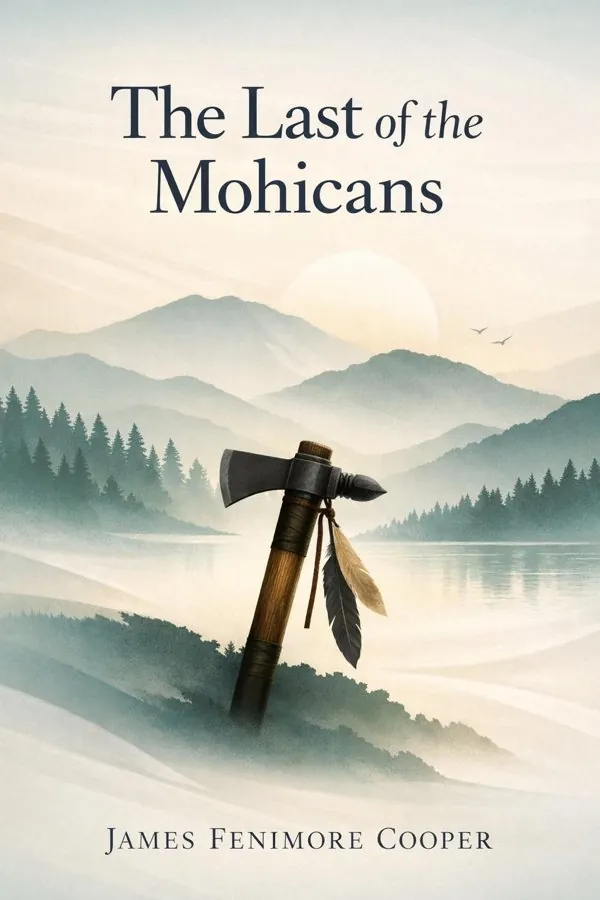
The Last of the Mohicans: Summary & Key Insights
 10 min9 chaptersAudio available
Key Takeaways from The Last of the Mohicans
A war does not merely destroy cities; it also reveals what people become when rules collapse.
Some of the strongest families in literature are not created by birth but by shared danger and earned trust.
The most dangerous collapse is not always military; sometimes it is the collapse of trust.
Adventure stories often promise that courage and speed can outrun fate; Cooper’s novel insists otherwise.
The wilderness in this novel is never just scenery; it is a living force that protects, conceals, confuses, and destroys.
What Is The Last of the Mohicans About?
The Last of the Mohicans by James Fenimore Cooper is a classics book spanning 4 pages. Set amid the violence and uncertainty of the French and Indian War, The Last of the Mohicans is far more than an adventure story. James Fenimore Cooper follows Hawkeye, the white frontiersman raised between cultures, and his Mohican companions Chingachgook and Uncas as they escort Cora and Alice Munro through a landscape shaped by military rivalry, betrayal, and constant mortal danger. What begins as a rescue mission unfolds into a sweeping meditation on loyalty, identity, love, and loss. The novel matters because it helped define the American historical romance and gave early U.S. literature one of its most enduring mythic figures in Natty Bumppo, or Hawkeye. Cooper captures a world where European empires fight for territory while Native peoples confront displacement, manipulation, and cultural destruction. Though modern readers may approach some of its portrayals critically, the book remains essential for understanding how America imagined its frontier, its conflicts, and its origins. Cooper’s authority comes from his foundational role in American fiction: few writers did more to turn the wilderness, and the moral questions within it, into literature.
This FizzRead summary covers all 9 key chapters of The Last of the Mohicans in approximately 10 minutes, distilling the most important ideas, arguments, and takeaways from James Fenimore Cooper's work. Also available as an audio summary and Key Quotes Podcast.
The Last of the Mohicans
Set amid the violence and uncertainty of the French and Indian War, The Last of the Mohicans is far more than an adventure story. James Fenimore Cooper follows Hawkeye, the white frontiersman raised between cultures, and his Mohican companions Chingachgook and Uncas as they escort Cora and Alice Munro through a landscape shaped by military rivalry, betrayal, and constant mortal danger. What begins as a rescue mission unfolds into a sweeping meditation on loyalty, identity, love, and loss.
The novel matters because it helped define the American historical romance and gave early U.S. literature one of its most enduring mythic figures in Natty Bumppo, or Hawkeye. Cooper captures a world where European empires fight for territory while Native peoples confront displacement, manipulation, and cultural destruction. Though modern readers may approach some of its portrayals critically, the book remains essential for understanding how America imagined its frontier, its conflicts, and its origins. Cooper’s authority comes from his foundational role in American fiction: few writers did more to turn the wilderness, and the moral questions within it, into literature.
Who Should Read The Last of the Mohicans?
This book is perfect for anyone interested in classics and looking to gain actionable insights in a short read. Whether you're a student, professional, or lifelong learner, the key ideas from The Last of the Mohicans by James Fenimore Cooper will help you think differently.
- ✓Readers who enjoy classics and want practical takeaways
- ✓Professionals looking to apply new ideas to their work and life
- ✓Anyone who wants the core insights of The Last of the Mohicans in just 10 minutes
Want the full summary?
Get instant access to this book summary and 100K+ more with Fizz Moment.
Get Free SummaryAvailable on App Store • Free to download
Key Chapters
A war does not merely destroy cities; it also reveals what people become when rules collapse. In The Last of the Mohicans, the French and Indian War is not just a historical backdrop but the force that shapes every choice, alliance, and tragedy. Cooper presents the northern frontier as a contested space where British officers, French commanders, Native nations, scouts, and civilians are drawn into one another’s fates. Forest trails, lakes, caves, and forts become places where military strategy and moral character are tested at once.
This setting matters because it strips away the illusion of safety. Characters cannot rely on rank, manners, or official power. Major Heyward’s formal military identity means less in the woods than Hawkeye’s practical knowledge. The Munro sisters’ social status offers no protection against ambush. Even fortified spaces such as Fort William Henry prove fragile when diplomacy fails and honor breaks down. Cooper uses this instability to show that civilization and wilderness are not simple opposites. Instead, both contain courage, cruelty, wisdom, and blindness.
For modern readers, this idea applies far beyond war fiction. In any high-pressure environment—economic crisis, political upheaval, organizational change—the real test is not what people claim to value in calm conditions, but what they do when protection disappears. Expertise becomes situational, and the most reliable guide may be the person who understands reality rather than appearances.
As you read, ask not who holds formal authority, but who sees clearly, adapts quickly, and acts with integrity when the landscape turns hostile.
Some of the strongest families in literature are not created by birth but by shared danger and earned trust. The bond among Hawkeye, Chingachgook, and Uncas is one of the novel’s deepest emotional centers. Cooper presents them not as a casual alliance but as a fellowship built through mutual respect, practical dependence, and moral recognition. Hawkeye, though white, lives according to frontier knowledge learned from Native companions. Chingachgook embodies experience, dignity, and endurance. Uncas combines youthful nobility with courage, grace, and restraint.
Their relationship is central because it complicates simplistic divisions between "civilized" and "savage," European and Native, outsider and insider. Hawkeye is neither fully of the colonial settlements nor fully Native; he occupies an in-between position that allows him to interpret multiple worlds. Chingachgook and Uncas are not side figures attached to a white hero but essential moral and practical agents in the story. Together, the three model a form of brotherhood grounded in competence, loyalty, and common purpose.
This idea has a clear practical application. In contemporary life, effective teams are often built across difference, not within sameness. Trust grows when each person’s strengths are recognized and when status is based on contribution rather than background. The trio succeeds because they understand one another’s capacities, communicate under pressure, and place shared duty above ego.
A useful takeaway is to build alliances the way Cooper’s frontiersmen do: respect lived experience, value complementary strengths, and let trust be earned through action instead of assumed through identity.
The most dangerous collapse is not always military; sometimes it is the collapse of trust. The siege and fall of Fort William Henry form one of the novel’s most powerful episodes because they expose how fragile political agreements become when fear, pride, and revenge overtake restraint. Cooper depicts the fort as a symbol of British order, hierarchy, and military confidence. Yet once surrounded, weakened, and forced into surrender, that order proves unable to protect those who depend on it.
The negotiations following the siege reveal competing codes of honor. European commanders may agree to terms, but those terms do not automatically bind every allied force in the same way. This gap between written agreement and lived reality produces catastrophe. What appears settled at the level of formal diplomacy erupts into violence when old grievances and unstable loyalties reassert themselves. In narrative terms, the fall of the fort is a turning point: it transforms the story from controlled mission into desperate flight, scattering the vulnerable and intensifying personal stakes.
There is a modern lesson here about systems and assumptions. Institutions often appear strong because they have structure, titles, and procedure. But when underlying interests are misaligned, formality can mask instability rather than solve it. Businesses, governments, and communities fail in similar ways when leaders mistake official agreement for genuine shared commitment.
The actionable takeaway is simple: whenever a situation depends on trust between different parties, do not assume a signed truce, public statement, or policy document is enough. Ask who is truly committed, who feels excluded, and what tensions remain unresolved beneath the surface.
Adventure stories often promise that courage and speed can outrun fate; Cooper’s novel insists otherwise. The long sequence of pursuit, capture, escape, and renewed pursuit gives The Last of the Mohicans its momentum, but it also reveals a harsher truth: even heroic effort cannot guarantee a just outcome. Hawkeye and his companions repeatedly track enemies, rescue captives, improvise through impossible terrain, and demonstrate astonishing resilience. Yet the wilderness remains unpredictable, and human malice remains relentless.
This section of the novel works because every chase is also a moral test. The rescuers must choose between caution and speed, individual attachment and group survival, violence and restraint. Magua, the novel’s most persistent antagonist, is not merely an obstacle but the embodiment of grievance hardened into revenge. His intelligence and determination make the pursuit feel psychologically charged, not mechanically plotted. The result is that the landscape itself becomes dramatic: cliffs, rivers, forests, and hidden passes are all part of the struggle.
For readers today, this idea speaks to the limits of control. We are trained to believe that enough planning, talent, and effort can solve everything. Cooper suggests that life is more tragic than that. Competence matters deeply, but it exists alongside contingency. We may do what is right and still face loss.
An actionable takeaway is to judge yourself not only by outcomes but by the quality of your choices under pressure. Persistence, courage, and loyalty remain meaningful even when events do not end as hoped.
The wilderness in this novel is never just scenery; it is a living force that protects, conceals, confuses, and destroys. Cooper’s forests, waterfalls, caves, and lakes are beautiful, but they are also morally neutral. The same ravine that shelters the innocent can hide an ambush. The same river that offers escape can trap the vulnerable. This dual character of nature gives the novel much of its atmosphere and tension.
Cooper uses landscape as a way of measuring character. Those who understand the terrain—Hawkeye, Chingachgook, and Uncas—can move through it with discipline and humility. Those who impose assumptions on it, especially visitors from settled society, are often exposed as naive. The point is not that wilderness is pure and civilization corrupt, but that reality must be learned on its own terms. Nature rewards attention and punishes arrogance.
This insight remains relevant. In modern life, “terrain” can mean more than geography. It can mean a new workplace, an unfamiliar culture, a changing market, or a personal crisis. People fail when they assume old habits will automatically work in new conditions. They succeed when they observe carefully, adapt, and respect complexity.
Cooper’s practical lesson is to stop treating environment as background. Whether you are entering a negotiation, a community, or a difficult life transition, study the setting as closely as the people. The actionable takeaway: before acting, learn the terrain—its dangers, its hidden advantages, and the rules that are not written but always in force.
Villains become memorable when they believe their rage is justified. Magua is one of Cooper’s most compelling creations because he is not driven by chaos alone. He is intelligent, patient, wounded, manipulative, and consumed by revenge. His enmity toward Colonel Munro and his pursuit of Munro’s daughters give the novel much of its emotional danger. He operates not as a mere criminal but as a strategist whose grievances have become his identity.
Magua matters because he reveals how injury, humiliation, and political conflict can harden into a worldview. He understands the motives of others and exploits their weaknesses with frightening precision. In this sense, he functions as a dark counterpart to Hawkeye. Both can read people and landscapes, but one uses knowledge in service of protection while the other uses it to dominate and avenge.
Modern readers can recognize the pattern. People who define themselves entirely through past wounds often become trapped by them. Their pain may be real, but when every relationship becomes a theater for repayment, destruction follows. On teams, in families, and in politics, unresolved resentment can outlast the event that caused it and shape choices long after practical solutions are available.
The actionable takeaway is to take grievance seriously before it turns toxic. Address conflict early, listen for humiliation beneath anger, and refuse to let old injuries become the organizing principle of your life. Justice matters, but revenge rarely stops where it claims it will.
The novel’s deepest tension is not simply between armies but between ways of being human. Cooper repeatedly asks where true identity comes from: race, upbringing, loyalty, law, skill, language, or moral conduct. Hawkeye stands at the center of this question. Though white by birth, he lives according to frontier knowledge and often judges the colonial world with skepticism. Yet he is also not fully assimilated into Native identity. He belongs everywhere and nowhere.
This uncertain belonging gives the novel much of its power. Many characters move between worlds they do not fully understand. Major Heyward must learn that military training does not equal wilderness wisdom. The Munro sisters carry the expectations of British society into a space where those expectations collapse. Chingachgook and Uncas represent a people whose presence is ancient, yet whose future is endangered by imperial expansion. Identity in the novel is therefore not stable; it is tested by context.
This is highly relevant today. Many people live between cultures, professions, classes, or communities. They know the strength and loneliness of hybridity. Cooper suggests that in-between figures can become translators, protectors, and truth-tellers precisely because they are not fully captive to one system.
A practical takeaway is to treat complex identity as a strength rather than a flaw. If you feel divided between worlds, ask how your double vision helps you interpret conflict, connect people, and see blind spots others miss.
A society reveals itself by how it treats those placed at greatest risk. In The Last of the Mohicans, Cora and Alice Munro are often the figures most visibly endangered, yet Cooper uses them to explore contrasting forms of courage, vulnerability, and emotional influence. Alice is younger, more fragile, and associated with innocence. Cora is more composed, more perceptive, and morally formidable under pressure. Their differing responses to fear and captivity create some of the novel’s strongest human contrasts.
Although the sisters are frequently in need of rescue, they are not simply passive symbols. Their presence shapes the decisions of nearly every major character. Cora in particular brings out nobility, protectiveness, and sacrifice in others, especially Uncas and Heyward. She also confronts danger with a steadiness that challenges assumptions about feminine weakness. Cooper may write within the conventions of his time, but he still grants his female characters emotional gravity and ethical consequence.
For modern readers, this key idea invites a broader reflection. Strength is not only physical dominance or strategic mastery. It can also appear as composure, dignity, emotional endurance, and the capacity to preserve humanity in brutal conditions. In workplaces, families, and crises, people often underestimate these quieter forms of power.
The actionable takeaway is to widen your definition of courage. Notice who stabilizes others, who keeps moral clarity under stress, and who influences outcomes without commanding the spotlight. Those are often the people carrying more strength than anyone first assumes.
Some novels end with victory; this one ends with mourning. The title The Last of the Mohicans announces from the beginning that the story is haunted by disappearance. Uncas is not only a heroic individual but a symbol of a people facing extinction within the political and cultural transformations of colonial America. Chingachgook’s survival does not cancel that loss; it intensifies it. He remains, but as the remnant of a lineage and a world that is passing away.
This elegiac dimension is one reason the novel has endured. Beneath the chase plot and battle scenes lies a meditation on historical erasure. Cooper frames the frontier not as the birth of one world alone, but as the destruction of another. The rise of empire, settlement, and national mythology comes with irretrievable human cost. Even readers who critique Cooper’s representations can still recognize that the novel is trying to register the sorrow of cultural disappearance.
Today, this theme resonates in discussions of endangered languages, displaced communities, vanishing ecosystems, and memory itself. Progress often arrives with a story of gain while minimizing what is lost. Cooper pushes us to hold both truths at once: history moves forward, and history also buries.
The actionable takeaway is to practice historical attention. Whenever you celebrate development, expansion, or success, ask what traditions, relationships, or peoples are being pushed aside. Progress is more honest when it includes remembrance.
All Chapters in The Last of the Mohicans
About the Author
James Fenimore Cooper (1789–1851) was one of the first major American novelists and a foundational figure in U.S. literary history. Born in Burlington, New Jersey, and raised partly in Cooperstown, New York, he drew heavily on frontier landscapes and early American conflicts in his fiction. He is best known for the Leatherstocking Tales, the series that includes The Last of the Mohicans and introduced Natty Bumppo, one of the great archetypal heroes of American literature. Cooper’s novels helped establish the historical romance in the United States and gave literary form to the frontier, the wilderness, and the tensions between Native and colonial worlds. Though his style and cultural depictions are often debated today, his influence on American storytelling remains profound.
Get This Summary in Your Preferred Format
Read or listen to the The Last of the Mohicans summary by James Fenimore Cooper anytime, anywhere. FizzRead offers multiple formats so you can learn on your terms — all free.
Available formats: App · Audio · PDF · EPUB — All included free with FizzRead
Download The Last of the Mohicans PDF and EPUB Summary
Key Quotes from The Last of the Mohicans
“A war does not merely destroy cities; it also reveals what people become when rules collapse.”
“Some of the strongest families in literature are not created by birth but by shared danger and earned trust.”
“The most dangerous collapse is not always military; sometimes it is the collapse of trust.”
“Adventure stories often promise that courage and speed can outrun fate; Cooper’s novel insists otherwise.”
“The wilderness in this novel is never just scenery; it is a living force that protects, conceals, confuses, and destroys.”
Frequently Asked Questions about The Last of the Mohicans
The Last of the Mohicans by James Fenimore Cooper is a classics book that explores key ideas across 9 chapters. Set amid the violence and uncertainty of the French and Indian War, The Last of the Mohicans is far more than an adventure story. James Fenimore Cooper follows Hawkeye, the white frontiersman raised between cultures, and his Mohican companions Chingachgook and Uncas as they escort Cora and Alice Munro through a landscape shaped by military rivalry, betrayal, and constant mortal danger. What begins as a rescue mission unfolds into a sweeping meditation on loyalty, identity, love, and loss. The novel matters because it helped define the American historical romance and gave early U.S. literature one of its most enduring mythic figures in Natty Bumppo, or Hawkeye. Cooper captures a world where European empires fight for territory while Native peoples confront displacement, manipulation, and cultural destruction. Though modern readers may approach some of its portrayals critically, the book remains essential for understanding how America imagined its frontier, its conflicts, and its origins. Cooper’s authority comes from his foundational role in American fiction: few writers did more to turn the wilderness, and the moral questions within it, into literature.
You Might Also Like


Browse by Category
Ready to read The Last of the Mohicans?
Get the full summary and 100K+ more books with Fizz Moment.