
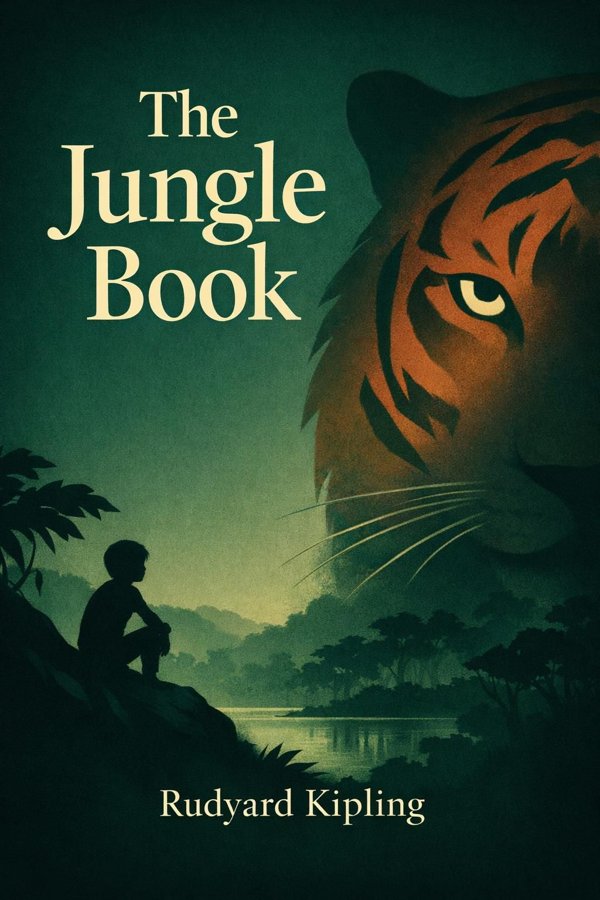
The Jungle Book: Summary & Key Insights
 10 min9 chaptersAudio available
Key Takeaways from The Jungle Book
A powerful truth runs through The Jungle Book: belonging is never automatic, even when a community saves you.
One of Kipling’s most striking insights is that true freedom depends on structure.
The Jungle Book repeatedly shows that bravery without judgment is little more than recklessness.
Behind every memorable act of growth in The Jungle Book stands a teacher.
Kipling’s jungle is full of powerful creatures, but the most dangerous figures are often those who misuse power rather than those who merely possess it.
What Is The Jungle Book About?
The Jungle Book by Rudyard Kipling is a general book. What if growing up meant learning not only who you are, but also which laws, loyalties, and instincts deserve your trust? Rudyard Kipling’s The Jungle Book is far more than a children’s adventure classic. First published in 1894, it is a rich collection of interlinked stories set in the Indian jungle, where animals speak, communities enforce ancient codes, and survival depends on courage, intelligence, and self-mastery. The most famous tales follow Mowgli, a boy raised by wolves, as he navigates belonging, danger, and the tension between the wild and the human world. Yet the book also includes memorable stories of Rikki-Tikki-Tavi, Kotick the White Seal, and Toomai of the Elephants, each exploring bravery, duty, and discovery from a different angle. Kipling writes with vivid imagery, rhythmic language, and a sharp understanding of hierarchy, discipline, and character. His lasting authority comes from his gift for turning fables into living worlds. The Jungle Book still matters because it speaks to timeless questions: How do we earn respect, where do we belong, and what kind of strength helps us endure?
This FizzRead summary covers all 9 key chapters of The Jungle Book in approximately 10 minutes, distilling the most important ideas, arguments, and takeaways from Rudyard Kipling's work. Also available as an audio summary and Key Quotes Podcast.
The Jungle Book
What if growing up meant learning not only who you are, but also which laws, loyalties, and instincts deserve your trust? Rudyard Kipling’s The Jungle Book is far more than a children’s adventure classic. First published in 1894, it is a rich collection of interlinked stories set in the Indian jungle, where animals speak, communities enforce ancient codes, and survival depends on courage, intelligence, and self-mastery. The most famous tales follow Mowgli, a boy raised by wolves, as he navigates belonging, danger, and the tension between the wild and the human world. Yet the book also includes memorable stories of Rikki-Tikki-Tavi, Kotick the White Seal, and Toomai of the Elephants, each exploring bravery, duty, and discovery from a different angle. Kipling writes with vivid imagery, rhythmic language, and a sharp understanding of hierarchy, discipline, and character. His lasting authority comes from his gift for turning fables into living worlds. The Jungle Book still matters because it speaks to timeless questions: How do we earn respect, where do we belong, and what kind of strength helps us endure?
Who Should Read The Jungle Book?
This book is perfect for anyone interested in general and looking to gain actionable insights in a short read. Whether you're a student, professional, or lifelong learner, the key ideas from The Jungle Book by Rudyard Kipling will help you think differently.
- ✓Readers who enjoy general and want practical takeaways
- ✓Professionals looking to apply new ideas to their work and life
- ✓Anyone who wants the core insights of The Jungle Book in just 10 minutes
Want the full summary?
Get instant access to this book summary and 100K+ more with Fizz Moment.
Get Free SummaryAvailable on App Store • Free to download
Key Chapters
A powerful truth runs through The Jungle Book: belonging is never automatic, even when a community saves you. Mowgli is adopted by the wolf pack, protected by Baloo the bear and Bagheera the panther, and permitted to live according to the Law of the Jungle. Yet he is never simply absorbed without question. He must be argued for, defended, and taught. His place depends not on sentiment alone but on whether he can understand the rules of the world he inhabits.
This idea gives the book unusual depth. Kipling shows that identity is shaped through participation. Mowgli belongs among the wolves because he learns their signals, honors their customs, and accepts the discipline required for survival. At the same time, his human nature never disappears. He exists between worlds, and that tension becomes central to his growth. Belonging, then, is not just about where one begins; it is about where one proves capable of living responsibly.
This insight applies well beyond fiction. In families, schools, workplaces, and communities, people often assume acceptance should be instant. Kipling suggests otherwise. Trust is built by learning shared expectations, contributing meaningfully, and respecting the values of the group. A new employee, for example, does not become part of a team simply by being hired. They become part of it by listening carefully, understanding the culture, and earning confidence through action.
At the same time, The Jungle Book warns against blind conformity. Mowgli’s uniqueness matters. He survives partly because he can do what the animals cannot. Real belonging does not require erasing difference; it requires aligning difference with shared purpose.
Actionable takeaway: If you want to belong somewhere, learn the rules, contribute with consistency, and use your uniqueness in service of the group rather than against it.
One of Kipling’s most striking insights is that true freedom depends on structure. The jungle may seem like a place of instinct and chaos, but it is governed by the Law of the Jungle, a code that regulates hunting, territory, leadership, and conduct. Baloo teaches this law to the young, not as empty tradition but as practical wisdom. Without it, the jungle would collapse into constant fear and pointless violence.
This theme challenges a common idea that freedom means doing whatever one wants. In The Jungle Book, creatures that ignore the law become dangerous not because they are powerful, but because they are ungoverned. The Bandar-log, or monkey people, are the clearest example. They boast, imitate, chatter endlessly, and follow no leader or code. Their lack of discipline makes them ridiculous, unstable, and threatening. By contrast, the wolves, elephants, and even predators operate within a moral and social order.
Kipling’s point is deeply practical. In any functioning system, freedom relies on reliable boundaries. Children flourish when routines are clear. Teams perform better when responsibilities are defined. Friendships grow stronger when respect and honesty are expected. A road without traffic rules does not create freedom; it creates collisions. Likewise, a workplace with no standards may feel liberating for a moment, but confusion and conflict soon replace creativity.
The book also suggests that law should be learned before crisis arrives. Baloo’s patient instruction prepares Mowgli to respond wisely under pressure. Discipline acquired in calm moments becomes protection in dangerous ones. This is why habits matter so much in real life. Financial stability, physical health, and emotional resilience all grow from repeated small acts of order.
Actionable takeaway: Identify one area of life that feels chaotic and create a simple code for it—clear rules, repeated habits, and visible boundaries—so your freedom rests on discipline rather than impulse.
The Jungle Book repeatedly shows that bravery without judgment is little more than recklessness. Mowgli survives not because he is the strongest creature in the jungle, but because he learns when to observe, when to speak, and when to act. Bagheera’s stealth, Baloo’s instruction, and Kaa’s hypnotic power all reveal different forms of strength, yet what makes them effective is intelligent use of that strength.
Kipling avoids presenting courage as simple fearlessness. His characters face danger constantly, but the admirable ones respond with awareness. Rikki-Tikki-Tavi is a perfect example. He is bold, but his battle against the cobras is not won by aggression alone. He studies his enemies, anticipates their moves, and chooses his moments carefully. Courage in Kipling’s world is thoughtful. It combines nerve with strategy.
This matters because many people still confuse confidence with wisdom. In business, a leader who makes dramatic decisions without understanding the facts may appear brave, but they create risk for everyone. In personal life, confronting a problem too early, too emotionally, or without preparation can make matters worse. Real courage may involve asking questions first, gathering allies, or waiting for the right opportunity.
Kipling’s stories also remind us that knowledge reduces fear. Mowgli’s education in jungle signs, speech, and custom gives him a way to navigate threats that would otherwise overwhelm him. Preparation does not eliminate danger, but it makes action possible. This applies to difficult conversations, career changes, and emergencies alike. Training, study, and practice turn panic into capability.
Actionable takeaway: The next time you face a difficult challenge, do not ask only, “How can I be brave?” Ask, “What information, preparation, or timing would make my bravery effective?”
Behind every memorable act of growth in The Jungle Book stands a teacher. Mowgli’s journey is not a story of isolated genius; it is a story of guidance. Baloo teaches him the Law of the Jungle and the languages of the forest. Bagheera teaches discernment, caution, and the realities of power. Even stern correction becomes part of Mowgli’s formation. Kipling presents mentorship as essential not only for survival but for character.
What makes these mentors compelling is that they are different from one another. Baloo represents patient instruction and moral memory. Bagheera represents practical wisdom and strategic thinking. Together they provide both principle and application. This is an important insight: one teacher is rarely enough. Human beings often need several models to grow fully. One mentor may help with ethics, another with skill, and another with emotional strength.
The book also makes clear that good mentorship is not always comfortable. Baloo’s lessons are demanding. Bagheera is affectionate but unsentimental. The purpose of teaching is not constant affirmation; it is readiness. In modern life, people often prefer encouragement over correction, but Kipling suggests that loving guidance includes challenge. A coach who points out weakness, a manager who insists on higher standards, or a friend who tells the truth may be doing life-saving work.
At the same time, Mowgli is not passive. He must listen, practice, and internalize what he learns. Mentorship only matters when the student commits to growth. The same is true in careers and personal development. Access to advice is common; disciplined application is rare.
Actionable takeaway: Identify one person who can sharpen your judgment or character, and approach them with a specific question or goal. Then apply what you learn consistently enough to make the guidance real.
Kipling’s jungle is full of powerful creatures, but the most dangerous figures are often those who misuse power rather than those who merely possess it. Shere Khan is fearsome not only because he is a tiger, but because he is driven by pride, resentment, and appetite unchecked by principle. The Bandar-log are troublesome because they seek attention and influence without discipline or accountability. In both cases, power detached from responsibility becomes destructive.
This theme gives The Jungle Book moral seriousness. Strength alone is not admirable. Authority must be justified by self-control and by service to a broader order. Akela leads the wolf pack not through noise or vanity, but through competence and legitimacy. Hathi the elephant carries immense stature because he represents memory, order, and continuity. Kipling consistently links rightful power with duty.
The lesson is highly relevant today. In organizations, a manager with authority but no integrity can poison an entire culture. On social media, visibility without accountability can spread confusion and cruelty quickly. In personal relationships, emotional influence can be used either to protect or manipulate. The real question is never simply, “Who has power?” but “What governs the use of that power?”
Kipling also implies that communities must stay alert to irresponsible power. Mowgli survives partly because others recognize Shere Khan’s nature and prepare accordingly. Ignoring dangerous character traits because someone is impressive is a recurring human mistake. We often excuse arrogance, volatility, or selfishness when paired with talent. The Jungle Book refuses to romanticize that tradeoff.
Actionable takeaway: Evaluate any power you hold—status, skill, influence, or authority—and ask whether your habits show responsibility. If not, create one concrete practice of accountability, such as seeking feedback, setting limits, or tying your decisions to shared values.
Although The Jungle Book is set among animals, it is deeply concerned with human life. Kipling uses the jungle as a mirror that makes social truths easier to see. The pack, the council, the law, the outcasts, the teachers, the boastful imitators, and the disciplined workers all reflect recognizable human patterns. By shifting the setting away from ordinary society, Kipling sharpens our view of how communities function.
This is one reason the book endures. Readers are drawn in by the excitement of animals speaking and acting with purpose, but beneath that adventure lies an exploration of order, status, loyalty, and identity. The wolves model collective responsibility. The monkeys parody empty noise and trend-chasing. Shere Khan represents domination fueled by ego. Mowgli, caught between species, dramatizes the experience of anyone who feels divided between worlds.
Stories often teach best by indirection. A reader may resist a lecture about discipline or belonging, but they will remember Baloo instructing Mowgli or the chaos of the Bandar-log. In that sense, The Jungle Book remains practical literature. It helps readers think about schools, teams, families, and nations by presenting those dynamics in symbolic form.
This approach can be useful in everyday life as well. When a workplace feels confusing, it can help to ask: Which part of the jungle does this resemble? Is there lawful order, manipulative power, performative chaos, or wise leadership? Metaphor creates distance, and distance can improve judgment. Teachers, parents, and leaders still use stories for this reason: they make patterns visible without triggering immediate defensiveness.
Actionable takeaway: When facing a difficult social situation, describe it as if it were a story with roles, rules, and motives. This can help you see hidden patterns and respond more wisely.
Few characters in literature embody divided identity as vividly as Mowgli. He is a human child raised by wolves, taught by jungle creatures, and yet inevitably pulled toward the world of men. His struggle is not simply external; it is existential. Where does he belong? Which world defines him? What should he do when loyalty to one place conflicts with his nature or future? Kipling does not offer an easy answer, and that complexity is one of the book’s greatest strengths.
Mowgli’s in-between status gives him unusual power. Because he is not fully of one world, he can move between worlds, understand multiple systems, and use abilities others lack. But this gift comes with loneliness. He can never rest entirely in simplicity. That tension will feel familiar to many readers: immigrants, children of mixed cultures, people changing careers, students leaving home, or anyone whose values have evolved beyond their original environment.
The book suggests that identity is not solved by denying one side of oneself. Mowgli does not become a wolf, nor can he ignore his humanity. Growth requires integrating complexity. In modern life, people often feel pressure to choose a single label or present a neat story about who they are. Kipling points to a more demanding truth: maturity may involve holding multiple loyalties, histories, and capabilities at once.
This also creates empathy. Those who live between worlds often become translators, mediators, and innovators because they can see assumptions others miss. Their perspective is difficult but valuable. Rather than viewing in-betweenness as weakness, The Jungle Book reveals it as a source of hard-won wisdom.
Actionable takeaway: If you feel divided between identities or communities, list what each world has taught you. Then build a self-definition that integrates those strengths instead of forcing a false choice.
In The Jungle Book, loyalty is precious precisely because it is not cheap. Characters declare affection and allegiance, but the stories insist that real loyalty is proven under pressure. Bagheera buys Mowgli’s life with a freshly killed bull. The wolf family risks the displeasure of stronger voices to protect him. Rikki-Tikki-Tavi puts himself in mortal danger for the family he has come to guard. Again and again, devotion becomes visible in sacrifice.
Kipling treats loyalty as a bond rooted in action, memory, and mutual obligation. It is not blind obedience. The best loyalties in the book are intelligent and moral. Characters are faithful to one another because they recognize value, duty, and shared life. This distinction matters. Blind loyalty can become complicity, but principled loyalty strengthens communities by making trust durable.
In modern life, loyalty is often discussed sentimentally, as though saying the right words or maintaining surface closeness is enough. Kipling offers a firmer standard. A loyal colleague gives honest warning, not just praise. A loyal friend shows up in difficulty, not only celebration. A loyal leader protects the vulnerable and accepts responsibility in moments of failure.
The stories also show that loyalty is tested by fear, convenience, and self-interest. It is easy to belong when the cost is low. The real measure comes when loyalty demands courage, patience, or loss. This is true in marriages, teams, neighborhoods, and institutions. Reliable bonds are built through repeated costly choices.
Actionable takeaway: Choose one important relationship and ask what loyalty would look like in practice this week—perhaps defending someone fairly, keeping a hard promise, offering truthful counsel, or being present in a difficult moment.
Adventure in The Jungle Book is never just spectacle. Every chase, confrontation, and journey becomes part of a larger process of education. Mowgli does not wander through danger for entertainment alone; he is being shaped. The same is true of other stories in the collection. Kotick’s long search for a safe home for the seals and Toomai’s extraordinary encounter with the elephants both turn experience into transformation. Kipling treats adventure as a severe but effective teacher.
This matters because the book refuses to separate excitement from growth. Modern culture often treats challenge either as trauma to avoid or thrill to consume. Kipling presents a more balanced view. Difficult experiences can reveal character, widen perception, and produce responsibility. What matters is not danger for its own sake, but what the encounter demands from the person within it.
In practical terms, adventure can take many forms. It might mean moving to a new city, taking on a hard role at work, learning a demanding skill, traveling alone, or stepping into an unfamiliar community. These experiences unsettle habits and expose weaknesses, but they also produce adaptability. Like Mowgli, people often discover who they are by meeting realities they cannot control.
The Jungle Book also suggests that maturity comes from reflecting on experience, not merely having it. Mowgli learns because he remembers, connects lessons, and changes his behavior. Without reflection, adventure remains noise. With reflection, it becomes wisdom.
Actionable takeaway: Seek one stretching experience that pushes you beyond routine, and afterward write down what it revealed about your strengths, fears, and next area of growth.
All Chapters in The Jungle Book
About the Author
Rudyard Kipling was born in Bombay, India, in 1865 and became one of the most widely read English-language writers of his era. Educated in England but deeply shaped by his early years in India, he drew on imperial settings, folklore, and vivid observation to create stories, poems, and novels with lasting cultural impact. His best-known works include The Jungle Book, Kim, and Just So Stories, as well as the poem “If—.” Kipling was awarded the Nobel Prize in Literature in 1907, becoming the first English-language author to receive it. Though his reputation is sometimes debated because of his association with British imperial attitudes, his storytelling power, memorable characters, and command of language have secured his place as a major literary figure.
Get This Summary in Your Preferred Format
Read or listen to the The Jungle Book summary by Rudyard Kipling anytime, anywhere. FizzRead offers multiple formats so you can learn on your terms — all free.
Available formats: App · Audio · PDF · EPUB — All included free with FizzRead
Download The Jungle Book PDF and EPUB Summary
Key Quotes from The Jungle Book
“A powerful truth runs through The Jungle Book: belonging is never automatic, even when a community saves you.”
“One of Kipling’s most striking insights is that true freedom depends on structure.”
“The Jungle Book repeatedly shows that bravery without judgment is little more than recklessness.”
“Behind every memorable act of growth in The Jungle Book stands a teacher.”
“Kipling’s jungle is full of powerful creatures, but the most dangerous figures are often those who misuse power rather than those who merely possess it.”
Frequently Asked Questions about The Jungle Book
The Jungle Book by Rudyard Kipling is a general book that explores key ideas across 9 chapters. What if growing up meant learning not only who you are, but also which laws, loyalties, and instincts deserve your trust? Rudyard Kipling’s The Jungle Book is far more than a children’s adventure classic. First published in 1894, it is a rich collection of interlinked stories set in the Indian jungle, where animals speak, communities enforce ancient codes, and survival depends on courage, intelligence, and self-mastery. The most famous tales follow Mowgli, a boy raised by wolves, as he navigates belonging, danger, and the tension between the wild and the human world. Yet the book also includes memorable stories of Rikki-Tikki-Tavi, Kotick the White Seal, and Toomai of the Elephants, each exploring bravery, duty, and discovery from a different angle. Kipling writes with vivid imagery, rhythmic language, and a sharp understanding of hierarchy, discipline, and character. His lasting authority comes from his gift for turning fables into living worlds. The Jungle Book still matters because it speaks to timeless questions: How do we earn respect, where do we belong, and what kind of strength helps us endure?
You Might Also Like
Duct Tape Marketing: The World's Most Practical Small Business Marketing Guide
John Jantsch
10 minDusk, Night, Dawn: On Revival and Courage
Anne Lamott
10 minFinish Big: How Great Entrepreneurs Exit Their Companies on Top
Bo Burlingham
10 minFirst As Tragedy, Then As Farce
Slavoj Zizek
10 minFirst Principles: What America's Founders Learned from the Greeks and Romans and How That Shaped Our Country
Thomas E. Ricks
10 minGood Habits, Bad Habits: The Science of Making Positive Changes That Stick
Wendy Wood
10 minBrowse by Category
Ready to read The Jungle Book?
Get the full summary and 100K+ more books with Fizz Moment.