
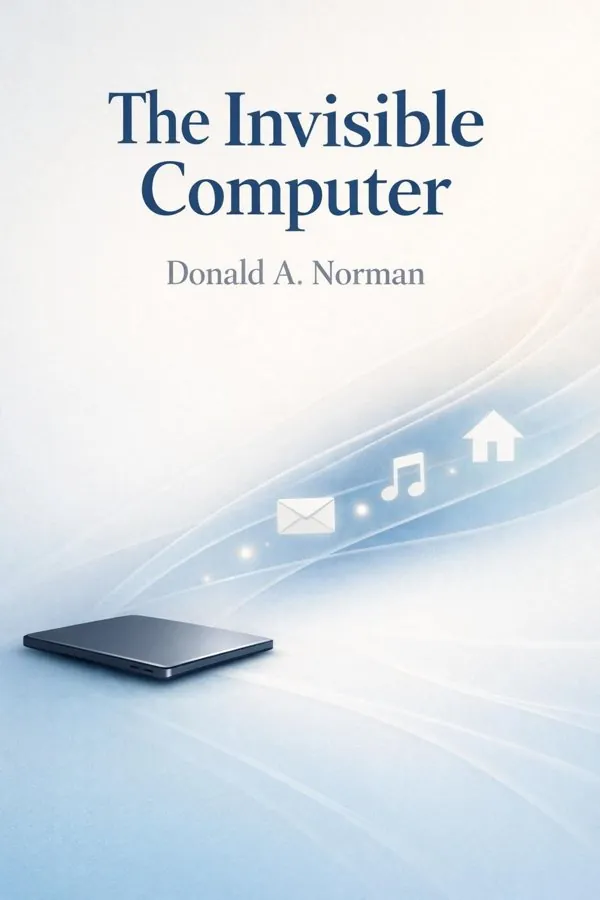
The Invisible Computer: Why Good Products Can Fail, the Personal Computer Is So Complex, and Information Appliances Are the Solution: Summary & Key Insights
 10 min8 chaptersAudio available
What Is The Invisible Computer: Why Good Products Can Fail, the Personal Computer Is So Complex, and Information Appliances Are the Solution About?
The Invisible Computer: Why Good Products Can Fail, the Personal Computer Is So Complex, and Information Appliances Are the Solution by Donald A. Norman is a design book spanning 8 pages. In this influential work, cognitive scientist Donald A. Norman argues that the personal computer, despite its ubiquity, is an overly complex and poorly designed tool for most users. He envisions a future where specialized 'information appliances'—simple, task-focused devices—replace the general-purpose PC. Norman explores how design, usability, and human-centered thinking can transform technology into something truly invisible: seamlessly integrated into daily life.
This FizzRead summary covers all 8 key chapters of The Invisible Computer: Why Good Products Can Fail, the Personal Computer Is So Complex, and Information Appliances Are the Solution in approximately 10 minutes, distilling the most important ideas, arguments, and takeaways from Donald A. Norman's work. Also available as an audio summary and Key Quotes Podcast.
The Invisible Computer: Why Good Products Can Fail, the Personal Computer Is So Complex, and Information Appliances Are the Solution
In this influential work, cognitive scientist Donald A. Norman argues that the personal computer, despite its ubiquity, is an overly complex and poorly designed tool for most users. He envisions a future where specialized 'information appliances'—simple, task-focused devices—replace the general-purpose PC. Norman explores how design, usability, and human-centered thinking can transform technology into something truly invisible: seamlessly integrated into daily life.
Who Should Read The Invisible Computer: Why Good Products Can Fail, the Personal Computer Is So Complex, and Information Appliances Are the Solution?
This book is perfect for anyone interested in design and looking to gain actionable insights in a short read. Whether you're a student, professional, or lifelong learner, the key ideas from The Invisible Computer: Why Good Products Can Fail, the Personal Computer Is So Complex, and Information Appliances Are the Solution by Donald A. Norman will help you think differently.
- ✓Readers who enjoy design and want practical takeaways
- ✓Professionals looking to apply new ideas to their work and life
- ✓Anyone who wants the core insights of The Invisible Computer: Why Good Products Can Fail, the Personal Computer Is So Complex, and Information Appliances Are the Solution in just 10 minutes
Want the full summary?
Get instant access to this book summary and 100K+ more with Fizz Moment.
Get Free SummaryAvailable on App Store • Free to download
Key Chapters
To understand how we reached this paradox of power and frustration, we must revisit the history of computing. The first computers were gigantic, dedicated machines used by scientists and engineers. They were not meant for the public. When the personal computer arrived, it carried with it the culture of those early systems: a focus on flexibility, programmability, and control. The idea was seductive—give everyone their own computer, and watch creativity explode. So in the 1980s, millions of people brought these machines into their homes and offices.
But these devices were modeled after professional tools, not everyday appliances. The menus, file systems, and commands that programmers found natural were foreign to ordinary users. As I often tell my students, technology inherits the assumptions of its ancestors. The personal computer inherited a worldview: that users must adapt to the machine. This lineage created a rift between expert and novice users, between those who find a PC empowering and those who find it alienating.
Still, it’s worth recognizing that the early PC revolution succeeded because it promised universality. Businesses standardized around it; software companies built ecosystems upon it. The computer industry flourished by selling more powerful processors, more memory, more features—each cycle of improvement justifying the next round of complexity. By the time the Web took off, the PC had become both indispensable and oppressive. What was once a thrilling innovation turned into a maintenance headache.
I often compare this to the early days of electricity. Before the household outlet existed, users needed to understand wiring and generators. Only when electricity became embedded—when it disappeared—did it truly transform society. The same transition must happen with computing. We must move from a world of general-purpose machines to one of embedded computational systems, quietly empowering our daily acts without demanding constant attention.
The personal computer is a symbol of technological sophistication, but it is also a study in unnecessary complexity. When I observe people using their computers, I see a steady undercurrent of anxiety and confusion. Despite decades of advances, the user’s core experience remains fragile. A mistaken click, an unfamiliar message, or a system update can derail hours of work.
Complexity arises from two intertwined causes. First, the architecture of the personal computer is inherently general-purpose—one device must serve as a word processor, a spreadsheet, a photo editor, and a communications hub. Each function layers additional controls and abstractions onto the same interface. Second, the culture of computing valorizes power over clarity. Engineers measure success by functionality, not by user satisfaction.
When I use the term 'cognitive overload,' I mean the state in which the human brain is forced to hold too many arbitrary details at once. Computers still demand that of us. File hierarchies, error codes, dialog boxes—all these artifacts assume that users will think like machines. But our minds operate differently; we organize meaning through goals, narratives, and sensory cues, not through command syntax. In working with technology companies, I’ve seen bright engineers underestimate this difference again and again.
I am not advocating a dumbing-down of computing. Simplicity is not shallowness. Rather, it is the art of making complexity manageable, of embedding intelligence into design itself. The true measure of progress is not how many features a system has, but how gracefully it supports human purposes. Most people don’t want to operate a computer—they want to write a letter, book a flight, or share a photo. Technology should honor those desires directly, without extraneous steps. That is the promise of human-centered design, and it is where our journey next turns.
+ 6 more chapters — available in the FizzRead app
All Chapters in The Invisible Computer: Why Good Products Can Fail, the Personal Computer Is So Complex, and Information Appliances Are the Solution
About the Author
Donald A. Norman is an American cognitive scientist and usability engineer, best known for his work on design, usability, and cognitive psychology. He has served as a professor at the University of California, San Diego, and as a vice president at Apple. Norman’s books, including 'The Design of Everyday Things' and 'The Invisible Computer,' have shaped modern thinking about human-centered design.
Get This Summary in Your Preferred Format
Read or listen to the The Invisible Computer: Why Good Products Can Fail, the Personal Computer Is So Complex, and Information Appliances Are the Solution summary by Donald A. Norman anytime, anywhere. FizzRead offers multiple formats so you can learn on your terms — all free.
Available formats: App · Audio · PDF · EPUB — All included free with FizzRead
Download The Invisible Computer: Why Good Products Can Fail, the Personal Computer Is So Complex, and Information Appliances Are the Solution PDF and EPUB Summary
Key Quotes from The Invisible Computer: Why Good Products Can Fail, the Personal Computer Is So Complex, and Information Appliances Are the Solution
“To understand how we reached this paradox of power and frustration, we must revisit the history of computing.”
“The personal computer is a symbol of technological sophistication, but it is also a study in unnecessary complexity.”
Frequently Asked Questions about The Invisible Computer: Why Good Products Can Fail, the Personal Computer Is So Complex, and Information Appliances Are the Solution
The Invisible Computer: Why Good Products Can Fail, the Personal Computer Is So Complex, and Information Appliances Are the Solution by Donald A. Norman is a design book that explores key ideas across 8 chapters. In this influential work, cognitive scientist Donald A. Norman argues that the personal computer, despite its ubiquity, is an overly complex and poorly designed tool for most users. He envisions a future where specialized 'information appliances'—simple, task-focused devices—replace the general-purpose PC. Norman explores how design, usability, and human-centered thinking can transform technology into something truly invisible: seamlessly integrated into daily life.
You Might Also Like
The Design of Everyday Things
Don Norman
10 min
The Better Angels of Our Nature
Steven Pinker
10 min
A Designer's Art
Paul Rand
10 min
Architects' Sketchbooks
Various Editors
10 min
Architectural Graphic Standards
The American Institute of Architects
10 min
Design Is Storytelling
Ellen Lupton
10 minBrowse by Category
Ready to read The Invisible Computer: Why Good Products Can Fail, the Personal Computer Is So Complex, and Information Appliances Are the Solution?
Get the full summary and 100K+ more books with Fizz Moment.