
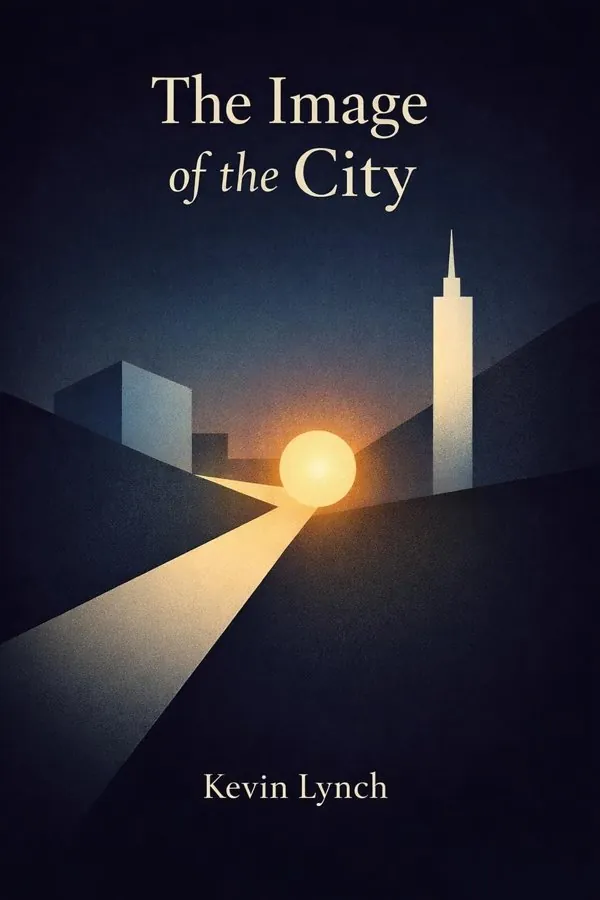
The Image of the City: Summary & Key Insights
by Kevin Lynch
 10 min10 chaptersAudio available
What Is The Image of the City About?
The Image of the City by Kevin Lynch is a design book spanning 10 pages. In this influential work, urban planner Kevin Lynch explores how people perceive and navigate cities. Through empirical studies in Boston, Jersey City, and Los Angeles, he introduces the concept of 'imageability'—the quality of a city that makes it legible and memorable. Lynch identifies five key elements—paths, edges, districts, nodes, and landmarks—that shape the mental maps people form of urban environments. The book has become a foundational text in urban design and planning, emphasizing the importance of human perception in shaping livable cities.
This FizzRead summary covers all 10 key chapters of The Image of the City in approximately 10 minutes, distilling the most important ideas, arguments, and takeaways from Kevin Lynch's work. Also available as an audio summary and Key Quotes Podcast.
The Image of the City
In this influential work, urban planner Kevin Lynch explores how people perceive and navigate cities. Through empirical studies in Boston, Jersey City, and Los Angeles, he introduces the concept of 'imageability'—the quality of a city that makes it legible and memorable. Lynch identifies five key elements—paths, edges, districts, nodes, and landmarks—that shape the mental maps people form of urban environments. The book has become a foundational text in urban design and planning, emphasizing the importance of human perception in shaping livable cities.
Who Should Read The Image of the City?
This book is perfect for anyone interested in design and looking to gain actionable insights in a short read. Whether you're a student, professional, or lifelong learner, the key ideas from The Image of the City by Kevin Lynch will help you think differently.
- ✓Readers who enjoy design and want practical takeaways
- ✓Professionals looking to apply new ideas to their work and life
- ✓Anyone who wants the core insights of The Image of the City in just 10 minutes
Want the full summary?
Get instant access to this book summary and 100K+ more with Fizz Moment.
Get Free SummaryAvailable on App Store • Free to download
Key Chapters
The image of a city is not the city itself—it is the pattern of impressions that a city leaves in our memory. Every person holds an individual image, yet these private maps share a collective structure. They shape not only how we move but how we feel. Legibility, then, is the degree to which a city can be easily recognized and organized into this mental map. A legible city gives its inhabitants the confidence to explore, while an illegible city fosters confusion and alienation.
I found that legibility is not an abstract quality. It arises from the visible cues embedded in the urban environment—the continuity of streets, the recognizable form of neighborhoods, the clarity of spatial transitions. When these cues are clear, the individual can form a mental map that is both stable and flexible. This relationship between design and perception is at the core of urban happiness. A city that can be well-imagined is also one that can be well-lived.
To investigate how people actually perceive their cities, I conducted field studies in Boston, Jersey City, and Los Angeles. In each, we asked residents to describe and sketch the city as they saw it. These cognitive maps were then compared to the actual urban form. The patterns were revealing. Boston’s medieval street pattern produced rich but complex images; Los Angeles, with its broad structure and dispersed centers, yielded images that were fragmented; Jersey City’s transitional character lay somewhere in between.
By interviewing participants as they navigated their cities, we noticed a constant interplay between personal history and physical structure. The repeated route to work, the remembered landmarks, and the emotional associations with particular places became the building blocks of the mental map. From this data, a common language began to emerge: certain recurring elements that appeared again and again in how people described their environment.
+ 8 more chapters — available in the FizzRead app
All Chapters in The Image of the City
About the Author
Kevin Andrew Lynch (1918–1984) was an American urban planner and author known for his pioneering work on the perceptual form of urban environments. He taught at the Massachusetts Institute of Technology and influenced generations of architects and planners through his research on how people experience and understand cities.
Get This Summary in Your Preferred Format
Read or listen to the The Image of the City summary by Kevin Lynch anytime, anywhere. FizzRead offers multiple formats so you can learn on your terms — all free.
Available formats: App · Audio · PDF · EPUB — All included free with FizzRead
Download The Image of the City PDF and EPUB Summary
Key Quotes from The Image of the City
“The image of a city is not the city itself—it is the pattern of impressions that a city leaves in our memory.”
“To investigate how people actually perceive their cities, I conducted field studies in Boston, Jersey City, and Los Angeles.”
Frequently Asked Questions about The Image of the City
The Image of the City by Kevin Lynch is a design book that explores key ideas across 10 chapters. In this influential work, urban planner Kevin Lynch explores how people perceive and navigate cities. Through empirical studies in Boston, Jersey City, and Los Angeles, he introduces the concept of 'imageability'—the quality of a city that makes it legible and memorable. Lynch identifies five key elements—paths, edges, districts, nodes, and landmarks—that shape the mental maps people form of urban environments. The book has become a foundational text in urban design and planning, emphasizing the importance of human perception in shaping livable cities.
You Might Also Like

The Design of Everyday Things
Don Norman
10 min
The Better Angels of Our Nature
Steven Pinker
10 min
A Designer's Art
Paul Rand
10 min
Architects' Sketchbooks
Various Editors
10 min
Architectural Graphic Standards
The American Institute of Architects
10 min
Design Is Storytelling
Ellen Lupton
10 minBrowse by Category
Ready to read The Image of the City?
Get the full summary and 100K+ more books with Fizz Moment.