
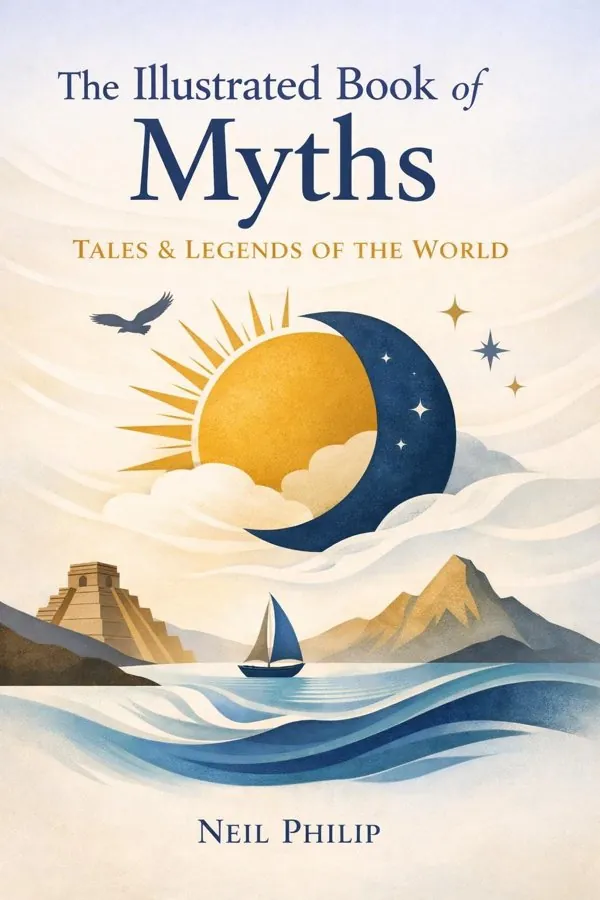
The Illustrated Book of Myths: Tales & Legends of the World: Summary & Key Insights
by Neil Philip
 10 min10 chaptersAudio available
Key Takeaways from The Illustrated Book of Myths: Tales & Legends of the World
Every culture begins by asking the same impossible question: how did something come from nothing?
Gods are rarely just supernatural beings; they are enlarged mirrors of human power, desire, and conflict.
Stories about the first humans are never only about the past; they are arguments about what people are like.
A hero is not defined by strength alone, but by what suffering reveals.
Not all wisdom comes from noble figures; some of the most revealing characters in myth are troublemakers.
What Is The Illustrated Book of Myths: Tales & Legends of the World About?
The Illustrated Book of Myths: Tales & Legends of the World by Neil Philip is a classics book spanning 10 pages. The Illustrated Book of Myths: Tales & Legends of the World is a richly retold collection of sacred stories, heroic adventures, and enduring legends drawn from many civilizations, including Greece, Egypt, China, the Norse world, and the Americas. Rather than presenting myths as dusty relics, Neil Philip reveals them as living expressions of humanity’s oldest questions: How did the world begin? Why do people suffer? What makes a hero? What happens after death? Across its pages, readers encounter gods who create and destroy, tricksters who disrupt order, lovers tested by fate, and cultures trying to explain the mysteries around them. What makes this book especially meaningful is its breadth and accessibility. Philip does not flatten myths into simple children’s tales; he preserves their wonder, strangeness, and symbolic depth while making them easy to enter. The illustrations further amplify the emotional and imaginative power of the stories, reminding us that myth has always been both verbal and visual. As a respected folklorist, poet, and anthologist, Neil Philip brings authority, sensitivity, and literary skill to his retellings. The result is a beautiful introduction to world mythology and a reminder that ancient stories still speak directly to modern fears, hopes, and moral dilemmas.
This FizzRead summary covers all 10 key chapters of The Illustrated Book of Myths: Tales & Legends of the World in approximately 10 minutes, distilling the most important ideas, arguments, and takeaways from Neil Philip's work. Also available as an audio summary and Key Quotes Podcast.
The Illustrated Book of Myths: Tales & Legends of the World
The Illustrated Book of Myths: Tales & Legends of the World is a richly retold collection of sacred stories, heroic adventures, and enduring legends drawn from many civilizations, including Greece, Egypt, China, the Norse world, and the Americas. Rather than presenting myths as dusty relics, Neil Philip reveals them as living expressions of humanity’s oldest questions: How did the world begin? Why do people suffer? What makes a hero? What happens after death? Across its pages, readers encounter gods who create and destroy, tricksters who disrupt order, lovers tested by fate, and cultures trying to explain the mysteries around them.
What makes this book especially meaningful is its breadth and accessibility. Philip does not flatten myths into simple children’s tales; he preserves their wonder, strangeness, and symbolic depth while making them easy to enter. The illustrations further amplify the emotional and imaginative power of the stories, reminding us that myth has always been both verbal and visual. As a respected folklorist, poet, and anthologist, Neil Philip brings authority, sensitivity, and literary skill to his retellings. The result is a beautiful introduction to world mythology and a reminder that ancient stories still speak directly to modern fears, hopes, and moral dilemmas.
Who Should Read The Illustrated Book of Myths: Tales & Legends of the World?
This book is perfect for anyone interested in classics and looking to gain actionable insights in a short read. Whether you're a student, professional, or lifelong learner, the key ideas from The Illustrated Book of Myths: Tales & Legends of the World by Neil Philip will help you think differently.
- ✓Readers who enjoy classics and want practical takeaways
- ✓Professionals looking to apply new ideas to their work and life
- ✓Anyone who wants the core insights of The Illustrated Book of Myths: Tales & Legends of the World in just 10 minutes
Want the full summary?
Get instant access to this book summary and 100K+ more with Fizz Moment.
Get Free SummaryAvailable on App Store • Free to download
Key Chapters
Every culture begins by asking the same impossible question: how did something come from nothing? Creation myths are humanity’s first great attempt to transform confusion into pattern. In this collection, Neil Philip shows that although cultures describe the beginning in different ways, they often share a common emotional purpose: to make the world feel intelligible. Some myths imagine an ordered universe emerging from emptiness, darkness, water, or cosmic conflict. Others describe divine speech, sacrifice, or separation, where sky is lifted from earth and life becomes possible. Beneath the variety lies a shared need to explain not only where the world came from, but why it feels structured, sacred, and morally charged.
These stories matter because they reveal what a society values at its core. A creation myth centered on conflict may suggest a world shaped by struggle. One centered on harmony may reflect a culture that sees balance as fundamental. Even today, we still rely on origin stories. Families tell stories about where they came from. Nations build founding myths. Companies create narratives about visionary beginnings. Individuals explain their lives through turning points that feel almost mythic in hindsight.
Reading creation myths from different cultures helps us recognize both our common humanity and our cultural assumptions. We begin to see that the stories we inherit are not neutral; they shape how we understand order, purpose, and destiny. Practical application is simple: pay attention to the origin stories that define your life, community, or work. Ask what they emphasize, what they omit, and what values they encode. Actionable takeaway: write down one “creation story” you live by, whether personal or cultural, and examine how it influences your choices today.
Gods are rarely just supernatural beings; they are enlarged mirrors of human power, desire, and conflict. One of the most striking insights in Philip’s collection is that divine worlds often resemble the societies that imagined them. The Greek gods on Olympus form a volatile family full of rivalry, romance, vanity, and political maneuvering. Egyptian deities are tied to kingship, cosmic order, and the rhythms of life and death. In many traditions, heaven is not abstract perfection but a recognizable hierarchy, complete with rulers, messengers, rebels, and boundaries.
This matters because myths about gods do more than explain religion; they reveal how humans think authority works. A storm god who rules through force may embody a culture’s respect for power. A wise creator who sustains harmony may reflect admiration for justice and balance. Even divine flaws are instructive. Zeus is mighty but inconsistent. Loki is clever but destabilizing. These stories suggest that power is rarely simple, and that leadership often mixes creativity with danger.
In everyday life, we still mythologize authority figures. Political leaders, celebrities, founders, and even family elders can become godlike in the stories people tell about them. We project ideals onto them, excuse contradictions, or fear their anger. Myth helps us understand this pattern. It teaches that systems of power are emotional as well as structural.
A practical way to use this insight is to examine the “gods” in your own world: who holds influence, what traits they represent, and how communities justify their authority. By noticing these patterns, you become less naïve about leadership and more thoughtful about responsibility. Actionable takeaway: choose one authority figure or institution you admire and ask what mythic qualities you have projected onto it.
Stories about the first humans are never only about the past; they are arguments about what people are like. Myths of first people often explain why humans are fragile, curious, rebellious, hardworking, mortal, or uniquely connected to the divine. In some traditions, humans are shaped from clay, wood, corn, or dust, suggesting intimacy with the natural world. In others, they are descendants of gods, survivors of catastrophe, or beings who accidentally acquire consciousness and suffering. However different these stories are, they all attempt to answer the same enduring question: what does it mean to be human?
Philip’s retellings highlight how myths frame human nature as a tension between greatness and limitation. First people are often given gifts such as fire, language, memory, or culture, yet they also inherit burdens: toil, death, jealousy, separation, and moral responsibility. In this way, myth avoids simplistic optimism. It admits that humanity is capable of beauty and ruin at the same time.
This remains deeply relevant. Modern debates about education, politics, technology, and justice all depend on assumptions about human nature. Are people basically cooperative or selfish? Are they corrupted by society or disciplined by it? Mythic first-human stories remind us that these questions are ancient.
You can apply this insight by comparing the assumptions behind the stories you believe about people. For example, a workplace built on distrust will look very different from one built on faith in human creativity. A family that sees mistakes as moral failure will raise children differently than one that sees them as part of growth. Actionable takeaway: identify one belief you hold about “how people are” and trace whether it leads you toward cynicism, compassion, or wisdom.
A hero is not defined by strength alone, but by what suffering reveals. Myths from around the world repeatedly return to heroic quests because they dramatize transformation. Heroes leave the familiar, confront danger, descend into uncertainty, and return changed. They may battle monsters, outwit enemies, seek magical objects, rescue others, or restore lost order. Yet the outer adventure always reflects an inner test: courage against fear, loyalty against temptation, or perseverance against despair.
Philip’s collection shows that heroic myths are far more varied than the stereotype of the invincible warrior. Some heroes succeed through force, but many depend on endurance, humility, cleverness, or help from unexpected allies. Heroism is often communal, not individualistic. A hero may act for family, tribe, kingdom, or cosmic balance rather than personal glory. This makes these tales especially powerful: they remind us that greatness is usually tied to service.
The reason heroic myths endure is practical. We still frame major life passages as quests. Starting a new career, recovering from loss, immigrating to another country, raising children, or standing up for principle all involve uncertainty, sacrifice, and change. Myth gives us a language for these experiences. It tells us that difficulty is not necessarily failure; it may be the path itself.
To apply this lesson, think about what challenge in your life currently feels like a “monster.” Is it external, like a conflict or setback, or internal, like self-doubt? Heroic myths suggest that preparation, allies, and meaning matter as much as talent. Actionable takeaway: name your current quest, identify one ally and one fear, and take the next concrete step instead of waiting to feel ready.
Not all wisdom comes from noble figures; some of the most revealing characters in myth are troublemakers. Tricksters disrupt order, mock pretension, cross boundaries, and expose hidden weaknesses in gods and humans alike. Whether appearing as cunning animals, shape-shifters, sly wanderers, or divine pranksters, they create chaos that is often destructive but also strangely creative. In Philip’s gathering of myths, trickster figures remind us that stability alone does not produce insight. Sometimes rules must be bent to reveal what those rules conceal.
The trickster occupies a morally ambiguous space. Unlike the hero, who is admired for discipline, the trickster is memorable because of unpredictability. Yet that unpredictability serves a purpose. Tricksters reveal vanity in the powerful, rigidity in institutions, and blind spots in communities. They often bring fire, language, laughter, or survival through unorthodox means. Their methods are questionable, but their impact can be transformative.
This idea remains highly relevant in modern life. Satirists, comedians, whistleblowers, and unconventional thinkers sometimes play trickster roles. They irritate people precisely because they challenge accepted narratives. In organizations, innovation often begins with someone willing to ask a rude but necessary question. In personal growth, a mistake or disruption can teach what obedience never would.
The practical lesson is not to celebrate deceit, but to understand the value of creative disruption. A rigid person or system may appear strong while actually becoming brittle. The trickster warns against taking order as an unquestioned good. Actionable takeaway: look at one area of your life governed by habit or convention and ask whether a playful, unconventional approach might reveal a better solution.
Love in myth is rarely sentimental. It is powerful, intoxicating, disruptive, and often inseparable from betrayal, longing, sacrifice, or grief. In these stories, desire can unite worlds or destroy them. Lovers cross social boundaries, challenge divine laws, endure impossible tests, or lose each other at the threshold of fulfillment. By retelling such tales, Philip reminds us that myth treats love not as a private emotion alone, but as a force that reshapes identity, family, and fate.
These stories endure because they understand a difficult truth: love reveals vulnerability. To love is to risk misunderstanding, jealousy, abandonment, and transformation. Myths of betrayal make this especially clear. A broken promise, a moment of doubt, or an act of disloyalty can alter the future forever. Yet these same tales also suggest that love gives life depth. Even when it ends in tragedy, it exposes what people value most.
In modern life, we may no longer explain romance through gods and enchantments, but the emotional patterns remain recognizable. People still idealize partners, ignore warning signs, test trust, and discover that intimacy changes them in ways they did not foresee. Myths help readers see such experiences with greater perspective. They do not offer easy advice, but they do warn against illusions and honor emotional complexity.
A practical application is to read love stories symbolically as well as literally. Ask what the beloved represents: freedom, status, belonging, wholeness, or escape. This can clarify why certain attachments feel overwhelming. Actionable takeaway: reflect on one important relationship and identify whether it is being guided more by clear commitment, fear of loss, or an idealized fantasy.
Nothing has shaped myth more deeply than the fact of death. Stories of the underworld, the land of the dead, or the soul’s journey beyond life reveal how different cultures faced the most universal human mystery. Philip’s collection shows that myths do not treat death as a single idea. Sometimes the afterlife is a realm of judgment, sometimes shadowy continuation, sometimes renewal, and sometimes a dangerous place that heroes briefly enter but cannot permanently conquer. Across traditions, however, one truth remains: death gives urgency and meaning to life.
Underworld myths often center on crossing boundaries. A living person descends to recover a loved one, seek knowledge, or prove courage. Such journeys are powerful because they dramatize grief itself. To mourn someone is to feel as if part of you has entered another world. The rules of that world are unforgiving: there are taboos, tests, and irreversible consequences. These stories teach that mortality cannot simply be defeated through desire.
They also preserve the importance of memory. To remember the dead is to resist total loss. Rituals, names, stories, and offerings become bridges between worlds. Even in secular life, memorial practices serve a mythic function by helping communities keep meaning alive.
The practical lesson is to approach mortality not only with fear, but with reflection. Death awareness can sharpen priorities, deepen gratitude, and make relationships more intentional. Myths of the underworld remind us that denial is not wisdom. Actionable takeaway: consider one way to honor impermanence this week, whether by reconnecting with someone you love, recording a family story, or clarifying what matters most to you now.
When many cultures tell stories of overwhelming floods and world-shattering disasters, it suggests that catastrophe is one of humanity’s oldest shared memories. Flood myths appear in widely separated traditions, yet they often contain familiar elements: divine anger or cosmic imbalance, warning signs ignored by many, a chosen survivor, a vessel of preservation, and a renewed beginning after destruction. Philip’s retellings make clear that these are not merely disaster stories; they are meditations on vulnerability, justice, and survival.
Such myths express a hard truth about human existence: order is fragile. Nature can erase what seems permanent. Societies can collapse through arrogance, violence, or neglect. At the same time, flood narratives are rarely hopeless. They often focus on what is saved, not only what is lost: family lines, sacred knowledge, seeds, animals, tools, or moral lessons. Survival is portrayed not as random luck alone, but as the preservation of what deserves continuity.
This insight remains strikingly modern. Climate crises, pandemics, wars, and economic shocks reveal how quickly normal life can be overturned. In these contexts, ancient flood myths feel less primitive than prophetic. They remind us to take warnings seriously, to prepare collectively, and to think in terms of stewardship rather than complacency.
A practical application is to ask what must be “carried through the flood” in your own life or community. That could mean values, relationships, emergency readiness, cultural memory, or practical resilience. The point is not panic, but thoughtful preservation. Actionable takeaway: identify one essential thing worth protecting in times of disruption and take one realistic step to safeguard it.
Stories about the end of the world are really stories about how we are living now. Myths of final battle, cosmic winter, fire, darkness, or renewal through destruction reveal what cultures fear most and what they hope might survive. In Philip’s collection, end-times narratives do not merely predict doom; they place moral weight on the present. If the world can end, then actions matter. Character matters. Communities are judged by what they honor before the collapse arrives.
Apocalyptic myths often combine terror and renewal. A corrupt age reaches breaking point, old structures fail, and the world is remade. This pattern reflects more than religion. It is psychological and political as well. People often imagine change only after a crisis severe enough to force it. End-times stories dramatize that threshold. They insist that decay cannot continue indefinitely without consequence.
In modern culture, apocalyptic thinking appears everywhere, from environmental anxiety to technological fears and political polarization. While this can become unhealthy, myth offers a useful corrective. It frames endings not only as annihilation, but as revelation. Crisis shows what foundations were weak, what loyalties were false, and what values are worth rebuilding around.
The practical lesson is to use end-times imagery as a mirror, not a script. Instead of asking whether collapse is coming, ask what your fears reveal about your values. What kind of world are you trying to preserve or create? Actionable takeaway: write down one “end of the world” fear you carry and translate it into one positive responsibility you can act on in the present.
Myths endure not because they provide literal history, but because they preserve emotional and cultural truth. One of the strongest contributions of Philip’s book is showing that myths are containers of moral memory. They teach through narrative rather than instruction. Instead of abstract principles, they present consequences: pride leads to downfall, hospitality builds alliance, greed isolates, courage restores order, and disrespect for nature or the sacred invites disaster. These lessons are not always neat, but they are memorable because they are embodied in story.
At the same time, myths are deeply cultural. They encode social values, rituals, fears, landscapes, kinship structures, and views of the cosmos. To read myths from around the world is to encounter different ways of organizing meaning. This helps readers become more culturally literate and less trapped in the assumption that their own worldview is universal. Myths enlarge empathy by showing that other peoples have long wrestled with the same human dilemmas in distinct symbolic languages.
In practical terms, myths still influence literature, film, religion, politics, and personal identity. Recognizing their patterns can deepen how we read modern stories and understand contemporary debates. More importantly, myths can become tools for reflection. A teacher may use them to explore ethics. A parent may use them to discuss courage or honesty. A reader may use them to think about recurring patterns in personal life.
The actionable lesson is to treat myth as a guide to meaning rather than superstition to outgrow. Read slowly, notice repeated symbols, and ask what behavior each story rewards or warns against. Actionable takeaway: choose one myth that stays with you and write down the moral or question it seems to place before your own life.
All Chapters in The Illustrated Book of Myths: Tales & Legends of the World
About the Author
Neil Philip is a British author, poet, editor, and folklorist best known for his work on myths, legends, fairy tales, and traditional storytelling. Over the course of his career, he has written and compiled numerous books that introduce readers to the symbolic power and cultural richness of folklore from around the world. Philip is especially admired for his ability to retell ancient and oral narratives with literary elegance while preserving their mystery, emotional force, and cultural context. His work often bridges scholarship and accessibility, making him a trusted guide for both general readers and younger audiences. Through collections such as The Illustrated Book of Myths, he has helped keep traditional stories alive for modern readers, showing that myth is not merely a remnant of the past but a continuing source of insight and imagination.
Get This Summary in Your Preferred Format
Read or listen to the The Illustrated Book of Myths: Tales & Legends of the World summary by Neil Philip anytime, anywhere. FizzRead offers multiple formats so you can learn on your terms — all free.
Available formats: App · Audio · PDF · EPUB — All included free with FizzRead
Download The Illustrated Book of Myths: Tales & Legends of the World PDF and EPUB Summary
Key Quotes from The Illustrated Book of Myths: Tales & Legends of the World
“Every culture begins by asking the same impossible question: how did something come from nothing?”
“Gods are rarely just supernatural beings; they are enlarged mirrors of human power, desire, and conflict.”
“Stories about the first humans are never only about the past; they are arguments about what people are like.”
“A hero is not defined by strength alone, but by what suffering reveals.”
“Not all wisdom comes from noble figures; some of the most revealing characters in myth are troublemakers.”
Frequently Asked Questions about The Illustrated Book of Myths: Tales & Legends of the World
The Illustrated Book of Myths: Tales & Legends of the World by Neil Philip is a classics book that explores key ideas across 10 chapters. The Illustrated Book of Myths: Tales & Legends of the World is a richly retold collection of sacred stories, heroic adventures, and enduring legends drawn from many civilizations, including Greece, Egypt, China, the Norse world, and the Americas. Rather than presenting myths as dusty relics, Neil Philip reveals them as living expressions of humanity’s oldest questions: How did the world begin? Why do people suffer? What makes a hero? What happens after death? Across its pages, readers encounter gods who create and destroy, tricksters who disrupt order, lovers tested by fate, and cultures trying to explain the mysteries around them. What makes this book especially meaningful is its breadth and accessibility. Philip does not flatten myths into simple children’s tales; he preserves their wonder, strangeness, and symbolic depth while making them easy to enter. The illustrations further amplify the emotional and imaginative power of the stories, reminding us that myth has always been both verbal and visual. As a respected folklorist, poet, and anthologist, Neil Philip brings authority, sensitivity, and literary skill to his retellings. The result is a beautiful introduction to world mythology and a reminder that ancient stories still speak directly to modern fears, hopes, and moral dilemmas.
You Might Also Like

Browse by Category
Ready to read The Illustrated Book of Myths: Tales & Legends of the World?
Get the full summary and 100K+ more books with Fizz Moment.