
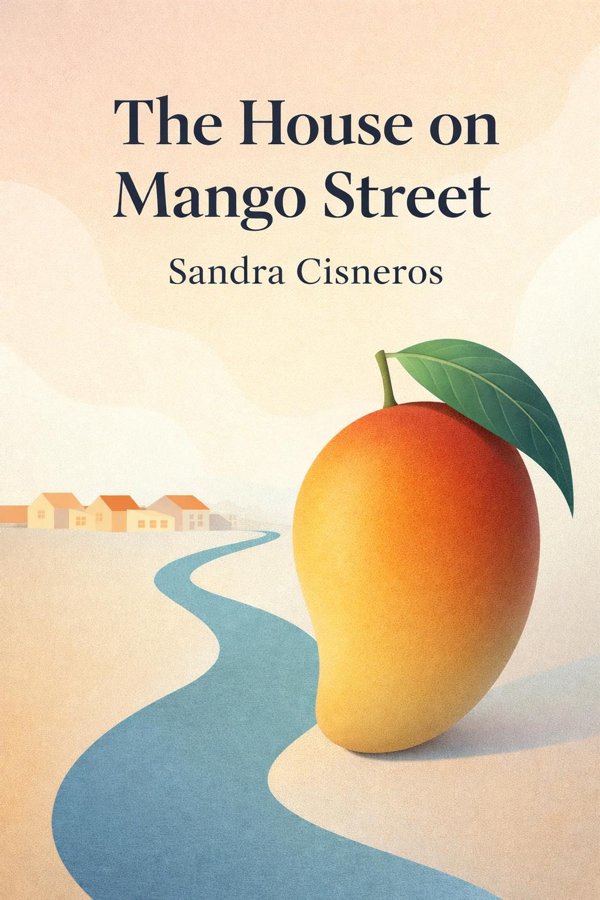
The House on Mango Street: Summary & Key Insights
 10 min10 chaptersAudio available
Key Takeaways from The House on Mango Street
A house can be more than a building; it can become a measure of dignity, disappointment, and desire.
Communities are often judged from the outside, but those who live inside them know their hidden complexity.
We often discover who we are by noticing when we fit in and when we do not.
One of the book’s sharpest insights is that limitation often looks ordinary from the outside.
Children learn class and ethnicity not from theory, but from moments of embarrassment, comparison, and exclusion.
What Is The House on Mango Street About?
The House on Mango Street by Sandra Cisneros is a classics book spanning 10 pages. Sandra Cisneros’s The House on Mango Street is a modern classic that transforms the ordinary details of neighborhood life into a profound portrait of growing up. Told through a sequence of short, lyrical vignettes, the novel follows Esperanza Cordero, a young Latina girl coming of age in a poor Chicago neighborhood. What begins as the story of one family’s move to Mango Street becomes something much larger: a meditation on identity, language, gender, class, belonging, and the dream of a different future. Through Esperanza’s observant and often poetic voice, Cisneros captures the tension between loving where you come from and longing to escape its limitations. The book matters because it gives emotional and literary weight to lives too often ignored in mainstream fiction, especially the lives of girls and women shaped by poverty and cultural expectation. Cisneros writes with unusual authority because she draws on her own Mexican American upbringing in Chicago and helped redefine American literature through a distinctly Chicana voice. The result is a slim but powerful work that feels intimate, memorable, and universally resonant.
This FizzRead summary covers all 10 key chapters of The House on Mango Street in approximately 10 minutes, distilling the most important ideas, arguments, and takeaways from Sandra Cisneros's work. Also available as an audio summary and Key Quotes Podcast.
The House on Mango Street
Sandra Cisneros’s The House on Mango Street is a modern classic that transforms the ordinary details of neighborhood life into a profound portrait of growing up. Told through a sequence of short, lyrical vignettes, the novel follows Esperanza Cordero, a young Latina girl coming of age in a poor Chicago neighborhood. What begins as the story of one family’s move to Mango Street becomes something much larger: a meditation on identity, language, gender, class, belonging, and the dream of a different future. Through Esperanza’s observant and often poetic voice, Cisneros captures the tension between loving where you come from and longing to escape its limitations. The book matters because it gives emotional and literary weight to lives too often ignored in mainstream fiction, especially the lives of girls and women shaped by poverty and cultural expectation. Cisneros writes with unusual authority because she draws on her own Mexican American upbringing in Chicago and helped redefine American literature through a distinctly Chicana voice. The result is a slim but powerful work that feels intimate, memorable, and universally resonant.
Who Should Read The House on Mango Street?
This book is perfect for anyone interested in classics and looking to gain actionable insights in a short read. Whether you're a student, professional, or lifelong learner, the key ideas from The House on Mango Street by Sandra Cisneros will help you think differently.
- ✓Readers who enjoy classics and want practical takeaways
- ✓Professionals looking to apply new ideas to their work and life
- ✓Anyone who wants the core insights of The House on Mango Street in just 10 minutes
Want the full summary?
Get instant access to this book summary and 100K+ more with Fizz Moment.
Get Free SummaryAvailable on App Store • Free to download
Key Chapters
A house can be more than a building; it can become a measure of dignity, disappointment, and desire. At the start of The House on Mango Street, Esperanza introduces the home her family has finally moved into after years of renting cramped apartments. This house was supposed to represent arrival, stability, and pride. Instead, Mango Street exposes the painful gap between what the family hoped for and what they actually have. The house is small, worn, and far from the dream Esperanza has carried in her mind. That contrast shapes the entire book. Mango Street is both shelter and symbol: it gives Esperanza a place to stand, but also a reason to imagine leaving.
Cisneros uses this opening to show how children absorb social realities very quickly. Esperanza understands that houses communicate status. She has already learned the embarrassment of being judged by where she lives, and she feels the sting when a nun questions her about her old apartment. Her longing is not just for material comfort, but for beauty, privacy, and self-respect. She dreams of a house of her own with quiet, space, and room to become herself.
In practical terms, this idea speaks to how environments shape identity. Many readers know what it feels like to compare their home, school, or neighborhood to someone else’s and come away feeling smaller. Cisneros reminds us that ambition often begins in discomfort. Esperanza’s dissatisfaction becomes creative fuel rather than permanent shame.
Actionable takeaway: Pay attention to the places that make you feel limited. Instead of hiding that feeling, use it to clarify what kind of life, home, or future you want to build.
Communities are often judged from the outside, but those who live inside them know their hidden complexity. Through Esperanza’s eyes, Mango Street becomes a vivid social world made up of children, workers, mothers, old men, gossip, music, fear, and laughter. Cisneros does not present the neighborhood as a simple symbol of hardship. It is crowded with contradictions. There is poverty, but there is also creativity. There is danger, but also intimacy. There is confinement, but also familiarity and warmth. The neighborhood functions almost like a character, shaping everyone who lives there.
Esperanza notices details that reveal how place organizes daily life: women who spend much of their time at windows, kids making games out of almost nothing, families packed close together, and streets where everyone watches everyone else. These details show how physical and social boundaries overlap. A few blocks contain an entire emotional universe. For children, the neighborhood is both playground and map of social reality. It teaches them what is possible, what is forbidden, and how people are seen.
This idea matters because many people reduce neighborhoods like Mango Street to statistics or stereotypes. Cisneros insists on texture. She reveals that a community can be deeply flawed and deeply loved at the same time. Readers can apply this by looking more carefully at the places they come from. Instead of seeing only what is missing, they can also observe the relationships, rituals, and stories that give a place meaning.
Actionable takeaway: Describe your own neighborhood in human terms rather than abstract labels. Ask what stories, habits, and invisible rules shape the people who live there.
We often discover who we are by noticing when we fit in and when we do not. Throughout the book, Esperanza’s friendships help define her changing sense of self. She bonds with girls like Lucy, Rachel, Alicia, and Sally, and each relationship reveals a different possibility for girlhood. Friendship offers companionship and play, but it also exposes jealousy, confusion, social pressure, and emotional vulnerability. Esperanza wants to belong, yet she also senses that belonging can come at a cost if it requires silence or imitation.
Cisneros captures the intensity of childhood friendships, where a shared game, joke, or secret can feel enormous. Shoes, names, dancing, and small outings become moments of self-invention. At the same time, Esperanza learns that not all friendships lead to safety or understanding. Some girls accept limits too quickly. Some perform maturity before they are ready. Some are trapped by attention from men and boys. Esperanza watches, participates, and slowly starts to separate her own vision from the expectations around her.
This idea is highly practical because identity is often social before it becomes personal. People test versions of themselves among friends long before they can fully explain who they are. Readers can see how peer groups shape confidence, speech, style, and ambition. Cisneros shows that it is possible to care for others without becoming identical to them.
Actionable takeaway: Reflect on which relationships help you grow and which ones pressure you to shrink. Choose belonging that strengthens your voice rather than weakens it.
One of the book’s sharpest insights is that limitation often looks ordinary from the outside. Esperanza repeatedly observes women on Mango Street whose lives have narrowed into routines of waiting, watching, enduring, and regretting. Some are trapped by marriage, some by fear, some by poverty, and some by the belief that there are no alternatives. They appear in windows, at kitchen tables, in overheard stories, and in whispered warnings. Together, they form a quiet education for Esperanza.
Characters such as Rafaela, Minerva, and Mamacita embody different forms of confinement. Their circumstances vary, but they share a common lack of freedom. Some long for romance and discover control. Some have talent or intelligence but are worn down by domestic burdens. Some are isolated by language, migration, or dependence. Cisneros does not reduce these women to victims alone; she gives them longing, humor, memory, and complexity. Still, Esperanza recognizes that many have been denied the space to direct their own lives.
The practical relevance is clear: social roles can become prisons when they are treated as destiny. Cisneros encourages readers to notice how gender expectations are passed down through example as much as through rules. Esperanza learns not only from what women say, but from the lives they live.
Actionable takeaway: Look for the inherited patterns in your environment, especially those that seem normal but quietly limit people’s choices. Naming a pattern is often the first step toward breaking it.
Children learn class and ethnicity not from theory, but from moments of embarrassment, comparison, and exclusion. Esperanza’s world is shaped by material scarcity and by the social meanings attached to being Mexican American in the United States. Cisneros shows how poverty affects not just comfort, but self-perception. Worn clothes, crowded homes, and a lack of privacy all become part of how people are judged. At the same time, ethnic identity brings both pride and vulnerability. Esperanza is rooted in her culture, yet she also feels how outsiders diminish it.
Importantly, Cisneros avoids turning poverty into a moral lesson or ethnic identity into a slogan. She portrays both as lived realities. Esperanza feels shame in some moments, but she also learns to recognize the dignity and resilience of her family and neighbors. Even her name becomes a site of reflection. It carries family history, cultural weight, and expectations she did not choose. In examining its meanings, Esperanza begins to understand that identity can be inherited without being fixed.
This idea applies broadly to anyone who has felt split between how they see themselves and how institutions, strangers, or dominant culture see them. Cisneros reminds readers that self-definition is hard work when the world offers narrow categories. Yet she also suggests that language and storytelling can reclaim what has been devalued.
Actionable takeaway: Identify one label that has shaped you from the outside and one meaning you want to give yourself from the inside. The gap between them may reveal your next stage of growth.
Growing up is not only a process of discovery; for girls, it is often also a process of learning risk. As Esperanza moves toward adolescence, she becomes increasingly aware of her body, of desire, and of the way men and boys look at girls. Cisneros treats this awakening with honesty and sadness. Moments that begin with curiosity or play often turn unsettling. High heels become symbols of glamour for the girls, but also attract dangerous attention. Small social experiences quickly reveal how fragile innocence can be.
Esperanza is not simply learning about romance. She is learning about power. She sees how female attractiveness can be treated as public property, how vulnerability is misunderstood, and how girls are expected to navigate these realities with little protection. The novel does not sensationalize trauma, but it does make clear that gendered harm is woven into everyday life. This knowledge changes Esperanza’s understanding of the neighborhood and of herself.
Readers can apply this insight by recognizing that coming of age involves social education as much as personal emotion. Many transitions into adulthood are shaped by messages about what bodies mean, who gets freedom, and who must stay alert. Cisneros offers a language for those experiences, especially for readers whose adolescence involved confusion, fear, or premature maturity.
Actionable takeaway: Treat emotional and bodily boundaries as forms of wisdom, not overreaction. Learning to name discomfort early can protect your sense of self later.
Dreams become powerful when they are specific. Esperanza does not just want to leave Mango Street in a vague way; she imagines a house of her own. This dream is central to the book because it combines material independence, artistic freedom, and emotional self-possession. The house she imagines is not only bigger or nicer than the one on Mango Street. It is a place where she will not be ashamed, where she can think, write, and exist without being crowded by other people’s needs. In that sense, the dream is creative as well as economic.
Cisneros links space to agency. For Esperanza, having a room, a door, and some quiet would mean having authority over her own life. This echoes a long literary tradition about women needing physical and psychological space in order to create. But Cisneros grounds that idea in the realities of working-class Latina life. Esperanza’s desire is not abstract feminism; it grows directly out of cramped living conditions, gender restrictions, and the examples of women who had no place to claim as their own.
This idea remains deeply relevant. Whether the goal is a home, time, financial security, or mental space, people often need some protected territory in order to become fully themselves. The book encourages readers to define what independence looks like in concrete terms.
Actionable takeaway: Turn your freedom into a specific vision. Write down what your own version of a house of your own would include, whether it is a real room, a financial goal, or time reserved for your work.
Maturity often begins when the stories we were told about the world no longer hold. As The House on Mango Street progresses, Esperanza encounters betrayal, exploitation, humiliation, and grief. These moments strip away childish illusions and force her to confront the unequal realities around her. Cisneros writes these episodes with restraint, which makes them more powerful. Rather than turning pain into spectacle, she shows how trauma settles into memory and changes how a person moves through the world.
Yet the book is not defined by despair. Esperanza develops resilience not by denying what happens, but by learning to hold experience and still imagine a future. She observes, feels, remembers, and eventually writes. Language becomes a way to metabolize what would otherwise remain unspeakable. This is one of the novel’s deepest contributions: it suggests that storytelling can convert suffering into witness, and witness into selfhood.
In practical terms, many readers will recognize that resilience is not the same as toughness. Esperanza does not become invulnerable. She becomes more conscious. She learns that pain can distort a life if it is buried, but can also sharpen purpose if it is acknowledged. Her growth demonstrates that inner strength is often quiet, cumulative, and creative.
Actionable takeaway: When a painful experience changes how you see yourself, try to give it form through writing, conversation, or art. Expression does not erase hurt, but it can prevent hurt from defining you in silence.
Belonging is rarely simple because love and burden often come together. Esperanza’s family is a source of embarrassment at times, but also tenderness, tradition, and grounding. Cisneros presents family life as noisy, imperfect, and deeply formative. Parents, siblings, and inherited stories all shape Esperanza’s emotional world. She does not reject her family, even when she wants more than the life available to them. Instead, she carries them into her evolving understanding of self.
Cultural memory appears in names, customs, language, gender expectations, and family narratives. Esperanza’s awareness of her great-grandmother, for example, becomes part of how she thinks about women’s roles and inherited patterns. The past is not distant; it lives inside the present. Cisneros shows how children absorb generational history before they can fully interpret it. Family identity can create obligation, but it also provides continuity and meaning.
This matters because many readers experience heritage as both gift and weight. One generation’s survival strategy may become another generation’s limitation. The challenge is to honor what deserves preserving without accepting every inherited script. Esperanza’s development suggests that maturity involves reinterpretation, not simple rebellion.
Actionable takeaway: Ask which parts of your family story you want to continue and which parts you want to revise. Respecting your roots does not require repeating every pattern you inherited.
Escaping a place does not always mean abandoning it. By the end of the book, Esperanza’s deepest realization is that she must leave Mango Street, but she must also return in some form for those who cannot leave. This is not a literal promise alone; it is an artistic and ethical commitment. She has gained enough distance to see that her voice can carry the neighborhood beyond its boundaries. Writing becomes the bridge between departure and responsibility.
This ending transforms the entire novel. What seemed like a personal coming-of-age story reveals itself as the making of a writer. Esperanza’s experiences, observations, and longings are not random memories; they are the material of witness. She will not erase Mango Street to become someone else. Instead, she will turn it into literature. In doing so, she honors the people whose lives are often ignored, especially women whose stories remain locked inside homes and routines.
The idea has broad application. Many people who outgrow their origins feel guilty for leaving or trapped by the belief that they must choose between ambition and loyalty. Cisneros offers a third option: transform where you come from into understanding, service, or art. You can move beyond a place without pretending it never shaped you.
Actionable takeaway: Consider how your past can become contribution rather than only memory. The places you outgrow may still contain stories, lessons, and people your voice can help make visible.
All Chapters in The House on Mango Street
About the Author
Sandra Cisneros is an American novelist, poet, and essayist whose work has had a major impact on contemporary literature, especially Chicana and Latino writing. Born in Chicago in 1954 to a Mexican father and a Mexican American mother, she grew up moving between urban neighborhoods and absorbing the cultural tensions that would later shape her fiction. She is best known for The House on Mango Street, a groundbreaking novel-in-vignettes that brought a young Latina voice to the center of American literature. Cisneros’s writing often explores home, identity, class, migration, gender, and the lives of women navigating cultural expectations. Her style combines poetic precision with emotional honesty and strong social insight. Over her career, she has received broad critical acclaim and remains one of the most widely taught and influential writers of her generation.
Get This Summary in Your Preferred Format
Read or listen to the The House on Mango Street summary by Sandra Cisneros anytime, anywhere. FizzRead offers multiple formats so you can learn on your terms — all free.
Available formats: App · Audio · PDF · EPUB — All included free with FizzRead
Download The House on Mango Street PDF and EPUB Summary
Key Quotes from The House on Mango Street
“A house can be more than a building; it can become a measure of dignity, disappointment, and desire.”
“Communities are often judged from the outside, but those who live inside them know their hidden complexity.”
“We often discover who we are by noticing when we fit in and when we do not.”
“One of the book’s sharpest insights is that limitation often looks ordinary from the outside.”
“Children learn class and ethnicity not from theory, but from moments of embarrassment, comparison, and exclusion.”
Frequently Asked Questions about The House on Mango Street
The House on Mango Street by Sandra Cisneros is a classics book that explores key ideas across 10 chapters. Sandra Cisneros’s The House on Mango Street is a modern classic that transforms the ordinary details of neighborhood life into a profound portrait of growing up. Told through a sequence of short, lyrical vignettes, the novel follows Esperanza Cordero, a young Latina girl coming of age in a poor Chicago neighborhood. What begins as the story of one family’s move to Mango Street becomes something much larger: a meditation on identity, language, gender, class, belonging, and the dream of a different future. Through Esperanza’s observant and often poetic voice, Cisneros captures the tension between loving where you come from and longing to escape its limitations. The book matters because it gives emotional and literary weight to lives too often ignored in mainstream fiction, especially the lives of girls and women shaped by poverty and cultural expectation. Cisneros writes with unusual authority because she draws on her own Mexican American upbringing in Chicago and helped redefine American literature through a distinctly Chicana voice. The result is a slim but powerful work that feels intimate, memorable, and universally resonant.
You Might Also Like





Browse by Category
Ready to read The House on Mango Street?
Get the full summary and 100K+ more books with Fizz Moment.