
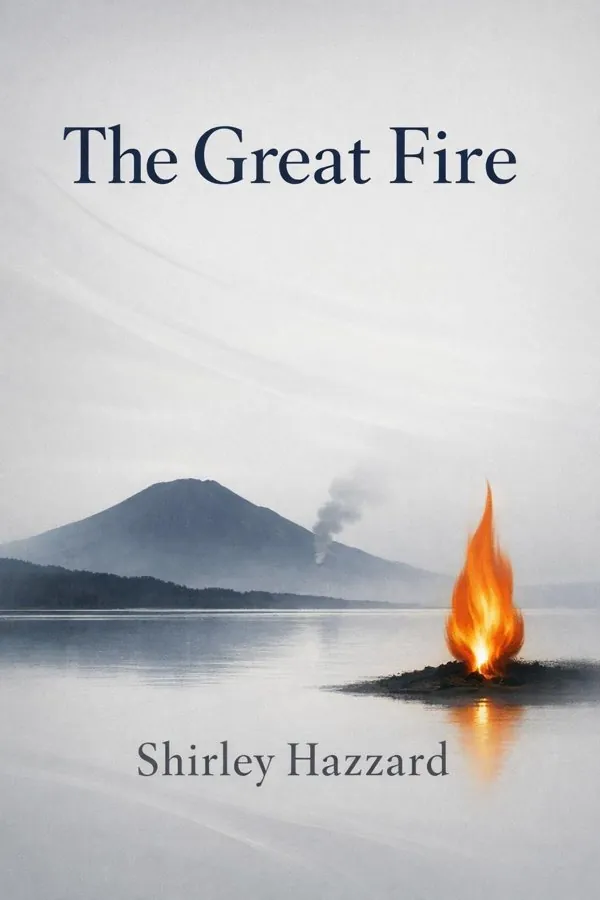
The Great Fire: Summary & Key Insights
 10 min8 chaptersAudio available
Key Takeaways from The Great Fire
One of the novel’s deepest insights is that history does not end when the shooting stops.
Catastrophe is most frightening when it reveals not chaos, but human design.
Sometimes love begins not with possession, but with recognition.
The novel refuses one of our favorite fantasies: that love becomes meaningful only when it is immediately fulfilled.
Violence does not end with ruined buildings; it lingers in the habits of mind people bring into peacetime.
What Is The Great Fire About?
The Great Fire by Shirley Hazzard is a classics book spanning 4 pages. Set in the unsettled years after World War II, The Great Fire follows Aldred Leith, a decorated British veteran who travels through Asia and Australia trying to understand what remains after history’s most destructive blaze. In ruined cities, military compounds, and uneasy colonial outposts, he encounters not only the physical wreckage of war but also the moral exhaustion it leaves behind. The novel’s emotional center emerges when Leith meets Helen Driscoll, an intelligent, vulnerable young woman living under the authority of her compromised family in occupied Japan. Their connection gives the story its deepest tension: can tenderness survive in a world shaped by violence, hierarchy, and grief? What makes this novel matter is Shirley Hazzard’s rare ability to fuse private feeling with historical consequence. She does not treat war as background scenery. Instead, she shows how public catastrophe reshapes speech, desire, loyalty, and conscience long after peace has been declared. Hazzard, one of the finest stylists in modern fiction, brings moral precision and luminous prose to a story about damage, dignity, and the possibility of renewal. The Great Fire is both a love story and a meditation on civilization after collapse.
This FizzRead summary covers all 8 key chapters of The Great Fire in approximately 10 minutes, distilling the most important ideas, arguments, and takeaways from Shirley Hazzard's work. Also available as an audio summary and Key Quotes Podcast.
The Great Fire
Set in the unsettled years after World War II, The Great Fire follows Aldred Leith, a decorated British veteran who travels through Asia and Australia trying to understand what remains after history’s most destructive blaze. In ruined cities, military compounds, and uneasy colonial outposts, he encounters not only the physical wreckage of war but also the moral exhaustion it leaves behind. The novel’s emotional center emerges when Leith meets Helen Driscoll, an intelligent, vulnerable young woman living under the authority of her compromised family in occupied Japan. Their connection gives the story its deepest tension: can tenderness survive in a world shaped by violence, hierarchy, and grief?
What makes this novel matter is Shirley Hazzard’s rare ability to fuse private feeling with historical consequence. She does not treat war as background scenery. Instead, she shows how public catastrophe reshapes speech, desire, loyalty, and conscience long after peace has been declared. Hazzard, one of the finest stylists in modern fiction, brings moral precision and luminous prose to a story about damage, dignity, and the possibility of renewal. The Great Fire is both a love story and a meditation on civilization after collapse.
Who Should Read The Great Fire?
This book is perfect for anyone interested in classics and looking to gain actionable insights in a short read. Whether you're a student, professional, or lifelong learner, the key ideas from The Great Fire by Shirley Hazzard will help you think differently.
- ✓Readers who enjoy classics and want practical takeaways
- ✓Professionals looking to apply new ideas to their work and life
- ✓Anyone who wants the core insights of The Great Fire in just 10 minutes
Want the full summary?
Get instant access to this book summary and 100K+ more with Fizz Moment.
Get Free SummaryAvailable on App Store • Free to download
Key Chapters
One of the novel’s deepest insights is that history does not end when the shooting stops. When Aldred Leith arrives in postwar Hong Kong, he enters a world officially at peace yet still saturated with dislocation, corruption, and memory. Shirley Hazzard presents the city as a place where victory feels morally ambiguous. Bureaucrats resume routines, officers circulate through clubs and residences, and empire tries to restore its surface order, but beneath that appearance lies a more unsettling truth: war has altered everyone, and no administrative calm can erase what has been seen.
Leith’s role is crucial because he is neither triumphant nor naïve. As a veteran and observer, he carries the burden of witness. He has seen destruction firsthand, and this gives him a sharpened perception of the small evasions people use to protect themselves. He notices the ways official language minimizes suffering, how class and rank distort sympathy, and how easily societies rush to normalization without moral reckoning. In this sense, Hong Kong becomes more than a setting. It becomes a laboratory for examining what happens after collective disaster, when the temptation is to move on before understanding what the disaster revealed.
This idea has practical force beyond the novel. In any organization, family, or nation emerging from crisis, there is pressure to restore routine quickly. But recovery without honest witness often preserves the conditions that caused the damage. Leith reminds us that attention is a form of ethics. To see clearly, without sentimentality or denial, is the first act of rebuilding.
Actionable takeaway: After any difficult upheaval, resist the urge to skip straight to normality. First ask what the crisis exposed, who was harmed, and what truth still needs to be faced.
Catastrophe is most frightening when it reveals not chaos, but human design. In occupied Japan, Leith confronts devastation on a scale that forces the novel into its largest moral questions. Entire urban landscapes have been destroyed, and the atomic shadow hangs over everything as evidence that modern civilization, for all its refinement and technical brilliance, can create horrors beyond previous imagining. Hazzard does not present this destruction as spectacle. She presents it as a challenge to consciousness: how do thoughtful people continue to believe in culture, order, or human progress after such proof of organized annihilation?
Leith’s experience in Japan sharpens the novel’s critique of abstraction. Military strategy, political justification, and historical necessity all sound thinner when placed against the daily reality of broken places and damaged lives. Hazzard insists that modern violence is not only physical; it is linguistic and moral. Systems make devastation easier by reducing persons to categories and consequences to statistics. Leith’s humanity lies in his refusal to let those abstractions have the last word.
For readers today, this idea remains urgent. We still live in a world where decisions with enormous human cost are often explained through distant rhetoric: security, efficiency, inevitability, collateral damage. The novel asks us to recover a scale of moral judgment grounded in lived experience rather than official language. It also reminds us that beauty and conscience must be defended precisely when history seems to discredit them.
Actionable takeaway: Whenever large institutions justify harm in abstract terms, bring the question back to real human lives. Ask what the policy, decision, or system looks like on the ground for those who must endure it.
Sometimes love begins not with possession, but with recognition. When Leith meets Helen Driscoll in Japan, the novel’s emotional register changes. Helen is young, intelligent, and emotionally exposed, living in the shadow of a damaged family structure and under the careless authority of adults who fail to protect what is finest in her. Leith’s response to her is not merely romantic fascination. It is an awakening of tenderness, responsibility, and reverence for a life that has been neglected by those nearest to it.
Hazzard handles this relationship with delicacy because she is interested in more than attraction. Helen represents a possibility that war has not extinguished: the survival of inwardness, perception, and ethical beauty. Leith sees in her a seriousness and sensitivity that the surrounding world neither understands nor deserves. Their bond becomes meaningful because it is formed in contrast to environments shaped by vulgarity, carelessness, and emotional misuse. In loving Helen, Leith is also choosing a moral stance. He turns away from cynicism and toward the belief that another person’s dignity can still call forth one’s best self.
This idea has practical application in ordinary life. Relationships often reveal our character more clearly than our public achievements do. To care for someone well means perceiving them accurately, honoring their complexity, and resisting the social pressures that flatten them into roles. Real tenderness is disciplined attention.
The novel also warns that youth and intelligence do not guarantee safety. Without thoughtful adults, gifted and vulnerable people can be trapped in systems of condescension and exploitation. Leith’s sensitivity matters because he sees Helen as fully real.
Actionable takeaway: In your closest relationships, practice recognition before judgment. Ask yourself whether you are truly seeing the other person’s reality, or merely responding to the role they play in your life.
The novel refuses one of our favorite fantasies: that love becomes meaningful only when it is immediately fulfilled. In The Great Fire, separation is not a narrative inconvenience but a moral test. Leith and Helen do not inhabit a world arranged for happiness. Distance, authority, age, family constraint, and the residue of war all stand between them. Yet Hazzard transforms this obstruction into a deeper inquiry. What remains of feeling when convenience disappears? What kind of hope deserves our loyalty when outcomes are uncertain?
Leith’s attachment to Helen becomes durable because it is not based on instant possession. Instead, it is refined by waiting, doubt, and sustained inward commitment. Hazzard suggests that hope is not optimism. Optimism expects favorable conditions; hope persists without guarantees. This distinction matters throughout the novel, where characters are repeatedly forced to choose between resignation and a more disciplined faithfulness to what they know to be valuable.
In practical terms, the novel offers a corrective to modern impatience. We often assume that if something meaningful does not resolve quickly, it must not be real. Hazzard challenges that idea. Some of the most serious forms of love, vocation, and moral conviction require endurance through ambiguity. The willingness to continue, to remain inwardly aligned with what matters even when circumstances delay or distort it, is one of the book’s noblest virtues.
This does not mean passive waiting or self-delusion. It means refusing to let immediate frustration determine ultimate meaning. Leith’s example shows that hope can be active, lucid, and self-commanding rather than merely sentimental.
Actionable takeaway: When something truly matters, distinguish between temporary obstacle and final impossibility. Let patience clarify your commitment instead of treating delay as automatic defeat.
Violence does not end with ruined buildings; it lingers in the habits of mind people bring into peacetime. A central achievement of The Great Fire is its portrayal of how war deforms moral imagination. Characters emerge from the conflict carrying altered standards of feeling and judgment. Some have become hardened, others evasive, others superficially efficient but inwardly numbed. Hazzard shows that large-scale violence trains people to accept what would once have been unthinkable.
This is why the novel pays such careful attention to tone, conversation, and social atmosphere. Casual cruelty, bureaucratic indifference, and trivial self-importance all become symptoms of a damaged moral world. People who have lived through emergency conditions may begin to mistake bluntness for realism, detachment for maturity, or domination for competence. Leith stands apart because he has endured war without surrendering his capacity for moral astonishment. He still knows that some things should offend the conscience.
This insight applies widely. Intense pressure, competition, or prolonged instability can normalize poor conduct in workplaces, families, and institutions. People say, “That’s just how things are,” when in fact they have adapted to conditions they should be resisting. The danger is not only that wrong actions occur, but that imagination shrinks until better possibilities seem childish.
Hazzard’s answer is not innocence. It is cultivated discernment. To remain human after exposure to brutality, one must consciously preserve language, memory, and judgment from contamination. Leith’s seriousness is a form of resistance to spiritual coarsening.
Actionable takeaway: Notice the behaviors your environment has taught you to treat as normal. Ask whether necessity has quietly become an excuse for coldness, cynicism, or moral laziness.
One of the novel’s sharpest observations is that power often survives catastrophe by changing tone rather than character. In the postwar world Hazzard depicts, imperial administration and class privilege continue to shape relationships long after military victory. Social rank determines who is heard, who is dismissed, who moves freely, and who becomes vulnerable to private abuse. The war may have exposed the fragility of civilization, but it has not dissolved the old hierarchies that helped structure its injustices.
Characters embedded in official and upper-class systems often speak the language of duty, breeding, or practical necessity. Yet Hazzard reveals how such language can mask selfishness, vanity, and moral irresponsibility. The domestic sphere is especially important here. Families, residences, and command structures reproduce larger patterns of domination. Helen’s situation illustrates how private dependence and public hierarchy intersect: those with authority over her are not merely flawed individuals but participants in a social order that confuses status with worth.
Leith’s relative independence gives him a different perspective. He can see how polished manners and institutional legitimacy often conceal ethical failure. Hazzard’s critique is subtle but forceful: corruption is not always dramatic. It frequently appears as entitlement, thoughtlessness, and the presumption that weaker people must accommodate stronger ones.
This remains relevant wherever prestige discourages accountability. A respected title, elite background, or official role can make misconduct seem less visible. The novel encourages readers to look beyond appearances and evaluate character by conduct rather than station.
Actionable takeaway: When assessing people or institutions, do not let prestige substitute for integrity. Pay close attention to how power treats those who have the least freedom to resist it.
The Great Fire suggests that to pay deep attention is not merely an artistic virtue; it is a moral one. Hazzard’s prose lingers over gesture, atmosphere, silence, and implication because the novel believes that reality is ethically textured. People reveal themselves in what they notice, what they ignore, and how carefully they register another person’s presence. Leith’s distinctiveness comes less from dramatic action than from the quality of his attention. He listens, observes, remembers, and interprets with unusual seriousness.
This matters because inattentiveness enables harm. The negligent adults around Helen do not fail her through one spectacular crime alone; they fail through habitual misrecognition. They do not truly see her. Likewise, political and military systems produce suffering more easily when individual particularity disappears from view. Attention restores scale. It returns us from ideology and vanity to the irreducible fact of another life.
In everyday life, this principle has immediate application. Strong relationships, wise leadership, and fair judgment all depend on careful observation. Many conflicts escalate because people react quickly rather than perceive accurately. Many injustices persist because they remain beneath the threshold of notice. To attend well is to grant reality its due weight.
Hazzard also implies that attention protects beauty. In a shattered world, the ability to register a landscape, a phrase, a mood, or a moment of grace becomes a way of refusing total spiritual devastation. Beauty is not escapism here; it is evidence that perception itself can remain intact.
Actionable takeaway: Slow your first response. In difficult situations, spend more time observing before concluding. Better attention often leads to better ethics, better decisions, and deeper human connection.
After immense destruction, rebuilding usually brings to mind roads, governments, and economies. Hazzard asks a more intimate question: what rebuilds the inner world? In The Great Fire, love is not presented as a decorative subplot but as a genuine force of reconstruction. Leith and Helen’s connection offers a counter-history to war. Against the logic of destruction, they represent receptivity, trust, and the possibility that one life may shelter another.
Importantly, Hazzard does not sentimentalize this idea. Love does not erase trauma, abolish social barriers, or simplify grief. Instead, it creates a moral and emotional orientation through which damaged people can begin to live differently. Leith’s affection for Helen makes him more purposeful, more patient, and more alert to what deserves protection. Helen’s presence gathers into focus many of the values the postwar world has obscured: innocence without stupidity, sensitivity without weakness, and hope without denial.
For modern readers, this idea broadens the meaning of recovery. After personal loss, burnout, illness, or collective upheaval, repair may begin not with total solutions but with forms of loyal care. A trustworthy friendship, a generous mentor, a stable partnership, or a renewed commitment to family can become the first architecture of a livable future. Reconstruction is relational before it is institutional.
The novel ultimately insists that love is credible not because the world is safe, but because the world is unsafe. In times of fracture, humane attachment becomes more necessary, not less.
Actionable takeaway: If your life feels marked by damage or disruption, begin rebuilding through relationship. Invest in one bond defined by honesty, care, and steadiness, and let that become the foundation for wider renewal.
All Chapters in The Great Fire
About the Author
Shirley Hazzard (1931–2016) was an Australian-born novelist, short story writer, and essayist celebrated for her refined prose and penetrating moral vision. She spent parts of her life in Australia, New Zealand, Hong Kong, Europe, and the United States, experiences that gave her fiction an unusually international perspective. Hazzard also worked for the United Nations, an experience that informed her skepticism toward bureaucracy and official power. Her writing often examines love, exile, war, memory, and the ethical pressure of history on private life. Though admired for decades by serious readers and critics, she reached an even wider audience when The Great Fire won the 2003 National Book Award for Fiction. Today she is regarded as one of the great stylists of twentieth- and twenty-first-century literary fiction.
Get This Summary in Your Preferred Format
Read or listen to the The Great Fire summary by Shirley Hazzard anytime, anywhere. FizzRead offers multiple formats so you can learn on your terms — all free.
Available formats: App · Audio · PDF · EPUB — All included free with FizzRead
Download The Great Fire PDF and EPUB Summary
Key Quotes from The Great Fire
“One of the novel’s deepest insights is that history does not end when the shooting stops.”
“Catastrophe is most frightening when it reveals not chaos, but human design.”
“Sometimes love begins not with possession, but with recognition.”
“The novel refuses one of our favorite fantasies: that love becomes meaningful only when it is immediately fulfilled.”
“Violence does not end with ruined buildings; it lingers in the habits of mind people bring into peacetime.”
Frequently Asked Questions about The Great Fire
The Great Fire by Shirley Hazzard is a classics book that explores key ideas across 8 chapters. Set in the unsettled years after World War II, The Great Fire follows Aldred Leith, a decorated British veteran who travels through Asia and Australia trying to understand what remains after history’s most destructive blaze. In ruined cities, military compounds, and uneasy colonial outposts, he encounters not only the physical wreckage of war but also the moral exhaustion it leaves behind. The novel’s emotional center emerges when Leith meets Helen Driscoll, an intelligent, vulnerable young woman living under the authority of her compromised family in occupied Japan. Their connection gives the story its deepest tension: can tenderness survive in a world shaped by violence, hierarchy, and grief? What makes this novel matter is Shirley Hazzard’s rare ability to fuse private feeling with historical consequence. She does not treat war as background scenery. Instead, she shows how public catastrophe reshapes speech, desire, loyalty, and conscience long after peace has been declared. Hazzard, one of the finest stylists in modern fiction, brings moral precision and luminous prose to a story about damage, dignity, and the possibility of renewal. The Great Fire is both a love story and a meditation on civilization after collapse.
More by Shirley Hazzard



You Might Also Like



Browse by Category
Ready to read The Great Fire?
Get the full summary and 100K+ more books with Fizz Moment.