
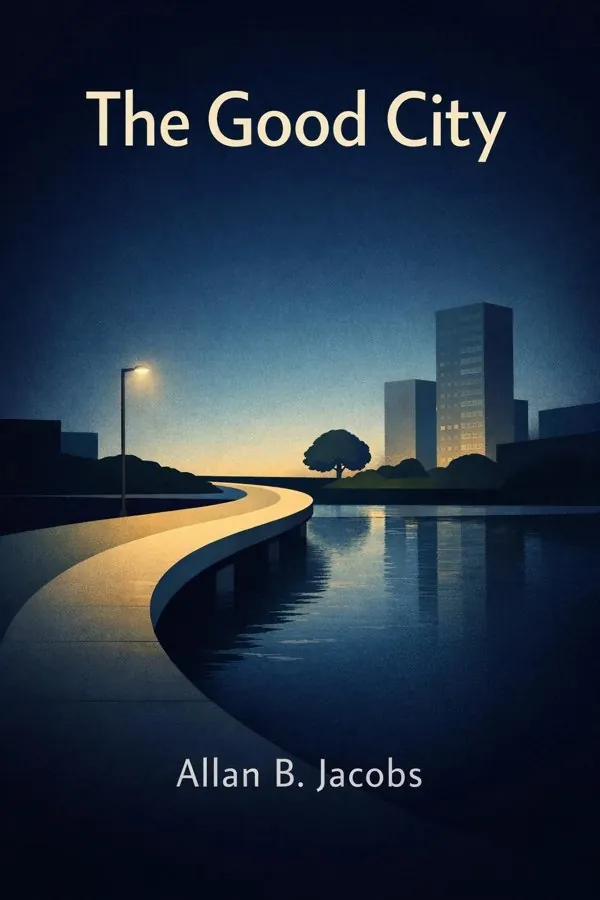
The Good City: Essays on Urban Design and Development: Summary & Key Insights
 10 min7 chaptersAudio available
What Is The Good City: Essays on Urban Design and Development About?
The Good City: Essays on Urban Design and Development by Allan B. Jacobs is a design book spanning 7 pages. In 'The Good City', Allan B. Jacobs explores what makes cities livable, beautiful, and humane. Drawing on decades of experience as an urban planner and scholar, Jacobs examines the physical and social elements that contribute to successful urban environments, from street design and public spaces to community engagement and policy. The book collects essays and reflections that advocate for cities designed around people rather than cars or profit, offering both theoretical insights and practical examples from around the world.
This FizzRead summary covers all 7 key chapters of The Good City: Essays on Urban Design and Development in approximately 10 minutes, distilling the most important ideas, arguments, and takeaways from Allan B. Jacobs's work. Also available as an audio summary and Key Quotes Podcast.
The Good City: Essays on Urban Design and Development
In 'The Good City', Allan B. Jacobs explores what makes cities livable, beautiful, and humane. Drawing on decades of experience as an urban planner and scholar, Jacobs examines the physical and social elements that contribute to successful urban environments, from street design and public spaces to community engagement and policy. The book collects essays and reflections that advocate for cities designed around people rather than cars or profit, offering both theoretical insights and practical examples from around the world.
Who Should Read The Good City: Essays on Urban Design and Development?
This book is perfect for anyone interested in design and looking to gain actionable insights in a short read. Whether you're a student, professional, or lifelong learner, the key ideas from The Good City: Essays on Urban Design and Development by Allan B. Jacobs will help you think differently.
- ✓Readers who enjoy design and want practical takeaways
- ✓Professionals looking to apply new ideas to their work and life
- ✓Anyone who wants the core insights of The Good City: Essays on Urban Design and Development in just 10 minutes
Want the full summary?
Get instant access to this book summary and 100K+ more with Fizz Moment.
Get Free SummaryAvailable on App Store • Free to download
Key Chapters
The forms of cities tell stories of human intention across millennia. When I look back to ancient city plans—from the ordered grids of Hippodamus to the organic sprawls of medieval towns—it becomes clear that each era reflects distinctive beliefs about society and power. Early cities were shaped by defense and trade; later by religion, empire, and industrialization. The evolution of city form is, in essence, a reflection of civilization’s changing priorities.
Modern urban design, emerging from this lineage, carries both wisdom and error. The industrial age gave us efficiency, yet often at the expense of human experience. The car became a measure of progress, and in its wake, streets lost their social meaning. Through the 20th century, planners chased abstract ideals of order while communities fragmented. Against this backdrop, movements such as Garden Cities, postwar reconstruction, and later, New Urbanism sought to restore balance between design and human need.
Understanding this history matters. The lessons of Rome, Paris, or Brasília remind us that form is not neutral—it either nurtures or constrains life. When cities evolved toward vehicular dominance, they neglected the walker’s pace, the rhythm of daily interaction. The good city must reclaim these lost dimensions, not through nostalgia but through deliberate inclusion of the principles that made ancient streets and squares enduring: scale, continuity, and adaptability. The study of past city forms offers not a blueprint, but a compass guiding contemporary design toward equilibrium between growth and grace.
Every city begins with its physical bones: streets, blocks, buildings, and open spaces. These elements define not only movement but meaning. As I have found in my studies—especially in 'Great Streets'—a street is more than a conduit; it is a room in the public realm. When well-designed, it invites walking, conversation, and exchange. Its proportions, edges, and materials speak directly to the senses, articulating comfort and belonging.
Blocks form the framework within which buildings and activities unfold. Their size and configuration determine accessibility, visual variety, and the scale of human life. Too large, and they shut down the intricate connections that make neighborhoods thrive. Too small or fragmented, and they lose coherence. The good city finds harmony here—not uniformity, but legible structure.
Open spaces, meanwhile, are the breathing rooms of a city. From parks to plazas, they allow public life to flourish beyond private walls. They gather the energy of communities and express civic identity. I have always believed that designing these spaces demands both functional awareness and poetic imagination. A plaza succeeds when it hosts both solitude and festivity; a park becomes vital when it is integral to daily routines, not cut off as an isolated amenity.
Together, these physical elements define the city’s aesthetic and its moral character. Design is never simply physical—it reflects the social compact of a community. Streets and buildings articulate how a society sees its citizens. The good city therefore starts where form meets empathy: it is built of materials and proportions that acknowledge human scale and dignity.
+ 5 more chapters — available in the FizzRead app
All Chapters in The Good City: Essays on Urban Design and Development
About the Author
Allan B. Jacobs is an American urban designer, planner, and professor emeritus at the University of California, Berkeley. He is best known for his influential works on urban form and street design, including 'Great Streets' and 'Looking at Cities'. His research and practice have shaped modern urban planning and design education globally.
Get This Summary in Your Preferred Format
Read or listen to the The Good City: Essays on Urban Design and Development summary by Allan B. Jacobs anytime, anywhere. FizzRead offers multiple formats so you can learn on your terms — all free.
Available formats: App · Audio · PDF · EPUB — All included free with FizzRead
Download The Good City: Essays on Urban Design and Development PDF and EPUB Summary
Key Quotes from The Good City: Essays on Urban Design and Development
“The forms of cities tell stories of human intention across millennia.”
“Every city begins with its physical bones: streets, blocks, buildings, and open spaces.”
Frequently Asked Questions about The Good City: Essays on Urban Design and Development
The Good City: Essays on Urban Design and Development by Allan B. Jacobs is a design book that explores key ideas across 7 chapters. In 'The Good City', Allan B. Jacobs explores what makes cities livable, beautiful, and humane. Drawing on decades of experience as an urban planner and scholar, Jacobs examines the physical and social elements that contribute to successful urban environments, from street design and public spaces to community engagement and policy. The book collects essays and reflections that advocate for cities designed around people rather than cars or profit, offering both theoretical insights and practical examples from around the world.
You Might Also Like

The Design of Everyday Things
Don Norman
10 min
The Better Angels of Our Nature
Steven Pinker
10 min
A Designer's Art
Paul Rand
10 min
Architects' Sketchbooks
Various Editors
10 min
Architectural Graphic Standards
The American Institute of Architects
10 min
Design Is Storytelling
Ellen Lupton
10 minBrowse by Category
Ready to read The Good City: Essays on Urban Design and Development?
Get the full summary and 100K+ more books with Fizz Moment.