
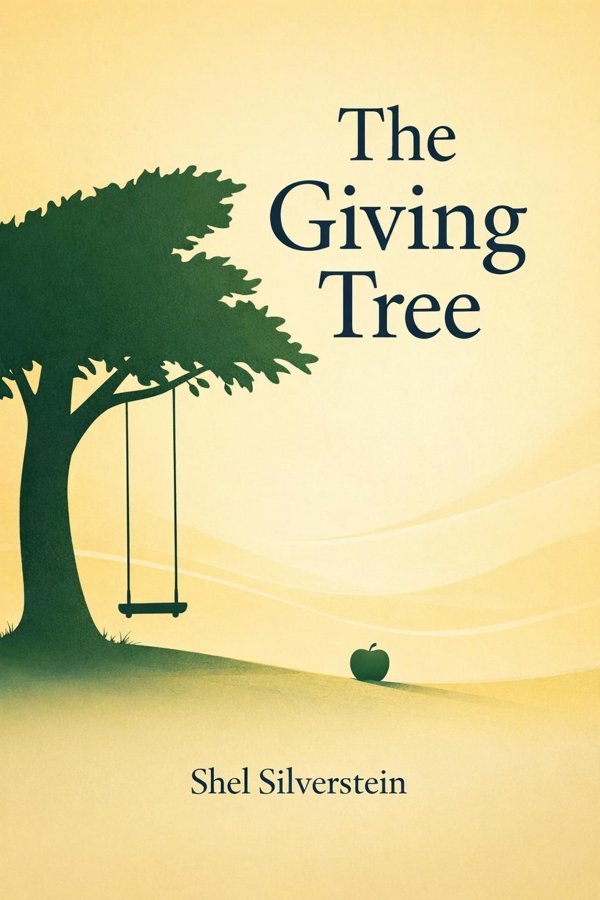
The Giving Tree: Summary & Key Insights
 10 min9 chaptersAudio available
Key Takeaways from The Giving Tree
The purest relationships often begin before anyone starts keeping score.
Growing up often means wanting more than joy alone can provide.
One of the most striking features of The Giving Tree is that the tree finds happiness in giving.
The first major act of loss in the story is deceptively gentle.
When the boy returns wanting a house, the tree offers her branches so he can build one.
What Is The Giving Tree About?
The Giving Tree by Shel Silverstein is a classics book spanning 5 pages. Shel Silverstein’s The Giving Tree is one of the most beloved and debated picture books ever written. On the surface, it tells a simple story: a boy and a tree share a bond that changes as the boy grows older. What begins as carefree companionship slowly becomes a pattern of asking and giving, until the tree has offered nearly everything she has. Yet beneath its spare language and childlike drawings lies a deeply moving meditation on love, sacrifice, aging, need, gratitude, and the passage of time. That emotional depth is precisely why the book continues to matter across generations. Children can read it as a tender fable, while adults often encounter it as something more unsettling and profound. Silverstein had a rare gift for pairing simplicity with emotional force. Known for his poetry, songs, cartoons, and unforgettable children’s books, he understood how a short story could hold complex truths without losing its accessibility. The Giving Tree endures because it asks timeless questions: What does it mean to love? How much should we give? And what do we owe those who have sustained us?
This FizzRead summary covers all 9 key chapters of The Giving Tree in approximately 10 minutes, distilling the most important ideas, arguments, and takeaways from Shel Silverstein's work. Also available as an audio summary and Key Quotes Podcast.
The Giving Tree
Shel Silverstein’s The Giving Tree is one of the most beloved and debated picture books ever written. On the surface, it tells a simple story: a boy and a tree share a bond that changes as the boy grows older. What begins as carefree companionship slowly becomes a pattern of asking and giving, until the tree has offered nearly everything she has. Yet beneath its spare language and childlike drawings lies a deeply moving meditation on love, sacrifice, aging, need, gratitude, and the passage of time. That emotional depth is precisely why the book continues to matter across generations. Children can read it as a tender fable, while adults often encounter it as something more unsettling and profound. Silverstein had a rare gift for pairing simplicity with emotional force. Known for his poetry, songs, cartoons, and unforgettable children’s books, he understood how a short story could hold complex truths without losing its accessibility. The Giving Tree endures because it asks timeless questions: What does it mean to love? How much should we give? And what do we owe those who have sustained us?
Who Should Read The Giving Tree?
This book is perfect for anyone interested in classics and looking to gain actionable insights in a short read. Whether you're a student, professional, or lifelong learner, the key ideas from The Giving Tree by Shel Silverstein will help you think differently.
- ✓Readers who enjoy classics and want practical takeaways
- ✓Professionals looking to apply new ideas to their work and life
- ✓Anyone who wants the core insights of The Giving Tree in just 10 minutes
Want the full summary?
Get instant access to this book summary and 100K+ more with Fizz Moment.
Get Free SummaryAvailable on App Store • Free to download
Key Chapters
The purest relationships often begin before anyone starts keeping score. At the start of The Giving Tree, the boy and the tree exist in a world of uncomplicated affection. He climbs her trunk, swings from her branches, gathers her apples, and rests in her shade. She is happy simply because he is with her. This early stage matters because it establishes a bond rooted in delight rather than transaction. Nothing is being measured. No debt is created. Their connection is defined by presence, play, and mutual belonging.
This innocence mirrors many of life’s earliest relationships: childhood friendships, a parent’s bond with a small child, or our first sense of connection with nature. In those moments, joy comes from shared experience rather than utility. Silverstein shows how powerful such a beginning can be. It gives the story its emotional weight, because we later compare every change to this original wholeness.
In practical terms, this idea invites us to examine relationships before roles and obligations took over. Think of a friendship that began with curiosity and laughter but became dominated by favors, logistics, or expectations. Or consider how children experience a park, a garden, or a family home—not as resources to exploit, but as places of wonder. The opening of the book reminds us that love often starts with attention and delight, not achievement.
A useful takeaway is to intentionally create moments that are free from demand. Spend time with someone you care about without trying to fix, advise, or extract anything. Return, even briefly, to the spirit of simple companionship.
Growing up often means wanting more than joy alone can provide. As the boy gets older, he no longer comes to the tree just to play. He wants money, possessions, progress, and the markers of a larger life. Silverstein does not condemn this change outright; wanting things is part of human development. The tragedy is not that the boy grows, but that his growth increasingly turns relationship into usefulness. The tree is still a companion, yet she also becomes a solution.
This shift captures a painful truth about adulthood. As responsibilities multiply, our attention often moves from being to having. Teenagers want independence. Young adults want financial security. Midlife brings pressure to build, provide, and achieve. In all of this, people can begin to approach others mainly through the lens of need: Who can help me? What can I get? What will move my life forward?
The story encourages readers to notice how desire can narrow perspective. The boy is not presented as evil; he is ordinary. That is what makes the book resonate. Most people, at some point, drift away from the sources of early nourishment and return only when they need something. We may do this with parents, mentors, communities, or even places that once made us feel grounded.
A practical application is to ask yourself where ambition has replaced appreciation. Are you reaching out to someone only when you need support, advice, or resources? If so, pause and reintroduce gratitude into the relationship. The actionable takeaway: before making a request of someone who has long supported you, acknowledge their presence and value apart from what they can provide.
One of the most striking features of The Giving Tree is that the tree finds happiness in giving. When the boy needs money, she offers apples to sell. She does not resist, negotiate, or ask for anything in return. Her identity is deeply tied to generosity. Silverstein presents giving as something that can be meaningful, even joyous, for the giver. This is an important truth. Real love often does involve sacrifice. Caregivers, teachers, friends, and partners regularly give time, energy, and resources because another person’s flourishing matters to them.
At the same time, the book invites a more careful reading. Giving is beautiful when it arises from love, but it can become dangerous when self-erasure is mistaken for virtue. Many readers recognize themselves in the tree: the parent who never rests, the friend who is always available, the employee who keeps saying yes, the partner who confuses devotion with depletion. The tree’s happiness is sincere, yet it raises a difficult question: can someone keep giving without limit and remain whole?
In everyday life, healthy generosity includes discernment. A grandparent may love helping with childcare, but still need boundaries. A mentor may want to support a younger colleague, but not solve every problem for them. A friend can offer care without becoming another person’s entire emotional infrastructure. Giving is most sustainable when it is chosen freely and balanced with self-respect.
The actionable takeaway is simple: continue to give where love calls you, but ask whether your generosity is renewing life or draining it. Make one supportive gesture this week that is wholehearted and sustainable, not resentful or self-destructive.
The first major act of loss in the story is deceptively gentle. When the boy says he needs money, the tree offers her apples so he can sell them. Apples are natural gifts; trees produce them without being destroyed. Yet this moment marks a turning point, because the relationship has shifted from sharing abundance to extracting value. What once was playful enjoyment now becomes economic use.
This stage reflects many real-life transitions. Early in adult life, people often rely on the “fruit” of others before demanding their deeper reserves. A young person may depend on a family’s financial help, a mentor’s recommendations, or a friend’s emotional encouragement. These forms of giving can be appropriate and loving. But they still shape the relationship. Once a person becomes accustomed to receiving practical benefits, it can become easy to overlook the personhood behind the gift.
Silverstein’s brilliance lies in how quietly this change occurs. Nothing dramatic is announced. The boy asks. The tree gives. He leaves. She is happy. But readers sense that a pattern is forming. This is how imbalance often begins in real life—not with cruelty, but with unexamined habits.
To apply this insight, consider the “apples” in your own relationships: the easy contributions others keep making for you. Maybe someone always listens, lends money, handles details, or opens doors. These gifts may be offered freely, but they still deserve recognition. Gratitude helps prevent entitlement.
Actionable takeaway: identify one recurring benefit you receive from someone in your life and thank them specifically for it. Better yet, ask how you can reciprocate in a way that honors the relationship rather than merely consuming its fruits.
When the boy returns wanting a house, the tree offers her branches so he can build one. Here the sacrifice becomes more severe. Branches are not extra. They define the tree’s shape, reach, and shelter. By giving them away, she loses part of her form so the boy can construct a life elsewhere. Symbolically, this moment speaks to the costs hidden inside many acts of support. Sometimes helping someone grow means surrendering something substantial.
This image resonates strongly with parenthood and caregiving. Parents often give up sleep, money, privacy, freedom, and personal ambition to help children establish secure lives. Teachers and mentors may invest years in others’ development with little outward recognition. Even institutions, communities, and ecosystems can be stripped of their “branches” in the name of someone else’s advancement. The book does not reduce this to a moral slogan; it presents the beauty and sadness together.
There is also a warning here. The house the boy builds represents independence, but it is built from a relationship he does not fully honor. Independence achieved through unseen sacrifice can produce amnesia. Many adults proudly celebrate what they have built while forgetting who lost time, comfort, or possibility along the way.
In practice, this key idea asks us to reflect on the hidden architecture of our lives. Who gave up something meaningful so you could feel secure? What opportunities, comforts, or energies of theirs became the framework of your current stability? Remembering this can deepen humility and reshape how we give to others.
The actionable takeaway: think of one person whose sacrifice helped build your sense of home, security, or confidence. Reach out and name what they gave. Recognition may not restore the branches, but it restores dignity.
There comes a point in some relationships when giving is no longer about sharing abundance but about surrendering the self. When the boy wants a boat so he can sail away, the tree offers her trunk. With that act, she loses nearly everything that made her a tree. The trunk is her core—her strength, her vertical presence, her capacity to stand in the world. This is the most devastating image in the book because it turns love into near-total relinquishment.
Silverstein leaves readers to wrestle with the ambiguity. Is this the highest form of devotion, or a portrait of love without boundaries? The answer may be both. That tension explains why The Giving Tree continues to provoke strong reactions. Many readers see in the tree a sacred model of unconditional love. Others see a painful warning about exploitation, dependency, and the romanticizing of self-destruction.
In everyday terms, the trunk represents the essential parts of ourselves: health, identity, dignity, purpose, financial stability, emotional reserves. To give these away entirely for another person’s wishes can be noble in rare emergencies, but disastrous as a pattern. Healthy love should not require the repeated removal of one’s core capacities.
This idea is especially relevant in families, partnerships, and helping professions. Burnout often begins when people start cutting into the trunk of who they are. They stop resting, stop saying no, stop protecting time, and stop honoring their own needs.
The actionable takeaway is to define your trunk. What part of your life must remain protected for you to stay whole? Write down one non-negotiable boundary—time, health, finances, or emotional space—and commit to honoring it even while loving generously.
One of the quiet achievements of The Giving Tree is its portrayal of time not as background, but as an active force. The boy changes from child to adolescent to adult to old man. His needs evolve from play to money to shelter to escape to rest. The tree changes too, not because her love diminishes, but because giving alters her physical reality. By the end, both are shaped by years of asking, offering, absence, and return.
This temporal dimension is what gives the story lasting emotional power. Many relationships are not defined by one dramatic event but by repeated patterns over decades. A family bond, for example, may move through tenderness, strain, dependence, distance, reconciliation, and quiet companionship. What once felt mutual may become unequal; what once seemed permanent may erode. Yet love can persist through all of it, changed but not erased.
The book also reminds us that what people seek from one another varies across life stages. A child wants play. A young adult wants resources. A middle-aged person may want utility. An older person may want peace. Understanding this can help us respond to others with more wisdom. It can also help us notice when we are stuck in immature patterns of taking.
Practically, this insight encourages long-term reflection. Instead of judging a relationship by one season, look at its arc. What roles have you and the other person played over time? What has remained constant, and what needs to evolve? Relationships mature when people revisit them consciously rather than repeating inherited patterns.
Actionable takeaway: choose one important relationship and map its different seasons. Ask what this stage of life requires now—not what was needed ten years ago. Let time deepen awareness rather than merely accumulate history.
Few picture-book endings are as simple and as haunting as the final scene of The Giving Tree. The boy returns as an old man, tired and needing only a quiet place to sit. The tree, reduced to a stump, can finally offer that. He sits. The tree is happy. The scene is tender, but it is not easy. It does not tell readers exactly what to feel. Instead, it leaves room for grief, peace, admiration, discomfort, or all of them at once.
This openness is part of the book’s genius. Some see reconciliation: after a lifetime of restless wanting, the boy returns to stillness, and the tree can once again simply be with him. Others see irreversible loss: by the time the boy needs only presence, the tree has already given away nearly all she had. Both readings carry truth. Life often grants insight late, after damage has been done.
The ending therefore becomes a mirror. Readers bring their own experiences with parenting, aging, loyalty, exhaustion, and regret. A child may see comfort. An adult may see warning. Someone caring for an aging parent may feel the ache of all that was given before gratitude arrived.
In practical life, moral reflection matters because relationships are rarely cleanly heroic or villainous. Love may involve both beauty and imbalance. A meaningful response is not to force a single interpretation, but to let the story sharpen our ethical attention.
The actionable takeaway: after finishing the book, ask yourself not only what the boy should have done, but what you should do differently now. Let the discomfort become instruction—express gratitude earlier, give more wisely, and notice what cannot be replaced once spent.
The deepest power of The Giving Tree may be that it holds two truths at once: love can be radically generous, and generosity without gratitude or limits can become tragic. Rather than choosing one lesson, Silverstein creates a parable spacious enough to include both. The tree represents a love many people long for—steady, forgiving, and abundant. The boy represents a human tendency many people recognize in themselves—restless desire, self-absorption, and late understanding.
This duality is what makes the book so useful beyond childhood. It can spark conversations about parenting, environmental responsibility, emotional labor, and the ethics of care. Some readers interpret the tree as nature itself, endlessly giving fruit, wood, and shelter to humanity. In that frame, the story becomes a warning about consumption. Others read it as a family story, where the challenge is learning to appreciate sacrifices before they become invisible. Both interpretations are valid because the book speaks in archetypes.
Applied practically, the story encourages two habits. First, receive with gratitude. If someone gives to you consistently, let appreciation become visible through words, reciprocity, and care. Second, give with wisdom. Love does not require you to abandon every limit. In fact, responsible care often depends on boundaries that preserve dignity on both sides.
The actionable takeaway is to practice both sides of the lesson this week: thank one person whose generosity has shaped your life, and review one area where your own giving needs healthier limits. The most mature love honors sacrifice without demanding endless depletion.
All Chapters in The Giving Tree
About the Author
Shel Silverstein (1930–1999) was an American writer, poet, cartoonist, playwright, songwriter, and illustrator whose work reached both children and adults. He became widely known for his distinctive hand-drawn illustrations and deceptively simple writing style, which often combined humor, tenderness, and philosophical depth. His best-known books include The Giving Tree, Where the Sidewalk Ends, A Light in the Attic, and Falling Up. Silverstein also wrote songs, including pieces recorded by major artists, and contributed cartoons to magazines such as Playboy. What made him exceptional was his ability to express complex emotions and ideas in language that felt playful and immediate. His work continues to endure because it respects the imagination of children while speaking directly to the emotional lives of adults.
Get This Summary in Your Preferred Format
Read or listen to the The Giving Tree summary by Shel Silverstein anytime, anywhere. FizzRead offers multiple formats so you can learn on your terms — all free.
Available formats: App · Audio · PDF · EPUB — All included free with FizzRead
Download The Giving Tree PDF and EPUB Summary
Key Quotes from The Giving Tree
“The purest relationships often begin before anyone starts keeping score.”
“Growing up often means wanting more than joy alone can provide.”
“One of the most striking features of The Giving Tree is that the tree finds happiness in giving.”
“The first major act of loss in the story is deceptively gentle.”
“When the boy returns wanting a house, the tree offers her branches so he can build one.”
Frequently Asked Questions about The Giving Tree
The Giving Tree by Shel Silverstein is a classics book that explores key ideas across 9 chapters. Shel Silverstein’s The Giving Tree is one of the most beloved and debated picture books ever written. On the surface, it tells a simple story: a boy and a tree share a bond that changes as the boy grows older. What begins as carefree companionship slowly becomes a pattern of asking and giving, until the tree has offered nearly everything she has. Yet beneath its spare language and childlike drawings lies a deeply moving meditation on love, sacrifice, aging, need, gratitude, and the passage of time. That emotional depth is precisely why the book continues to matter across generations. Children can read it as a tender fable, while adults often encounter it as something more unsettling and profound. Silverstein had a rare gift for pairing simplicity with emotional force. Known for his poetry, songs, cartoons, and unforgettable children’s books, he understood how a short story could hold complex truths without losing its accessibility. The Giving Tree endures because it asks timeless questions: What does it mean to love? How much should we give? And what do we owe those who have sustained us?
You Might Also Like






Browse by Category
Ready to read The Giving Tree?
Get the full summary and 100K+ more books with Fizz Moment.