
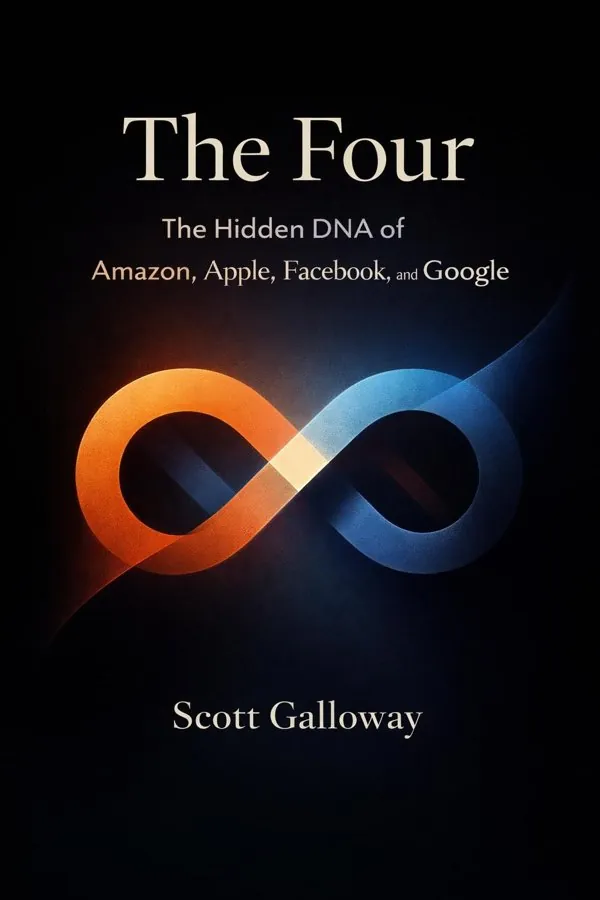
The Four: The Hidden DNA of Amazon, Apple, Facebook, and Google: Summary & Key Insights
 10 min11 chaptersAudio available
What Is The Four: The Hidden DNA of Amazon, Apple, Facebook, and Google About?
The Four: The Hidden DNA of Amazon, Apple, Facebook, and Google by Scott Galloway is a strategy book spanning 11 pages. In this book, business professor Scott Galloway examines how Amazon, Apple, Facebook, and Google have become the most powerful companies in the world. He explores their strategies, cultural impact, and the ways they have infiltrated our lives, drawing parallels between these corporations and fundamental human drives such as love, sex, and consumption. Galloway provides a critical analysis of their dominance and the implications for society and the economy.
This FizzRead summary covers all 11 key chapters of The Four: The Hidden DNA of Amazon, Apple, Facebook, and Google in approximately 10 minutes, distilling the most important ideas, arguments, and takeaways from Scott Galloway's work. Also available as an audio summary and Key Quotes Podcast.
The Four: The Hidden DNA of Amazon, Apple, Facebook, and Google
In this book, business professor Scott Galloway examines how Amazon, Apple, Facebook, and Google have become the most powerful companies in the world. He explores their strategies, cultural impact, and the ways they have infiltrated our lives, drawing parallels between these corporations and fundamental human drives such as love, sex, and consumption. Galloway provides a critical analysis of their dominance and the implications for society and the economy.
Who Should Read The Four: The Hidden DNA of Amazon, Apple, Facebook, and Google?
This book is perfect for anyone interested in strategy and looking to gain actionable insights in a short read. Whether you're a student, professional, or lifelong learner, the key ideas from The Four: The Hidden DNA of Amazon, Apple, Facebook, and Google by Scott Galloway will help you think differently.
- ✓Readers who enjoy strategy and want practical takeaways
- ✓Professionals looking to apply new ideas to their work and life
- ✓Anyone who wants the core insights of The Four: The Hidden DNA of Amazon, Apple, Facebook, and Google in just 10 minutes
Want the full summary?
Get instant access to this book summary and 100K+ more with Fizz Moment.
Get Free SummaryAvailable on App Store • Free to download
Key Chapters
Every empire begins as a story. The Four are masters at crafting narratives that make us believe—not just in their products, but in their purpose. Each company has established a myth that taps into ancient human archetypes. Amazon seduces us with the promise of the great provider, ensuring every need is met at the click of a button. Apple plays the role of the creator, offering not merely devices but beautifully designed objects that elevate our sense of self. Facebook presents itself as the enabler of community, a digital campfire for a species that thrives on connection. Google, meanwhile, positions itself as the modern oracle, a search engine that seemingly knows everything and expects nothing in return.
These myths are not accidental. They are the result of disciplined brand strategy and psychological insight. When Apple tells you to 'Think Different,' it frames innovation as an identity. When Amazon declares itself 'Earth’s most customer-centric company,' it is invoking trust and reliability at a primal level. Each narrative constructs a feedback loop between company and consumer—our emotional investment strengthens their commercial dominance, and their convenience deepens our dependency.
What’s truly remarkable is how thoroughly these companies have convinced us that they are forces for good. By cloaking their ambitions in benevolence or creativity, they’ve built brands immune to rational criticism. When we question them, we often feel like we’re questioning progress itself. Understanding their mythology is the first step toward understanding their power.
Amazon’s secret is not simply logistics—it’s worship. The company has positioned itself as a digital deity of consumerism. Every item we desire, from the mundane to the luxurious, flows through its ecosystem. It knows what we want before we articulate it, and delivers it faster than we expect. What used to be a transactional experience—buying—has become an act of faith. We trust Amazon implicitly with our credit cards, our addresses, and increasingly, our homes through Alexa.
Behind this devotion lies an extraordinary operational machine. Amazon reinvests nearly all profits into growth, sacrificing short-term margins for long-term dominance. By owning the supply chain end-to-end—from warehouses to delivery vans—it ensures that convenience is not just a slogan, but a structural advantage. The result is that traditional retailers can’t compete, not because they lack ambition, but because they can’t match Amazon’s infrastructure or patience.
Emotionally, Amazon fulfills our evolutionary craving for efficiency and abundance. It eliminates friction, granting us the illusion of mastery over scarcity. But there’s a darker dimension: as consumers thrive, competitors die. Every town’s shuttered bookstore or department store testifies to Amazon’s near-theological pursuit of perfection. I don’t demonize this; I acknowledge it as a force. To understand Amazon is to understand the modern economy’s new religion: convenience at any cost.
+ 9 more chapters — available in the FizzRead app
All Chapters in The Four: The Hidden DNA of Amazon, Apple, Facebook, and Google
About the Author
Scott Galloway is a professor of marketing at New York University’s Stern School of Business and the founder of several companies, including L2, Red Envelope, and Prophet. He is known for his research and commentary on technology, business strategy, and the digital economy.
Get This Summary in Your Preferred Format
Read or listen to the The Four: The Hidden DNA of Amazon, Apple, Facebook, and Google summary by Scott Galloway anytime, anywhere. FizzRead offers multiple formats so you can learn on your terms — all free.
Available formats: App · Audio · PDF · EPUB — All included free with FizzRead
Download The Four: The Hidden DNA of Amazon, Apple, Facebook, and Google PDF and EPUB Summary
Key Quotes from The Four: The Hidden DNA of Amazon, Apple, Facebook, and Google
“The Four are masters at crafting narratives that make us believe—not just in their products, but in their purpose.”
“Amazon’s secret is not simply logistics—it’s worship.”
Frequently Asked Questions about The Four: The Hidden DNA of Amazon, Apple, Facebook, and Google
The Four: The Hidden DNA of Amazon, Apple, Facebook, and Google by Scott Galloway is a strategy book that explores key ideas across 11 chapters. In this book, business professor Scott Galloway examines how Amazon, Apple, Facebook, and Google have become the most powerful companies in the world. He explores their strategies, cultural impact, and the ways they have infiltrated our lives, drawing parallels between these corporations and fundamental human drives such as love, sex, and consumption. Galloway provides a critical analysis of their dominance and the implications for society and the economy.
More by Scott Galloway

You Might Also Like

Mastery
Robert Greene
10 min
Cut Costs Not Corners: A Practical Guide to Staying Competitive and Improving Profits
Colin Barrow
10 min
Good Strategy/Bad Strategy: The Difference and Why It Matters
Richard P. Rumelt
10 min
On Grand Strategy
John Lewis Gaddis
10 min
The Six Disciplines of Digital Transformation
George Westerman
10 min
7 Powers: The Foundations of Business Strategy
Hamilton Helmer
10 minBrowse by Category
Ready to read The Four: The Hidden DNA of Amazon, Apple, Facebook, and Google?
Get the full summary and 100K+ more books with Fizz Moment.