
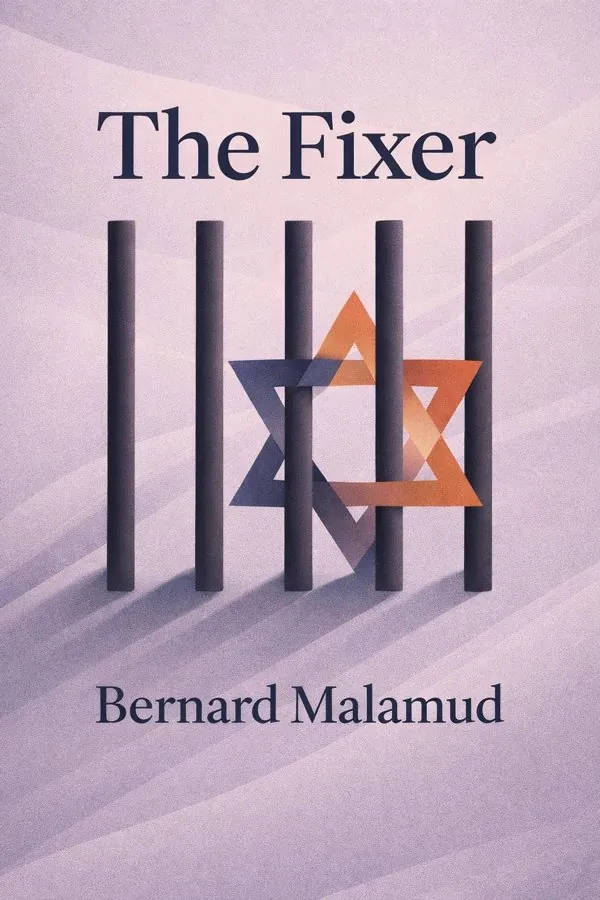
The Fixer: Summary & Key Insights
 10 min4 chaptersAudio available
What Is The Fixer About?
The Fixer by Bernard Malamud is a classics book spanning 4 pages. The Fixer is a 1966 novel by American author Bernard Malamud. Set in Tsarist Russia, it tells the story of Yakov Bok, a Jewish handyman wrongfully imprisoned for the ritual murder of a Christian boy. The novel explores themes of injustice, anti-Semitism, and human endurance in the face of oppression. It won both the Pulitzer Prize for Fiction and the National Book Award for Fiction in 1967.
This FizzRead summary covers all 4 key chapters of The Fixer in approximately 10 minutes, distilling the most important ideas, arguments, and takeaways from Bernard Malamud's work. Also available as an audio summary and Key Quotes Podcast.
The Fixer
The Fixer is a 1966 novel by American author Bernard Malamud. Set in Tsarist Russia, it tells the story of Yakov Bok, a Jewish handyman wrongfully imprisoned for the ritual murder of a Christian boy. The novel explores themes of injustice, anti-Semitism, and human endurance in the face of oppression. It won both the Pulitzer Prize for Fiction and the National Book Award for Fiction in 1967.
Who Should Read The Fixer?
This book is perfect for anyone interested in classics and looking to gain actionable insights in a short read. Whether you're a student, professional, or lifelong learner, the key ideas from The Fixer by Bernard Malamud will help you think differently.
- ✓Readers who enjoy classics and want practical takeaways
- ✓Professionals looking to apply new ideas to their work and life
- ✓Anyone who wants the core insights of The Fixer in just 10 minutes
Want the full summary?
Get instant access to this book summary and 100K+ more with Fizz Moment.
Get Free SummaryAvailable on App Store • Free to download
Key Chapters
Yakov Bok’s journey begins with departure. His wife has left him; his small Jewish village has enclosed him in poverty and gossip. He is weary of failure and superstition, of the walls that define what a Jew may or may not become. So he sets out for Kiev, the grand city that gleams in his imagination as a place of opportunity. Yet beneath his decision to leave lies an inward rejection: he wants to cease being only a Jew, to live simply as a man among men.
But the world he enters will not allow such simplicity. In Kiev, Yakov quickly learns that Jewishness is not something one can easily discard. He hides his identity to find work, shaves, removes his cap, and answers to a false name. The irony is that in denying what he is, he becomes more visible to fate. Through deception he finds temporary success—employed by a wealthy Christian mud merchant, Lebedev, as a fixer of roofs and broken furniture. Yet his concealment is an act of fragility, not freedom. The tension between what he pretends to be and what he is will soon pull him into catastrophe.
When Yakov moves into the outskirts near Lebedev’s factory, he enters a divided landscape. The air is heavy with prejudice, with rumors of Jews poisoning wells or killing Christian children. Though Yakov wants only to live quietly, the myths of the society around him tighten invisibly around his life. His story becomes less a personal venture and more an unwitting confrontation with the irrational hatred embedded in the system itself. By seeking to live outside his identity, he will discover that the world forces him back into it—violently, tragically, and ultimately redemptively.
The murder of the Christian boy Zhenia transforms Yakov’s ordinary existence into a nightmare. The child’s body is found near the factory, mutilated in a way that feeds the old and poisonous myth of Jewish ritual murder. To the authorities, desperate to control political unrest, the crime presents an opportunity. A Jew is a perfect culprit—an enemy ready-made, a scapegoat whose blood can quiet the mob. And so Yakov Bok, who had only wanted to work and keep to himself, is seized by officers and branded as a murderer.
From the moment of arrest, reason evaporates. The police search his room and find nothing; they construct their evidence through malice and imagination. Yakov, bewildered, insists on his innocence. But the machinery of accusation has its own momentum. He is beaten, interrogated, humiliated. The idea of the Jew as a demonic outsider, poisoner of wells and drinker of Christian blood, floats through official conversations as if it were the most natural assumption in the world. In this hysteria, Yakov’s individuality vanishes; he becomes a symbol of everything they hate and fear.
I wanted this part of the story to show how prejudice can masquerade as certainty, how law can become an instrument of myth. The officials are not merely individuals but representatives of an empire that sustains itself through lies. The boy’s death is useful to them precisely because it directs anger away from real corruption and political failure. And at the center of their convenience stands Yakov, an innocent man who will learn, through agony, that his suffering is part of a much older story—one written not by him but against him.
For Yakov, the arrest annihilates his former illusions: that he could outrun Jewishness, that merit could transcend hatred, that a man’s innocence might protect him. Standing in his cell, he realizes the truth: he is now the embodiment of a prejudice older than his birth. And yet, within this injustice, something new begins—a slow awakening to self, to dignity, to the courage of saying no when the world demands submission.
+ 2 more chapters — available in the FizzRead app
All Chapters in The Fixer
About the Author
Bernard Malamud (1914–1986) was an American novelist and short story writer, known for his works exploring Jewish identity, morality, and the human condition. His notable works include The Natural, The Assistant, and The Fixer, which earned him major literary awards and established him as one of the leading figures in postwar American fiction.
Get This Summary in Your Preferred Format
Read or listen to the The Fixer summary by Bernard Malamud anytime, anywhere. FizzRead offers multiple formats so you can learn on your terms — all free.
Available formats: App · Audio · PDF · EPUB — All included free with FizzRead
Download The Fixer PDF and EPUB Summary
Key Quotes from The Fixer
“Yakov Bok’s journey begins with departure.”
“The murder of the Christian boy Zhenia transforms Yakov’s ordinary existence into a nightmare.”
Frequently Asked Questions about The Fixer
The Fixer by Bernard Malamud is a classics book that explores key ideas across 4 chapters. The Fixer is a 1966 novel by American author Bernard Malamud. Set in Tsarist Russia, it tells the story of Yakov Bok, a Jewish handyman wrongfully imprisoned for the ritual murder of a Christian boy. The novel explores themes of injustice, anti-Semitism, and human endurance in the face of oppression. It won both the Pulitzer Prize for Fiction and the National Book Award for Fiction in 1967.
You Might Also Like






Browse by Category
Ready to read The Fixer?
Get the full summary and 100K+ more books with Fizz Moment.