
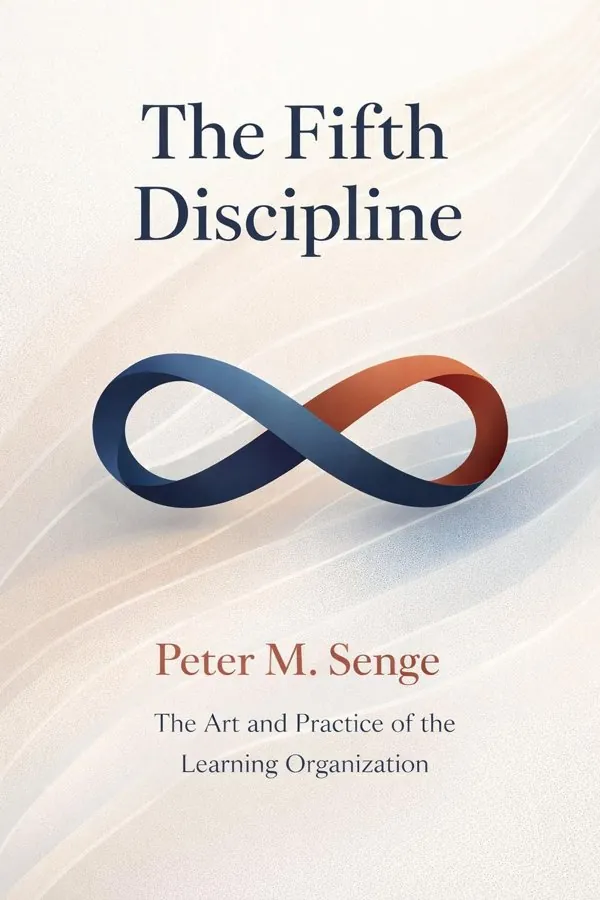
The Fifth Discipline: The Art and Practice of the Learning Organization: Summary & Key Insights
 10 min6 chaptersAudio available
What Is The Fifth Discipline: The Art and Practice of the Learning Organization About?
The Fifth Discipline: The Art and Practice of the Learning Organization by Peter M. Senge is a organization book spanning 6 pages. This influential management book introduces the concept of the 'learning organization,' where people continually expand their capacity to create desired results. Senge outlines five disciplines—systems thinking, personal mastery, mental models, shared vision, and team learning—that enable organizations to adapt and thrive in complex environments. The work emphasizes holistic thinking and collective growth as keys to sustainable success.
This FizzRead summary covers all 6 key chapters of The Fifth Discipline: The Art and Practice of the Learning Organization in approximately 10 minutes, distilling the most important ideas, arguments, and takeaways from Peter M. Senge's work. Also available as an audio summary and Key Quotes Podcast.
The Fifth Discipline: The Art and Practice of the Learning Organization
This influential management book introduces the concept of the 'learning organization,' where people continually expand their capacity to create desired results. Senge outlines five disciplines—systems thinking, personal mastery, mental models, shared vision, and team learning—that enable organizations to adapt and thrive in complex environments. The work emphasizes holistic thinking and collective growth as keys to sustainable success.
Who Should Read The Fifth Discipline: The Art and Practice of the Learning Organization?
This book is perfect for anyone interested in organization and looking to gain actionable insights in a short read. Whether you're a student, professional, or lifelong learner, the key ideas from The Fifth Discipline: The Art and Practice of the Learning Organization by Peter M. Senge will help you think differently.
- ✓Readers who enjoy organization and want practical takeaways
- ✓Professionals looking to apply new ideas to their work and life
- ✓Anyone who wants the core insights of The Fifth Discipline: The Art and Practice of the Learning Organization in just 10 minutes
Want the full summary?
Get instant access to this book summary and 100K+ more with Fizz Moment.
Get Free SummaryAvailable on App Store • Free to download
Key Chapters
Of all the disciplines, systems thinking is the cornerstone. It allows us to see patterns beneath events, to perceive interrelationships rather than isolated parts. Too often, when faced with problems, we react to symptoms rather than addressing fundamental causes. We fire one manager, reorganize the department, launch yet another initiative—only to find ourselves facing the same issues a year later. Systems thinking invites us to step back and see the larger system that generates these recurring problems.
Imagine a thermostat that regulates temperature. When the room gets cold, the system responds by turning on the heat; when it gets hot, the system shuts it off. This is feedback in action—a basic systems structure. But human systems are far more complex. In organizations, feedback loops constantly shape behaviors, often invisibly. A company that cuts training to cut costs will later find its quality declining, forcing further rework, which raises costs again. Without a systems perspective, leaders misinterpret cause and effect; they move too quickly and unintentionally intensify the very pressures they seek to relieve.
By cultivating systems thinking, we start to recognize the *structures* that underlie behavior—delays between action and results, reinforcing cycles that accelerate growth or decline, balancing loops that limit progress. Once we see these patterns, we can intervene more wisely. This discipline gives us a language for understanding complexity and the humility to realize that quick fixes rarely work. In a learning organization, systems thinking becomes the shared grammar through which everyone—from executives to front-line staff—makes sense of their interconnected world.
The second discipline, personal mastery, begins with the individual. It is the ongoing process of clarifying what truly matters to us and continually focusing our energies toward those aspirations. Many people confuse mastery with dominance or expertise. But the mastery I speak of is different—it is about living on purpose, about aligning our actions with our deepest values.
In organizations, we often speak of vision and mission, but if individuals themselves lack vision, the collective vision is hollow. Personal mastery is about holding a creative tension between our current reality and the future we desire. Rather than seeing that gap as discouraging, we use it as a source of energy. When we see reality clearly and stay connected to what we want to create, we generate the drive to move forward.
Practicing personal mastery means developing self-awareness—learning how our habits, fears, and assumptions shape our perceptions. It involves cultivating patience, a love of truth, and the discipline to see both ourselves and the world as they truly are. In a learning organization, people with high levels of personal mastery do not need external motivation; their commitment comes from within. They are the carriers of the organization’s long-term vitality because they embody its most essential learning process: the continuous expansion of capacity.
+ 4 more chapters — available in the FizzRead app
All Chapters in The Fifth Discipline: The Art and Practice of the Learning Organization
About the Author
Peter M. Senge is an American systems scientist and senior lecturer at the MIT Sloan School of Management. He is known for his pioneering work on organizational learning and systems thinking, and he founded the Society for Organizational Learning to promote these ideas globally.
Get This Summary in Your Preferred Format
Read or listen to the The Fifth Discipline: The Art and Practice of the Learning Organization summary by Peter M. Senge anytime, anywhere. FizzRead offers multiple formats so you can learn on your terms — all free.
Available formats: App · Audio · PDF · EPUB — All included free with FizzRead
Download The Fifth Discipline: The Art and Practice of the Learning Organization PDF and EPUB Summary
Key Quotes from The Fifth Discipline: The Art and Practice of the Learning Organization
“Of all the disciplines, systems thinking is the cornerstone.”
“The second discipline, personal mastery, begins with the individual.”
Frequently Asked Questions about The Fifth Discipline: The Art and Practice of the Learning Organization
The Fifth Discipline: The Art and Practice of the Learning Organization by Peter M. Senge is a organization book that explores key ideas across 6 chapters. This influential management book introduces the concept of the 'learning organization,' where people continually expand their capacity to create desired results. Senge outlines five disciplines—systems thinking, personal mastery, mental models, shared vision, and team learning—that enable organizations to adapt and thrive in complex environments. The work emphasizes holistic thinking and collective growth as keys to sustainable success.
More by Peter M. Senge
You Might Also Like
A Guide to the Project Management Body of Knowledge (PMBOK® Guide)
Project Management Institute
10 min
Organizational Behavior
Stephen P. Robbins
10 min
Accelerate: The Science of Lean Software and DevOps – Building and Scaling High Performing Technology Organizations
Nicole Forsgren, Jez Humble, Gene Kim
10 min
Awakening Compassion at Work: The Quiet Power That Elevates People and Organizations
Monica C. Worline, Jane E. Dutton
10 min
Building an Inclusive Organization: Leveraging the Power of a Diverse Workforce
Stephen Frost
10 min
Collaborative Intelligence: Thinking with People Who Think Differently
Dawna Markova, Angie McArthur
10 minBrowse by Category
Ready to read The Fifth Discipline: The Art and Practice of the Learning Organization?
Get the full summary and 100K+ more books with Fizz Moment.