
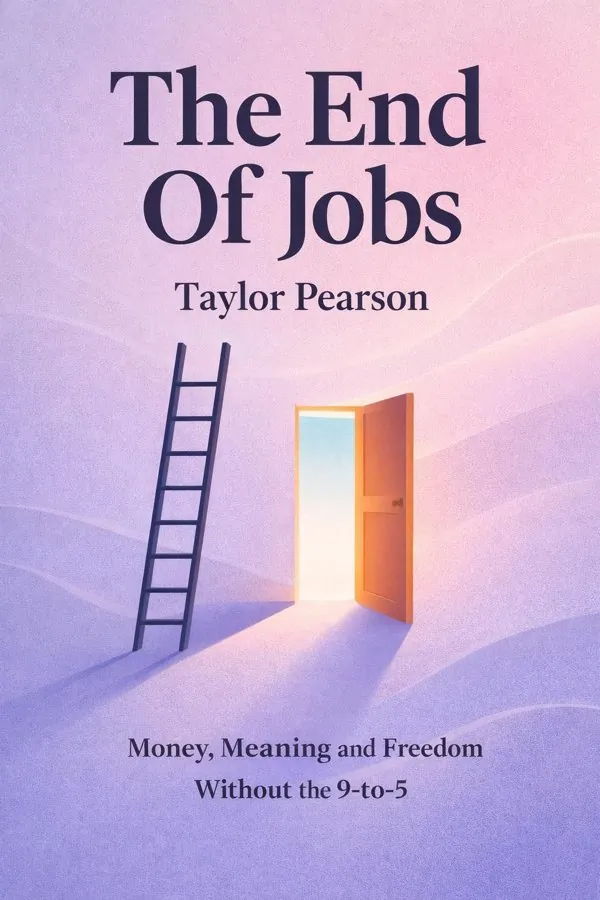
The End Of Jobs: Money, Meaning and Freedom Without the 9-to-5: Summary & Key Insights
 10 min5 chaptersAudio available
What Is The End Of Jobs: Money, Meaning and Freedom Without the 9-to-5 About?
The End Of Jobs: Money, Meaning and Freedom Without the 9-to-5 by Taylor Pearson is a entrepreneurship book spanning 5 pages. The End of Jobs explores how the traditional concept of stable employment is being replaced by entrepreneurship and independent work. Taylor Pearson argues that technological progress and globalization have shifted the balance of opportunity away from traditional jobs toward creating value through entrepreneurial ventures. The book provides insights into how individuals can adapt to this new economy by developing skills, building businesses, and finding meaning beyond the 9-to-5 structure.
This FizzRead summary covers all 5 key chapters of The End Of Jobs: Money, Meaning and Freedom Without the 9-to-5 in approximately 10 minutes, distilling the most important ideas, arguments, and takeaways from Taylor Pearson's work. Also available as an audio summary and Key Quotes Podcast.
The End Of Jobs: Money, Meaning and Freedom Without the 9-to-5
The End of Jobs explores how the traditional concept of stable employment is being replaced by entrepreneurship and independent work. Taylor Pearson argues that technological progress and globalization have shifted the balance of opportunity away from traditional jobs toward creating value through entrepreneurial ventures. The book provides insights into how individuals can adapt to this new economy by developing skills, building businesses, and finding meaning beyond the 9-to-5 structure.
Who Should Read The End Of Jobs: Money, Meaning and Freedom Without the 9-to-5?
This book is perfect for anyone interested in entrepreneurship and looking to gain actionable insights in a short read. Whether you're a student, professional, or lifelong learner, the key ideas from The End Of Jobs: Money, Meaning and Freedom Without the 9-to-5 by Taylor Pearson will help you think differently.
- ✓Readers who enjoy entrepreneurship and want practical takeaways
- ✓Professionals looking to apply new ideas to their work and life
- ✓Anyone who wants the core insights of The End Of Jobs: Money, Meaning and Freedom Without the 9-to-5 in just 10 minutes
Want the full summary?
Get instant access to this book summary and 100K+ more with Fizz Moment.
Get Free SummaryAvailable on App Store • Free to download
Key Chapters
Throughout most of human history, scarcity defined our existence. The industrial economy was a response to that scarcity—it optimized for production, for making more things faster. Factories and jobs emerged as mechanisms to distribute wealth through reliable employment. But as technology advanced, the marginal cost of creating and distributing information, products, and even services declined sharply. We moved from scarcity to abundance, and the centralized job system began to lose its rationale.
Globalization and digital technology have made it possible to coordinate labor and capital across borders almost effortlessly. A small business can now reach millions of customers online without warehouses, sales teams, or storefronts. Scarcity was replaced by oversupply—not of resources, but of opportunity. Yet most people remain trapped in industrial-age thinking, believing that security comes from attaching themselves to an institution. The truth is that the world rewards adaptability and creation, not compliance. The traditional job structure, designed to minimize human variance, now suppresses the very skills that the market values most: creativity, problem-solving, and initiative.
As I examined data and personal stories from entrepreneurs across the globe, one clear truth emerged: value no longer flows vertically through corporations but horizontally through networks. Those who understand how to use leverage—technology, distribution platforms, software, and media—can create enormous economic value without the infrastructure of a company. The end of jobs is really an evolution—a reallocation of opportunity from institutions to individuals.
Even before automation and AI became buzzwords, traditional employment began to weaken. The notion of a career ladder made sense when organizations had the same core structure for decades. Today, however, entire industries can shift overnight. Job security has become an illusion, a holdover from a time when capital was scarce and corporations were dominant. What changed is that knowledge and tools—the essential capital of creation—are no longer locked inside corporate walls. Anyone with skill and internet access can compete globally.
I realized that the greatest misalignment in the modern world is between what people are trained to do and what the economy rewards. Educational institutions still condition students to seek jobs, not autonomy. Yet, as information becomes cheaper and global reach easier, the middle layers of management—the traditional gatekeepers to opportunity—are dissolving. The result is an abundance of underutilized human potential. People cling to jobs not because they are efficient, but because they are familiar.
The irony is that entrepreneurial work, once considered unstable, may now be the most stable path available. In entrepreneurship, risk is distributed. Instead of relying on one employer, your livelihood depends on your ability to create and maintain systems that generate value in diverse ways. The individual who builds audience, intellectual property, or product systems attains true resilience—the very security that employees are told only jobs can provide.
+ 3 more chapters — available in the FizzRead app
All Chapters in The End Of Jobs: Money, Meaning and Freedom Without the 9-to-5
About the Author
Taylor Pearson is an entrepreneur, writer, and speaker focused on the future of work and entrepreneurship. He has written extensively about how technology and globalization are reshaping the economy and how individuals can thrive in this changing landscape.
Get This Summary in Your Preferred Format
Read or listen to the The End Of Jobs: Money, Meaning and Freedom Without the 9-to-5 summary by Taylor Pearson anytime, anywhere. FizzRead offers multiple formats so you can learn on your terms — all free.
Available formats: App · Audio · PDF · EPUB — All included free with FizzRead
Download The End Of Jobs: Money, Meaning and Freedom Without the 9-to-5 PDF and EPUB Summary
Key Quotes from The End Of Jobs: Money, Meaning and Freedom Without the 9-to-5
“Throughout most of human history, scarcity defined our existence.”
“Even before automation and AI became buzzwords, traditional employment began to weaken.”
Frequently Asked Questions about The End Of Jobs: Money, Meaning and Freedom Without the 9-to-5
The End Of Jobs: Money, Meaning and Freedom Without the 9-to-5 by Taylor Pearson is a entrepreneurship book that explores key ideas across 5 chapters. The End of Jobs explores how the traditional concept of stable employment is being replaced by entrepreneurship and independent work. Taylor Pearson argues that technological progress and globalization have shifted the balance of opportunity away from traditional jobs toward creating value through entrepreneurial ventures. The book provides insights into how individuals can adapt to this new economy by developing skills, building businesses, and finding meaning beyond the 9-to-5 structure.
You Might Also Like

Lean Analytics
Alistair Croll, Benjamin Yoskovitz
10 min
21 Days To A Big Idea: Creating Breakthrough Business Concepts
Bryan Mattimore
10 min
Sam Walton: Made in America: My Story
Sam Walton
10 min
10x Is Easier Than 2x: How World-Class Entrepreneurs Achieve More by Doing Less
Dan Sullivan, Benjamin Hardy
10 min
12 Months to $1 Million: How to Pick a Winning Product, Build a Real Business, and Become a Seven-Figure Entrepreneur
Ryan Daniel Moran
10 min
24 Assets: Create a Digital, Scalable, Valuable Business
Daniel Priestley
10 minBrowse by Category
Ready to read The End Of Jobs: Money, Meaning and Freedom Without the 9-to-5?
Get the full summary and 100K+ more books with Fizz Moment.