
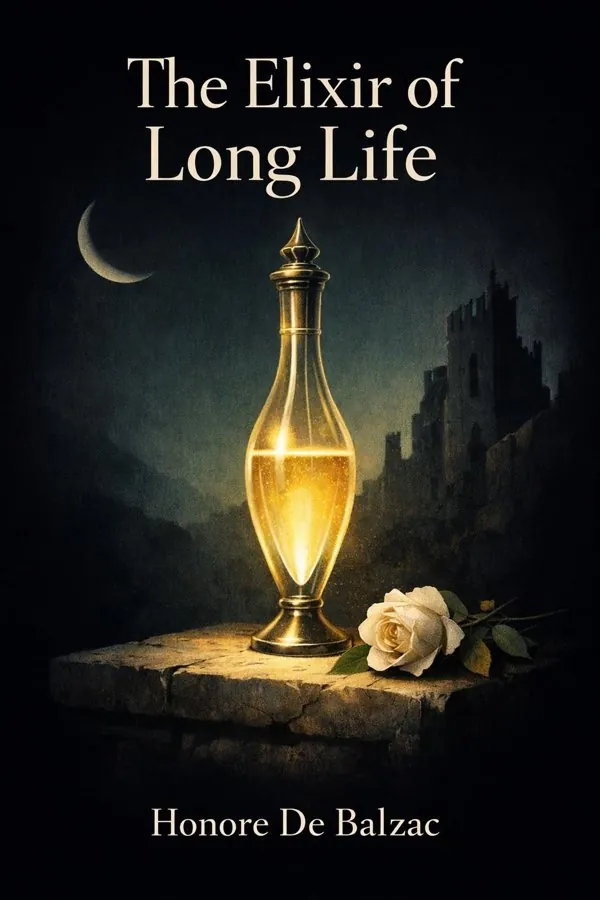
The Elixir of Long Life: Summary & Key Insights
 10 min3 chaptersAudio available
What Is The Elixir of Long Life About?
The Elixir of Long Life by Honore De Balzac is a classics book spanning 3 pages. The Elixir of Long Life is a short story by Honoré de Balzac, first published in 1830. It tells the tale of Don Juan Belvidero, an Italian nobleman obsessed with eternal youth who discovers a potion capable of prolonging life. Through this dark fable, Balzac explores themes of vanity, moral corruption, and the desire for immortality, blending realism and the supernatural in a gothic atmosphere.
This FizzRead summary covers all 3 key chapters of The Elixir of Long Life in approximately 10 minutes, distilling the most important ideas, arguments, and takeaways from Honore De Balzac's work. Also available as an audio summary and Key Quotes Podcast.
The Elixir of Long Life
The Elixir of Long Life is a short story by Honoré de Balzac, first published in 1830. It tells the tale of Don Juan Belvidero, an Italian nobleman obsessed with eternal youth who discovers a potion capable of prolonging life. Through this dark fable, Balzac explores themes of vanity, moral corruption, and the desire for immortality, blending realism and the supernatural in a gothic atmosphere.
Who Should Read The Elixir of Long Life?
This book is perfect for anyone interested in classics and looking to gain actionable insights in a short read. Whether you're a student, professional, or lifelong learner, the key ideas from The Elixir of Long Life by Honore De Balzac will help you think differently.
- ✓Readers who enjoy classics and want practical takeaways
- ✓Professionals looking to apply new ideas to their work and life
- ✓Anyone who wants the core insights of The Elixir of Long Life in just 10 minutes
Want the full summary?
Get instant access to this book summary and 100K+ more with Fizz Moment.
Get Free SummaryAvailable on App Store • Free to download
Key Chapters
Don Juan Belvidero’s father is a man of extremes—his life devoted entirely to ascetic purity and spiritual salvation. His faith, however, is not serene; it is restless, searching. He has spent decades experimenting with alchemy, a science that balances on the edge between divine revelation and forbidden knowledge. His ambition is not born of vanity but of yearning—to preserve life as a sacred spark beyond earthly decay. Yet even in that sanctity lies temptation. For when we aspire to immortalize the flesh, we begin to trespass on the domain of God.
As he ages, the father succeeds in creating a substance unlike any other: a dense, luminous liquid contained in a small crystal vial. He believes it to hold the power to suspend death itself—a divine intermediary between matter and spirit. Lying upon his deathbed, frail yet luminous with conviction, he calls his son to his side. The chamber is filled with torchlight flickering against marble, an atmosphere of both holiness and dread. He entrusts Don Juan with the vial, beseeching him to obey one sacred command: when death has claimed his body, apply a single drop of the elixir upon his corpse, and his soul will return to this world for one final moment. It is a ritual meant to manifest faith itself.
But Don Juan listens with the distracted air of youth. He sees not divinity in his father’s discovery, but opportunity. The notion of reviving the dead thrills him like a forbidden game. His thoughts drift to experiments, curiosity tinged with irreverence. What good could immortality serve except pleasure? Such is the seed of corruption—the transformation of reverence into appetite.
That night, when his father dies, Don Juan hesitates. The sanctity of death surrounds him, yet his mind burns with temptation. What if the elixir truly works? What if life could be rekindled, rules rewritten? Driven by a spirit that balances between skepticism and arrogance, he draws near the body, and with hands both trembling and fascinated, he applies a drop of the potion to the cold flesh.
The air thickens. A murmur, almost imperceptible, breaks the silence. The father’s skin quivers; his eyes open, glimmering with unearthly awareness. He moves, slowly, and the living gaze meets the son’s. Horror floods Don Juan’s heart—the elixir works. The boundary of death has been breached.
Yet in that instant, he feels not triumph but terror. The revived face bears judgment—his father’s gaze glowing with celestial reproach, piercing through every layer of conceit. Don Juan drops the vial, trembling, confronted by the realization that immortality is not a gift but a curse. He flees, leaving behind the revived body and the echo of divine wrath. The elixir’s secret passes into his hands, and with it, a deathless legacy.
Years pass. The world believes Don Juan to be a man blessed by fortune—his face untouched by time, his vitality radiant amid decay. Women adore him, poets envy him, priests denounce him. Yet beneath the splendor lies stagnation. Immortality has made his existence a theatre of indulgence and moral emptiness.
He learns to use the elixir sparingly, each drop a clandestine pact between body and damnation. It preserves his flesh while corrupting his soul, offering the illusion of perpetual youth even as it devours empathy, guilt, and faith. He becomes the perfect emblem of sensual hedonism—the Renaissance nobleman whose every pleasure is sharpened by the knowledge that it can never end.
But immortality is monotony. The centuries weigh not in years but in echoes of repetition. He watches friends grow old and die, lovers fade, the beauty of youth shattered by the natural order that he alone escapes. What was once triumph becomes isolation; his secret demands silence, lest the world see him for what he is—the man who defied God’s will.
The city around him transforms. Marble palaces crumble, civilizations shift, yet Don Juan endures unchanged, an ageless specter haunting history. With every new lover, he feels less of love; with every feast, less of joy. Pleasure becomes his religion, but even its rituals dull. In immortality, desire loses its meaning. He begins to understand that infinite life robs existence of consequence, and without consequence there can be no morality.
The elixir that once promised him power now enslaves him. He cannot stop using it, yet each use deepens his alienation. The face in his mirror remains youthful, but his eyes stare back empty. His soul has become the corpse his father once revived—lifeless yet animate. He roams through time not as a victor over death but as its prisoner.
The longer he lives, the more the world feels unreal to him. Death becomes his fascination; he dreams of it as others dream of love. The eternal repetition of days whispers mockery. He begins to fear that the elixir has bound him not to immortal life, but to perpetual decay of meaning. And thus, the man who conquered death finds himself longing for the peace of mortality.
+ 1 more chapters — available in the FizzRead app
All Chapters in The Elixir of Long Life
About the Author
Honoré de Balzac (1799–1850) was a major French writer of the 19th century, best known for La Comédie humaine, a vast panorama of post-Napoleonic French society. His work, comprising more than ninety novels and stories, is noted for its detailed observation of manners, psychological depth, and encyclopedic ambition.
Get This Summary in Your Preferred Format
Read or listen to the The Elixir of Long Life summary by Honore De Balzac anytime, anywhere. FizzRead offers multiple formats so you can learn on your terms — all free.
Available formats: App · Audio · PDF · EPUB — All included free with FizzRead
Download The Elixir of Long Life PDF and EPUB Summary
Key Quotes from The Elixir of Long Life
“Don Juan Belvidero’s father is a man of extremes—his life devoted entirely to ascetic purity and spiritual salvation.”
“The world believes Don Juan to be a man blessed by fortune—his face untouched by time, his vitality radiant amid decay.”
Frequently Asked Questions about The Elixir of Long Life
The Elixir of Long Life by Honore De Balzac is a classics book that explores key ideas across 3 chapters. The Elixir of Long Life is a short story by Honoré de Balzac, first published in 1830. It tells the tale of Don Juan Belvidero, an Italian nobleman obsessed with eternal youth who discovers a potion capable of prolonging life. Through this dark fable, Balzac explores themes of vanity, moral corruption, and the desire for immortality, blending realism and the supernatural in a gothic atmosphere.
More by Honore De Balzac
You Might Also Like






Browse by Category
Ready to read The Elixir of Long Life?
Get the full summary and 100K+ more books with Fizz Moment.