
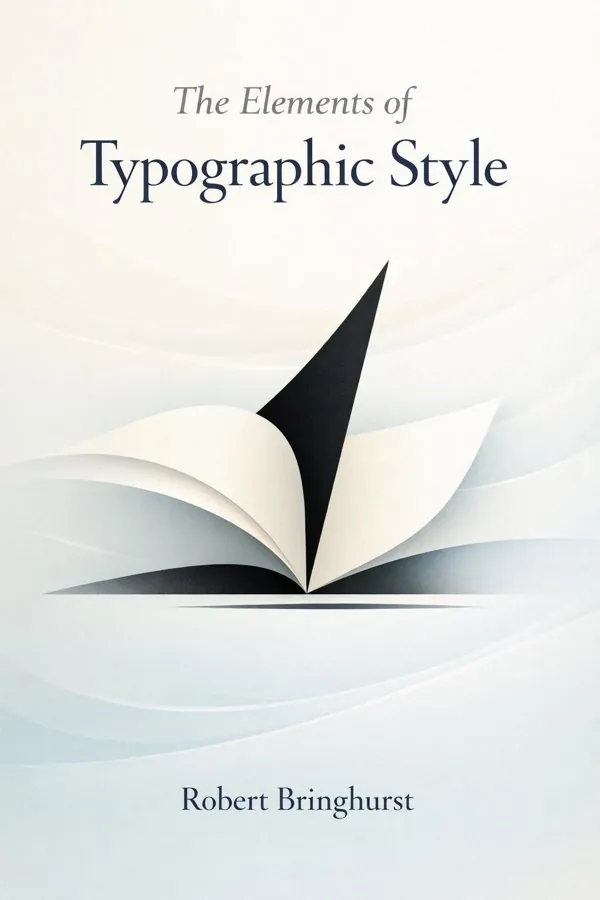
The Elements of Typographic Style: Summary & Key Insights
 10 min10 chaptersAudio available
Key Takeaways from The Elements of Typographic Style
Every typographic decision begins before the page—with the nature of language itself.
A page is not read letter by letter alone; it is read through patterns of rhythm.
A typeface is a voice, and choosing one carelessly is like casting the wrong narrator for a film.
Readers do not encounter a text all at once; they enter it through signals.
A page is not a blank container waiting to be filled; it is a built environment for reading.
What Is The Elements of Typographic Style About?
The Elements of Typographic Style by Robert Bringhurst is a design book spanning 10 pages. Typography is often mistaken for surface polish, but Robert Bringhurst shows that it is something far deeper: the disciplined art of giving language a visible, durable, and humane form. In The Elements of Typographic Style, he blends history, craft, aesthetics, and philosophy into a guide that teaches readers how type works—not only as a technical system, but as a cultural and ethical practice. This is not merely a manual for choosing fonts or setting margins. It is a meditation on how written language can be shaped so that meaning becomes clearer, reading becomes more pleasurable, and the page acquires grace without calling attention to itself. Bringhurst writes with the precision of a master typographer and the sensitivity of a poet, making the book unusually rich among design classics. His authority comes from deep knowledge of type history, literary form, and practical composition, and his influence on generations of designers is immense. For anyone who works with words—graphic designers, editors, publishers, UX writers, students, and thoughtful readers—this book remains one of the most important works ever written on typography.
This FizzRead summary covers all 10 key chapters of The Elements of Typographic Style in approximately 10 minutes, distilling the most important ideas, arguments, and takeaways from Robert Bringhurst's work. Also available as an audio summary and Key Quotes Podcast.
The Elements of Typographic Style
Typography is often mistaken for surface polish, but Robert Bringhurst shows that it is something far deeper: the disciplined art of giving language a visible, durable, and humane form. In The Elements of Typographic Style, he blends history, craft, aesthetics, and philosophy into a guide that teaches readers how type works—not only as a technical system, but as a cultural and ethical practice. This is not merely a manual for choosing fonts or setting margins. It is a meditation on how written language can be shaped so that meaning becomes clearer, reading becomes more pleasurable, and the page acquires grace without calling attention to itself. Bringhurst writes with the precision of a master typographer and the sensitivity of a poet, making the book unusually rich among design classics. His authority comes from deep knowledge of type history, literary form, and practical composition, and his influence on generations of designers is immense. For anyone who works with words—graphic designers, editors, publishers, UX writers, students, and thoughtful readers—this book remains one of the most important works ever written on typography.
Who Should Read The Elements of Typographic Style?
This book is perfect for anyone interested in design and looking to gain actionable insights in a short read. Whether you're a student, professional, or lifelong learner, the key ideas from The Elements of Typographic Style by Robert Bringhurst will help you think differently.
- ✓Readers who enjoy design and want practical takeaways
- ✓Professionals looking to apply new ideas to their work and life
- ✓Anyone who wants the core insights of The Elements of Typographic Style in just 10 minutes
Want the full summary?
Get instant access to this book summary and 100K+ more with Fizz Moment.
Get Free SummaryAvailable on App Store • Free to download
Key Chapters
Every typographic decision begins before the page—with the nature of language itself. Bringhurst’s central claim is that typography is not the art of arranging shapes for their own sake; it is the art of serving words. Letters are not decorative objects detached from meaning. They are vessels of speech, memory, culture, and thought. A page succeeds when the form given to language helps the reader hear the voice of the text more clearly and experience its meaning with less friction.
This idea changes the designer’s role. Instead of asking, “How can I make this look impressive?” Bringhurst asks, “What does this text need in order to speak?” A legal contract, a lyric poem, a museum catalog, and a children’s story do not require the same typographic treatment because they do not ask readers to engage in the same way. Typography should reflect tone, pace, seriousness, and structure. A quiet serif face with restrained spacing may suit a long essay, while a more assertive sans serif may better serve signage or technical instructions.
Bringhurst also insists that typography has a moral dimension: it should respect both the author and the reader. Poor typography interrupts reading, muddies emphasis, and places ego above communication. Good typography disappears into usefulness while still expressing character.
In practice, this means beginning every project by studying the text itself. Identify its voice, intended audience, reading conditions, and emotional register before choosing typefaces or page structures. Treat typography as interpretation, not decoration. Actionable takeaway: before designing any page, write one sentence describing the text’s purpose and tone, then make every typographic choice answer that sentence.
A page is not read letter by letter alone; it is read through patterns of rhythm. Bringhurst treats typography as a temporal art as much as a visual one. Reading unfolds across time, and spacing governs that movement. The spaces between letters, words, lines, paragraphs, margins, and columns work together to create a pulse. When that pulse is balanced, reading feels natural. When it is disrupted, even beautiful type becomes tiring.
Bringhurst emphasizes that good proportion is relational, not formulaic. There is no single ideal line length, margin width, or leading value that works in every circumstance. Instead, proportions should reflect the size of the type, the measure of the line, the texture of the page, and the expected reading distance. A narrow column might need less line spacing than a wide one. A delicate old-style serif may need different letterspacing than a geometric sans. Rhythm comes from fitting these parts together so the eye glides rather than stumbles.
Practical examples make this idea immediately useful. Dense lines with too little leading can feel airless in a book chapter. Excessive word spacing in justified text creates rivers that distract the eye. Tiny margins can make a page feel cramped even when the typeface itself is elegant. By contrast, properly tuned spacing gives text a calm texture that invites sustained attention.
Bringhurst teaches designers to see white space not as emptiness but as active structure. Actionable takeaway: print a sample page and evaluate its rhythm from a distance—if the gray value looks blotchy, cramped, or uneven, adjust line length, leading, and word spacing until the page reads as a coherent texture.
A typeface is a voice, and choosing one carelessly is like casting the wrong narrator for a film. Bringhurst urges readers to select typefaces based on appropriateness, craft quality, historical awareness, and functional performance rather than novelty or trend. Type should align with the nature of the text and the reading experience desired. The best choice is rarely the loudest one; it is the one that sustains attention without strain.
He distinguishes between superficial style matching and meaningful fit. A Renaissance text does not automatically require a revival typeface, nor does a modern brand always need a stark sans serif. Instead, the designer should understand what different type traditions embody: humanist forms suggest warmth and literacy; transitional types balance clarity and refinement; modern faces may feel crisp, dramatic, or severe. The point is not to follow historical rules blindly but to choose with informed intention.
Bringhurst also addresses the art of combining typefaces. Successful pairings are built on controlled contrast and shared underlying values. A serif text face may pair well with a clean sans for captions and headings if their proportions, x-heights, and color on the page harmonize. Combining too many unrelated voices, however, creates confusion and weakens hierarchy.
In practical terms, this matters in books, editorial layouts, presentations, websites, and brand systems. A thoughtfully chosen type palette can make reading easier, hierarchy clearer, and tone more credible. Actionable takeaway: limit yourself to one primary text face and one complementary display or utility face, then test them together across headings, body text, captions, and numerals before committing.
Readers do not encounter a text all at once; they enter it through signals. Typography provides those signals through hierarchy. Bringhurst shows that titles, headings, subheadings, notes, extracts, captions, and body text must differ enough to guide attention, yet remain unified enough to preserve coherence. Hierarchy is not visual noise layered on top of content. It is the structural translation of thought.
When hierarchy works well, readers understand what matters first, what supports it, and where they are within a larger argument. A chapter title should announce entry. A subheading should organize progression. Footnotes should be available without competing with the main text. These distinctions can be achieved through size, weight, placement, spacing, case, and typeface—not necessarily through dramatic contrast. Bringhurst often favors subtle hierarchy because it respects the continuity of reading.
This principle applies far beyond books. In a report, poor hierarchy can make insights hard to find. In a website article, weak distinction between headline, intro, body, and pull quote can cause users to skim without orientation. In instructional design, hierarchy can affect comprehension and task completion.
Bringhurst’s deeper point is that hierarchy should emerge from the logic of the text, not from arbitrary styling habits. If everything is emphasized, nothing is. Strong typography allows significance to be legible.
Actionable takeaway: map the information structure before styling it. List every text element—title, subtitle, heading levels, body, quotes, notes, captions—and assign each a clear visual role with only as much contrast as needed to distinguish function.
A page is not a blank container waiting to be filled; it is a built environment for reading. Bringhurst treats page design as architecture, where margins, columns, running heads, folios, line lengths, and placement create stability, movement, and quiet. Typography happens not only in the letters but in the relationships that organize them across the whole field.
This architectural view shifts attention from isolated details to composition. A generous inner margin can improve binding comfort. A carefully chosen text block can create visual dignity and aid concentration. Folios and running heads, if positioned well, help orientation without disturbing the text. On a spread, the two pages should relate as parts of a larger rhythm rather than as separate units.
Bringhurst values classical proportion, but not as dogma. The goal is not to mimic old books mechanically; it is to design pages that feel settled, lucid, and alive. In some contexts, asymmetry or modular grids may be entirely appropriate. What matters is whether the structure supports the reading act. A poetry collection may require more openness and sensitivity to lineation. A reference book may need firmer navigation and denser organization. A digital reading layout may require flexible widths and adaptive hierarchy while still preserving the integrity of the text.
Thinking architecturally also reduces clutter. Instead of adding graphic devices to create interest, the designer can rely on proportion, alignment, and placement to produce elegance.
Actionable takeaway: design the page frame before styling details. Establish margins, measure, baseline rhythm, and navigation elements first, then place the text within that system so the layout feels intentional rather than improvised.
Excellence in typography often reveals itself in details most readers never consciously notice. Bringhurst pays unusual attention to punctuation spacing, ligatures, dashes, quotation marks, numerals, hyphenation, alignment, indents, capitals, and other refinements that distinguish careless composition from cultivated craft. These details matter because reading is cumulative: tiny disruptions repeated across a page create fatigue, while tiny acts of care create fluency.
Consider the difference between a hyphen, an en dash, and an em dash. Each has a different function, and confusing them blurs meaning. Straight quotes used in place of proper quotation marks may seem trivial, but they lower typographic tone. Poorly handled numerals can undermine tables, dates, and financial text. Bad hyphenation can create awkward textures and semantic confusion. Excessive tracking in lowercase text weakens word shape and readability. The smallest choices influence the page’s voice.
Bringhurst is not arguing for pedantry for its own sake. He is arguing that typographic precision is a form of respect. It tells the reader that the text has been thoughtfully made. In editorial, publishing, academic, and brand contexts, this care communicates credibility. In digital products, typographic details also affect usability, especially where dense information must remain legible.
The practical lesson is that polishing details should be part of the design process, not an afterthought. Actionable takeaway: build a final-pass checklist for every project that includes quotation marks, dash usage, numeral style, ligatures, hyphenation settings, paragraph indents, spacing around punctuation, and consistency in headings and notes.
Typography is a living tradition, and Bringhurst believes designers work better when they know where forms come from. The shapes of letters, the conventions of pages, and the norms of composition are not arbitrary software defaults; they are the result of centuries of adaptation across manuscripts, metal type, printing houses, and digital systems. To study this history is not to become nostalgic. It is to gain judgment.
Historical awareness helps designers understand why certain forms endure. Old-style serif typefaces remain readable in long texts because their proportions evolved in dialogue with the human hand and eye. The conventions of margins, paragraphing, and punctuation emerged through repeated practical use. Even typographic restraint has a history: many of the most successful pages in print culture achieve distinction through quiet discipline rather than constant novelty.
Bringhurst’s historical perspective also protects designers from shallow trend-chasing. When a new type style appears fashionable, history provides context: what problem does it solve, what tradition does it extend or reject, and where will it likely fail? This allows for innovation grounded in understanding rather than impulse.
In practical work, historical literacy is useful when designing books, cultural materials, luxury brands, academic journals, or any artifact where tone and credibility matter. It also enriches typeface selection and pairing because one begins to see relationships between forms rather than isolated names in a font menu.
Actionable takeaway: when choosing a typeface, learn its lineage. Spend ten minutes researching when it was designed, what tradition it belongs to, and what kinds of texts it has served well before using it in your project.
Letters are visual symbols, but language is more than symbols—it has grammar, sound, cadence, emphasis, and cultural specificity. Bringhurst repeatedly reminds readers that typography should adapt to the linguistic realities of the text. Good composition is not just about fitting words into a frame; it is about understanding how language behaves and giving it room to remain intelligible and dignified.
This becomes especially important when dealing with different scripts, multilingual texts, poetry, quotations, scholarly apparatus, and complex punctuation. A poem may depend on exact line breaks and silence. A bilingual edition may require balancing two reading systems without implying that one is secondary in value. Italics, small caps, and letterspacing may function differently depending on language conventions. Even hyphenation rules and quotation styles vary across linguistic contexts.
Bringhurst’s broader insight is that typography is a mediator between abstract language and embodied reading. If a designer ignores the structure of the language, visual decisions become crude. For example, overcompressing long German compounds, mishandling diacritics in French or Spanish, or using poor line breaks in verse can distort meaning. In digital products, this extends to localization, responsive text behavior, and support for international characters.
Respecting language also means preserving textual nuance. Quotations, citations, glosses, and emphasis should be marked in ways that remain clear without overwhelming the page. Actionable takeaway: before typesetting any text, identify its linguistic needs—script support, diacritics, hyphenation rules, quotation conventions, line-break sensitivity, and multilingual structure—then verify your typeface and layout system can handle them correctly.
Technology can generate pages instantly, but it cannot replace typographic intelligence. Bringhurst’s work, though rooted in print traditions, remains strikingly relevant in the digital era because his standards are based on reading, not machinery. Software can justify lines, scale fonts, apply styles, and snap to grids, yet these automated operations often produce lifeless or flawed results unless guided by someone who understands proportion, hierarchy, spacing, and textual nuance.
Digital environments introduce new challenges: screens vary in size and resolution, users change settings, interfaces demand flexibility, and content is often modular rather than fixed. These conditions do not cancel typographic principles; they make them more important. A well-designed reading experience on a phone still depends on line length, leading, hierarchy, and rhythm. A design system still needs coherent type choices, spacing rules, and semantic levels. Variable fonts and responsive layouts expand possibilities, but they also increase the need for disciplined judgment.
Bringhurst’s philosophy counters a common digital mistake: treating text as just another interface element. When typography is reduced to generic defaults, reading quality suffers. News apps become tiring, long-form articles feel chaotic, dashboards become harder to scan, and brand voices lose distinction.
The practical implication is clear: digital typography deserves the same care as book typography, even if the solutions differ. Actionable takeaway: test your typography on real devices and real content, not only in design files. Evaluate readability, hierarchy, spacing, and tone across screen sizes, then refine manually instead of relying on default settings.
The highest goal of typography, in Bringhurst’s view, is harmony: a state in which text, typeface, spacing, structure, and page architecture all support one another so naturally that the design feels inevitable. Harmony is not blandness, and it is not the absence of personality. It is coherence under pressure—the successful balancing of utility, beauty, tone, and logic.
This concept gathers together everything else in the book. A harmonious page uses type appropriate to the text, spacing tuned to the eye, hierarchy shaped by meaning, details handled with care, and structure built with proportion. Nothing feels random or overworked. The design has character, but its character grows from the text rather than competing with it. Such harmony can be quiet, classical, bold, modern, or experimental, provided the parts belong together.
Bringhurst’s idea of harmony is especially valuable today because design culture often rewards immediate visual effect. Yet pages meant to be read, studied, or returned to over time need deeper qualities than novelty. Harmony produces trust. It invites sustained attention. It makes content feel worth reading.
In practical terms, harmony is achieved through revision. Designers compare alternatives, adjust spacing, remove unnecessary emphasis, align elements more carefully, and notice where tone breaks down. The process is less about adding features than about refining relationships.
Actionable takeaway: after completing a layout, review it as a whole and ask four questions: Does it read easily? Do all elements feel related? Is any stylistic choice louder than the text itself? What can be simplified to improve unity?
All Chapters in The Elements of Typographic Style
About the Author
Robert Bringhurst is a Canadian poet, essayist, translator, and typographer whose work bridges literature, language, and design. Born in 1946, he has become one of the most respected voices in typographic thought through his landmark book The Elements of Typographic Style, widely regarded as a foundational text for designers and publishers. Bringhurst’s perspective is distinctive because it draws not only on technical expertise in type and bookmaking, but also on a poet’s sensitivity to rhythm, tone, and meaning. Beyond typography, he has written extensively on mythology, Indigenous oral literature, translation, and cultural history. This unusually broad intellectual range gives his work depth and authority, helping him speak about typography not simply as visual arrangement, but as a humane art devoted to the life of language.
Get This Summary in Your Preferred Format
Read or listen to the The Elements of Typographic Style summary by Robert Bringhurst anytime, anywhere. FizzRead offers multiple formats so you can learn on your terms — all free.
Available formats: App · Audio · PDF · EPUB — All included free with FizzRead
Download The Elements of Typographic Style PDF and EPUB Summary
Key Quotes from The Elements of Typographic Style
“Every typographic decision begins before the page—with the nature of language itself.”
“A page is not read letter by letter alone; it is read through patterns of rhythm.”
“A typeface is a voice, and choosing one carelessly is like casting the wrong narrator for a film.”
“Readers do not encounter a text all at once; they enter it through signals.”
“A page is not a blank container waiting to be filled; it is a built environment for reading.”
Frequently Asked Questions about The Elements of Typographic Style
The Elements of Typographic Style by Robert Bringhurst is a design book that explores key ideas across 10 chapters. Typography is often mistaken for surface polish, but Robert Bringhurst shows that it is something far deeper: the disciplined art of giving language a visible, durable, and humane form. In The Elements of Typographic Style, he blends history, craft, aesthetics, and philosophy into a guide that teaches readers how type works—not only as a technical system, but as a cultural and ethical practice. This is not merely a manual for choosing fonts or setting margins. It is a meditation on how written language can be shaped so that meaning becomes clearer, reading becomes more pleasurable, and the page acquires grace without calling attention to itself. Bringhurst writes with the precision of a master typographer and the sensitivity of a poet, making the book unusually rich among design classics. His authority comes from deep knowledge of type history, literary form, and practical composition, and his influence on generations of designers is immense. For anyone who works with words—graphic designers, editors, publishers, UX writers, students, and thoughtful readers—this book remains one of the most important works ever written on typography.
You Might Also Like
The Design of Everyday Things
Don Norman
10 min
The Better Angels of Our Nature
Steven Pinker
10 min
A Designer's Art
Paul Rand
10 min
Architects' Sketchbooks
Various Editors
10 min
Architectural Graphic Standards
The American Institute of Architects
10 min
Design Is Storytelling
Ellen Lupton
10 minBrowse by Category
Ready to read The Elements of Typographic Style?
Get the full summary and 100K+ more books with Fizz Moment.