
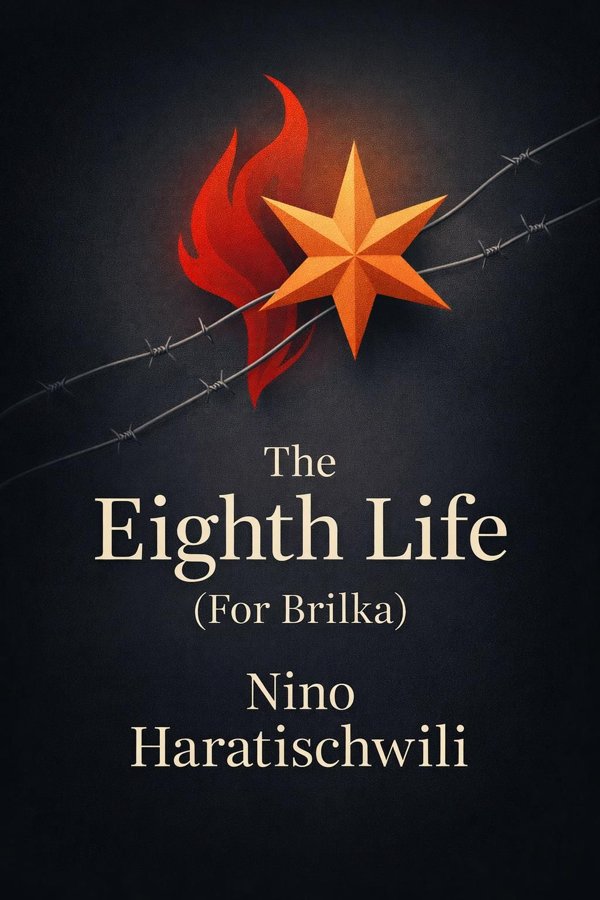
The Eighth Life (For Brilka): Summary & Key Insights
 10 min8 chaptersAudio available
Key Takeaways from The Eighth Life (For Brilka)
History rarely announces itself politely; more often, it breaks into ordinary life and rearranges everything.
Desire can feel like freedom, but in a totalitarian world it often becomes another route to destruction.
The most effective political systems do not merely command obedience; they shape the emotional lives of children.
After war ends, suffering does not end with it; it simply changes form.
Families often inherit not just stories, but strategic silences.
What Is The Eighth Life (For Brilka) About?
The Eighth Life (For Brilka) by Nino Haratischwili is a classics book spanning 6 pages. The Eighth Life (For Brilka) is a vast, emotionally charged family saga in which private lives are inseparable from political catastrophe. Spanning much of the twentieth century and beyond, Nino Haratischwili follows six generations of the Jashi family as they move through the collapse of empire, Stalinism, war, repression, disillusionment, and the fragile freedoms of the post-Soviet world. At the center of the novel is Niza, who writes the family’s story for her young niece Brilka, hoping to make sense of the secrets, wounds, and patterns that have shaped them all. What makes this novel so powerful is its scale and intimacy at once. It is not simply a historical chronicle of Georgia and the Soviet Union, but a study of how history enters the home: through marriages, betrayals, absences, ambitions, and inherited fear. Haratischwili writes with the authority of someone deeply connected to Georgia’s fractured modern history while also bringing the distance and craft of a major contemporary European novelist. The result is an epic that feels both monumental and painfully personal, reminding readers that the grand narratives of nations are ultimately lived out in individual bodies, memories, and families.
This FizzRead summary covers all 8 key chapters of The Eighth Life (For Brilka) in approximately 10 minutes, distilling the most important ideas, arguments, and takeaways from Nino Haratischwili's work. Also available as an audio summary and Key Quotes Podcast.
The Eighth Life (For Brilka)
The Eighth Life (For Brilka) is a vast, emotionally charged family saga in which private lives are inseparable from political catastrophe. Spanning much of the twentieth century and beyond, Nino Haratischwili follows six generations of the Jashi family as they move through the collapse of empire, Stalinism, war, repression, disillusionment, and the fragile freedoms of the post-Soviet world. At the center of the novel is Niza, who writes the family’s story for her young niece Brilka, hoping to make sense of the secrets, wounds, and patterns that have shaped them all.
What makes this novel so powerful is its scale and intimacy at once. It is not simply a historical chronicle of Georgia and the Soviet Union, but a study of how history enters the home: through marriages, betrayals, absences, ambitions, and inherited fear. Haratischwili writes with the authority of someone deeply connected to Georgia’s fractured modern history while also bringing the distance and craft of a major contemporary European novelist. The result is an epic that feels both monumental and painfully personal, reminding readers that the grand narratives of nations are ultimately lived out in individual bodies, memories, and families.
Who Should Read The Eighth Life (For Brilka)?
This book is perfect for anyone interested in classics and looking to gain actionable insights in a short read. Whether you're a student, professional, or lifelong learner, the key ideas from The Eighth Life (For Brilka) by Nino Haratischwili will help you think differently.
- ✓Readers who enjoy classics and want practical takeaways
- ✓Professionals looking to apply new ideas to their work and life
- ✓Anyone who wants the core insights of The Eighth Life (For Brilka) in just 10 minutes
Want the full summary?
Get instant access to this book summary and 100K+ more with Fizz Moment.
Get Free SummaryAvailable on App Store • Free to download
Key Chapters
History rarely announces itself politely; more often, it breaks into ordinary life and rearranges everything. That is the atmosphere in which the Jashi family first emerges. In the early twentieth century, Georgia still exists under the shadow of the Russian Empire, and Stasia, the daughter of a celebrated chocolatier, grows up in a world that appears refined, orderly, and full of promise. Yet the elegance around her is fragile. Revolution, war, and shifting loyalties soon expose how quickly stability can vanish.
Stasia’s story introduces one of the novel’s defining ideas: private dreams are always vulnerable to public violence. She is not merely a symbolic figure of innocence lost. She represents a generation raised to believe in continuity, beauty, and family honor, only to discover that politics can intrude into love, marriage, and even memory itself. The family’s famed hot chocolate recipe, with its almost mystical aura, becomes a powerful emblem of this world. It promises sweetness and distinction, yet it is tied to a legacy that feels increasingly burdened, even cursed.
Haratischwili shows that the end of an era is not experienced in speeches or treaties alone. It appears in the changed mood of a household, in marriages made for security rather than love, in the fear of saying the wrong thing, and in the small acts of survival people learn too late. Readers can connect this to any period of instability: when institutions weaken, families often become both refuge and battlefield.
A useful way to apply this insight is to look at your own family stories and ask what historical events shaped them, even indirectly. Actionable takeaway: reflect on one family turning point and identify the larger social forces behind it.
Desire can feel like freedom, but in a totalitarian world it often becomes another route to destruction. If Stasia embodies endurance, her sister Christine embodies dangerous intensity. She is brilliant, seductive, restless, and unwilling to accept the narrow life offered to her. Under Soviet rule, however, charisma and longing do not lead to liberation. They collide with systems built on control, suspicion, and ideological performance.
Christine’s arc reveals how political regimes exploit human hunger. Her relationships, ambitions, and self-image are shaped by a culture in which power is personal and public life is theatrical. Love becomes entangled with status, attraction with danger, and beauty with vulnerability. Haratischwili never reduces Christine to a cautionary tale about recklessness. Instead, she shows how a woman’s search for intensity can be deformed by the surrounding machinery of fear. In a world where truth is unstable, self-destruction can masquerade as passion.
This section of the novel also deepens the book’s recurring contrast between chosen identity and assigned destiny. Christine wants a life that feels exceptional. Yet the Soviet system rewards conformity while corrupting intimacy. Her choices ripple far beyond her own life, proving that one person’s emotional rebellion can alter a family’s future for decades.
In practical terms, Christine’s story speaks to anyone who has confused drama with meaning. Intense experiences are not always authentic ones, and charismatic environments can hide exploitation. It is worth asking whether a pursuit is enlarging your life or merely consuming it. Actionable takeaway: identify one area where excitement may be clouding judgment, and replace impulse with one deliberate boundary.
The most effective political systems do not merely command obedience; they shape the emotional lives of children. Through Kitty and Kostya, Haratischwili explores what it means to grow up inside a regime that presents itself as destiny. They inherit not only a family name and private wounds, but also a social order that determines which hopes are permissible, which ambitions are rewarded, and which silences are necessary for survival.
Their generation does not remember the old world as clearly as Stasia’s or Christine’s. Instead, they are formed by the Soviet project itself: its institutions, myths, rituals, and contradictions. That is what makes their story so haunting. They are not simply victims of oppression from the outside; they internalize it. Achievement becomes tangled with loyalty. Personal advancement comes at moral cost. Emotional restraint is learned as a practical skill. Even love may be filtered through fear of exposure, disgrace, or ideological contamination.
Kitty and Kostya also show how family trauma evolves across generations. What was once open shock becomes normalized adaptation. Children sense the secrets adults refuse to explain, and they build their identities around absences they cannot name. Readers may recognize this dynamic beyond politics: in any family where pain is hidden, the next generation often carries symptoms without understanding the original wound.
A practical application is to notice inherited scripts in your own life. Do you treat caution as wisdom because earlier generations had to? Do you equate success with safety? Haratischwili suggests that awareness is the first step toward freedom. Actionable takeaway: write down one belief about work, love, or trust that may have been inherited rather than chosen, and question whether it still serves you.
After war ends, suffering does not end with it; it simply changes form. Elene’s story unfolds in the heavy atmosphere of the postwar years, when survival itself has become ordinary and exhaustion settles over daily life like dust. Haratischwili is especially perceptive here about the emotional texture of aftermath. The visible drama of revolution and conflict gives way to quieter forms of damage: compromise, resignation, bitterness, and the ache of unlived possibilities.
Elene carries the weight of a world in which people are expected to continue as though continuation were healing. But repair is never automatic. Families return to routines while remaining internally fractured. Relationships are shaped by missing people, compromised ideals, and the humiliation of dependence on systems no one respects. In such a context, moral clarity becomes difficult. People do what they must, then spend years wondering who they became in the process.
This part of the novel is especially valuable because it resists simple narratives of resilience. Elene is strong, but strength is not romanticized. Haratischwili shows that endurance can preserve life while also narrowing it. The postwar generation often becomes expert at carrying burdens they never chose, and this habit of carrying can pass on to children as emotional distance, hypervigilance, or relentless practicality.
For modern readers, Elene’s experience resonates with any period after collective crisis: economic collapse, migration, illness, or social upheaval. The question becomes not only how to survive, but how to remain human afterward. Actionable takeaway: if you have come through a hard season, name one coping habit that protected you then but limits you now, and begin loosening its hold.
Families often inherit not just stories, but strategic silences. One of the most striking ideas in The Eighth Life (For Brilka) is that secrecy functions like an invisible heirloom. The Jashi family passes down names, habits, resentments, and objects, but also omissions. People disappear from conversation. Motives are blurred. Shame is hidden under politeness. Over time, what is not said becomes as powerful as what is known.
Haratischwili understands that secrets rarely stay contained within the generation that creates them. Instead, they shape emotional climate. Children learn to read tension before they understand facts. They sense danger around certain topics, and that sensed danger influences how they love, trust, and imagine themselves. In the novel, secrecy is not simply a device for suspense. It is a mode of survival under political repression and a habit that lingers even when the original danger has changed.
This has broad practical relevance. In many real families, silence begins as protection: to avoid punishment, shame, grief, or conflict. But over time, secrecy can distort identity. People may feel responsible for moods they cannot explain or guilty for histories they never committed. Haratischwili’s insight is that truth may be painful, but concealment often multiplies pain across generations.
The novel does not suggest that every secret must be exposed dramatically. Instead, it points toward careful witnessing. Naming the past does not erase suffering, but it can interrupt repetition. Even writing the story down, as Niza does, becomes an act of resistance against disappearance. Actionable takeaway: identify one recurring family silence and consider whether understanding it more clearly could reduce confusion rather than increase it.
When empires fall, freedom arrives unevenly, carrying both relief and wreckage. In the stories of Daria and Niza, Haratischwili moves into the late Soviet and post-Soviet era, where collapse does not produce simple renewal. Instead, the younger generations inherit a confusing mix of possibility, fragmentation, and unresolved trauma. The ideology that shaped their elders loses authority, but its psychological effects remain.
Daria’s life reflects the struggle to define the self amid instability. The old structures are discredited, yet no stable replacement appears. Niza, as narrator, becomes the family’s interpreter and witness. She is not outside the story but burdened by it. Her act of narration is an attempt to rescue meaning from chaos and to prevent Brilka from being swallowed by an inheritance she did not choose. This makes the novel feel intensely modern: it asks what responsibility later generations bear toward history they did not make but cannot escape.
The practical value of this section lies in its portrayal of transition. Many people live after some kind of collapse, whether political, familial, or personal. The old world is gone, but the new one is not yet coherent. In such moments, identity work becomes essential. You cannot build a future simply by rejecting the past; you have to understand what the past planted in you.
Niza’s storytelling demonstrates one possible response: gather fragments, face contradictions, and tell the truth with compassion. This is not passive remembering; it is active moral labor. Actionable takeaway: if you are emerging from a period of upheaval, create a personal narrative of what happened, what it cost, and what you want to carry forward.
Every long family story eventually asks whether inheritance is destiny. Brilka, the youngest figure at the center of the novel, represents that question with heartbreaking urgency. She is the recipient of everything that came before: the losses, obsessions, silences, myths, and emotional residues of seven lives. Yet she also represents the possibility that a pattern can end.
What makes Brilka so important is that she is not treated as a simplistic symbol of hope. She is vulnerable, shaped by damage she barely understands, and at risk of being overwhelmed by a legacy too heavy for a child. Niza’s address to her is therefore both protective and desperate. To tell Brilka the family history is not merely to inform her. It is to offer her a chance to step outside the spell of repetition. Knowledge becomes a form of care.
Haratischwili suggests that renewal does not come from forgetting. It comes from seeing clearly enough to choose differently. Brilka’s “eighth life” is the imagined life beyond curse and compulsion, beyond the inherited scripts that trapped earlier generations. That idea has practical resonance for anyone trying to break cycles of addiction, secrecy, emotional neglect, or destructive love. Change often begins when someone becomes the first person in a line to ask: must this continue?
The novel does not promise easy liberation. But it insists that understanding expands possibility. The future is constrained by the past, not wholly determined by it. Actionable takeaway: identify one repeating pattern in your family or personal life and define one concrete act that would interrupt it for the next generation.
Political history is often taught through leaders, wars, and revolutions, but novels remind us that history is also made in bedrooms, kitchens, and letters. One of Haratischwili’s greatest achievements is showing how large historical forces reshape the smallest human exchanges. Marriages are formed under pressure. Friendships become dangerous. Parenthood is marked by fear. Love itself is distorted by surveillance, propaganda, ambition, and scarcity.
This is why The Eighth Life feels so immersive. It refuses to separate the personal from the political. A failed relationship is never just a failed relationship; it may also be an effect of ideology, class aspiration, exile, or inherited trauma. Likewise, a single family dispute may contain the aftershocks of empire. Haratischwili gives readers a richer understanding of history by embedding it in emotional life, where its consequences are lived most persistently.
The insight matters beyond literature. In our own lives, we often explain conflicts too narrowly, as though they arise only from personality. But context matters. Economic insecurity, public fear, social prejudice, and collective upheaval can all intensify private pain. Recognizing that does not remove responsibility, but it deepens compassion and analysis.
A practical use of this idea is to examine relationships with a wider lens. Instead of asking only, “What is wrong with this person?” ask, “What pressures shaped how we both arrived here?” Haratischwili’s novel invites that broader view without excusing harm. Actionable takeaway: the next time you reflect on a difficult relationship, map the larger cultural or family forces that may have influenced its dynamics.
All Chapters in The Eighth Life (For Brilka)
About the Author
Nino Haratischwili was born in 1983 in Tbilisi, Georgia, and later moved to Germany, where she established herself as a major novelist, playwright, and theater director. Writing primarily in German, she is known for ambitious works that link personal lives to political upheaval, often drawing on the histories of Georgia, the Soviet Union, and Europe. Her fiction combines epic narrative scale with psychological intensity, making her one of the most distinctive voices in contemporary German-language literature. Haratischwili has received widespread critical acclaim and multiple honors, including recognition from major literary institutions in Germany. With The Eighth Life (For Brilka), she reached an international audience, praised for transforming the history of a region often underrepresented in world literature into a deeply human, sweeping, and unforgettable family saga.
Get This Summary in Your Preferred Format
Read or listen to the The Eighth Life (For Brilka) summary by Nino Haratischwili anytime, anywhere. FizzRead offers multiple formats so you can learn on your terms — all free.
Available formats: App · Audio · PDF · EPUB — All included free with FizzRead
Download The Eighth Life (For Brilka) PDF and EPUB Summary
Key Quotes from The Eighth Life (For Brilka)
“History rarely announces itself politely; more often, it breaks into ordinary life and rearranges everything.”
“Desire can feel like freedom, but in a totalitarian world it often becomes another route to destruction.”
“The most effective political systems do not merely command obedience; they shape the emotional lives of children.”
“After war ends, suffering does not end with it; it simply changes form.”
“Families often inherit not just stories, but strategic silences.”
Frequently Asked Questions about The Eighth Life (For Brilka)
The Eighth Life (For Brilka) by Nino Haratischwili is a classics book that explores key ideas across 8 chapters. The Eighth Life (For Brilka) is a vast, emotionally charged family saga in which private lives are inseparable from political catastrophe. Spanning much of the twentieth century and beyond, Nino Haratischwili follows six generations of the Jashi family as they move through the collapse of empire, Stalinism, war, repression, disillusionment, and the fragile freedoms of the post-Soviet world. At the center of the novel is Niza, who writes the family’s story for her young niece Brilka, hoping to make sense of the secrets, wounds, and patterns that have shaped them all. What makes this novel so powerful is its scale and intimacy at once. It is not simply a historical chronicle of Georgia and the Soviet Union, but a study of how history enters the home: through marriages, betrayals, absences, ambitions, and inherited fear. Haratischwili writes with the authority of someone deeply connected to Georgia’s fractured modern history while also bringing the distance and craft of a major contemporary European novelist. The result is an epic that feels both monumental and painfully personal, reminding readers that the grand narratives of nations are ultimately lived out in individual bodies, memories, and families.
You Might Also Like






Browse by Category
Ready to read The Eighth Life (For Brilka)?
Get the full summary and 100K+ more books with Fizz Moment.