
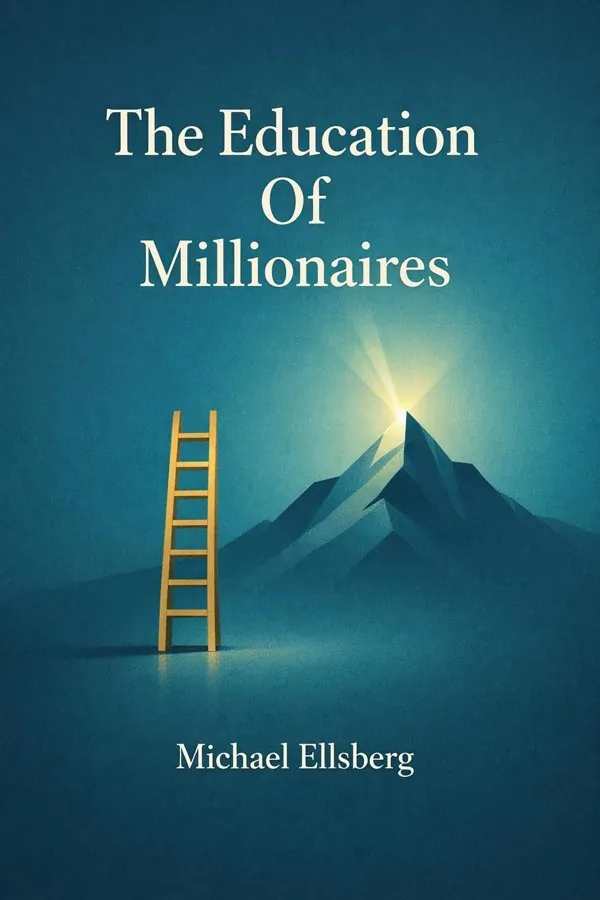
The Education Of Millionaires: Everything You Won't Learn In College About How To Be Successful: Summary & Key Insights
 10 min9 chaptersAudio available
Key Takeaways from The Education Of Millionaires: Everything You Won't Learn In College About How To Be Successful
One of the book’s boldest insights is that society often confuses credentials with competence.
A striking pattern in Ellsberg’s interviews is that many self-made millionaires were not products of a neat academic path.
Ellsberg emphasizes that certain skills consistently create outsized results, yet they are rarely taught well in school.
Another central lesson in the book is that opportunity flows through people.
Ellsberg’s entrepreneurial mindset is not limited to people who want to launch startups.
What Is The Education Of Millionaires: Everything You Won't Learn In College About How To Be Successful About?
The Education Of Millionaires: Everything You Won't Learn In College About How To Be Successful by Michael Ellsberg is a entrepreneurship book spanning 11 pages. The Education Of Millionaires is Michael Ellsberg’s sharp, provocative challenge to one of modern society’s most trusted assumptions: that the safest route to success runs through a college campus. Rather than dismissing learning itself, Ellsberg questions whether traditional higher education truly teaches the skills that create wealth, influence, and freedom in the real world. Drawing from interviews with self-made millionaires, entrepreneurs, and business builders, he uncovers a different curriculum—one centered on sales, communication, relationships, opportunity recognition, and the courage to act. What makes this book matter is its relevance. At a time when many people invest heavily in degrees yet still feel unprepared for meaningful work or financial independence, Ellsberg offers a practical alternative. He does not argue that college is useless for everyone; instead, he argues that many of the most valuable abilities are learned outside formal institutions. As an author, entrepreneur, and commentator on alternative education and success, Ellsberg brings both curiosity and conviction to the subject. The result is a book that speaks to students, career changers, founders, and anyone who suspects that real-world success depends on a different kind of education.
This FizzRead summary covers all 9 key chapters of The Education Of Millionaires: Everything You Won't Learn In College About How To Be Successful in approximately 10 minutes, distilling the most important ideas, arguments, and takeaways from Michael Ellsberg's work. Also available as an audio summary and Key Quotes Podcast.
The Education Of Millionaires: Everything You Won't Learn In College About How To Be Successful
The Education Of Millionaires is Michael Ellsberg’s sharp, provocative challenge to one of modern society’s most trusted assumptions: that the safest route to success runs through a college campus. Rather than dismissing learning itself, Ellsberg questions whether traditional higher education truly teaches the skills that create wealth, influence, and freedom in the real world. Drawing from interviews with self-made millionaires, entrepreneurs, and business builders, he uncovers a different curriculum—one centered on sales, communication, relationships, opportunity recognition, and the courage to act.
What makes this book matter is its relevance. At a time when many people invest heavily in degrees yet still feel unprepared for meaningful work or financial independence, Ellsberg offers a practical alternative. He does not argue that college is useless for everyone; instead, he argues that many of the most valuable abilities are learned outside formal institutions. As an author, entrepreneur, and commentator on alternative education and success, Ellsberg brings both curiosity and conviction to the subject. The result is a book that speaks to students, career changers, founders, and anyone who suspects that real-world success depends on a different kind of education.
Who Should Read The Education Of Millionaires: Everything You Won't Learn In College About How To Be Successful?
This book is perfect for anyone interested in entrepreneurship and looking to gain actionable insights in a short read. Whether you're a student, professional, or lifelong learner, the key ideas from The Education Of Millionaires: Everything You Won't Learn In College About How To Be Successful by Michael Ellsberg will help you think differently.
- ✓Readers who enjoy entrepreneurship and want practical takeaways
- ✓Professionals looking to apply new ideas to their work and life
- ✓Anyone who wants the core insights of The Education Of Millionaires: Everything You Won't Learn In College About How To Be Successful in just 10 minutes
Want the full summary?
Get instant access to this book summary and 100K+ more with Fizz Moment.
Get Free SummaryAvailable on App Store • Free to download
Key Chapters
One of the book’s boldest insights is that society often confuses credentials with competence. For decades, a college degree has been treated as proof of intelligence, discipline, and future earning power. But Ellsberg argues that this belief has hardened into a myth. A diploma may open some doors, yet it does not automatically teach the skills most responsible for creating value in the marketplace. Many graduates leave school with debt, uncertainty, and little experience in selling, negotiating, networking, or identifying profitable opportunities.
Ellsberg does not claim that education is unimportant. His point is that formal education and useful education are not always the same. The world tends to reward people who can solve real problems, communicate clearly, influence others, and take initiative. These abilities are often acquired through experience, apprenticeship, and self-directed learning rather than lectures and exams. A person who knows how to attract clients, build trust, and execute ideas may outperform someone with elite academic credentials but weak practical ability.
Consider two young professionals: one has a prestigious degree but no idea how to pitch an idea, build a customer base, or manage cash flow; the other has spent the same years freelancing, building side projects, and forming industry relationships. In many modern industries, the second person may create momentum faster.
The takeaway is not to reject college automatically, but to stop overvaluing credentials and start measuring education by outcomes. Ask yourself: what skills am I actually acquiring that can generate results in the real world?
A striking pattern in Ellsberg’s interviews is that many self-made millionaires were not products of a neat academic path. They learned in motion. They experimented, sold, failed, adapted, and built businesses by responding to reality rather than waiting until they felt fully qualified. Their education came from customers, mentors, markets, and mistakes.
This matters because conventional schooling often trains people to seek the right answer before taking action. Entrepreneurship works differently. In business, the market is the teacher. If customers buy, you are creating value. If they ignore you, you need to adjust. That feedback loop can teach faster than years of theory, especially when the learner is motivated and observant.
Ellsberg’s examples suggest that successful people rarely know everything in advance. Instead, they become excellent at learning what is necessary when it becomes necessary. A founder may begin with no formal expertise in marketing, then quickly develop persuasive writing skills because customer acquisition demands it. A consultant may learn pricing by undercharging, feeling the consequences, and recalibrating. A creator may discover branding by noticing what resonates with an audience.
This idea liberates people from the belief that they must be fully prepared before they begin. Read books, of course. Study the field. But do not confuse preparation with progress. The world rewards people who convert knowledge into experiments.
An actionable takeaway: choose one skill you have been postponing because you feel unready—selling, public speaking, freelancing, launching a product—and create a small real-world test this week. Action turns abstract ambition into practical education.
Ellsberg emphasizes that certain skills consistently create outsized results, yet they are rarely taught well in school. These include sales, communication, copywriting, negotiation, persuasion, and the ability to understand what people actually want. In the marketplace, these are leverage skills: they help you attract opportunities, influence decisions, and convert ideas into income.
Why are these skills so powerful? Because success is rarely just about having a good product or a smart idea. It is about getting other people to understand, trust, and act on what you offer. A brilliant concept can fail if nobody knows about it. A modest service can thrive if it is positioned clearly and sold well. This is why strong communicators often outperform more technically gifted peers.
Imagine a designer with excellent work but poor client communication, and another with slightly weaker design skills but clear proposals, responsive emails, and persuasive presentations. The second person often wins more business. The same pattern appears in startups, consulting, leadership, and even job interviews.
Ellsberg particularly elevates sales as an underappreciated master skill. Many people resist the word because they associate it with manipulation. But properly understood, sales is the process of connecting value with need. It is about listening, diagnosing problems, and helping others say yes to a solution that serves them.
A practical application is to identify one marketable communication skill and deliberately improve it. You might practice writing clearer emails, studying copywriting, learning how to make offers, or asking better discovery questions in conversations. The actionable takeaway: treat communication and sales not as side skills, but as core assets that can multiply everything else you know.
Another central lesson in the book is that opportunity flows through people. Resumes and formal applications matter in certain contexts, but long-term success is often driven by relationships—who knows you, trusts you, recommends you, and wants to collaborate with you. Ellsberg argues that networking, when done authentically, is not superficial ladder-climbing. It is the art of becoming valuable and visible within a community.
Many people approach networking the wrong way. They ask, “Who can help me?” instead of “How can I build real rapport and contribute?” The most effective relationship builders are curious, generous, and consistent. They follow up. They introduce people to each other. They remember details. Over time, they become trusted nodes in a network, and trust creates access that credentials alone cannot.
Consider how many jobs are filled through referrals, how many business deals start with a warm introduction, or how many partnerships emerge from repeated casual conversations. A person with average qualifications but strong relationships may hear about opportunities before they are public. A founder with a trusted network can get advice, customers, and investors faster than a more isolated competitor.
Ellsberg also highlights mentorship as a form of accelerated learning. Learning from someone who has already achieved what you want can save years of trial and error. But good mentorship usually grows from genuine engagement, not entitlement.
The actionable takeaway is simple: invest in relationships before you need them. Reach out to one person each week—former colleague, creator you admire, potential mentor, or peer—and aim to build connection through curiosity and usefulness rather than immediate personal gain.
Ellsberg’s entrepreneurial mindset is not limited to people who want to launch startups. It is a way of seeing the world. Entrepreneurs notice inefficiencies, unmet needs, and hidden possibilities. They ask, “What problem can I solve? What value can I create? What would people gladly pay for?” This mindset can be applied inside companies, in freelance work, in community projects, or in personal career decisions.
At the heart of entrepreneurship is agency. Instead of waiting for institutions to assign status or security, entrepreneurial thinkers create options. They test ideas, make offers, and assume responsibility for outcomes. This does not mean reckless risk-taking. It means becoming oriented toward creation rather than permission.
Practical entrepreneurship often begins with observation. Maybe you notice that local businesses struggle with social media consistency, parents in your area need tutoring support, or a niche audience wants curated industry insights. Opportunity frequently hides inside everyday frustration. The people Ellsberg profiles tend to spot those frictions and turn them into services, products, or platforms.
The entrepreneurial mindset also reframes work itself. Instead of asking only, “How do I get hired?” you can ask, “How do I become so useful that people seek me out?” That shift changes how you learn, market yourself, and build experience. It encourages initiative, experimentation, and ownership.
An actionable takeaway: write down five recurring problems you notice in your work, industry, or community. Then choose one and sketch a simple paid or testable solution. Entrepreneurship starts when you train yourself to connect problems with value-creating responses.
One of Ellsberg’s most empowering ideas is that education no longer belongs exclusively to institutions. In a world of books, online courses, podcasts, communities, apprenticeships, and direct access to experts, motivated people can design their own curriculum. The challenge is not lack of information; it is learning how to learn intentionally.
Self-education becomes a competitive advantage when it is tied to goals. Random consumption can feel productive without producing results. Effective self-learners identify a skill gap, gather high-quality resources, apply what they learn immediately, and refine based on feedback. This creates a practical loop of study and implementation that often beats passive classroom learning.
For example, someone who wants to become a better marketer could read a classic copywriting book, analyze successful campaigns, write sales emails for a side project, and track open or conversion rates. In a few months, they may develop more usable ability than someone who spent years studying marketing theory but never tested a campaign. A writer can improve by publishing consistently. A salesperson can improve through actual calls. A founder can study pricing and change offers in real time.
Ellsberg’s broader point is that curiosity plus discipline can replace dependence on gatekeepers. The most successful learners are not waiting to be assigned material. They build learning into their lifestyle.
The actionable takeaway: create a personal learning plan around one income-relevant skill. Pick three resources, one mentor or model to study, and one real-world project where you will apply the skill over the next 30 days. Learn with purpose, not just interest.
A powerful truth beneath the book is that wealth usually follows value creation. People are rewarded when they solve meaningful problems, save time, reduce pain, increase status, create convenience, or generate pleasure. Ellsberg repeatedly points readers away from status-seeking and toward usefulness. If you want better opportunities, become someone whose work makes life better for others.
This perspective changes how you think about career growth. Instead of obsessing over titles or credentials, ask what outcomes you can produce. Can you help a business get more customers? Can you simplify a process? Can you teach a difficult concept clearly? Can you create content that attracts attention? Can you develop a service that meets an underserved need? Value is measurable in changed conditions.
This is especially important for entrepreneurs and independent professionals. The market rarely pays for effort alone. It pays for perceived and delivered results. A consultant is valuable if they help clients improve performance. A software tool succeeds if it removes friction. A coach gains referrals if they produce transformation. Reputation builds when value is delivered consistently enough that others talk about it.
Ellsberg’s insight also has a moral edge: creating value is a more durable path than trying to game systems. It aligns income with contribution. The more clearly you can link what you do to benefits for others, the easier it becomes to sell, market, and grow.
The actionable takeaway is to define your value proposition in one sentence: “I help X achieve Y by doing Z.” If you cannot state that clearly, refine your offer until the value you create becomes obvious.
Being talented is not enough if nobody knows what you can do. Ellsberg argues that visibility is a practical advantage, not vanity. In modern work, people who communicate their value effectively often gain disproportionate opportunities. A personal brand is simply the set of associations people have about you—your credibility, style, expertise, and reliability.
Many capable people stay invisible because they assume good work will speak for itself. Sometimes it does, but often it does not. Visibility helps opportunities find you. This can take many forms: publishing thoughtful content, speaking publicly, maintaining a strong website, sharing case studies, contributing to communities, or consistently articulating your insights online and offline. The goal is not self-promotion for its own sake; it is discoverability paired with trust.
For example, a consultant who regularly shares practical advice on LinkedIn may attract inbound clients. A developer who publishes project breakdowns can stand out beyond a standard resume. A freelancer who collects testimonials and showcases results makes it easier for prospects to say yes. Personal branding is most effective when it is evidence-based: show what you know, how you think, and what results you produce.
Ellsberg’s argument is especially relevant in competitive environments where many people have similar technical qualifications. Visibility becomes a differentiator. If others can describe your strengths clearly, your reputation starts working for you even when you are not in the room.
The actionable takeaway: choose one platform or channel and start documenting your expertise weekly. Share lessons, examples, or results. Build a public record of value so that your reputation compounds over time.
Ellsberg ties success not only to earning money but also to understanding and directing it. Financial literacy means more than knowing definitions; it means learning how income, expenses, debt, savings, investment, and risk actually interact in your life. Many highly educated people earn well yet remain financially fragile because they were never taught how to manage money strategically.
The book also connects financial independence with emotional resilience. Fear of failure keeps many people trapped in safe-looking paths that no longer serve them. Student debt, social expectations, and insecurity can make experimentation feel dangerous. Yet those who build wealth often learn to tolerate uncertainty better than average. They take calculated risks, view failure as data, and keep moving.
This is not an argument for blind optimism. It is a case for informed courage. Build a runway. Reduce unnecessary expenses. Learn basic investing. Understand the economics of your career or business. Then take intelligent action instead of waiting for perfect certainty. For instance, a professional might start a side business while employed, test demand, and gradually transition. An aspiring creator might save six months of living expenses before going independent. A founder might learn enough finance to understand margins and cash flow before scaling.
Ellsberg’s message is that financial literacy and action reinforce each other. The more you understand money, the less terrifying strategic risk becomes. The more you act, the faster your financial intelligence grows.
The actionable takeaway: review your personal finances this week, identify one source of waste and one opportunity to build assets or income, then make one concrete move. Financial confidence begins with clear numbers and decisive action.
All Chapters in The Education Of Millionaires: Everything You Won't Learn In College About How To Be Successful
About the Author
Michael Ellsberg is an American author, entrepreneur, and public speaker whose work focuses on education, entrepreneurship, communication, and practical success. He is best known for challenging conventional assumptions about higher education and arguing that many of the most valuable career skills are learned outside the classroom. In The Education Of Millionaires, Ellsberg combines interviews, personal inquiry, and cultural critique to examine how self-made successful people actually build wealth and opportunity. Beyond his books, he has written for major publications and contributed to discussions about alternative education, self-directed learning, and real-world business skills. His writing appeals to readers who want a more independent, entrepreneurial, and action-oriented approach to achievement in a rapidly changing economy.
Get This Summary in Your Preferred Format
Read or listen to the The Education Of Millionaires: Everything You Won't Learn In College About How To Be Successful summary by Michael Ellsberg anytime, anywhere. FizzRead offers multiple formats so you can learn on your terms — all free.
Available formats: App · Audio · PDF · EPUB — All included free with FizzRead
Download The Education Of Millionaires: Everything You Won't Learn In College About How To Be Successful PDF and EPUB Summary
Key Quotes from The Education Of Millionaires: Everything You Won't Learn In College About How To Be Successful
“One of the book’s boldest insights is that society often confuses credentials with competence.”
“A striking pattern in Ellsberg’s interviews is that many self-made millionaires were not products of a neat academic path.”
“Ellsberg emphasizes that certain skills consistently create outsized results, yet they are rarely taught well in school.”
“Another central lesson in the book is that opportunity flows through people.”
“Ellsberg’s entrepreneurial mindset is not limited to people who want to launch startups.”
Frequently Asked Questions about The Education Of Millionaires: Everything You Won't Learn In College About How To Be Successful
The Education Of Millionaires: Everything You Won't Learn In College About How To Be Successful by Michael Ellsberg is a entrepreneurship book that explores key ideas across 9 chapters. The Education Of Millionaires is Michael Ellsberg’s sharp, provocative challenge to one of modern society’s most trusted assumptions: that the safest route to success runs through a college campus. Rather than dismissing learning itself, Ellsberg questions whether traditional higher education truly teaches the skills that create wealth, influence, and freedom in the real world. Drawing from interviews with self-made millionaires, entrepreneurs, and business builders, he uncovers a different curriculum—one centered on sales, communication, relationships, opportunity recognition, and the courage to act. What makes this book matter is its relevance. At a time when many people invest heavily in degrees yet still feel unprepared for meaningful work or financial independence, Ellsberg offers a practical alternative. He does not argue that college is useless for everyone; instead, he argues that many of the most valuable abilities are learned outside formal institutions. As an author, entrepreneur, and commentator on alternative education and success, Ellsberg brings both curiosity and conviction to the subject. The result is a book that speaks to students, career changers, founders, and anyone who suspects that real-world success depends on a different kind of education.
More by Michael Ellsberg
You Might Also Like
Lean Analytics
Alistair Croll, Benjamin Yoskovitz
10 min
21 Days To A Big Idea: Creating Breakthrough Business Concepts
Bryan Mattimore
10 min
Sam Walton: Made in America: My Story
Sam Walton
10 min
10x Is Easier Than 2x: How World-Class Entrepreneurs Achieve More by Doing Less
Dan Sullivan, Benjamin Hardy
10 min
12 Months to $1 Million: How to Pick a Winning Product, Build a Real Business, and Become a Seven-Figure Entrepreneur
Ryan Daniel Moran
10 min
24 Assets: Create a Digital, Scalable, Valuable Business
Daniel Priestley
10 minBrowse by Category
Ready to read The Education Of Millionaires: Everything You Won't Learn In College About How To Be Successful?
Get the full summary and 100K+ more books with Fizz Moment.