
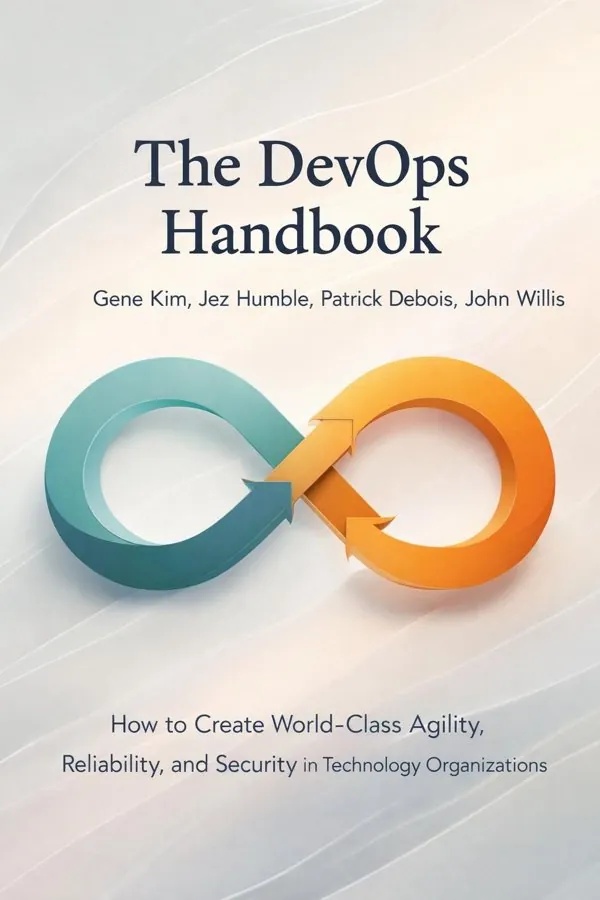
The Devops Handbook: How to Create World-Class Agility, Reliability, and Security in Technology Organizations: Summary & Key Insights
by Gene Kim, Jez Humble, Patrick Debois, John Willis
 10 min3 chaptersAudio available
What Is The Devops Handbook: How to Create World-Class Agility, Reliability, and Security in Technology Organizations About?
The Devops Handbook: How to Create World-Class Agility, Reliability, and Security in Technology Organizations by Gene Kim, Jez Humble, Patrick Debois, John Willis is a organization book spanning 3 pages. The DevOps Handbook explores how organizations can achieve high performance by integrating development and operations teams. It provides practical guidance on continuous delivery, automation, and cultural transformation to improve software reliability and speed. Drawing from real-world case studies, the book outlines principles and practices that enable technology organizations to deliver value faster and more securely.
This FizzRead summary covers all 3 key chapters of The Devops Handbook: How to Create World-Class Agility, Reliability, and Security in Technology Organizations in approximately 10 minutes, distilling the most important ideas, arguments, and takeaways from Gene Kim, Jez Humble, Patrick Debois, John Willis's work. Also available as an audio summary and Key Quotes Podcast.
The Devops Handbook: How to Create World-Class Agility, Reliability, and Security in Technology Organizations
The DevOps Handbook explores how organizations can achieve high performance by integrating development and operations teams. It provides practical guidance on continuous delivery, automation, and cultural transformation to improve software reliability and speed. Drawing from real-world case studies, the book outlines principles and practices that enable technology organizations to deliver value faster and more securely.
Who Should Read The Devops Handbook: How to Create World-Class Agility, Reliability, and Security in Technology Organizations?
This book is perfect for anyone interested in organization and looking to gain actionable insights in a short read. Whether you're a student, professional, or lifelong learner, the key ideas from The Devops Handbook: How to Create World-Class Agility, Reliability, and Security in Technology Organizations by Gene Kim, Jez Humble, Patrick Debois, John Willis will help you think differently.
- ✓Readers who enjoy organization and want practical takeaways
- ✓Professionals looking to apply new ideas to their work and life
- ✓Anyone who wants the core insights of The Devops Handbook: How to Create World-Class Agility, Reliability, and Security in Technology Organizations in just 10 minutes
Want the full summary?
Get instant access to this book summary and 100K+ more with Fizz Moment.
Get Free SummaryAvailable on App Store • Free to download
Key Chapters
When we talk about the First Way — Flow — we describe the lifeblood of DevOps: the smooth, uninterrupted movement of work from concept to customer. The First Way is about optimizing the entire system of work, not the individual silos. In traditional organizations, development pushes code down a one-way street toward operations, often without visibility into what happens next. The result is delay, rework, and frustration. DevOps reverses that pattern by making the whole process transparent and continuous.
Flow begins with seeing the value stream. Imagine tracing every step from the moment a developer writes code to the point where a user experiences the result. Each handoff, each approval, each waiting stage becomes visible. In that visibility, problems that once felt mysterious become solvable. One of the most liberating exercises we teach is Value Stream Mapping — it reveals where waste accumulates and where automation or simplification can make a radical difference.
The principle of Flow is inspired by lean manufacturing and the teachings of W. Edwards Deming and Toyota. Just as manufacturing revolutionaries realized that bottlenecks destroy performance, in software we must see waiting time, environment mismatches, and manual deployments as bottlenecks. To improve Flow, we automate wherever possible — build processes, testing, configuration management, and deployments. Automation is not about replacing people; it’s about freeing them from drudgery so they can innovate.
We’ve observed in places like Amazon and Etsy that improved Flow correlates directly with deployment frequency and stability. Teams that once fought through long release cycles now deploy hundreds of times a day. They do it safely because every stage — build, test, release — is consistent. The work of operations shifts from gatekeeping to enabling; they focus on making systems more resilient and scalable, not on saying no.
Achieving Flow requires discipline. You must standardize environments, treat infrastructure as code, and design architectures that support fast delivery and easy recovery. Most importantly, you must change how people think about their work. DevOps Flow replaces batch-and-queue processes with continuous movement and visual management. The reward is immediate feedback, faster innovation, and a deep sense of shared accomplishment.
In short, the First Way is about creating systems where work flows effortlessly from design to delivery, where effort produces visible progress, and where everyone can see how their contributions move value to the customer. Once you experience true Flow, you’ll never go back to the old way.
If the First Way accelerates delivery, the Second Way ensures we stay on course. Feedback is the compass that guides continuous improvement, allowing teams to detect issues early and adjust before small problems become catastrophic ones. In traditional environments, feedback is painfully slow — users report bugs long after releases, and operations only discover failures when systems are already down. DevOps collapses this delay by creating fast, automatic feedback loops at every stage.
In a DevOps organization, developers get immediate information about how their code behaves in production. Monitoring and telemetry tools feed real-time data back to the teams that wrote the code, encouraging accountability and continuous learning. The boundary between development and operations dissolves — both teams share responsibility for quality, uptime, and customer satisfaction.
One of the transformative practices that supports Feedback is Continuous Integration and Continuous Delivery (CI/CD). Instead of waiting weeks to merge changes, developers integrate code multiple times a day. Automated tests verify quality, and automated deployments make releases routine rather than risky. We’ve seen organizations move from the terror of Friday-night releases to the confidence of deploying anytime.
Feedback also lives in culture. It’s not just about systems telling us what failed; it’s about people communicating openly about what went wrong and what can be done to improve. Blameless postmortems are a hallmark of DevOps — teams examine incidents to learn, not to punish. This builds psychological safety, a key ingredient for innovation. Without fear, teams take ownership, experiment, and improve continuously.
Consider Netflix, which made resiliency a way of life through tools like Chaos Monkey. By intentionally inducing failure in its systems, Netflix constantly tests its ability to recover. That’s feedback in its purest form: learning through controlled adversity. These organizations prove that when feedback loops are fast and trusted, reliability increases dramatically.
The Second Way teaches us that great outcomes never come from endless planning or rigid control; they come from tight feedback loops and rapid adaptation. When you’re able to detect deviations quickly and respond intelligently, you build systems that evolve gracefully. Feedback turns operations into a source of learning, not blame, and turns development into an ongoing conversation with reality. In mastering the Second Way, you begin to see your technology not as fragile machinery but as a living, self-improving organism.
+ 1 more chapters — available in the FizzRead app
All Chapters in The Devops Handbook: How to Create World-Class Agility, Reliability, and Security in Technology Organizations
About the Authors
Gene Kim is a researcher and author focused on IT operations and DevOps. Jez Humble is known for his work on continuous delivery and lean software development. Patrick Debois coined the term 'DevOps' and is a pioneer in agile infrastructure. John Willis is a veteran in IT management and DevOps advocacy.
Get This Summary in Your Preferred Format
Read or listen to the The Devops Handbook: How to Create World-Class Agility, Reliability, and Security in Technology Organizations summary by Gene Kim, Jez Humble, Patrick Debois, John Willis anytime, anywhere. FizzRead offers multiple formats so you can learn on your terms — all free.
Available formats: App · Audio · PDF · EPUB — All included free with FizzRead
Download The Devops Handbook: How to Create World-Class Agility, Reliability, and Security in Technology Organizations PDF and EPUB Summary
Key Quotes from The Devops Handbook: How to Create World-Class Agility, Reliability, and Security in Technology Organizations
“When we talk about the First Way — Flow — we describe the lifeblood of DevOps: the smooth, uninterrupted movement of work from concept to customer.”
“If the First Way accelerates delivery, the Second Way ensures we stay on course.”
Frequently Asked Questions about The Devops Handbook: How to Create World-Class Agility, Reliability, and Security in Technology Organizations
The Devops Handbook: How to Create World-Class Agility, Reliability, and Security in Technology Organizations by Gene Kim, Jez Humble, Patrick Debois, John Willis is a organization book that explores key ideas across 3 chapters. The DevOps Handbook explores how organizations can achieve high performance by integrating development and operations teams. It provides practical guidance on continuous delivery, automation, and cultural transformation to improve software reliability and speed. Drawing from real-world case studies, the book outlines principles and practices that enable technology organizations to deliver value faster and more securely.
You Might Also Like
A Guide to the Project Management Body of Knowledge (PMBOK® Guide)
Project Management Institute
10 min
Organizational Behavior
Stephen P. Robbins
10 min
Accelerate: The Science of Lean Software and DevOps – Building and Scaling High Performing Technology Organizations
Nicole Forsgren, Jez Humble, Gene Kim
10 min
Awakening Compassion at Work: The Quiet Power That Elevates People and Organizations
Monica C. Worline, Jane E. Dutton
10 min
Building an Inclusive Organization: Leveraging the Power of a Diverse Workforce
Stephen Frost
10 min
Collaborative Intelligence: Thinking with People Who Think Differently
Dawna Markova, Angie McArthur
10 minBrowse by Category
Ready to read The Devops Handbook: How to Create World-Class Agility, Reliability, and Security in Technology Organizations?
Get the full summary and 100K+ more books with Fizz Moment.