
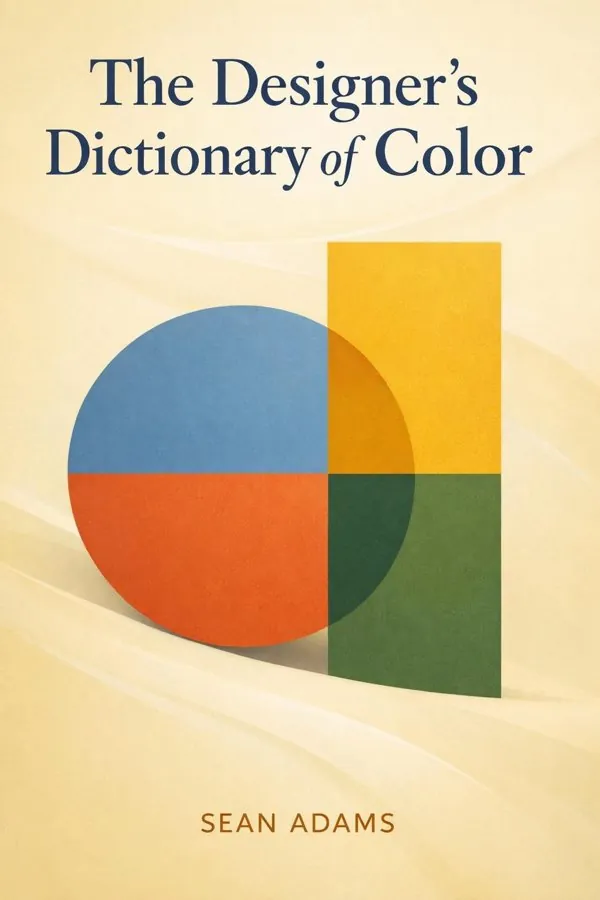
The Designer's Dictionary of Color: Summary & Key Insights
by Sean Adams
 10 min9 chaptersAudio available
Key Takeaways from The Designer's Dictionary of Color
We often talk about color as if it were pure feeling, but color only becomes expressive because it has structure.
Long before modern design systems, pigments carried status, ritual meaning, and economic value, and those associations still shape how we respond to color today.
Designers often know that color matters, yet they struggle to discuss it with precision.
Some colors feel like they move toward us, and that is one reason warm hues are so powerful.
If warm colors activate, cool colors stabilize.
What Is The Designer's Dictionary of Color About?
The Designer's Dictionary of Color by Sean Adams is a design book spanning 13 pages. Color is never neutral. Before a viewer reads a word, understands a logo, or decides whether to trust a package, color has already started shaping the message. In The Designer's Dictionary of Color, Sean Adams turns this often-intuitive part of design into a clear, usable system. Rather than treating color as mere decoration, he shows how every hue carries history, symbolism, emotional force, and practical consequences for communication. The book works as both a reference and a creative guide. Organized around major colors and their variations, it explores how red, blue, yellow, green, purple, and neutral tones have been understood across time and culture, and how designers can use them more deliberately in branding, print, interiors, and digital media. Adams blends color theory with historical context and visual application, helping readers see why one shade can feel luxurious while another feels playful, urgent, or trustworthy. Adams writes with unusual authority. As an award-winning designer, educator, and chair of Graphic Design at ArtCenter College of Design, he brings both scholarly insight and real-world experience. The result is a book that helps designers move from choosing colors they like to choosing colors that communicate.
This FizzRead summary covers all 9 key chapters of The Designer's Dictionary of Color in approximately 10 minutes, distilling the most important ideas, arguments, and takeaways from Sean Adams's work. Also available as an audio summary and Key Quotes Podcast.
The Designer's Dictionary of Color
Color is never neutral. Before a viewer reads a word, understands a logo, or decides whether to trust a package, color has already started shaping the message. In The Designer's Dictionary of Color, Sean Adams turns this often-intuitive part of design into a clear, usable system. Rather than treating color as mere decoration, he shows how every hue carries history, symbolism, emotional force, and practical consequences for communication.
The book works as both a reference and a creative guide. Organized around major colors and their variations, it explores how red, blue, yellow, green, purple, and neutral tones have been understood across time and culture, and how designers can use them more deliberately in branding, print, interiors, and digital media. Adams blends color theory with historical context and visual application, helping readers see why one shade can feel luxurious while another feels playful, urgent, or trustworthy.
Adams writes with unusual authority. As an award-winning designer, educator, and chair of Graphic Design at ArtCenter College of Design, he brings both scholarly insight and real-world experience. The result is a book that helps designers move from choosing colors they like to choosing colors that communicate.
Who Should Read The Designer's Dictionary of Color?
This book is perfect for anyone interested in design and looking to gain actionable insights in a short read. Whether you're a student, professional, or lifelong learner, the key ideas from The Designer's Dictionary of Color by Sean Adams will help you think differently.
- ✓Readers who enjoy design and want practical takeaways
- ✓Professionals looking to apply new ideas to their work and life
- ✓Anyone who wants the core insights of The Designer's Dictionary of Color in just 10 minutes
Want the full summary?
Get instant access to this book summary and 100K+ more with Fizz Moment.
Get Free SummaryAvailable on App Store • Free to download
Key Chapters
We often talk about color as if it were pure feeling, but color only becomes expressive because it has structure. Sean Adams begins with a core truth of color theory: every color is defined by hue, saturation, and value. Hue is the color family itself, such as red or blue. Saturation describes intensity, from vivid and pure to muted and gray. Value refers to lightness or darkness. Together, these three qualities determine how a color behaves and how we experience it.
This matters because a color's impact can change dramatically even when its hue stays the same. A bright, saturated red can signal urgency, passion, or danger. A dark, desaturated red may feel elegant, historical, or restrained. Likewise, a pale blue can feel calm and airy, while a deep blue can feel authoritative and corporate. Designers who understand these shifts can stop thinking in broad labels and start making precise decisions.
Adams encourages readers to see color as a system rather than a loose instinct. That system affects legibility, hierarchy, accessibility, mood, and brand positioning. In practice, a designer choosing a website palette should not ask only, "Do I like this green?" but also, "What value contrast does it create against text?" and "Does its saturation suggest luxury, nature, or affordability?" A package designer might compare two nearly identical yellows and discover that one feels energetic while the other feels soft and nostalgic.
The practical lesson is simple: never evaluate a color in name alone. Test its hue, saturation, and value in context, and judge what it communicates on the page or screen, not just in theory.
No color arrives empty. Long before modern design systems, pigments carried status, ritual meaning, and economic value, and those associations still shape how we respond to color today. Adams traces color back to eras when dyes were difficult to produce and certain shades were rare enough to signal wealth, power, or sacred importance. Purple, for example, was once tied to royalty because of the labor required to create it. Blue shifted in meaning over centuries, moving from scarcity to spiritual significance to broad trustworthiness in modern culture.
Understanding this historical background gives designers a richer vocabulary. A color is not powerful simply because it looks attractive; it is powerful because it brings inherited associations into a new context. Black can suggest mourning, authority, rebellion, or sophistication depending on its cultural and visual setting. Gold can imply divinity, prestige, or excess. White may signal purity in one context and emptiness or sterility in another.
This is especially useful in identity design and editorial work, where emotional nuance matters. A luxury skincare brand might use muted gold and ivory to borrow from traditions of refinement and ritual. A museum poster using deep ultramarine may echo art history and spirituality. A heritage food label can use earthy reds and ochres to evoke craftsmanship and age.
Adams's larger point is that design does not happen outside culture. Historical memory is embedded in color perception, even when viewers are not consciously aware of it. The most effective designers learn these inherited meanings and use them with intention rather than accident.
Actionable takeaway: before finalizing a palette, research the historical baggage of your chosen colors and ask whether those inherited meanings strengthen or complicate your message.
Designers often know that color matters, yet they struggle to discuss it with precision. That is why the book's dictionary format is so valuable. Instead of presenting color as an abstract lecture, Adams organizes it into entries that function like a practical language tool. Each color is examined through its history, symbolism, visual character, and likely applications, helping readers compare shades and use them more intelligently.
This structure mirrors the way designers actually work. In a real project, you rarely need a grand theory first; you need to know what a specific hue does. If you are building a wellness brand, should you choose sage, mint, forest, or emerald? If you are designing for finance, is navy more credible than royal blue? A dictionary approach lets you move from concept to decision by treating each color as a distinct communication choice.
The format also teaches an important discipline: colors that seem similar are not interchangeable. Yellow is not simply yellow. Warm golden yellow, acidic chartreuse, and pale butter all communicate different things. Red can move from celebratory to aggressive depending on its tone. Neutral colors, often dismissed as background, become essential tools for framing more expressive hues.
For teams, this level of specificity improves collaboration. Creative directors, clients, and marketers can talk about palettes with shared reference points instead of vague statements like "make it pop" or "make it feel premium." In educational settings, it helps students build visual literacy and defend their decisions.
Actionable takeaway: build your own working color reference, noting emotional associations, cultural meanings, and successful use cases for each shade so future design decisions become faster and more intentional.
Some colors feel like they move toward us, and that is one reason warm hues are so powerful. Adams shows that red, orange, and yellow are among the most attention-grabbing colors in the designer's toolkit. They tend to signal energy, heat, urgency, optimism, appetite, and motion. Used well, they can animate a composition and create emotional immediacy. Used poorly, they can overwhelm, cheapen, or exhaust the viewer.
Red is perhaps the clearest example of color's dual nature. It can mean love, celebration, warning, violence, appetite, or power. In branding, red often suits industries that want intensity and visibility, such as food, sports, retail, or entertainment. Orange carries some of red's energy but tends to feel friendlier, more youthful, and more accessible. It can suggest creativity, sociability, and affordability. Yellow can communicate joy, light, and innovation, but at high saturation it can also introduce anxiety or reduce readability, especially in digital environments.
Adams encourages designers to think about both emotional tone and practical use. A red call-to-action button may boost attention on a website, but too much red across the interface can create stress. An orange identity may help a startup feel energetic and approachable, while a muted apricot tone could suit hospitality or lifestyle packaging. Yellow may work beautifully as an accent, especially when paired with a dark neutral, but may fail as a dominant text background.
Warm colors are not just loud colors; they are directional tools. They pull the eye, create focal points, and shape pacing in a composition.
Actionable takeaway: use warm colors for emphasis and emotional charge, then balance them with neutrals or cooler hues so their energy stays purposeful rather than chaotic.
If warm colors activate, cool colors stabilize. Adams explores green, blue, and purple as hues that often suggest calm, intelligence, reflection, nature, spirituality, or authority. These colors frequently appear in branding for healthcare, finance, education, technology, and wellness because they can reassure viewers before any message is read.
Blue is one of the most widely used colors in contemporary design, and for good reason. It is associated with trust, competence, and clarity. But Adams reminds us that blue is not universally safe in the same way. Light blue can feel open, youthful, and clean. Mid-tone blue often appears reliable and modern. Deep navy conveys seriousness, professionalism, and institutional strength. Green operates with similar range. Fresh, bright greens can suggest health, sustainability, or freshness; darker greens often communicate stability, wealth, or tradition. Purple remains especially complex, carrying associations of royalty, creativity, mystery, luxury, and the spiritual realm.
The practical challenge with cool colors is avoiding sameness. Because blue is so common in corporate design, it can quickly become generic. A designer must therefore refine the exact shade, accompanying neutrals, and visual system. A fintech app might combine slate blue with vivid cyan to feel both secure and innovative. A premium tea brand might choose muted green-gray to signal natural sophistication rather than mass-market wellness. Purple can help creative brands distinguish themselves, especially when used in combination with metallics, black, or soft neutrals.
Cool colors often perform best when their emotional promise aligns with the brand's behavior. A trustworthy blue identity paired with confusing user experience creates dissonance.
Actionable takeaway: when using cool colors, choose specific tones that express your brand's unique character rather than relying on broad assumptions about trust, calm, or luxury.
The most underestimated colors in design are often the ones that seem least dramatic. Adams gives serious attention to black, white, gray, brown, beige, and other earth-based tones, showing that neutrals do not merely support color; they define its context. A bright accent color can look luxurious, playful, or harsh depending on the neutral environment around it. In this sense, neutrals are not the absence of meaning. They are powerful carriers of tone.
Black can communicate sophistication, severity, modernism, rebellion, or elegance. White can feel clean, sacred, minimalist, clinical, or spacious. Gray often signals balance, professionalism, and restraint, though overuse can make a design feel lifeless. Brown and earth tones connect to craft, soil, durability, comfort, and authenticity. These associations are especially valuable in food packaging, hospitality, interiors, editorial design, and artisanal branding.
Neutrals also solve practical design problems. They improve readability, create hierarchy, and make palette systems flexible across print and digital touchpoints. A luxury fashion brand may rely almost entirely on black, white, and warm gray to build exclusivity. A sustainable coffee company might pair terracotta, walnut, and cream to express earthiness and handcraft. A technology product can use cool grays to support clarity while introducing a single vibrant accent for calls to action.
Adams's treatment of earth tones is especially useful in a design era often obsessed with brightness. Muted palettes can create emotional sophistication and longevity. They may also photograph better and adapt more easily across materials.
Actionable takeaway: design your neutral palette as carefully as your accent colors, because the background tones often decide whether the overall system feels premium, friendly, natural, or forgettable.
One of the most dangerous mistakes in design is assuming that a color means the same thing everywhere. Adams repeatedly emphasizes that color symbolism is shaped by geography, religion, politics, class, and local custom. A color that conveys celebration in one culture may signal mourning in another. A hue associated with purity in one setting may imply emptiness, caution, or even bad luck elsewhere.
This does not mean designers should become paralyzed by complexity. It means they must become alert. Context includes not only national or regional culture, but also industry, audience age, platform, and moment in history. Red in a fashion campaign, a hospital emergency sign, and a political poster does not function the same way. White in luxury packaging behaves differently from white in medical branding. Green can suggest environmental responsibility, but in finance it may signal prosperity and growth instead.
For global brands, this issue is especially important. A palette that succeeds in North America may need adjustment for Asian, Middle Eastern, or Latin American markets. Even within one country, subcultures interpret color differently. Younger audiences may read neon tones as digital playfulness, while older audiences may find them abrasive. A historical nonprofit may benefit from muted, archival colors, whereas a youth app might need bolder and more synthetic choices.
Adams's contribution is to make color selection a research activity, not just a styling exercise. Designers should test palettes with target audiences and evaluate whether meaning shifts between touchpoints such as packaging, mobile screens, advertising, and physical environments.
Actionable takeaway: before locking a palette, check its cultural and contextual meanings with the actual audience you serve, especially if your brand crosses borders or industries.
A single color rarely does the full job. Design almost always involves combinations, and Adams shows that the success of a palette depends on relationships rather than isolated choices. Complementary, analogous, triadic, and monochromatic schemes offer useful starting structures, but harmony is not a formula to apply blindly. It is the art of balancing contrast, emphasis, rhythm, and unity.
Complementary colors, opposite each other on the color wheel, create high contrast and visual energy. Blue and orange, or red and green, can be striking when one dominates and the other supports. Analogous colors, which sit near each other, produce smoother and more atmospheric effects, such as blue-green-teal or yellow-orange-red. Monochromatic systems can feel elegant and focused, especially when variation in value and saturation creates hierarchy. Triadic palettes offer broad range but require careful control to avoid visual noise.
Adams also makes clear that harmony is shaped by proportion. The same three colors can feel calm or chaotic depending on how much of each one appears. A mostly neutral interface with a single vivid accent feels intentional. The same colors used at equal strength can become exhausting. Harmony also depends on medium: a palette that works in print may shift on screen due to light, calibration, and accessibility constraints.
In practical design, palette building should include testing. Place colors beside one another, evaluate text contrast, and see how they behave in large fields and small details. A strong brand palette should work across logos, packaging, social media, websites, and presentation materials.
Actionable takeaway: build palettes by testing relationships and proportions, not just selecting favorite colors, and always review them in the real formats where they will be used.
At its deepest level, Adams's message is that color is not an ornament added at the end of a project. It is a strategic choice that influences recognition, usability, emotion, and meaning from the beginning. Designers who treat color casually risk sending mixed signals. Those who treat it deliberately can sharpen a brand, guide attention, and build stronger audience relationships.
In branding, color supports positioning. A law firm may choose a restrained palette to communicate seriousness and authority, while a children's product may use playful contrasts to signal energy and imagination. In editorial design, color can organize content, separate sections, or establish mood. In digital product design, color affects navigation, accessibility, and interaction. A payment app needs colors that inspire confidence and make actions clear. A wellness app may use softer tones to reduce stress and support calm routines.
Adams also invites designers to think beyond immediate preference. The right color is not always the trendiest one. It is the one that aligns with message, medium, and audience while remaining practical across production methods. Ink behavior, paper stock, display screens, and ambient lighting all influence the final result. Strategic color choices therefore require both aesthetic sensitivity and technical awareness.
Perhaps the book's most lasting value is that it trains designers to justify color decisions. Instead of saying, "This looks better," they can say, "This darker, less saturated green improves legibility, supports our sustainability story, and differentiates us from clinical competitors." That shift marks a more mature design practice.
Actionable takeaway: choose color early, defend it with purpose, and evaluate it against audience, function, and execution—not personal taste alone.
All Chapters in The Designer's Dictionary of Color
About the Author
Sean Adams is an American designer, educator, and author widely recognized for his contributions to graphic design and visual communication. He co-founded the influential design firm AdamsMorioka, where he helped create identity systems and branding work known for clarity, wit, and conceptual strength. In addition to his professional practice, Adams has played a major role in design education and has served as Chair of Graphic Design at ArtCenter College of Design in Pasadena, California. His writing often bridges theory and application, making complex design ideas accessible to both students and professionals. With deep knowledge of design history, symbolism, and form, Adams brings unusual authority to the subject of color, treating it not as decoration but as a vital tool for meaning, emotion, and strategy.
Get This Summary in Your Preferred Format
Read or listen to the The Designer's Dictionary of Color summary by Sean Adams anytime, anywhere. FizzRead offers multiple formats so you can learn on your terms — all free.
Available formats: App · Audio · PDF · EPUB — All included free with FizzRead
Download The Designer's Dictionary of Color PDF and EPUB Summary
Key Quotes from The Designer's Dictionary of Color
“We often talk about color as if it were pure feeling, but color only becomes expressive because it has structure.”
“Long before modern design systems, pigments carried status, ritual meaning, and economic value, and those associations still shape how we respond to color today.”
“Designers often know that color matters, yet they struggle to discuss it with precision.”
“Some colors feel like they move toward us, and that is one reason warm hues are so powerful.”
“If warm colors activate, cool colors stabilize.”
Frequently Asked Questions about The Designer's Dictionary of Color
The Designer's Dictionary of Color by Sean Adams is a design book that explores key ideas across 9 chapters. Color is never neutral. Before a viewer reads a word, understands a logo, or decides whether to trust a package, color has already started shaping the message. In The Designer's Dictionary of Color, Sean Adams turns this often-intuitive part of design into a clear, usable system. Rather than treating color as mere decoration, he shows how every hue carries history, symbolism, emotional force, and practical consequences for communication. The book works as both a reference and a creative guide. Organized around major colors and their variations, it explores how red, blue, yellow, green, purple, and neutral tones have been understood across time and culture, and how designers can use them more deliberately in branding, print, interiors, and digital media. Adams blends color theory with historical context and visual application, helping readers see why one shade can feel luxurious while another feels playful, urgent, or trustworthy. Adams writes with unusual authority. As an award-winning designer, educator, and chair of Graphic Design at ArtCenter College of Design, he brings both scholarly insight and real-world experience. The result is a book that helps designers move from choosing colors they like to choosing colors that communicate.
You Might Also Like

The Design of Everyday Things
Don Norman
10 min
The Better Angels of Our Nature
Steven Pinker
10 min
A Designer's Art
Paul Rand
10 min
Architects' Sketchbooks
Various Editors
10 min
Architectural Graphic Standards
The American Institute of Architects
10 min
Design Is Storytelling
Ellen Lupton
10 minBrowse by Category
Ready to read The Designer's Dictionary of Color?
Get the full summary and 100K+ more books with Fizz Moment.