
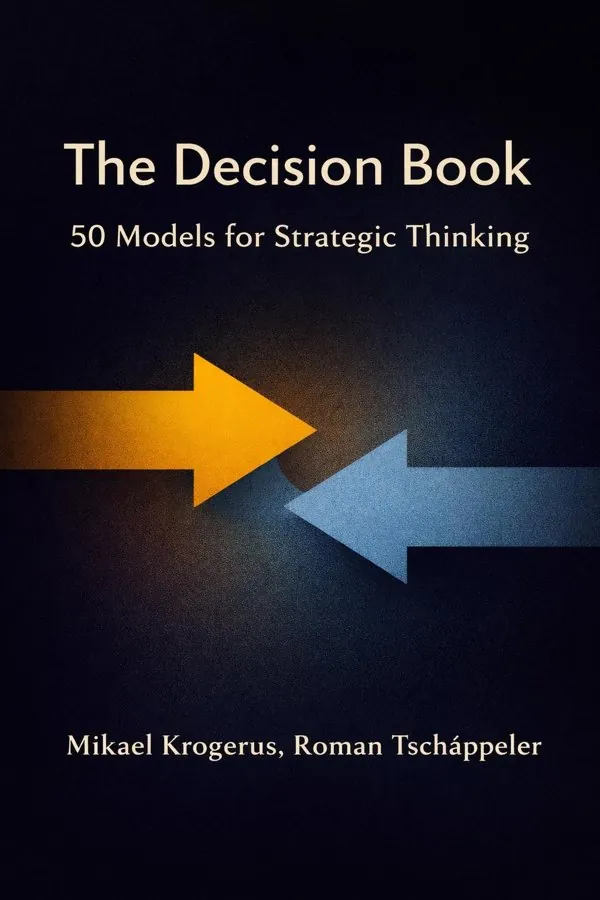
The Decision Book: 50 Models for Strategic Thinking: Summary & Key Insights
by Mikael Krogerus, Roman Tschäppeler
 10 min4 chaptersAudio available
What Is The Decision Book: 50 Models for Strategic Thinking About?
The Decision Book: 50 Models for Strategic Thinking by Mikael Krogerus, Roman Tschäppeler is a strategy book spanning 4 pages. The Decision Book presents fifty concise models that help readers understand and improve their decision-making, communication, and self-management. Each model is illustrated and explained in a way that makes complex ideas accessible, drawing from psychology, management theory, and behavioral economics.
This FizzRead summary covers all 4 key chapters of The Decision Book: 50 Models for Strategic Thinking in approximately 10 minutes, distilling the most important ideas, arguments, and takeaways from Mikael Krogerus, Roman Tschäppeler's work. Also available as an audio summary and Key Quotes Podcast.
The Decision Book: 50 Models for Strategic Thinking
The Decision Book presents fifty concise models that help readers understand and improve their decision-making, communication, and self-management. Each model is illustrated and explained in a way that makes complex ideas accessible, drawing from psychology, management theory, and behavioral economics.
Who Should Read The Decision Book: 50 Models for Strategic Thinking?
This book is perfect for anyone interested in strategy and looking to gain actionable insights in a short read. Whether you're a student, professional, or lifelong learner, the key ideas from The Decision Book: 50 Models for Strategic Thinking by Mikael Krogerus, Roman Tschäppeler will help you think differently.
- ✓Readers who enjoy strategy and want practical takeaways
- ✓Professionals looking to apply new ideas to their work and life
- ✓Anyone who wants the core insights of The Decision Book: 50 Models for Strategic Thinking in just 10 minutes
Want the full summary?
Get instant access to this book summary and 100K+ more with Fizz Moment.
Get Free SummaryAvailable on App Store • Free to download
Key Chapters
Every strategic thought begins with introspection. In this section, we explore models that reveal how you see yourself, how you act, and how you manage time and motivation. Let’s begin with the Johari Window, a deceptively simple diagram of four quadrants that depicts what is known and unknown to ourselves and others. When we share more of what we know about ourselves—the ‘open area’—our relationships strengthen. When we seek feedback to discover our ‘blind spots,’ personal growth accelerates. This process forces us to confront the truth: self-awareness is collaborative.
From knowing ourselves, we move to managing ourselves. The Eisenhower Matrix, a classic decision model, helps us distinguish between the urgent and the important. Many of us spend our days extinguishing fires—emails, meetings, requests—without realizing we have neglected what truly yields progress. The Matrix redirects attention toward what builds long-term value. This model, used by leaders like Dwight Eisenhower, embodies strategic discipline: being busy is not the same as being effective.
Then comes motivation, the spark that sustains action when discipline falters. Here, the Flow Model, designed by Mihaly Csikszentmihalyi, teaches that genuine engagement arises when challenge meets skill. Too little challenge leads to boredom; too much, to anxiety. Adjusting this balance transforms work into fulfillment. Alongside it, the SMART model—specific, measurable, achievable, relevant, and time-bound—channels ambition into clarity. Goals, when defined concretely, cease to be vague hopes and become attainable milestones.
Together these frameworks encourage self-guided mastery. Self-improvement is not a spontaneous burst of inspiration, but the result of structured awareness—of how we perceive, prioritize, and persist.
After understanding ourselves, we must learn to understand others. Miscommunication is the most common source of conflict, not malice. The models in this part equip us to decode human interaction.
Transactional Analysis, created by Eric Berne, uncovers the psychological roles we assume in dialogue—Parent, Adult, or Child. In daily exchanges, tone and choice of words reveal which role dominates. When both sides communicate from the ‘Adult’ stance—rational, open, and respectful—dialogue flows. But when one retreats into ‘Parent’ criticism or ‘Child’ defensiveness, communication collapses. This simple yet profound model helps us reset conversations toward mutual understanding.
Friedemann Schulz von Thun’s Four-Sides Model deepens this perspective. Every statement carries four layers: factual content, self-revelation, relationship, and appeal. Recognizing these dimensions turns listening into empathy. When a colleague says, ‘You’re late again,’ they may mean more than a fact—they may reveal frustration or concern. This model trains us to hear beyond words.
In groups, we confront another complexity: collective behavior. Belbin’s Team Roles identify nine distinct ways people contribute within teams—whether as coordinators, innovators, or completers. Recognizing this diversity prevents misjudgment and allows balanced collaboration. Similarly, Bruce Tuckman’s stages—forming, storming, norming, performing—chart the natural rhythm of group development. Tension is not failure; it is a stage toward alignment.
Conflict is inevitable, but the Thomas-Kilmann Conflict Model reframes it as choice. It defines five styles—competing, collaborating, compromising, avoiding, and accommodating—each suited for different contexts. True mastery in communication is not winning every argument; it is choosing the right approach for the right moment. Through empathy and awareness, we replace friction with synergy.
+ 2 more chapters — available in the FizzRead app
All Chapters in The Decision Book: 50 Models for Strategic Thinking
About the Authors
Mikael Krogerus is a Finnish-Swedish journalist and author, and Roman Tschäppeler is a Swiss creative producer. Together, they have co-authored several bestselling books on communication, decision-making, and self-improvement.
Get This Summary in Your Preferred Format
Read or listen to the The Decision Book: 50 Models for Strategic Thinking summary by Mikael Krogerus, Roman Tschäppeler anytime, anywhere. FizzRead offers multiple formats so you can learn on your terms — all free.
Available formats: App · Audio · PDF · EPUB — All included free with FizzRead
Download The Decision Book: 50 Models for Strategic Thinking PDF and EPUB Summary
Key Quotes from The Decision Book: 50 Models for Strategic Thinking
“Every strategic thought begins with introspection.”
“After understanding ourselves, we must learn to understand others.”
Frequently Asked Questions about The Decision Book: 50 Models for Strategic Thinking
The Decision Book: 50 Models for Strategic Thinking by Mikael Krogerus, Roman Tschäppeler is a strategy book that explores key ideas across 4 chapters. The Decision Book presents fifty concise models that help readers understand and improve their decision-making, communication, and self-management. Each model is illustrated and explained in a way that makes complex ideas accessible, drawing from psychology, management theory, and behavioral economics.
You Might Also Like

Mastery
Robert Greene
10 min
Cut Costs Not Corners: A Practical Guide to Staying Competitive and Improving Profits
Colin Barrow
10 min
Good Strategy/Bad Strategy: The Difference and Why It Matters
Richard P. Rumelt
10 min
On Grand Strategy
John Lewis Gaddis
10 min
The Six Disciplines of Digital Transformation
George Westerman
10 min
7 Powers: The Foundations of Business Strategy
Hamilton Helmer
10 minBrowse by Category
Ready to read The Decision Book: 50 Models for Strategic Thinking?
Get the full summary and 100K+ more books with Fizz Moment.