
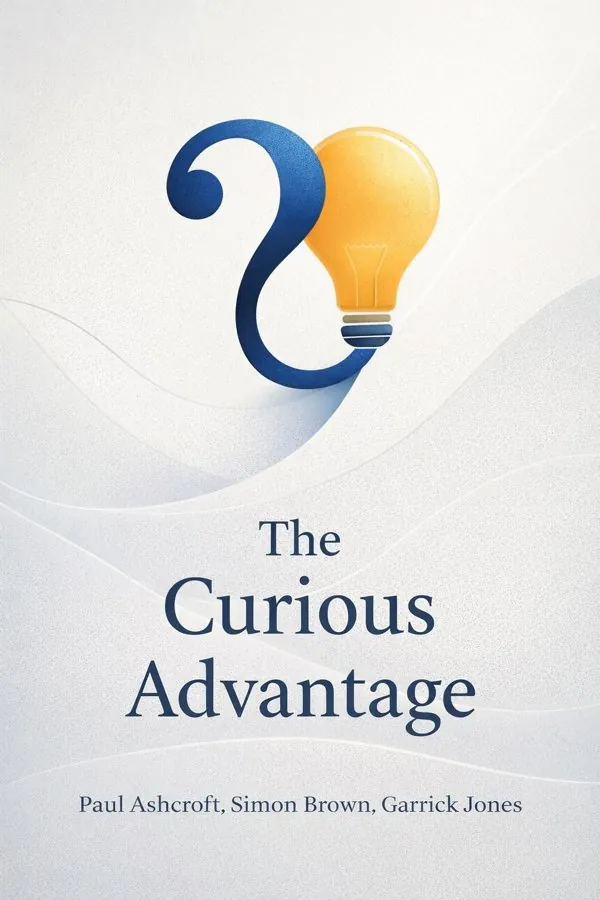
The Curious Advantage: Summary & Key Insights
by Paul Ashcroft, Simon Brown, Garrick Jones
 10 min5 chaptersAudio available
What Is The Curious Advantage About?
The Curious Advantage by Paul Ashcroft, Simon Brown, Garrick Jones is a organization book spanning 5 pages. The Curious Advantage explores the behavior of curiosity and its central role in the digital age. It provides pragmatic tools and case studies to demonstrate how curiosity drives value, collaboration, creativity, and innovation in modern organizations. The book argues that curiosity is the greatest enabler for success and adaptability in a rapidly changing world.
This FizzRead summary covers all 5 key chapters of The Curious Advantage in approximately 10 minutes, distilling the most important ideas, arguments, and takeaways from Paul Ashcroft, Simon Brown, Garrick Jones's work. Also available as an audio summary and Key Quotes Podcast.
The Curious Advantage
The Curious Advantage explores the behavior of curiosity and its central role in the digital age. It provides pragmatic tools and case studies to demonstrate how curiosity drives value, collaboration, creativity, and innovation in modern organizations. The book argues that curiosity is the greatest enabler for success and adaptability in a rapidly changing world.
Who Should Read The Curious Advantage?
This book is perfect for anyone interested in organization and looking to gain actionable insights in a short read. Whether you're a student, professional, or lifelong learner, the key ideas from The Curious Advantage by Paul Ashcroft, Simon Brown, Garrick Jones will help you think differently.
- ✓Readers who enjoy organization and want practical takeaways
- ✓Professionals looking to apply new ideas to their work and life
- ✓Anyone who wants the core insights of The Curious Advantage in just 10 minutes
Want the full summary?
Get instant access to this book summary and 100K+ more with Fizz Moment.
Get Free SummaryAvailable on App Store • Free to download
Key Chapters
Curiosity has deep evolutionary roots. From the first humans who ventured beyond their familiar valleys to our present-day scientists pushing the boundaries of quantum understanding, the instinct to explore has been humanity’s constant companion. In the book, we emphasize that curiosity is not merely a luxury of leisure: it is our survival mechanism. It drives us to learn, to invent, to adapt when confronted with novelty. The psychological sciences reinforce this—curiosity is tightly linked to dopamine reward systems. In other words, asking questions and discovering answers are intrinsically pleasurable, wired into our biology as the essence of learning.
Understanding this changes how we see education, leadership, and innovation. Rather than treating curiosity as a spontaneous spark, we can intentionally design environments that stimulate it. When learners and employees feel safe to ask questions, when leaders reward exploration instead of mere efficiency, they activate the same ancient pathways that once led early humans to discover fire and tools. Curiosity, in both personal and organizational contexts, becomes an act of renewal—our mind’s way of reaching toward possibilities beyond current experience.
But curiosity also has its paradoxes. Not all curiosity is productive. Idle wandering can devolve into distraction; unbounded exploration without direction can exhaust rather than inspire. That is why our framework guides you to balance curiosity with purpose—to create a rhythm between exploration and application, between wondering and doing. This balance is at the heart of the Curious Advantage.
Our research led us to articulate what we call the Curious Advantage Framework—seven essential enablers that allow curiosity to flourish sustainably within individuals and organizations. These are not rigid steps but interwoven principles that build one another.
The journey begins with context. We must first understand the environment in which we operate and what makes curiosity relevant there. This awareness allows us to direct curiosity toward meaningful discovery. Then comes purpose: curiosity needs fuel, an inquiry that matters. When you link curiosity to purpose, you transform it from idle interest into strategic exploration.
The third enabler is exploration itself—diving into new domains, crossing boundaries between disciplines, and seeking diverse perspectives. This expands cognitive flexibility and sparks innovation. Next comes questioning: learning to ask better, deeper, more generative questions. The fifth principle centers on experimentation—the courage to test, fail, and iterate.
The sixth enabler is empowerment. Without psychological safety, curiosity cannot thrive. People need to feel free to wonder aloud, to challenge norms without fear. Finally, there is reflection—the act of making sense of our discoveries. Reflection closes the curiosity loop, turning new experiences into wisdom.
When we apply these seven enablers, individuals and organizations don’t just accumulate information—they develop adaptive intelligence, the capacity to navigate change dynamically. This framework shows curiosity not as chaos, but as a disciplined approach to learning and innovation.
+ 3 more chapters — available in the FizzRead app
All Chapters in The Curious Advantage
About the Authors
Paul Ashcroft, Simon Brown, and Garrick Jones are co-founders of The Curious Advantage movement and experts in organizational learning and innovation. They have extensive experience in helping global companies foster curiosity and creativity to thrive in the digital era.
Get This Summary in Your Preferred Format
Read or listen to the The Curious Advantage summary by Paul Ashcroft, Simon Brown, Garrick Jones anytime, anywhere. FizzRead offers multiple formats so you can learn on your terms — all free.
Available formats: App · Audio · PDF · EPUB — All included free with FizzRead
Download The Curious Advantage PDF and EPUB Summary
Key Quotes from The Curious Advantage
“Our research led us to articulate what we call the Curious Advantage Framework—seven essential enablers that allow curiosity to flourish sustainably within individuals and organizations.”
Frequently Asked Questions about The Curious Advantage
The Curious Advantage by Paul Ashcroft, Simon Brown, Garrick Jones is a organization book that explores key ideas across 5 chapters. The Curious Advantage explores the behavior of curiosity and its central role in the digital age. It provides pragmatic tools and case studies to demonstrate how curiosity drives value, collaboration, creativity, and innovation in modern organizations. The book argues that curiosity is the greatest enabler for success and adaptability in a rapidly changing world.
You Might Also Like
A Guide to the Project Management Body of Knowledge (PMBOK® Guide)
Project Management Institute
10 min
Organizational Behavior
Stephen P. Robbins
10 min
Accelerate: The Science of Lean Software and DevOps – Building and Scaling High Performing Technology Organizations
Nicole Forsgren, Jez Humble, Gene Kim
10 min
Awakening Compassion at Work: The Quiet Power That Elevates People and Organizations
Monica C. Worline, Jane E. Dutton
10 min
Building an Inclusive Organization: Leveraging the Power of a Diverse Workforce
Stephen Frost
10 min
Collaborative Intelligence: Thinking with People Who Think Differently
Dawna Markova, Angie McArthur
10 minBrowse by Category
Ready to read The Curious Advantage?
Get the full summary and 100K+ more books with Fizz Moment.