
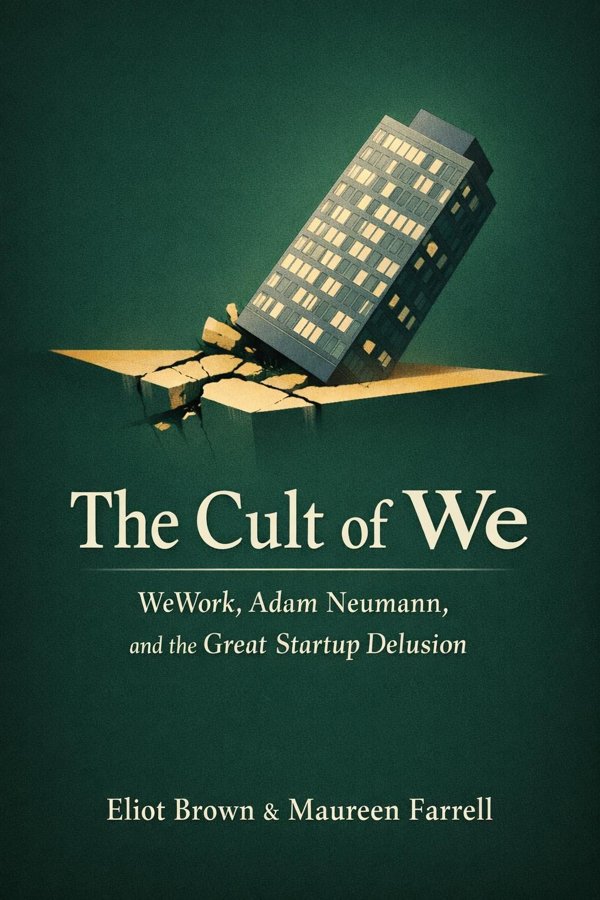
The Cult of We: WeWork, Adam Neumann, and the Great Startup Delusion: Summary & Key Insights
by Eliot Brown, Maureen Farrell
 10 min5 chaptersAudio available
What Is The Cult of We: WeWork, Adam Neumann, and the Great Startup Delusion About?
The Cult of We: WeWork, Adam Neumann, and the Great Startup Delusion by Eliot Brown, Maureen Farrell is a entrepreneurship book spanning 5 pages. An investigative account of the meteoric rise and dramatic fall of WeWork and its charismatic founder Adam Neumann. The book explores how a startup that promised to revolutionize the workplace culture became a cautionary tale of hubris, unchecked ambition, and the excesses of venture capital. Drawing on extensive reporting, the authors reveal the inner workings of WeWork’s culture, its investors, and the mythmaking that fueled its valuation before its collapse.
This FizzRead summary covers all 5 key chapters of The Cult of We: WeWork, Adam Neumann, and the Great Startup Delusion in approximately 10 minutes, distilling the most important ideas, arguments, and takeaways from Eliot Brown, Maureen Farrell's work. Also available as an audio summary and Key Quotes Podcast.
The Cult of We: WeWork, Adam Neumann, and the Great Startup Delusion
An investigative account of the meteoric rise and dramatic fall of WeWork and its charismatic founder Adam Neumann. The book explores how a startup that promised to revolutionize the workplace culture became a cautionary tale of hubris, unchecked ambition, and the excesses of venture capital. Drawing on extensive reporting, the authors reveal the inner workings of WeWork’s culture, its investors, and the mythmaking that fueled its valuation before its collapse.
Who Should Read The Cult of We: WeWork, Adam Neumann, and the Great Startup Delusion?
This book is perfect for anyone interested in entrepreneurship and looking to gain actionable insights in a short read. Whether you're a student, professional, or lifelong learner, the key ideas from The Cult of We: WeWork, Adam Neumann, and the Great Startup Delusion by Eliot Brown, Maureen Farrell will help you think differently.
- ✓Readers who enjoy entrepreneurship and want practical takeaways
- ✓Professionals looking to apply new ideas to their work and life
- ✓Anyone who wants the core insights of The Cult of We: WeWork, Adam Neumann, and the Great Startup Delusion in just 10 minutes
Want the full summary?
Get instant access to this book summary and 100K+ more with Fizz Moment.
Get Free SummaryAvailable on App Store • Free to download
Key Chapters
When you trace the very beginnings of WeWork, you find not a master plan but an experiment driven by two dreamers—Adam Neumann and Miguel McKelvey. Both were idealists shaped by unconventional upbringings. Neumann, an Israeli Navy veteran, possessed a magnetic charm and an instinct for grand visions; McKelvey, an architect from Oregon, brought design sensibility and quiet determination.
Their early venture, Green Desk, hinted at what was to come: a shared office concept built with recycled materials in Brooklyn. It was practical, community-driven, and surprisingly successful. After selling Green Desk to their landlord, the two men founded WeWork in 2010 in SoHo. But Adam wanted more than a business. He spoke about building a “we” company, a force that would redefine human connection through physical space. The term “cult of we” would later be used to criticize this vision, but in those early days, it inspired people. Employees and customers described the energy as contagious.
From day one, WeWork framed itself not as a real estate firm, but as a technology company—an identity critical to attracting Silicon Valley’s capital. After all, real estate is grounded in slow, steady returns; tech promised exponential growth. Neumann learned to perform this duality perfectly. Investors bought the myth: that WeWork’s value was in its community, its data-driven model, and its potential to scale infinitely. What was essentially a lease arbitrage business—renting long-term, subletting short-term—was rebranded as something ethereal, a new way of working for a new age.
In this way, Neumann positioned himself as a visionary, not a landlord. Employees worked exhaustingly long hours but believed they were changing the world. From the outside, WeWork’s sleek spaces and party-like culture cloaked a fundamental contradiction: a company selling physical spaces while calling itself a tech disruptor. Yet for years, that contradiction didn’t matter—because the story was too good to question.
The engine of WeWork’s spectacular ascent was not its business model—it was Adam Neumann himself. His charisma turned skeptics into believers, and his unbridled ambition created an aura of inevitability around everything he touched. Inside the company, employees often repeated his phrases like mantras: “We’re elevating the world’s consciousness.” “We’re not just building offices, we’re building a new way of life.”
Neumann blurred the line between spiritual awakening and corporate growth. All-hands meetings felt more like revival gatherings. He preached about family, purpose, and transcendence. Yet behind the exuberance lurked contradictions—a lifestyle of private jets, lavish parties, and grandiose pronouncements that masked operational chaos. Employees joined not only for salaries but for the promise of belonging. The resulting culture was both intoxicating and suffocating, driving many to burnout even as they idolized their leader.
As WeWork expanded, so did the myth. Media outlets featured Neumann as the next Steve Jobs or Elon Musk—a founder who fused idealism with profitability. But the numbers told another story. WeWork’s valuation, at times exceeding forty billion dollars, was increasingly divorced from its fundamentals. To maintain that illusion, the company needed constant funding. And Neumann became a master storyteller, convincing investors that money was secondary to the movement’s destiny.
Here, we witness how founder worship—common in Silicon Valley—enabled recklessness. Venture capitalists, enamored by Neumann’s magnetic confidence, ceded control. Benchmark, one of WeWork’s early backers, gave him near-total authority. He could overrule board members, appoint friends to key roles, and structure side deals that personally enriched him. In a sense, WeWork became a reflection of Neumann’s psyche: passionate, restless, and unwilling to face the constraints of reality.
This culture of personality worked—until it didn’t. As the company ballooned globally, cracks formed. Governance faltered, internal dissent was suppressed, and accountability vanished. What had once been a calling turned into a cult of belief, where questioning the founder’s vision was heresy. The very culture that had fueled WeWork’s early success would later ignite its implosion.
+ 3 more chapters — available in the FizzRead app
All Chapters in The Cult of We: WeWork, Adam Neumann, and the Great Startup Delusion
About the Authors
Eliot Brown is a journalist at The Wall Street Journal covering startups and venture capital. Maureen Farrell is also a Wall Street Journal reporter specializing in finance and IPOs. Together, they bring deep expertise in business reporting and investigative journalism.
Get This Summary in Your Preferred Format
Read or listen to the The Cult of We: WeWork, Adam Neumann, and the Great Startup Delusion summary by Eliot Brown, Maureen Farrell anytime, anywhere. FizzRead offers multiple formats so you can learn on your terms — all free.
Available formats: App · Audio · PDF · EPUB — All included free with FizzRead
Download The Cult of We: WeWork, Adam Neumann, and the Great Startup Delusion PDF and EPUB Summary
Key Quotes from The Cult of We: WeWork, Adam Neumann, and the Great Startup Delusion
“When you trace the very beginnings of WeWork, you find not a master plan but an experiment driven by two dreamers—Adam Neumann and Miguel McKelvey.”
“The engine of WeWork’s spectacular ascent was not its business model—it was Adam Neumann himself.”
Frequently Asked Questions about The Cult of We: WeWork, Adam Neumann, and the Great Startup Delusion
The Cult of We: WeWork, Adam Neumann, and the Great Startup Delusion by Eliot Brown, Maureen Farrell is a entrepreneurship book that explores key ideas across 5 chapters. An investigative account of the meteoric rise and dramatic fall of WeWork and its charismatic founder Adam Neumann. The book explores how a startup that promised to revolutionize the workplace culture became a cautionary tale of hubris, unchecked ambition, and the excesses of venture capital. Drawing on extensive reporting, the authors reveal the inner workings of WeWork’s culture, its investors, and the mythmaking that fueled its valuation before its collapse.
You Might Also Like

Lean Analytics
Alistair Croll, Benjamin Yoskovitz
10 min
21 Days To A Big Idea: Creating Breakthrough Business Concepts
Bryan Mattimore
10 min
Sam Walton: Made in America: My Story
Sam Walton
10 min
10x Is Easier Than 2x: How World-Class Entrepreneurs Achieve More by Doing Less
Dan Sullivan, Benjamin Hardy
10 min
12 Months to $1 Million: How to Pick a Winning Product, Build a Real Business, and Become a Seven-Figure Entrepreneur
Ryan Daniel Moran
10 min
24 Assets: Create a Digital, Scalable, Valuable Business
Daniel Priestley
10 minBrowse by Category
Ready to read The Cult of We: WeWork, Adam Neumann, and the Great Startup Delusion?
Get the full summary and 100K+ more books with Fizz Moment.