
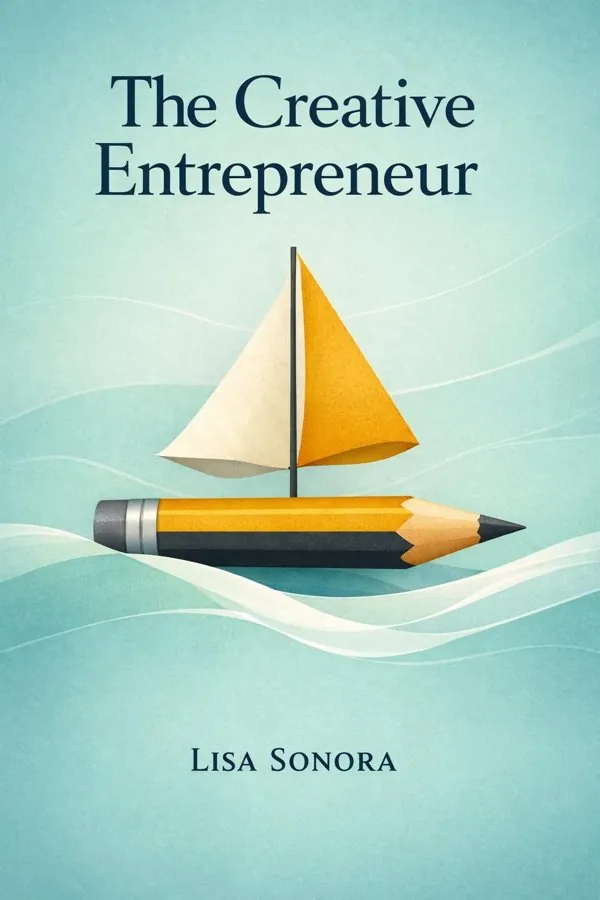
The Creative Entrepreneur: A DIY Visual Guidebook for Making Business Ideas Real: Summary & Key Insights
by Lisa Sonora
 10 min9 chaptersAudio available
Key Takeaways from The Creative Entrepreneur: A DIY Visual Guidebook for Making Business Ideas Real
A business becomes far more sustainable when it grows from identity instead of imitation.
Without inner clarity, external strategy quickly becomes noise.
Some ideas become visible only when we stop trying to think them into existence.
Not every talent becomes a business, and not every business-worthy idea comes from passion alone.
A creative business gains traction when it stops speaking to everyone and starts resonating with someone specific.
What Is The Creative Entrepreneur: A DIY Visual Guidebook for Making Business Ideas Real About?
The Creative Entrepreneur: A DIY Visual Guidebook for Making Business Ideas Real by Lisa Sonora is a entrepreneurship book spanning 9 pages. The Creative Entrepreneur is a practical, visually driven guide for artists, makers, freelancers, and idea-driven people who want to turn inspiration into a working business without losing their originality in the process. Rather than treating entrepreneurship as a rigid, numbers-only discipline, Lisa Sonora presents it as a creative act in itself: something that can be explored through images, journaling, collage, mapping, reflection, and experimentation. The book helps readers shape a business from the inside out, starting with identity, values, and vision before moving into offerings, audience, planning, money, marketing, and long-term sustainability. What makes the book especially valuable is its refusal to force creative people into a conventional mold. Sonora recognizes that many artists resist business because it feels mechanical or inauthentic, and she responds with tools that honor intuition while still producing structure and clarity. Drawing on her background in psychology, design, and consulting, she offers a method that is both imaginative and disciplined. The result is a guidebook for building a business that is not only viable, but deeply aligned with who you are and what you want to create.
This FizzRead summary covers all 9 key chapters of The Creative Entrepreneur: A DIY Visual Guidebook for Making Business Ideas Real in approximately 10 minutes, distilling the most important ideas, arguments, and takeaways from Lisa Sonora's work. Also available as an audio summary and Key Quotes Podcast.
The Creative Entrepreneur: A DIY Visual Guidebook for Making Business Ideas Real
The Creative Entrepreneur is a practical, visually driven guide for artists, makers, freelancers, and idea-driven people who want to turn inspiration into a working business without losing their originality in the process. Rather than treating entrepreneurship as a rigid, numbers-only discipline, Lisa Sonora presents it as a creative act in itself: something that can be explored through images, journaling, collage, mapping, reflection, and experimentation. The book helps readers shape a business from the inside out, starting with identity, values, and vision before moving into offerings, audience, planning, money, marketing, and long-term sustainability. What makes the book especially valuable is its refusal to force creative people into a conventional mold. Sonora recognizes that many artists resist business because it feels mechanical or inauthentic, and she responds with tools that honor intuition while still producing structure and clarity. Drawing on her background in psychology, design, and consulting, she offers a method that is both imaginative and disciplined. The result is a guidebook for building a business that is not only viable, but deeply aligned with who you are and what you want to create.
Who Should Read The Creative Entrepreneur: A DIY Visual Guidebook for Making Business Ideas Real?
This book is perfect for anyone interested in entrepreneurship and looking to gain actionable insights in a short read. Whether you're a student, professional, or lifelong learner, the key ideas from The Creative Entrepreneur: A DIY Visual Guidebook for Making Business Ideas Real by Lisa Sonora will help you think differently.
- ✓Readers who enjoy entrepreneurship and want practical takeaways
- ✓Professionals looking to apply new ideas to their work and life
- ✓Anyone who wants the core insights of The Creative Entrepreneur: A DIY Visual Guidebook for Making Business Ideas Real in just 10 minutes
Want the full summary?
Get instant access to this book summary and 100K+ more with Fizz Moment.
Get Free SummaryAvailable on App Store • Free to download
Key Chapters
A business becomes far more sustainable when it grows from identity instead of imitation. One of Lisa Sonora’s central insights is that creative people do not need to choose between being artists and being entrepreneurs. In fact, the strongest creative businesses emerge when those two identities are consciously integrated. Many artists have absorbed the belief that business is commercial, cold, or somehow opposed to integrity. Sonora challenges that false split by showing that entrepreneurship can be another medium for expression, problem-solving, and meaning-making.
This idea matters because creative ventures often fail not from lack of talent, but from internal resistance. If you secretly believe that selling your work makes it less pure, or that structure threatens spontaneity, you will avoid the very actions that allow your work to survive. Sonora encourages readers to examine their assumptions about money, visibility, success, and self-promotion. Through reflection and visual exercises, she helps them reframe business as a way to support the life and work they care about most.
Imagine a graphic designer who loves editorial illustration but hesitates to market herself because she fears becoming “too corporate.” By exploring her identity as both an artist and a service provider, she can define a business model that fits her values, perhaps working with independent publishers, nonprofits, or mission-driven brands. The point is not to become someone else. It is to build from what is already true.
Actionable takeaway: Write down the labels you currently use for yourself, such as artist, teacher, maker, consultant, or dreamer, and create a new statement that combines your creative identity with your entrepreneurial one.
Without inner clarity, external strategy quickly becomes noise. Sonora argues that creative entrepreneurs must begin by defining the deeper architecture of their enterprise: vision, mission, and values. These are not decorative branding terms. They are practical decision-making tools that help determine what kind of work to pursue, which opportunities to accept, how to communicate, and what success should actually look like.
Vision describes the future you want to help create. Mission defines the work you are here to do. Values identify the principles that shape how you do it. When these elements are vague, creative people often chase scattered opportunities, burn out pleasing the wrong clients, or build businesses that function but feel empty. Sonora’s approach brings business planning back to meaning. She invites readers to ask not only, “What can I sell?” but also, “What matters to me? What impact do I want my work to have? What kind of life do I want this business to support?”
For example, a ceramic artist might discover that her vision is to bring beauty and ritual into everyday living, her mission is to create handmade functional objects, and her values include slowness, craftsmanship, and local community. Those answers would shape everything from pricing and packaging to partnerships and marketing tone. Instead of copying mass-market strategies, she can build a business consistent with her purpose.
Actionable takeaway: Draft one sentence each for your vision, mission, and top five values, then use them as a filter for your next business decision.
Some ideas become visible only when we stop trying to think them into existence. A distinctive feature of Sonora’s book is her use of visual journaling as a tool for business discovery and design. Rather than relying exclusively on linear outlines or spreadsheets, she encourages readers to use collage, sketches, mind maps, handwritten notes, images, symbols, and color to explore what they want to build. This approach is especially powerful for people whose ideas are intuitive, layered, or difficult to articulate at first.
Visual journaling works because it bypasses the inner critic and creates room for emergence. A traditional business worksheet may trigger anxiety or perfectionism. A blank page filled with images and fragments, by contrast, can help reveal hidden themes, desires, fears, and opportunities. Sonora treats the journal as a laboratory where business ideas can evolve before they are forced into formal structure.
A photographer, for instance, might create a visual spread with magazine clippings, texture samples, favorite quotes, and notes about clients she admires. In the process, she may realize that what she truly wants is not generic portrait work but a brand centered on intimate storytelling for small creative businesses. The visual process helps her see patterns she might have missed through purely analytical planning.
This method also makes business planning more engaging. It turns strategy into an iterative creative practice rather than a one-time administrative task. Over time, the journal becomes a record of direction, experimentation, and growth.
Actionable takeaway: Set aside one hour to create a visual journal spread about your business idea using words, images, colors, and sketches, then circle the patterns that appear more than once.
Not every talent becomes a business, and not every business-worthy idea comes from passion alone. Sonora helps readers uncover the useful intersection between what they love, what they do well, and what others genuinely need. This is where a creative identity begins to turn into a concrete offering. Many aspiring entrepreneurs stay stuck because they define themselves too broadly: they are creative, multi-talented, and full of ideas, but unsure what exactly to offer. Sonora’s process narrows possibility into direction.
She encourages readers to inventory their strengths, experiences, interests, and natural working style. Just as important, she pushes them to translate these internal qualities into external value. A person may love collage, storytelling, and teaching, but the market does not buy “interests.” It buys workshops, commissioned work, products, consulting, experiences, or transformations. The challenge is to identify what form your creativity can take in a way that is meaningful to others.
Consider a writer who enjoys journaling, mindfulness, and community building. Through this process, she may discover several viable offerings: guided writing circles, digital journaling prompts, one-on-one creative coaching, or a subscription newsletter. Her strengths become the raw material, but the offering gives them shape and relevance.
This chapter is a reminder that business design requires both honesty and imagination. You do not need to force yourself into a format that does not fit, but you do need to define what people can actually say yes to. Clarity creates confidence.
Actionable takeaway: Make three columns labeled “What I love,” “What I do well,” and “What people need help with,” then look for overlaps that can be turned into a specific offer.
A creative business gains traction when it stops speaking to everyone and starts resonating with someone specific. Sonora emphasizes that identifying your audience is not an exercise in narrowing your spirit; it is a way of sharpening relevance. Many creatives resist defining a target market because they fear being boxed in or becoming less authentic. But in reality, the clearer you are about whom you serve, the easier it becomes to communicate value, design offers, and build trust.
Her approach is grounded in empathy rather than segmentation jargon. The question is not merely demographic. It is human. Who is this for? What are they struggling with, aspiring to, or seeking? What do they care about? How does your work fit into their emotional or practical world? This way of thinking is especially important for artistic businesses, where the purchase is often tied to identity, meaning, aesthetics, or transformation.
For example, a textile artist might initially think her audience is “people who like handmade things.” That is too broad to guide marketing. Through deeper reflection, she may realize her ideal customers are interior designers and homeowners who want ethically made, tactile pieces that add warmth and story to modern spaces. Suddenly, her messaging, product photography, pricing, and partnerships become much clearer.
Defining an audience does not mean excluding everyone else. It means creating a center of gravity. Once you know whom you most want to reach, your work can travel further with less confusion and more impact.
Actionable takeaway: Write a one-paragraph portrait of your ideal customer, including what they value, what problem or desire brings them to you, and why your work matters to them.
An idea feels more possible when you can map how it actually works. Sonora introduces the concept of a visual business model to help readers understand the moving parts of their enterprise in an accessible, non-intimidating way. Instead of burying strategy in dense documents, she encourages entrepreneurs to lay out the essential components visually: offerings, customers, channels, resources, partnerships, costs, and income streams. This creates a picture of the business as a whole.
The value of this approach is that it reveals both opportunity and imbalance. Many creative businesses are built around enthusiasm, but enthusiasm alone does not show whether the model is coherent. A visual map can expose missing pieces. Maybe the offer is exciting but the sales channel is weak. Maybe there is too much dependence on one client. Maybe the costs of production make a low-price strategy unrealistic. Seeing the business as a system helps readers move from vague hope to informed design.
Take a jewelry maker who sells only at occasional craft fairs. By mapping her business visually, she may notice that her income depends too heavily on seasonal events. She might then add an online shop, a wholesale line for boutiques, and a limited custom service. The model becomes more diverse and resilient.
Sonora’s method is especially useful for creative thinkers because it makes planning tactile and flexible. Sticky notes, sketches, and diagrams allow experimentation without the pressure of perfection.
Actionable takeaway: Create a one-page visual map of your business showing what you sell, to whom, how they find you, how money comes in, and what resources or costs are required to deliver your work.
Inspiration is powerful, but momentum comes from translating desire into concrete next steps. Sonora gives careful attention to goals, planning, and action, showing that a creative business grows through manageable movement rather than dramatic leaps. Many entrepreneurs stall because their dreams are too abstract or too overwhelming. They know what they want in a broad sense, but they do not know what to do this week, this month, or this quarter. Sonora bridges that gap.
Her framework encourages breaking a large vision into smaller, visible milestones. This matters because action becomes easier when it is specific. “Build my business” is paralyzing. “Launch a portfolio website by the end of the month” is actionable. She also recognizes that creative people often work in cycles, balancing experimentation with execution. Effective goals therefore need both structure and room for revision.
A freelance illustrator, for example, might identify a yearly goal of earning a stable income from client and product work. She can then define quarterly projects: refine portfolio, reach out to twenty aligned clients, open an online print shop, and test a monthly newsletter. Each project can be broken into weekly tasks. Progress no longer depends on mood alone.
This chapter also reinforces the motivational power of visible planning. Checklists, calendars, timelines, and progress charts can make forward movement tangible, which is particularly helpful when results arrive slowly. Creative entrepreneurship is rarely linear, but regular action compounds.
Actionable takeaway: Choose one major business goal for the next ninety days, then break it into three milestones and list the first five actions you can take this week.
Many creative people are comfortable making work but deeply uncomfortable talking about money or promotion. Sonora treats these subjects not as necessary evils, but as meaningful parts of a sustainable practice. If your work is valuable, then charging for it and communicating about it are not acts of betrayal. They are part of how the work reaches the people who need it and continues to exist.
On money, she encourages greater honesty and intentionality. Pricing should reflect not only materials or time, but also expertise, process, and the value delivered. Creative entrepreneurs often undercharge because they are afraid of being rejected or because the work comes naturally to them. Sonora helps readers understand that ease does not erase value. Likewise, she frames revenue as support for a larger mission: income funds time, tools, energy, and future creation.
On marketing, her tone is equally refreshing. Marketing does not have to mean hype, manipulation, or self-importance. It can mean storytelling, education, invitation, and relationship. A printmaker might share the process behind a new series, explain the inspiration, show studio photos, and tell customers why the edition matters. That is marketing rooted in authenticity.
When money and marketing are aligned with values, they become less threatening. They become forms of clarity. You are telling people what you offer, why it matters, and what it costs to sustain it.
Actionable takeaway: Review one current offer and rewrite its description to clearly state the value it provides, then confirm that the price reflects both the work involved and the outcome created.
A business plan is not a fixed verdict on your future; it is a living document that should evolve as you grow. Sonora closes the loop by reminding readers that creative entrepreneurship is an ongoing practice of reflection, adaptation, and renewal. This is crucial because many people either never finish planning or become too attached to the first version of their idea. Both extremes create stagnation. The healthier approach is to treat the business as something responsive.
Motivation fades when entrepreneurs expect certainty too early. Creative work unfolds through experimentation, feedback, setbacks, and surprise. Sonora normalizes that reality and offers tools for staying engaged over time. Revisiting your journal, refining your vision, updating your goals, and noticing what energizes or drains you are all part of maintaining alignment. The plan serves the creator, not the other way around.
For instance, a designer may begin by offering custom branding packages but later realize that productized templates, teaching, or licensing better fit her strengths and lifestyle. Instead of interpreting that shift as failure, Sonora would frame it as evolution based on learning. What matters is continued honesty about what is working, what is not, and what wants to emerge next.
This perspective reduces perfectionism. You do not need to predict your entire business from day one. You need a process for revising intelligently as real-world experience accumulates. Sustainability comes not only from discipline, but from adaptability.
Actionable takeaway: Schedule a monthly review session to assess what is energizing, what is profitable, what is confusing, and what needs to be adjusted in your business plan.
All Chapters in The Creative Entrepreneur: A DIY Visual Guidebook for Making Business Ideas Real
About the Author
Lisa Sonora is an artist, writer, facilitator, and business consultant whose work centers on helping creative people bring ideas into tangible form. With a background that blends psychology, design, and entrepreneurial practice, she has developed methods that make business planning more intuitive, visual, and personally meaningful. Sonora is especially known for using journaling, collage, and other creative tools to help artists, makers, and independent professionals clarify vision, align with their values, and build sustainable ventures. Her teaching reflects a deep understanding of both the inner and outer challenges of entrepreneurship: the emotional resistance many creatives feel toward business, and the practical structure required to make a project last. Through workshops, writing, and consulting, she has become a trusted guide for people seeking a business model that supports both livelihood and creative integrity.
Get This Summary in Your Preferred Format
Read or listen to the The Creative Entrepreneur: A DIY Visual Guidebook for Making Business Ideas Real summary by Lisa Sonora anytime, anywhere. FizzRead offers multiple formats so you can learn on your terms — all free.
Available formats: App · Audio · PDF · EPUB — All included free with FizzRead
Download The Creative Entrepreneur: A DIY Visual Guidebook for Making Business Ideas Real PDF and EPUB Summary
Key Quotes from The Creative Entrepreneur: A DIY Visual Guidebook for Making Business Ideas Real
“A business becomes far more sustainable when it grows from identity instead of imitation.”
“Without inner clarity, external strategy quickly becomes noise.”
“Some ideas become visible only when we stop trying to think them into existence.”
“Not every talent becomes a business, and not every business-worthy idea comes from passion alone.”
“A creative business gains traction when it stops speaking to everyone and starts resonating with someone specific.”
Frequently Asked Questions about The Creative Entrepreneur: A DIY Visual Guidebook for Making Business Ideas Real
The Creative Entrepreneur: A DIY Visual Guidebook for Making Business Ideas Real by Lisa Sonora is a entrepreneurship book that explores key ideas across 9 chapters. The Creative Entrepreneur is a practical, visually driven guide for artists, makers, freelancers, and idea-driven people who want to turn inspiration into a working business without losing their originality in the process. Rather than treating entrepreneurship as a rigid, numbers-only discipline, Lisa Sonora presents it as a creative act in itself: something that can be explored through images, journaling, collage, mapping, reflection, and experimentation. The book helps readers shape a business from the inside out, starting with identity, values, and vision before moving into offerings, audience, planning, money, marketing, and long-term sustainability. What makes the book especially valuable is its refusal to force creative people into a conventional mold. Sonora recognizes that many artists resist business because it feels mechanical or inauthentic, and she responds with tools that honor intuition while still producing structure and clarity. Drawing on her background in psychology, design, and consulting, she offers a method that is both imaginative and disciplined. The result is a guidebook for building a business that is not only viable, but deeply aligned with who you are and what you want to create.
You Might Also Like

Lean Analytics
Alistair Croll, Benjamin Yoskovitz
10 min
21 Days To A Big Idea: Creating Breakthrough Business Concepts
Bryan Mattimore
10 min
Sam Walton: Made in America: My Story
Sam Walton
10 min
10x Is Easier Than 2x: How World-Class Entrepreneurs Achieve More by Doing Less
Dan Sullivan, Benjamin Hardy
10 min
12 Months to $1 Million: How to Pick a Winning Product, Build a Real Business, and Become a Seven-Figure Entrepreneur
Ryan Daniel Moran
10 min
24 Assets: Create a Digital, Scalable, Valuable Business
Daniel Priestley
10 minBrowse by Category
Ready to read The Creative Entrepreneur: A DIY Visual Guidebook for Making Business Ideas Real?
Get the full summary and 100K+ more books with Fizz Moment.