
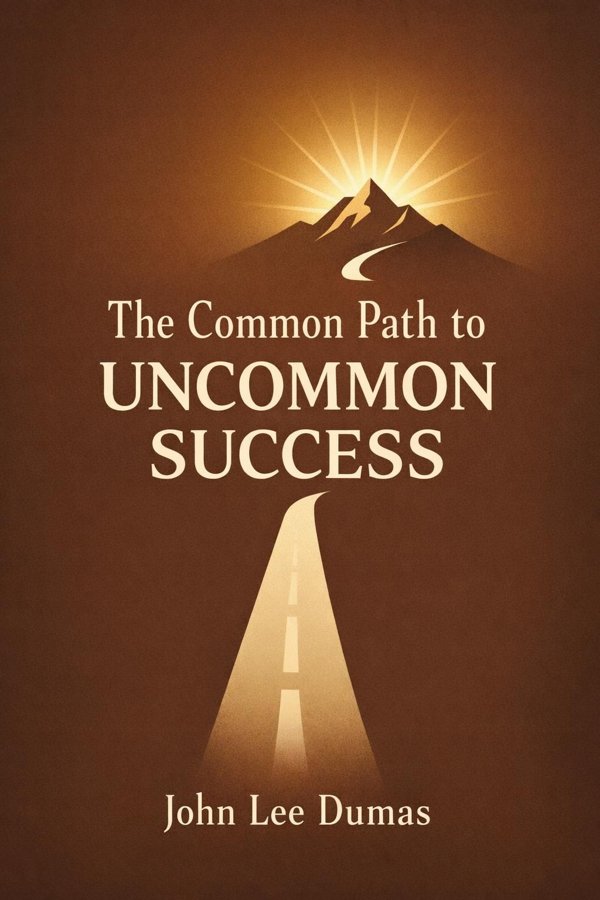
The Common Path to Uncommon Success: A Roadmap to Financial Freedom and Fulfillment: Summary & Key Insights
 10 min9 chaptersAudio available
Key Takeaways from The Common Path to Uncommon Success: A Roadmap to Financial Freedom and Fulfillment
A business rarely becomes remarkable by accident; it becomes remarkable because its founder starts with unusual clarity.
Trying to serve everyone is one of the fastest ways to be ignored.
Businesses become more effective the moment they stop speaking to a crowd and start speaking to one real person.
Success online often looks like omnipresence, but Dumas argues that it usually begins with disciplined concentration.
Entrepreneurship rewards independence, but it punishes isolation.
What Is The Common Path to Uncommon Success: A Roadmap to Financial Freedom and Fulfillment About?
The Common Path to Uncommon Success: A Roadmap to Financial Freedom and Fulfillment by John Lee Dumas is a entrepreneurship book spanning 6 pages. Most people want extraordinary results, yet few are given a practical map for creating them. In The Common Path to Uncommon Success, entrepreneur and podcast host John Lee Dumas argues that exceptional success is rarely mysterious or random. It comes from following a clear sequence of disciplined actions: identifying a powerful idea, narrowing it into a profitable niche, serving a specific audience, building trust, and creating systems that generate both income and meaning. Drawing from thousands of interviews on Entrepreneurs on Fire, Dumas translates big entrepreneurial lessons into a 17-step roadmap that is direct, usable, and grounded in lived experience rather than vague inspiration. What makes this book valuable is its insistence that financial freedom and personal fulfillment are not opposing goals. Instead, they can reinforce each other when your work is aligned with your strengths, values, and the needs of a clearly defined market. For aspiring founders, creators, coaches, and side-hustlers, this book offers a structured framework for turning ambition into a sustainable business and a more intentional life.
This FizzRead summary covers all 9 key chapters of The Common Path to Uncommon Success: A Roadmap to Financial Freedom and Fulfillment in approximately 10 minutes, distilling the most important ideas, arguments, and takeaways from John Lee Dumas's work. Also available as an audio summary and Key Quotes Podcast.
The Common Path to Uncommon Success: A Roadmap to Financial Freedom and Fulfillment
Most people want extraordinary results, yet few are given a practical map for creating them. In The Common Path to Uncommon Success, entrepreneur and podcast host John Lee Dumas argues that exceptional success is rarely mysterious or random. It comes from following a clear sequence of disciplined actions: identifying a powerful idea, narrowing it into a profitable niche, serving a specific audience, building trust, and creating systems that generate both income and meaning. Drawing from thousands of interviews on Entrepreneurs on Fire, Dumas translates big entrepreneurial lessons into a 17-step roadmap that is direct, usable, and grounded in lived experience rather than vague inspiration. What makes this book valuable is its insistence that financial freedom and personal fulfillment are not opposing goals. Instead, they can reinforce each other when your work is aligned with your strengths, values, and the needs of a clearly defined market. For aspiring founders, creators, coaches, and side-hustlers, this book offers a structured framework for turning ambition into a sustainable business and a more intentional life.
Who Should Read The Common Path to Uncommon Success: A Roadmap to Financial Freedom and Fulfillment?
This book is perfect for anyone interested in entrepreneurship and looking to gain actionable insights in a short read. Whether you're a student, professional, or lifelong learner, the key ideas from The Common Path to Uncommon Success: A Roadmap to Financial Freedom and Fulfillment by John Lee Dumas will help you think differently.
- ✓Readers who enjoy entrepreneurship and want practical takeaways
- ✓Professionals looking to apply new ideas to their work and life
- ✓Anyone who wants the core insights of The Common Path to Uncommon Success: A Roadmap to Financial Freedom and Fulfillment in just 10 minutes
Want the full summary?
Get instant access to this book summary and 100K+ more with Fizz Moment.
Get Free SummaryAvailable on App Store • Free to download
Key Chapters
A business rarely becomes remarkable by accident; it becomes remarkable because its founder starts with unusual clarity. Dumas insists that your big idea is the foundation of everything that follows. But he warns against confusing a passing interest with a durable business concept. A big idea sits at the intersection of passion, skill, experience, and market need. It is not simply what excites you today, but what you are willing to commit to long enough to master and monetize.
This matters because entrepreneurship gets hard quickly. When challenges arise, shallow motivation fades. A strong idea gives you staying power. Dumas encourages readers to reflect on what they enjoy, what they are good at, what problems they care about solving, and what gaps they see in the marketplace. For example, someone who loves nutrition, has coaching experience, and notices that busy parents need simple meal systems may have the seed of a valuable business idea. Another person may enjoy design, have experience in ecommerce, and recognize that small brands struggle with conversion-focused branding.
The point is not to invent something revolutionary from nothing. It is to identify a meaningful opportunity where your strengths can create clear value. Dumas draws on lessons from countless entrepreneurs who succeeded not because they chased trends, but because they chose ideas that were authentic, useful, and sustainable.
Actionable takeaway: Write down three possible business ideas and evaluate each against four filters: passion, expertise, market demand, and long-term commitment. Choose the one with the strongest overlap.
Trying to serve everyone is one of the fastest ways to be ignored. Dumas argues that once you have your big idea, your next task is to narrow it into a specific niche. This step feels counterintuitive to many new entrepreneurs because they fear losing opportunities. In reality, specificity creates traction. A niche makes your message sharper, your audience easier to identify, and your offer more compelling.
Broad ideas sound ambitious but often lack power. “I help people get healthy” is vague. “I help remote software engineers lose weight without giving up convenience food” is memorable. The second statement immediately tells people who the offer is for and why it matters. Niche clarity also makes content creation easier. You know what questions your audience asks, what frustrations they face, and what language resonates with them.
Dumas shows that successful businesses often begin by going narrow, not wide. A podcast for all entrepreneurs is difficult to differentiate. A podcast for first-time ecommerce founders scaling from zero to six figures has a clearer identity. A fitness coach who specializes in post-pregnancy strength training can build authority faster than a generic trainer serving anyone with a pulse.
Niche selection is not about boxing yourself in forever. It is about gaining initial focus so you can establish trust and momentum. Once people know exactly what you do well, expansion becomes easier. Precision attracts attention; vagueness dilutes it.
Actionable takeaway: Complete the sentence, “I help [specific person] achieve [specific result] without [specific pain point].” Refine it until it sounds unmistakably focused and practical.
Businesses become more effective the moment they stop speaking to a crowd and start speaking to one real person. Dumas emphasizes the importance of creating an avatar: a detailed representation of your ideal customer. This is not a superficial marketing exercise. It is a discipline that forces empathy, precision, and relevance into every decision you make.
When your avatar is vague, your content becomes generic. When your avatar is specific, everything sharpens. You know their age range, profession, fears, goals, objections, habits, language, and buying triggers. You understand what they complain about, what they search for at midnight, and what result they would gladly pay to achieve. If you serve “small business owners,” your messaging stays broad. If you serve “female solo consultants in their 30s who want to build a premium online course without hiring a team,” your product and marketing become much easier to shape.
Dumas encourages entrepreneurs to think deeply about demographics and psychographics. Where does your avatar spend time online? Who do they trust? What have they already tried that did not work? What would make them feel understood? These questions improve product design, email copy, social posts, podcast topics, and sales conversations. Even pricing and customer support benefit from avatar clarity.
The biggest advantage of an avatar is resonance. People respond when they feel seen. The more accurately you understand your ideal customer, the more naturally you can create offers that solve real problems rather than imagined ones.
Actionable takeaway: Build a one-page avatar profile with name, background, key challenge, desired transformation, common objections, and preferred platforms. Use it as a filter before publishing any content or launching any offer.
Success online often looks like omnipresence, but Dumas argues that it usually begins with disciplined concentration. Instead of scattering your energy across every social channel, newsletter format, and content type, he advises choosing one primary platform that aligns with your strengths and your audience’s attention. Focus creates depth, consistency, and mastery.
The best platform is not the trendiest one. It is the one you can commit to and use effectively over time. If you are articulate and enjoy conversation, podcasting may be ideal. If you teach visually, YouTube might fit. If you are a concise writer with a strong point of view, a newsletter or LinkedIn strategy may serve you well. If your audience discovers solutions through search, blogging or SEO-driven content can become a powerful engine.
Dumas’s own career demonstrates the value of platform commitment. He built authority not by dabbling everywhere, but by consistently showing up through a podcast format that matched his abilities and audience. That consistency compounded over time into trust, reach, relationships, and revenue.
Choosing a platform also helps set practical boundaries. A founder with limited time cannot sustainably post on six channels, host a podcast, write long-form essays, and launch webinars every week. Better to dominate one lane than underperform in many. Once systems are in place and traction grows, repurposing content into secondary platforms becomes possible.
Actionable takeaway: Select one primary platform based on three criteria: where your ideal customer already pays attention, what medium matches your natural strengths, and what you can consistently sustain for at least 12 months.
Entrepreneurship rewards independence, but it punishes isolation. Dumas stresses that one of the fastest ways to compress the learning curve is to find a mentor who has already traveled the road you want to walk. A good mentor does more than give advice. They help you avoid predictable mistakes, challenge your blind spots, and model what effective execution looks like.
Many people imagine mentorship as a formal relationship with unlimited access to a high-profile expert. Dumas presents a broader and more practical view. Mentors can appear through paid coaching, masterminds, books, podcasts, courses, or direct relationships. What matters is proximity to proven wisdom. If someone has already built the kind of business you want, their perspective can save you months or years of wasted effort.
A mentor can help with strategic choices like pricing, positioning, product sequencing, and audience growth. They can also provide emotional calibration. New founders often swing between overconfidence and discouragement. Experienced guidance brings perspective: which problems are normal, which decisions matter most, and when to stay the course. For instance, a first-time course creator might waste time obsessing over logos and software tools when a mentor would redirect attention toward customer research and offer validation.
Dumas also reminds readers that mentorship requires responsibility from the mentee. You must be coachable, prepared, and willing to implement what you learn. Advice without action creates no value.
Actionable takeaway: Identify one person, community, course, or mastermind that can mentor you in your next business stage, then invest time or money to shorten the distance between confusion and clarity.
Trust is rarely won through a sales pitch alone; it is earned through consistent value over time. Dumas argues that content is one of the most effective ways to build authority, attract the right audience, and demonstrate expertise before asking anyone to buy. But content only works when it is strategic. Random posting is noise. Useful, focused, repeatable content is an asset.
The purpose of content is not simply visibility. It is education, relationship-building, and proof. Every podcast episode, article, video, or email should answer a real question, solve a common problem, or move your audience one step closer to a desired transformation. If your niche is productivity for freelancers, your content might include pricing templates, client-boundary scripts, workflow tutorials, and time-blocking systems. If you coach health professionals launching private practices, your content might cover referral strategies, onboarding systems, and compliance basics.
Dumas emphasizes consistency because sporadic brilliance loses to reliable usefulness. A weekly publishing rhythm creates expectation and compounds trust. Over time, content also becomes a library that continues working for you. A podcast interview, blog post, or newsletter issue can attract leads months after it is published.
Strong content also improves product-market fit. By listening to comments, questions, and engagement patterns, you learn what your audience actually cares about. That feedback shapes better offers. Content is not just marketing; it is research.
Actionable takeaway: Create a simple 90-day content plan built around your avatar’s top three pain points, and publish consistently on your primary platform with one clear lesson or solution in every piece.
Attention without direction rarely becomes revenue. Dumas explains that once you begin attracting the right audience, you need a funnel: a deliberate path that moves people from discovery to trust to purchase. Many entrepreneurs resist this idea because funnels sound mechanical or overly sales-driven. But at their best, funnels are simply systems that help people get the help they need in a logical sequence.
A healthy funnel usually starts with free value, such as a podcast, article, checklist, webinar, or email series. From there, people are invited to take a next step that deepens the relationship. That might be joining your email list, booking a call, attending a workshop, or purchasing a low-risk offer. As trust increases, higher-value products or services become easier to sell because the audience already understands your expertise and believes in the result.
Dumas’s broader lesson is that every business needs intentional movement. If someone enjoys your content but has no obvious next step, you are leaving impact and income on the table. For example, a business coach might offer a free guide on client acquisition, followed by an email sequence, then a workshop, then a group coaching program. A creator teaching podcasting might offer a checklist, then a mini-course, then a premium mentorship program.
The best funnels feel helpful, not manipulative. They respect the customer’s journey and reduce friction by making the next action obvious.
Actionable takeaway: Map your customer journey from first encounter to paid offer, and make sure every piece of content includes one clear and relevant next step.
Financial freedom is not created by revenue alone; it is created by profitable systems that deliver value consistently. Dumas urges entrepreneurs to think beyond hustle and focus on monetization models that are aligned, repeatable, and scalable. Too many founders work hard but build businesses that depend entirely on their constant presence. That approach can generate income, but not freedom.
The book encourages readers to choose business models with intention. Depending on your niche and strengths, that might include services, coaching, memberships, sponsorships, digital products, courses, affiliate income, or software. The key question is not simply, “What can I sell?” but “What transformation can I deliver in a way that is sustainable for me and meaningful for my audience?”
Dumas also highlights the importance of systems. Payment processing, onboarding, email automation, scheduling, customer support, and content workflows all affect profitability. If every sale creates chaos, growth becomes painful. If delivery is documented and repeatable, scaling becomes far more realistic. For example, a consultant can move from custom hourly work to a productized service with a standard process. A coach can evolve from one-on-one sessions to a group program supported by templates, recordings, and automated communication.
Monetization should feel like an extension of service, not a betrayal of it. When your offer clearly solves a costly problem, charging appropriately becomes a form of confidence and professionalism.
Actionable takeaway: Audit your current or planned revenue model and identify one way to increase leverage, such as productizing a service, adding automation, or packaging your expertise into a repeatable offer.
Great plans are common; follow-through is rare. One of Dumas’s central messages is that uncommon success is produced by ordinary disciplines repeated long enough to create extraordinary outcomes. The 17-step roadmap is powerful not because it promises instant transformation, but because it gives structure to consistent execution. Discipline, not inspiration, is what closes the gap between intention and results.
This idea matters because entrepreneurship is full of distractions. New tools, trends, platforms, and opportunities constantly compete for attention. Without discipline, founders drift from idea to idea and mistake motion for progress. Dumas pushes readers to create routines, track meaningful metrics, protect focus, and keep moving through the process one step at a time. That may mean publishing every week even when growth feels slow, refining your sales page after each customer conversation, or continuing to test an offer instead of abandoning it prematurely.
He also links discipline to freedom. At first, structure feels restrictive. Over time, it becomes liberating. Systems reduce chaos. Habits reduce decision fatigue. Consistency builds trust. Revenue becomes more predictable. As your business gains stability, you create more space for choice, creativity, and personal fulfillment.
Importantly, Dumas does not frame discipline as punishment. He frames it as alignment: doing what matters most repeatedly enough for compounding to work. Freedom is earned through focused repetition.
Actionable takeaway: Choose three non-negotiable weekly actions that directly support your business growth, track them for the next 90 days, and measure success by consistency before outcome.
All Chapters in The Common Path to Uncommon Success: A Roadmap to Financial Freedom and Fulfillment
About the Author
John Lee Dumas is an American entrepreneur, author, and podcast host best known as the founder of Entrepreneurs on Fire, a long-running business podcast that has featured thousands of interviews with entrepreneurs, innovators, and industry leaders. Through that platform, he built a reputation for translating big success lessons into practical advice for founders and creators. Dumas focuses on entrepreneurship, productivity, audience building, and financial freedom, often emphasizing systems, consistency, and purposeful work. His own business career spans podcasting, online education, and digital products, giving him firsthand experience in building a location-independent brand. In The Common Path to Uncommon Success, he combines his personal journey with insights gathered from years of interviewing high achievers, offering readers a structured roadmap for creating profitable and fulfilling work.
Get This Summary in Your Preferred Format
Read or listen to the The Common Path to Uncommon Success: A Roadmap to Financial Freedom and Fulfillment summary by John Lee Dumas anytime, anywhere. FizzRead offers multiple formats so you can learn on your terms — all free.
Available formats: App · Audio · PDF · EPUB — All included free with FizzRead
Download The Common Path to Uncommon Success: A Roadmap to Financial Freedom and Fulfillment PDF and EPUB Summary
Key Quotes from The Common Path to Uncommon Success: A Roadmap to Financial Freedom and Fulfillment
“A business rarely becomes remarkable by accident; it becomes remarkable because its founder starts with unusual clarity.”
“Trying to serve everyone is one of the fastest ways to be ignored.”
“Businesses become more effective the moment they stop speaking to a crowd and start speaking to one real person.”
“Success online often looks like omnipresence, but Dumas argues that it usually begins with disciplined concentration.”
“Entrepreneurship rewards independence, but it punishes isolation.”
Frequently Asked Questions about The Common Path to Uncommon Success: A Roadmap to Financial Freedom and Fulfillment
The Common Path to Uncommon Success: A Roadmap to Financial Freedom and Fulfillment by John Lee Dumas is a entrepreneurship book that explores key ideas across 9 chapters. Most people want extraordinary results, yet few are given a practical map for creating them. In The Common Path to Uncommon Success, entrepreneur and podcast host John Lee Dumas argues that exceptional success is rarely mysterious or random. It comes from following a clear sequence of disciplined actions: identifying a powerful idea, narrowing it into a profitable niche, serving a specific audience, building trust, and creating systems that generate both income and meaning. Drawing from thousands of interviews on Entrepreneurs on Fire, Dumas translates big entrepreneurial lessons into a 17-step roadmap that is direct, usable, and grounded in lived experience rather than vague inspiration. What makes this book valuable is its insistence that financial freedom and personal fulfillment are not opposing goals. Instead, they can reinforce each other when your work is aligned with your strengths, values, and the needs of a clearly defined market. For aspiring founders, creators, coaches, and side-hustlers, this book offers a structured framework for turning ambition into a sustainable business and a more intentional life.
You Might Also Like

Lean Analytics
Alistair Croll, Benjamin Yoskovitz
10 min
21 Days To A Big Idea: Creating Breakthrough Business Concepts
Bryan Mattimore
10 min
Sam Walton: Made in America: My Story
Sam Walton
10 min
10x Is Easier Than 2x: How World-Class Entrepreneurs Achieve More by Doing Less
Dan Sullivan, Benjamin Hardy
10 min
12 Months to $1 Million: How to Pick a Winning Product, Build a Real Business, and Become a Seven-Figure Entrepreneur
Ryan Daniel Moran
10 min
24 Assets: Create a Digital, Scalable, Valuable Business
Daniel Priestley
10 minBrowse by Category
Ready to read The Common Path to Uncommon Success: A Roadmap to Financial Freedom and Fulfillment?
Get the full summary and 100K+ more books with Fizz Moment.