
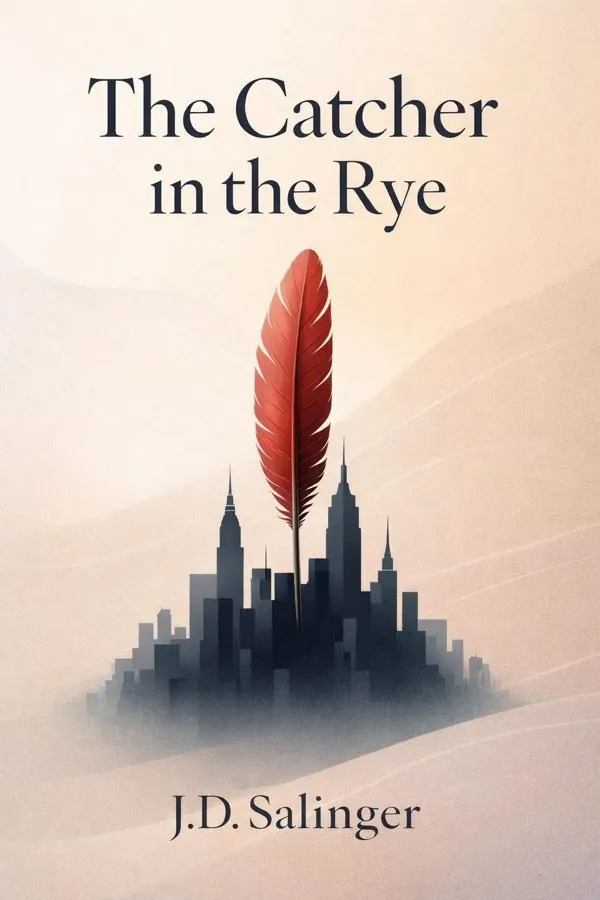
The Catcher in the Rye: Summary & Key Insights
 10 min9 chaptersAudio available
Key Takeaways from The Catcher in the Rye
Alienation often begins long before someone physically leaves a place; it starts when they no longer believe they belong there.
Freedom without direction can feel less like liberation and more like exposure.
What we protect often reveals what we fear losing in ourselves.
Sometimes the people who reject guidance most fiercely are the ones who need it most.
People often condemn falseness in others most fiercely when they are struggling to define what is true in themselves.
What Is The Catcher in the Rye About?
The Catcher in the Rye by J.D. Salinger is a classics book spanning 4 pages. The Catcher in the Rye follows Holden Caulfield, a sharp, wounded, deeply observant teenager who recounts the days after his expulsion from Pencey Prep. Wandering through New York City in a state of grief, anger, and confusion, Holden speaks in a voice that is casual, funny, defensive, and heartbreakingly sincere. What begins as the story of a boy avoiding school and home becomes a profound exploration of loneliness, innocence, identity, and the pain of growing up in a world that often feels false. The novel matters because it captures an emotional reality many readers recognize: the sense of not fitting in, of craving truth while suspecting that everyone around you is performing. Holden’s contempt for “phoniness” is not just adolescent rebellion; it is a desperate attempt to protect what is genuine and vulnerable in himself and others. First published in 1951, J.D. Salinger’s novel became one of the defining works of modern American literature. Its enduring power lies in how precisely it portrays inner turmoil, making Holden not simply a rebellious youth, but one of fiction’s most memorable witnesses to alienation and fragile hope.
This FizzRead summary covers all 9 key chapters of The Catcher in the Rye in approximately 10 minutes, distilling the most important ideas, arguments, and takeaways from J.D. Salinger's work. Also available as an audio summary and Key Quotes Podcast.
The Catcher in the Rye
The Catcher in the Rye follows Holden Caulfield, a sharp, wounded, deeply observant teenager who recounts the days after his expulsion from Pencey Prep. Wandering through New York City in a state of grief, anger, and confusion, Holden speaks in a voice that is casual, funny, defensive, and heartbreakingly sincere. What begins as the story of a boy avoiding school and home becomes a profound exploration of loneliness, innocence, identity, and the pain of growing up in a world that often feels false.
The novel matters because it captures an emotional reality many readers recognize: the sense of not fitting in, of craving truth while suspecting that everyone around you is performing. Holden’s contempt for “phoniness” is not just adolescent rebellion; it is a desperate attempt to protect what is genuine and vulnerable in himself and others. First published in 1951, J.D. Salinger’s novel became one of the defining works of modern American literature. Its enduring power lies in how precisely it portrays inner turmoil, making Holden not simply a rebellious youth, but one of fiction’s most memorable witnesses to alienation and fragile hope.
Who Should Read The Catcher in the Rye?
This book is perfect for anyone interested in classics and looking to gain actionable insights in a short read. Whether you're a student, professional, or lifelong learner, the key ideas from The Catcher in the Rye by J.D. Salinger will help you think differently.
- ✓Readers who enjoy classics and want practical takeaways
- ✓Professionals looking to apply new ideas to their work and life
- ✓Anyone who wants the core insights of The Catcher in the Rye in just 10 minutes
Want the full summary?
Get instant access to this book summary and 100K+ more with Fizz Moment.
Get Free SummaryAvailable on App Store • Free to download
Key Chapters
Alienation often begins long before someone physically leaves a place; it starts when they no longer believe they belong there. That is exactly the emotional condition Holden Caulfield describes at Pencey Prep. Though surrounded by classmates, teachers, routines, and expectations, he experiences school not as a community but as a performance. He sees smug ambition, shallow values, and empty school pride everywhere he looks. To Holden, Pencey claims to shape boys into admirable men, yet he perceives it as a factory for insincerity.
His expulsion is important, but what matters more is why he fails to connect. Holden is disgusted by students like Stradlater, who appears polished and socially successful, and by Ackley, whose awkwardness also irritates him. Even different personalities feel equally unbearable because Holden is not merely judging people; he is searching for authenticity and finding very little. His contempt becomes a shield. If he rejects the institution first, he does not have to admit how hurt and lost he feels inside it.
This dynamic extends beyond school. Many people experience similar disconnection in workplaces, social groups, or competitive environments where success seems to matter more than sincerity. When someone constantly calls others fake, it may signal moral clarity, but it may also reveal pain, grief, or fear of rejection.
Salinger uses Pencey to show that youthful rebellion is not always simple defiance. Sometimes it is a confused response to environments that reward conformity while neglecting emotional truth.
Actionable takeaway: When you feel intense contempt for a group or system, pause and ask what deeper need lies beneath that reaction—belonging, honesty, safety, or recognition.
Freedom without direction can feel less like liberation and more like exposure. After leaving Pencey early, Holden heads to New York City imagining movement will solve what still hurts inside him. Instead, the city becomes a stage for failed encounters, awkward conversations, and emotional isolation. Hotels, bars, taxis, museums, and late-night streets surround him with people, yet he remains painfully alone.
His wandering reveals a central paradox: he craves human connection while sabotaging it almost every time it appears. He calls old acquaintances, seeks company from strangers, and imagines meaningful conversations, but his mistrust and insecurity quickly turn each interaction brittle. With the women in the hotel lounge, he tries to act worldly and mature, but the exchange is hollow. With the taxi drivers, he asks odd questions about the ducks in Central Park, searching for some reassuring logic in a changing world. With Sally Hayes, he proposes an impulsive escape from society, then ruins the meeting with frustration and volatility.
These encounters matter because they show that loneliness is not simply the absence of people. It can also be the inability to be fully present with them. Holden wants understanding without vulnerability, intimacy without risk, rescue without confession. That emotional pattern is common in moments of distress. People often keep moving, messaging, socializing, or distracting themselves when what they truly need is honest contact.
New York, then, is not just a setting. It is a mirror of Holden’s interior life: crowded, restless, stimulating, and cold. His aimless movement suggests how easily pain can hide inside activity.
Actionable takeaway: If you find yourself constantly busy yet emotionally disconnected, stop chasing distraction and identify one person with whom you can speak honestly, even briefly.
What we protect often reveals what we fear losing in ourselves. For Holden, the emotional center of the novel lies in his bond with his younger siblings, especially Allie and Phoebe. Allie, who died of leukemia, remains preserved in Holden’s memory as pure, kind, and untouched by the falseness of the adult world. Phoebe, still living, embodies intelligence, spontaneity, and emotional honesty. Together, they represent innocence not as naivety, but as sincerity.
Holden’s grief over Allie shapes far more of his behavior than he openly admits. His anger, depression, and erratic decisions are tied to a wound he cannot process. Allie’s death shattered his trust in the world’s fairness. It also made him fiercely protective of children and childhood. That is why Phoebe matters so much. She sees through him, loves him without pretension, and asks direct questions he cannot easily evade. In her presence, Holden is less performative and more real.
This idea culminates in the fantasy from which the novel takes its title: Holden imagines himself as a “catcher in the rye,” standing in a field and saving children from falling off a cliff. It is a moving but impossible dream. He wants to preserve innocence forever, to stop time before children become compromised, disappointed, or wounded.
In everyday life, many people carry their own version of this impulse. They may idealize the past, overprotect loved ones, or resist necessary change because growth feels like loss. But innocence cannot be frozen. It can only be honored.
Actionable takeaway: Notice where nostalgia or protectiveness may be masking unresolved grief, and find a way to remember what you love without trying to prevent all change.
Sometimes the people who reject guidance most fiercely are the ones who need it most. In the latter part of the novel, Holden’s emotional defenses begin to collapse. He grows more exhausted, disoriented, and fragile as his wandering continues. He reaches toward adults for help, but these attempts are complicated. Mr. Antolini offers concern, perspective, and a warning about the self-destructive path Holden is on. Yet even this potentially stabilizing encounter turns uneasy and drives Holden away.
Whether we interpret Mr. Antolini’s behavior as troubling, misunderstood, or both, the scene matters because it captures Holden’s inability to trust care when it finally appears. He wants wisdom, but he fears corruption. He wants shelter, but he expects betrayal. That emotional conflict pushes him closer to breakdown. His fantasy of escaping west, disappearing from society, and living in isolation shows how overwhelmed he has become.
The turning point arrives not through philosophy, but through Phoebe. When she insists on joining him, carrying her suitcase and ready to leave everything behind, Holden is forced to confront the reality of his fantasy. He does not truly want to destroy her life or freeze her development. At the carousel, watching Phoebe reach for the gold ring, he experiences a rare moment of peace. He accepts that children must risk falling in order to grow.
This is the novel’s faint but meaningful hope: not that pain disappears, but that love can interrupt despair and make acceptance possible. Healing begins when Holden stops trying to control innocence and simply witnesses it.
Actionable takeaway: In moments of emotional overload, do not wait for a perfect breakthrough; let one caring relationship, one honest conversation, or one quiet moment ground you back in reality.
People often condemn falseness in others most fiercely when they are struggling to define what is true in themselves. Holden’s favorite accusation is that people are “phony.” He applies it to classmates, actors, school officials, social climbers, romantic partners, and nearly every adult institution he encounters. On one level, his criticism is justified. Salinger gives us plenty of examples of superficiality, vanity, manipulation, and performative behavior. Holden is often perceptive, even brilliant, in spotting hypocrisy.
But the novel complicates his judgment by showing that he, too, performs roles. He lies to strangers, invents identities, exaggerates stories, and shifts his behavior depending on what he wants from an interaction. He mocks pretension while acting sophisticated. He condemns artificiality while constantly hiding his vulnerability. This does not make him a hypocrite in a simplistic sense; it makes him human. He hates phoniness because he senses how easily everyone, including himself, slips into it.
The idea remains strikingly relevant. Modern life rewards self-presentation. Social media, professional branding, networking culture, and everyday politeness all involve performance. The challenge is not to become perfectly pure or unfiltered. It is to distinguish between necessary social roles and the deeper betrayal of one’s values.
Holden’s mistake is that he turns authenticity into an all-or-nothing test. If people are imperfect, he dismisses them. But maturity requires a subtler understanding: someone can be flawed, self-conscious, and still sincere.
Actionable takeaway: Instead of asking whether a person or situation is completely authentic, ask a better question—what feels genuinely felt, and what feels merely performed? That distinction is often more useful than total judgment.
To grow is to lose certain protections, and that loss can feel terrifying. Holden’s dream of being the catcher in the rye captures his deepest wish: to stand between children and the cliff of adulthood, saving them before they fall into corruption, compromise, sexuality, grief, and disappointment. It is one of the most famous images in literature because it expresses a universal desire—to protect innocence from experience.
Yet the novel quietly argues that this goal, however loving, is impossible. Children must move, reach, test, fail, and change. The carousel scene with Phoebe makes this visible. As she rides, reaching for the gold ring, Holden realizes that if children want to grab for it, you have to let them do it. They may fall, but stopping them entirely would mean stopping life itself. This is a profound shift. For perhaps the first time, Holden accepts that care does not equal control.
The insight applies broadly. Parents, teachers, managers, and friends often confuse protection with prevention. We want to spare others pain, but overprotection can also limit growth. Learning requires risk. Emotional maturity requires uncertainty. Authentic living means stepping into a world where disappointment is possible.
For Holden, this realization does not solve everything. He is still fragile. But it opens the door to a more compassionate understanding of adulthood—not as total corruption, but as a condition in which one can still love, remember, and remain sincere despite imperfection.
Actionable takeaway: When you feel compelled to prevent every mistake, ask whether support would serve better than control. Sometimes the healthiest form of love is allowing someone to reach, stumble, and learn.
A narrator can be factually unreliable and emotionally truthful at the same time. Much of The Catcher in the Rye’s power comes from Holden’s voice: conversational, repetitive, digressive, funny, defensive, and intensely alive. He does not present events with calm objectivity. He contradicts himself, exaggerates, avoids certain topics, and circles around what hurts most. Yet these flaws make him more believable, not less.
Salinger uses Holden’s narration to immerse readers in the texture of adolescent consciousness. The constant judgments, side comments, abrupt shifts, and evasions show a mind trying to manage overwhelming feeling through speech. Holden often tells us he does not want to discuss something, and that very refusal becomes revealing. His omissions are clues. His jokes are defenses. His casual tone often masks panic, sorrow, or longing.
This teaches an important reading lesson: truth in literature is not always delivered through clean analysis. Sometimes it appears through voice, rhythm, and what a character cannot say directly. It also offers a practical lesson for listening in real life. People rarely narrate themselves with perfect self-awareness. They may minimize pain, dramatize grievances, or focus on surface details. Still, their deeper emotional reality can emerge through patterns in what they repeat and avoid.
Holden’s voice has endured because it sounds less like polished literary authority and more like a living mind in distress trying to make sense of itself. Readers trust him not because he is always correct, but because his confusion feels real.
Actionable takeaway: When listening to someone—or to yourself—pay attention not only to the facts being stated, but to recurring themes, evasions, and emotional tones. They often reveal the deeper truth.
Some characters endure because they say what many people once felt but could not articulate. Holden Caulfield continues to matter across generations because his struggles are not limited to 1950s America or prep-school life. He embodies familiar tensions: wanting independence but fearing isolation, longing for sincerity but distrusting intimacy, criticizing society while feeling unable to live outside it.
Readers return to the novel at different ages and find different books inside it. Younger readers often recognize Holden’s anger, sensitivity, and disgust with hypocrisy. Older readers may notice more clearly his grief, mental exhaustion, and need for care. This shifting perspective is part of the novel’s brilliance. It does not freeze Holden as a symbol of teenage rebellion alone; it allows him to become a study in pain, perception, and the difficult passage toward maturity.
The novel also remains relevant because modern life continues to amplify its themes. Many people feel overwhelmed by performance culture, social comparison, institutional pressure, and emotional loneliness. Holden’s language may belong to another era, but his central questions feel current: How do you stay genuine in a world of roles? How do you mourn what is gone? How do you keep tenderness alive without becoming cynical?
The Catcher in the Rye does not offer neat answers. Its value lies in its honesty. It invites readers to sit with discomfort, contradiction, and vulnerability rather than rushing toward moral certainty.
Actionable takeaway: Revisit books that disturbed or moved you at a younger age; what once sounded like complaint may reveal, on a second reading, a deeper lesson about compassion and emotional survival.
All Chapters in The Catcher in the Rye
About the Author
Jerome David Salinger (1919–2010) was an American writer whose work left a lasting mark on modern literature. Born in New York City, he began publishing short stories in the 1940s and gained widespread recognition for his precise, emotionally layered portrayals of young people and their inner lives. His 1951 novel The Catcher in the Rye became one of the most influential and widely read American books of the 20th century. Salinger also wrote acclaimed collections and stories centered on the Glass family, including Franny and Zooey and Nine Stories. Although celebrated for his literary talent, he became famously reclusive, withdrawing from public life and rarely publishing in his later decades. His reputation endures through prose distinguished by psychological insight, spiritual searching, and unusual sensitivity to alienation, innocence, and modern discontent.
Get This Summary in Your Preferred Format
Read or listen to the The Catcher in the Rye summary by J.D. Salinger anytime, anywhere. FizzRead offers multiple formats so you can learn on your terms — all free.
Available formats: App · Audio · PDF · EPUB — All included free with FizzRead
Download The Catcher in the Rye PDF and EPUB Summary
Key Quotes from The Catcher in the Rye
“Alienation often begins long before someone physically leaves a place; it starts when they no longer believe they belong there.”
“Freedom without direction can feel less like liberation and more like exposure.”
“What we protect often reveals what we fear losing in ourselves.”
“Sometimes the people who reject guidance most fiercely are the ones who need it most.”
“People often condemn falseness in others most fiercely when they are struggling to define what is true in themselves.”
Frequently Asked Questions about The Catcher in the Rye
The Catcher in the Rye by J.D. Salinger is a classics book that explores key ideas across 9 chapters. The Catcher in the Rye follows Holden Caulfield, a sharp, wounded, deeply observant teenager who recounts the days after his expulsion from Pencey Prep. Wandering through New York City in a state of grief, anger, and confusion, Holden speaks in a voice that is casual, funny, defensive, and heartbreakingly sincere. What begins as the story of a boy avoiding school and home becomes a profound exploration of loneliness, innocence, identity, and the pain of growing up in a world that often feels false. The novel matters because it captures an emotional reality many readers recognize: the sense of not fitting in, of craving truth while suspecting that everyone around you is performing. Holden’s contempt for “phoniness” is not just adolescent rebellion; it is a desperate attempt to protect what is genuine and vulnerable in himself and others. First published in 1951, J.D. Salinger’s novel became one of the defining works of modern American literature. Its enduring power lies in how precisely it portrays inner turmoil, making Holden not simply a rebellious youth, but one of fiction’s most memorable witnesses to alienation and fragile hope.
You Might Also Like





Browse by Category
Ready to read The Catcher in the Rye?
Get the full summary and 100K+ more books with Fizz Moment.