
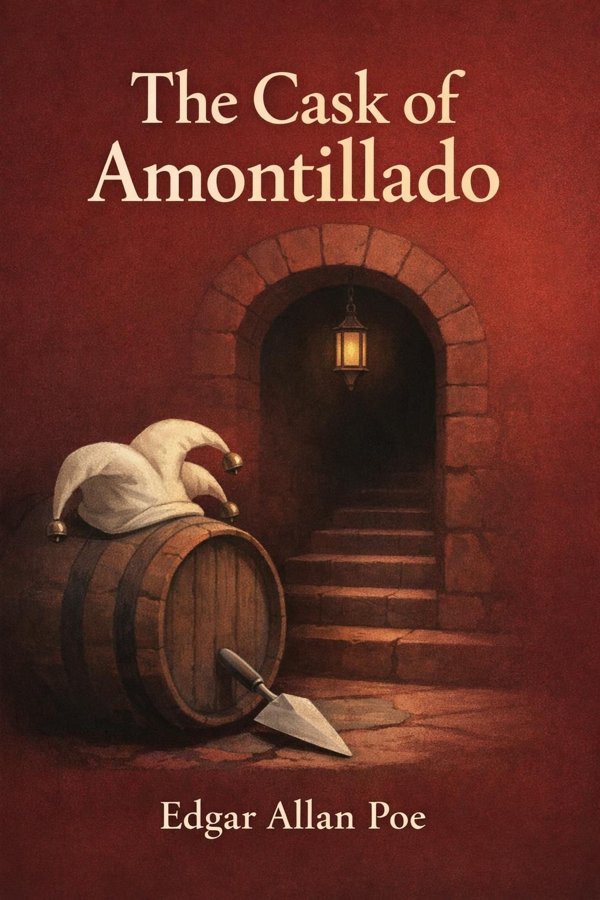
The Cask of Amontillado: Summary & Key Insights
 10 min9 chaptersAudio available
Key Takeaways from The Cask of Amontillado
Some of the most dangerous motives are the ones never fully explained.
The most frightening thing about Montresor is not that he wants revenge; it is that he wants it calmly.
A crowd can hide a crime as effectively as darkness.
People are rarely trapped by force alone; more often, they are trapped by what they need to believe about themselves.
The journey into the catacombs is not just movement through space; it is movement into the darkest chambers of the human mind.
What Is The Cask of Amontillado About?
The Cask of Amontillado by Edgar Allan Poe is a classics book spanning 5 pages. Few stories prove as powerfully as The Cask of Amontillado that terror does not require length to leave a lasting wound. First published in 1846, Edgar Allan Poe’s chilling tale follows Montresor, a man who claims he has endured countless wrongs from Fortunato and now intends to avenge one final insult. His method is elegant, patient, and horrifying: he tempts his victim into the family catacombs with the promise of tasting a rare cask of amontillado. What unfolds is not simply a murder plot, but a masterclass in psychological manipulation, irony, and controlled dread. Poe strips horror down to its essentials: wounded pride, deceptive civility, and a descent into darkness that feels both literal and moral. The story matters because it shows how revenge can masquerade as justice while hollowing out the soul of the avenger. Poe, one of America’s defining writers of the macabre and a pioneer of modern short fiction, demonstrates here why he remains indispensable. In just a few pages, he creates a world of vanity, secrecy, and doom that readers do not easily forget.
This FizzRead summary covers all 9 key chapters of The Cask of Amontillado in approximately 10 minutes, distilling the most important ideas, arguments, and takeaways from Edgar Allan Poe's work. Also available as an audio summary and Key Quotes Podcast.
The Cask of Amontillado
Few stories prove as powerfully as The Cask of Amontillado that terror does not require length to leave a lasting wound. First published in 1846, Edgar Allan Poe’s chilling tale follows Montresor, a man who claims he has endured countless wrongs from Fortunato and now intends to avenge one final insult. His method is elegant, patient, and horrifying: he tempts his victim into the family catacombs with the promise of tasting a rare cask of amontillado. What unfolds is not simply a murder plot, but a masterclass in psychological manipulation, irony, and controlled dread. Poe strips horror down to its essentials: wounded pride, deceptive civility, and a descent into darkness that feels both literal and moral. The story matters because it shows how revenge can masquerade as justice while hollowing out the soul of the avenger. Poe, one of America’s defining writers of the macabre and a pioneer of modern short fiction, demonstrates here why he remains indispensable. In just a few pages, he creates a world of vanity, secrecy, and doom that readers do not easily forget.
Who Should Read The Cask of Amontillado?
This book is perfect for anyone interested in classics and looking to gain actionable insights in a short read. Whether you're a student, professional, or lifelong learner, the key ideas from The Cask of Amontillado by Edgar Allan Poe will help you think differently.
- ✓Readers who enjoy classics and want practical takeaways
- ✓Professionals looking to apply new ideas to their work and life
- ✓Anyone who wants the core insights of The Cask of Amontillado in just 10 minutes
Want the full summary?
Get instant access to this book summary and 100K+ more with Fizz Moment.
Get Free SummaryAvailable on App Store • Free to download
Key Chapters
Some of the most dangerous motives are the ones never fully explained. The Cask of Amontillado begins with one of literature’s most unsettling openings: Montresor declares that he has suffered “a thousand injuries” from Fortunato, but only after an “insult” does he decide on revenge. Poe never tells us what Fortunato actually did. That omission is crucial. It forces readers to live inside Montresor’s mind rather than judge the facts objectively, and it immediately raises doubt about whether his grievance is real, exaggerated, or entirely imagined.
This ambiguity is what gives the story psychological depth. Montresor presents himself as rational, disciplined, and justified. Yet the lack of evidence suggests that revenge often depends less on truth than on personal narrative. People nurse perceived humiliations, replay slights, and turn wounded pride into moral certainty. In modern life, we see smaller versions of this everywhere: office resentments over credit, family feuds rooted in misunderstood remarks, friendships broken by assumptions rather than conversations. The original offense may be unclear, but the emotional injury becomes absolute in the mind of the offended person.
Poe’s insight is that vengeance begins long before the act itself. It starts in interpretation. Once someone decides an insult is unforgivable, every future thought can become part of a private prosecution. Montresor’s confession shows what happens when grievance is protected, polished, and fed in silence.
A practical lesson emerges here: when you feel deeply wronged, examine the story you are telling yourself before acting on it. Ask what happened, what was intended, and what can be clarified. Actionable takeaway: do not let an undefined injury harden into a defining obsession.
The most frightening thing about Montresor is not that he wants revenge; it is that he wants it calmly. Early in the story, he outlines two conditions for successful vengeance: the avenger must punish with impunity, and the wrong must be redressed in a way that makes the victim understand who is responsible. This is not emotional chaos. It is method. Poe transforms revenge from an outburst into a cold philosophy, and that coldness makes Montresor more terrifying than any impulsive villain.
Montresor never shouts, threatens, or reveals hostility. He smiles. He flatters. He appears concerned for Fortunato’s health. He stages every detail so his victim walks willingly toward doom. The story suggests that danger often wears the face of composure. In real life, harmful intentions are not always loud. Manipulators frequently rely on patience, politeness, and strategic restraint. A co-worker may undermine someone gently over time; a toxic acquaintance may use charm as cover for cruelty; a grudge may be pursued through planning rather than confrontation.
Poe also exposes the self-deception embedded in revenge. Montresor imagines himself principled, but his “code” only disguises brutality. He treats revenge as if it were justice with rules, when in truth it is personal hatred seeking satisfaction. This distinction matters because many destructive choices are justified through elegant language. People say they are “setting boundaries,” “teaching a lesson,” or “restoring balance,” when they are really trying to wound.
The practical application is simple but vital: whenever your anger starts sounding especially logical, pause. Rationalized cruelty is still cruelty. Actionable takeaway: if you are planning how to hurt someone while preserving your own image, step back and choose accountability over revenge.
A crowd can hide a crime as effectively as darkness. Poe sets the story during carnival, a season of noise, masks, intoxication, and social inversion. This is more than colorful atmosphere. The public celebration creates perfect private opportunity. While the city gives itself over to laughter and excess, Montresor prepares a murder. The contrast is one of the story’s greatest ironies: above ground, music and merriment; below ground, bones, dampness, and death.
Carnival symbolizes a world where appearances cannot be trusted. Masks conceal identity, costumes blur status, and drunkenness weakens judgment. Fortunato, dressed as a jester, becomes an especially bitter image of self-deception. He thinks he is a connoisseur and a man of influence, yet in the most important moment he is simply a fool led by vanity. Montresor, meanwhile, wears no literal mask, but socially he performs one all the same. He acts as friend while plotting annihilation.
The setting also reflects a timeless truth: dangerous decisions are often made in environments designed to lower vigilance. People take risks at parties, in competitive social scenes, or in moments when everyone else seems carefree. Excess creates blind spots. In business, public hype can obscure fraud. In relationships, charm and spectacle can conceal manipulation. The louder the celebration, the easier it may be to overlook warning signs.
Poe uses carnival to show that disorder does not merely accompany evil; it can enable it. When norms loosen, predatory people gain room to maneuver.
The lesson is practical: do not confuse festive energy with safety or sincerity. Stay alert when emotion, alcohol, status games, or social pressure are running high. Actionable takeaway: in chaotic environments, trust patterns of behavior more than mood, costume, or performance.
People are rarely trapped by force alone; more often, they are trapped by what they need to believe about themselves. Fortunato’s fatal weakness is pride. He wants to be recognized as an expert in wine, and Montresor exploits that desire with exquisite precision. The mention of a rare amontillado is bait, but the deeper hook is rivalry. By suggesting that another man, Luchesi, might judge the wine instead, Montresor ensures that Fortunato cannot resist proving his superiority.
This is one of Poe’s sharpest insights into human behavior. Vanity does not merely make people foolish; it makes them predictable. Fortunato ignores obvious risks because his self-image matters more than his safety. He is drunk, sick, and repeatedly warned about the damp catacombs, yet he presses on. Why? Because pride transforms caution into humiliation. To turn back would feel like surrendering status.
The same mechanism appears constantly in ordinary life. Consumers buy what flatters their identity. Professionals overcommit rather than admit ignorance. Leaders reject good advice because they fear appearing weak. Even online, people are lured into arguments because they need to win publicly. Manipulators understand this well: if you know what someone is desperate to be seen as, you know where to apply pressure.
Poe does not excuse Montresor, but he does show how arrogance collaborates with malice. Fortunato helps construct the path to his own destruction by insisting on his imagined invulnerability.
The practical takeaway is to notice where your ego overrides your judgment. Ask yourself: what compliment, challenge, or rivalry makes me easy to control? Actionable takeaway: whenever you feel compelled to prove yourself, pause and make sure your pride is not steering you into someone else’s trap.
The journey into the catacombs is not just movement through space; it is movement into the darkest chambers of the human mind. Step by step, Montresor leads Fortunato deeper beneath the surface world, away from light, society, and escape. The setting grows colder, more claustrophobic, and more saturated with death, surrounded by bones and nitre. This physical descent mirrors a moral and psychological descent already underway.
Poe’s genius lies in making the external environment reflect internal states. The catacombs are a literal burial place, but they also symbolize secrecy, inherited grievance, and the hidden rot beneath civility. Montresor’s family vaults suggest that his revenge is linked not only to personal resentment but to identity, lineage, and pride. Fortunato, meanwhile, descends laughing and coughing, unable to see that each step narrows his future.
In practical terms, the story captures how harmful choices often happen gradually rather than all at once. People descend into addiction, obsession, corruption, or abusive dynamics one justified step at a time. Each decision feels small enough to continue, until they find themselves in a place they never imagined. That is why the catacombs remain such a powerful image: they represent the slow surrender of perspective.
The descent also asks readers to notice thresholds. At what point could Fortunato have turned back? At what point could Montresor have stopped? Poe implies that terrible ends are often built from many ignored warnings.
The lesson is to recognize downward spirals early. If an action leads you into increasing secrecy, isolation, or moral numbness, take it seriously. Actionable takeaway: when a path keeps drawing you away from clarity, support, and self-respect, stop before the corridor narrows further.
Words can imprison before walls do. Throughout The Cask of Amontillado, Montresor uses language not to communicate truth but to choreograph Fortunato’s behavior. He flatters him, expresses concern for his cough, and repeatedly suggests they should turn back. These offers are not genuine. They are strategic. Each one deepens Fortunato’s commitment by making Montresor appear considerate and by giving Fortunato another chance to prove his toughness and expertise.
This is manipulation in its most refined form. Montresor never needs force because he controls the emotional frame of the interaction. He creates a situation in which Fortunato feels chosen, needed, and challenged. Even the repeated mention of Luchesi functions like a psychological lever, turning Fortunato’s insecurity into obedience. Poe shows that speech can guide people toward choices they mistakenly experience as their own.
This idea remains highly relevant. In modern settings, manipulative language often comes wrapped in politeness: “I’m only saying this because I care,” “You’re the only one who can do this,” or “If you walk away now, what will people think?” Sales tactics, toxic relationships, and political messaging alike can exploit pride, fear, and social identity through carefully framed words.
Poe’s story reminds us that sincerity and friendliness are not the same thing. Someone can speak gently while engineering harm. Listening critically means paying attention not just to tone, but to effect. Are the words giving you freedom, or narrowing your options?
The practical takeaway is to watch for language that flatters while pressuring you, or that presents risk as proof of loyalty or competence. Actionable takeaway: when someone’s words make you feel both special and cornered, pause and ask whose interests are really being served.
The story’s climax is terrifying because it turns a psychological threat into a physical fact. When Montresor chains Fortunato inside the niche and begins building the wall that will seal him in, Poe gives horror a shape readers can see and hear: stone, mortar, bells, and narrowing space. The act is methodical, almost mundane in its details, which makes it more dreadful. Evil here is not explosive. It is brick by brick.
This scene works so powerfully because it strips away all remaining illusions. Until this point, Fortunato may still seem protected by social familiarity, by disbelief, or by the absurdity of the situation. But the wall makes denial impossible. It is the materialization of Montresor’s long-nursed hatred. It also dramatizes a broader truth: emotional cruelty often becomes most devastating when it takes form in irreversible action. Resentment, if fed long enough, eventually seeks structure.
The wall can also be read symbolically. People construct emotional walls out of bitterness, silence, and punishment. Relationships are sealed off by contempt. Institutions trap people through systems built one policy at a time. Personal isolation can likewise become self-built, the result of choices repeated until no easy exit remains. Poe condenses all of that into one unforgettable image.
Even Montresor’s momentary hesitation when he hears Fortunato’s cries does not become remorse; he suppresses it and continues. That detail matters. It shows how easily a person can mistake persistence for strength once they have invested themselves in wrongdoing.
The practical lesson is to take the early stages of cruelty seriously, before they harden into actions that cannot be undone. Actionable takeaway: if your anger is moving from fantasy toward concrete steps, interrupt it immediately and seek distance, perspective, or help.
Time does not always heal; sometimes it preserves. One of the most haunting details in The Cask of Amontillado is that Montresor tells his story half a century after the crime, noting that no one has disturbed Fortunato’s remains. This ending raises a troubling question: why speak now? Is this a proud confession, a private boasting, a deathbed release, or an indirect admission of guilt? Poe refuses to settle the matter, and that uncertainty gives the final line its enduring power.
If Montresor feels no remorse, then the story becomes an example of evil preserved in memory without repentance. If he does feel remorse, it is equally chilling, because fifty years have not cleansed him. Either way, the past remains active. The crime is over, but its meaning is not. This is one reason the story lingers so deeply with readers: it suggests that buried acts are not necessarily finished acts.
In everyday life, people often believe that secrecy will protect them from consequences. A betrayal hidden, a lie uncorrected, a cruelty never acknowledged. Yet memory has its own catacombs. What is concealed from others may continue shaping the self through anxiety, defensiveness, numbness, or obsessive retelling. Silence can preserve guilt just as effectively as exposure can provoke it.
Poe’s ending reminds us that getting away with something is not the same as being free of it. Inner life can become a courtroom with no closing session.
The practical takeaway is to deal honestly with moral injury before it calcifies into identity. Confession, repair, and accountability are painful, but less corrosive than lifelong concealment. Actionable takeaway: if something unresolved still echoes years later, confront it directly rather than mistaking silence for peace.
What gives The Cask of Amontillado its special sting is not only what happens, but how relentlessly Poe arranges irony around it. Fortunato’s name suggests fortune, yet he walks into disaster. He dresses as a jester, unaware that he himself is the fool. Montresor toasts to Fortunato’s long life while leading him to death. The supposed quest for refined wine ends in a living burial. Even the setting of carnival, a time of celebration, intensifies the horror by contrast.
Irony matters here because it reveals the gap between appearance and reality, confidence and danger, language and intention. Poe builds the entire story on this gap. Readers see what Fortunato cannot, and that dramatic irony creates dread long before the final wall is sealed. We are trapped in the painful knowledge that every polite exchange carries a hidden edge.
Beyond the story, irony is one of the most useful tools for understanding human behavior. People often move through life trusting labels, titles, rituals, and familiar manners. Yet status does not guarantee wisdom, friendliness does not guarantee safety, and confidence does not guarantee control. Much suffering comes from mistaking the surface meaning of events for their actual direction.
Poe’s artistry also shows why short fiction can be so powerful. Every image, name, and line of dialogue contributes to a tightly coiled pattern. Nothing is wasted. The result is a story that rewards rereading because its ironies deepen once you know the ending.
The practical lesson is to read situations on more than one level. Ask not only what is being said, but what is being set up. Actionable takeaway: when words, settings, or symbols seem too neatly reassuring, look again for the hidden contradiction.
All Chapters in The Cask of Amontillado
About the Author
Edgar Allan Poe (1809–1849) was an American writer, poet, editor, and literary critic whose work helped define the modern short story and the literature of psychological horror. Born in Boston and marked by hardship from an early age, Poe built a career through fiction, poetry, and criticism, though he struggled financially for much of his life. He became famous for his haunting imagination, musical prose, and fascination with death, guilt, madness, and the uncanny. Among his best-known works are The Raven, The Tell-Tale Heart, The Fall of the House of Usher, and The Cask of Amontillado. Poe also pioneered detective fiction with The Murders in the Rue Morgue. Though his life was brief and troubled, his influence on horror, mystery, and literary style has been immense and enduring.
Get This Summary in Your Preferred Format
Read or listen to the The Cask of Amontillado summary by Edgar Allan Poe anytime, anywhere. FizzRead offers multiple formats so you can learn on your terms — all free.
Available formats: App · Audio · PDF · EPUB — All included free with FizzRead
Download The Cask of Amontillado PDF and EPUB Summary
Key Quotes from The Cask of Amontillado
“Some of the most dangerous motives are the ones never fully explained.”
“The most frightening thing about Montresor is not that he wants revenge; it is that he wants it calmly.”
“A crowd can hide a crime as effectively as darkness.”
“People are rarely trapped by force alone; more often, they are trapped by what they need to believe about themselves.”
“The journey into the catacombs is not just movement through space; it is movement into the darkest chambers of the human mind.”
Frequently Asked Questions about The Cask of Amontillado
The Cask of Amontillado by Edgar Allan Poe is a classics book that explores key ideas across 9 chapters. Few stories prove as powerfully as The Cask of Amontillado that terror does not require length to leave a lasting wound. First published in 1846, Edgar Allan Poe’s chilling tale follows Montresor, a man who claims he has endured countless wrongs from Fortunato and now intends to avenge one final insult. His method is elegant, patient, and horrifying: he tempts his victim into the family catacombs with the promise of tasting a rare cask of amontillado. What unfolds is not simply a murder plot, but a masterclass in psychological manipulation, irony, and controlled dread. Poe strips horror down to its essentials: wounded pride, deceptive civility, and a descent into darkness that feels both literal and moral. The story matters because it shows how revenge can masquerade as justice while hollowing out the soul of the avenger. Poe, one of America’s defining writers of the macabre and a pioneer of modern short fiction, demonstrates here why he remains indispensable. In just a few pages, he creates a world of vanity, secrecy, and doom that readers do not easily forget.
You Might Also Like





Browse by Category
Ready to read The Cask of Amontillado?
Get the full summary and 100K+ more books with Fizz Moment.