
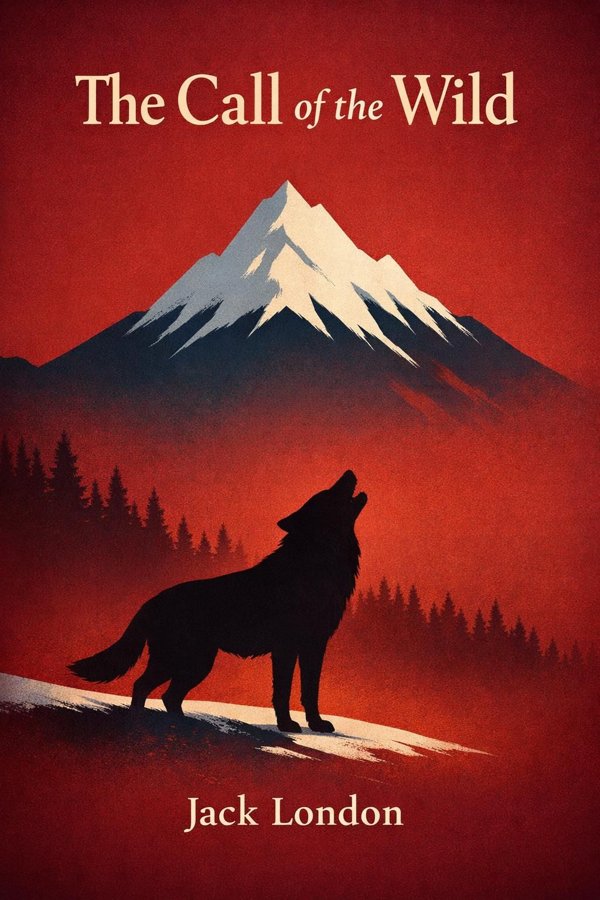
The Call of the Wild: Summary & Key Insights
by Jack London
 10 min8 chaptersAudio available
Key Takeaways from The Call of the Wild
Transformation often begins with rupture, not choice.
Civilization rests on rules; the wilderness strips them down to consequences.
Real strength is often built through repetition, pressure, and necessity.
Leadership is rarely granted to the strong; it is seized by the capable.
Not all suffering comes from nature; much of it comes from human foolishness.
What Is The Call of the Wild About?
The Call of the Wild by Jack London is a classics book spanning 6 pages. Set against the harsh backdrop of the Klondike Gold Rush, The Call of the Wild tells the unforgettable story of Buck, a powerful dog stolen from a life of comfort in California and thrust into the brutal world of northern sled teams. What begins as an adventure quickly becomes something deeper: a study of survival, instinct, power, loyalty, and transformation. As Buck adapts to cold, violence, hunger, and labor, he sheds the habits of domestication and awakens an older, wilder self buried within him. The novel’s emotional force comes from this tension between civilization and primal nature. More than a classic animal story, Jack London’s novel is a fierce meditation on what emerges when comfort is stripped away. London wrote from firsthand experience in the Yukon, and his familiarity with the North gives the book its visceral realism. Snow, starvation, hierarchy, and instinct are rendered with unusual authority. That realism, combined with mythic symbolism, makes The Call of the Wild enduringly powerful. It remains one of the most compelling literary explorations of what it means to survive, to adapt, and to answer the deepest voice within.
This FizzRead summary covers all 8 key chapters of The Call of the Wild in approximately 10 minutes, distilling the most important ideas, arguments, and takeaways from Jack London's work. Also available as an audio summary and Key Quotes Podcast.
The Call of the Wild
Set against the harsh backdrop of the Klondike Gold Rush, The Call of the Wild tells the unforgettable story of Buck, a powerful dog stolen from a life of comfort in California and thrust into the brutal world of northern sled teams. What begins as an adventure quickly becomes something deeper: a study of survival, instinct, power, loyalty, and transformation. As Buck adapts to cold, violence, hunger, and labor, he sheds the habits of domestication and awakens an older, wilder self buried within him. The novel’s emotional force comes from this tension between civilization and primal nature.
More than a classic animal story, Jack London’s novel is a fierce meditation on what emerges when comfort is stripped away. London wrote from firsthand experience in the Yukon, and his familiarity with the North gives the book its visceral realism. Snow, starvation, hierarchy, and instinct are rendered with unusual authority. That realism, combined with mythic symbolism, makes The Call of the Wild enduringly powerful. It remains one of the most compelling literary explorations of what it means to survive, to adapt, and to answer the deepest voice within.
Who Should Read The Call of the Wild?
This book is perfect for anyone interested in classics and looking to gain actionable insights in a short read. Whether you're a student, professional, or lifelong learner, the key ideas from The Call of the Wild by Jack London will help you think differently.
- ✓Readers who enjoy classics and want practical takeaways
- ✓Professionals looking to apply new ideas to their work and life
- ✓Anyone who wants the core insights of The Call of the Wild in just 10 minutes
Want the full summary?
Get instant access to this book summary and 100K+ more with Fizz Moment.
Get Free SummaryAvailable on App Store • Free to download
Key Chapters
Transformation often begins with rupture, not choice. At the start of The Call of the Wild, Buck lives as the proud ruler of Judge Miller’s estate in California. He is well fed, admired, and secure, a creature shaped by privilege rather than necessity. Buck has strength, confidence, and dignity, but he has never been tested by real danger. That changes instantly when Manuel, a servant driven by greed, kidnaps him and sells him into the dog trade during the Klondike Gold Rush. In a few brutal scenes, Buck learns that status in one world means nothing in another.
This opening matters because it establishes one of the novel’s central truths: comfort can conceal vulnerability. Buck is not weak, but he is unprepared. He discovers pain, betrayal, and powerlessness for the first time. The violence he encounters is not random; it is instructional. He is beaten into submission by the man in the red sweater, and this moment becomes the first stage of his awakening. Buck learns that force governs this new world and that innocence offers no protection.
The lesson extends beyond Buck. People often assume their current environment reflects their permanent identity. But jobs end, relationships break, and social systems change. Skills that mattered in one setting may suddenly be useless. Like Buck, we may discover that resilience begins when entitlement falls away and adaptation becomes necessary.
Buck’s theft is tragic, yet it is also the event that reveals his buried capacities. Hardship does not create his power from nothing; it exposes what was dormant. Actionable takeaway: do not let comfort convince you that you are fully formed. Build resilience before life forces the lesson.
Civilization rests on rules; the wilderness strips them down to consequences. When Buck arrives in the North and steps into snow for the first time, he enters a world governed by what London calls the law of club and fang. The club represents human domination through superior force. The fang represents the violent struggle among animals for place, food, and survival. Buck quickly learns that morality here is not sentimental. To live, he must observe, adapt, and act with intelligence.
The death of Curly teaches him a horrifying lesson. Her friendly approach to another dog is answered with a savage attack, and once she falls, the pack descends. Buck realizes that in this environment, weakness is fatal and a fall can mean death. He also learns to conserve energy, steal food when necessary, sleep in the snow, and read the moods of dogs and humans alike. These are not signs of corruption but of adaptation.
London’s insight is uncomfortable but profound: survival often depends less on fairness than on awareness. In modern life, the law of club and fang can appear in less literal forms. Workplaces, institutions, and competitive environments reward those who understand unspoken rules. A newcomer who assumes good intentions from everyone may be as naive as Buck was at first. That does not mean becoming cruel; it means becoming perceptive.
Buck’s education is rapid because the cost of ignorance is immediate. He learns that idealism without realism can be disastrous. Strength alone is insufficient; intelligence, timing, and restraint matter just as much. Actionable takeaway: wherever you enter a new environment, study its real rules before assuming your old instincts will protect you.
Real strength is often built through repetition, pressure, and necessity. In the sled teams of the North, Buck is forced into labor unlike anything he has known. He pulls heavy loads across ice and snow, travels long distances, and functions within a disciplined chain of command. At first the work is exhausting and degrading. But over time, labor reshapes him. His body hardens, his senses sharpen, and his mind becomes more alert. He learns not only how to endure work, but how to become excellent at it.
Under capable handlers like François and Perrault, Buck discovers that discipline is not always cruelty. Their methods are stern, but they understand the demands of the trail and value efficiency. Buck begins to take pride in his performance. He studies the routines of the team, masters his position, and gradually develops the stamina and confidence of a true working animal. This is a crucial phase in his evolution because it shows that growth does not come only through violence or instinct. It also comes through structure.
That idea remains relevant. Many people resist hardship when it comes in the form of routine, repetition, or demanding standards. Yet mastery in any field usually emerges from exactly those conditions. Athletes, musicians, entrepreneurs, and leaders all become stronger through consistent effort under pressure. The important distinction is between meaningful discipline and pointless abuse.
For Buck, work becomes a forge. It strips away softness, but it also reveals capability. He is no longer merely surviving; he is becoming formidable. London suggests that effort can awaken a deeper self hidden beneath comfort. Actionable takeaway: stop seeing disciplined effort as punishment. In the right setting, hard work is not just endurance; it is transformation.
Leadership is rarely granted to the strong; it is seized by the capable. Buck’s rivalry with Spitz, the lead dog, is one of the most gripping conflicts in the novel. Spitz represents the old order of the sled team: cunning, experienced, and ruthless. He understands the North and enforces dominance through intimidation. Buck, however, grows steadily in strength and confidence, and the tension between them becomes inevitable. Their conflict is not merely personal. It is a struggle over who is best fit to lead.
Buck does not challenge Spitz impulsively. He undermines him gradually, disrupting discipline and building his own authority within the team. This reveals Buck’s emerging intelligence. He is not just powerful; he is strategic. When the final fight comes, it is brutal and decisive. Buck wins not by blind rage, but by learning from Spitz’s methods and adapting faster. Once he becomes lead dog, the entire team improves. Under his command, they work with greater energy and cohesion.
London makes a sharp point here: true leadership combines strength, skill, and legitimacy earned through results. Titles alone do not create authority. Whether in organizations, communities, or families, people follow those who prove they can carry responsibility and improve outcomes. A leader who rules only by fear may hold power for a time, but a more capable rival eventually emerges.
Buck’s rise also shows that conflict, though uncomfortable, can be necessary when existing leadership becomes oppressive or inadequate. Avoiding every confrontation is not always virtuous. Sometimes growth requires contest. Actionable takeaway: if you want leadership, focus on becoming visibly competent and dependable first, then have the courage to step forward when the moment demands it.
Not all suffering comes from nature; much of it comes from human foolishness. After proving himself under competent handlers, Buck passes into the hands of less capable masters. This decline culminates with Hal, Charles, and Mercedes, whose vanity, inexperience, and refusal to learn make them disastrously unfit for the North. They overload the sled, waste supplies, mistreat the dogs, and ignore practical advice. Their incompetence turns hardship into catastrophe.
This section is one of London’s clearest critiques of sentimentality without judgment. Mercedes is emotional but not helpful. Hal is aggressive but not wise. Charles is passive and ineffective. Together they represent a dangerous combination: people who enter a harsh environment with ego, illusions, and no respect for reality. The dogs suffer for their mistakes. Buck, already hardened by experience, recognizes the danger before they do. When he finally refuses to move onto the thawing ice, his resistance is an act of instinctive wisdom.
The episode has broad relevance. In many areas of life, poor leadership does more damage than difficult conditions. A tough project can be manageable under competent guidance, while a simple task becomes destructive under confused authority. Teams, businesses, and families often endure needless pain because those in charge lack humility and refuse to listen.
Buck’s endurance under cruel masters also reveals an important limit: resilience is admirable, but it cannot redeem every system. Some situations are fundamentally unsafe and must be escaped, not endured indefinitely. John Thornton’s intervention saves Buck precisely because he recognizes this line. Actionable takeaway: learn to distinguish between hard conditions that build you and dysfunctional conditions that destroy you, and leave the latter as soon as you can.
Even in a brutal world, love can still shape destiny. John Thornton enters the novel at Buck’s lowest point, rescuing him from certain death after Hal and his companions drive the dogs toward disaster. Unlike many of Buck’s previous masters, Thornton is not defined by exploitation. He is firm, experienced, and deeply humane. Under his care, Buck recovers physically and emotionally, and for the first time since Judge Miller’s estate, he forms a bond based on trust rather than fear.
This relationship matters because it complicates the novel’s central tension between civilization and wildness. Thornton does not represent the soft, sheltered world Buck left behind. He is himself a man of the wilderness, but one who combines strength with compassion. Buck’s devotion to him is absolute. He saves Thornton from drowning, defends him in a fight, and performs astonishing feats of strength for him, including the famous scene in which he pulls a thousand-pound load. These acts are not mere obedience. They are expressions of loyalty rooted in affection.
London suggests that love does not weaken strength; it can intensify it. In human life, supportive relationships often unlock courage, discipline, and sacrifice that isolation never could. A respected mentor, trusted partner, or loyal friend can become the anchor that allows a person to flourish in difficult conditions.
Yet Thornton also represents the last tie holding Buck to the human world. That is what makes the bond so moving. It is genuine, but not final. Buck’s deeper nature continues to stir beneath it. Actionable takeaway: value the rare relationships that strengthen rather than diminish you, because real loyalty can become one of the greatest forces in your life.
Sometimes growth feels less like becoming someone new and more like remembering someone ancient. As Buck spends more time in the wilderness, he begins to experience something beyond adaptation. He senses a deep, inherited memory rising within him, as if the lives of his wild ancestors still echo in his blood. London presents this not as fantasy alone, but as a symbolic truth about instinct. Beneath habit and training lies an older layer of identity shaped by generations of struggle.
Buck’s dreams of the primitive world, his fascination with the forest, and his attraction to the wolf all point toward this awakening. The wild does not simply tempt him; it recognizes him. He becomes a superb hunter, more independent, more silent, and more attuned to nature’s rhythms. What once seemed like regression is revealed as another form of mastery. Buck is not losing himself. He is recovering a buried inheritance.
This idea resonates because people often sense a divide between social roles and deeper inclinations. Modern life encourages performance, conformity, and routine, yet many feel called toward something more elemental: meaningful work, direct experience, solitude, physical challenge, artistic truth, or spiritual depth. London gives that feeling dramatic form through Buck’s transformation.
The novel does not argue that civilization is fake and instinct is always pure. Rather, it suggests that ignoring the deepest parts of oneself carries its own cost. Buck becomes fully alive when he stops resisting what his nature demands. Actionable takeaway: pay attention to the recurring impulses, talents, and longings that make you feel most vividly yourself; they may point toward a truer way of living.
The most decisive changes happen when there is no path back. After Buck’s bond with John Thornton reaches its height, the novel moves toward tragedy. While Buck ranges farther into the wilderness and grows more skilled as a hunter, his attachment to Thornton remains the final bond tying him to humanity. When Thornton is killed by Yeehat warriors, that bond is severed. Buck’s grief is violent and total. In avenging Thornton, he completes his last act of human loyalty. After that, nothing remains to hold him in the old world.
Buck’s final movement into the wild is not a simple escape or a romantic victory march. It is a surrender to a truth that has been building throughout the novel. He joins the wolves, becomes a legendary presence in the forest, and is remembered by the Yeehats as a ghostlike creature of fear and power. He has answered the call completely. Civilization has not been defeated in an argument; it has become irrelevant to the being Buck has become.
This ending gives the novel its mythic force. It suggests that identity may ultimately demand sacrifice. To become fully oneself, one may have to lose comforting attachments, accepted roles, or familiar worlds. Such losses are painful, but they can also clear the way for a more authentic existence.
In contemporary life, answering the call of one’s deeper nature may not mean abandoning society for the forest. It may mean leaving a false career, ending a deadening pattern, or choosing a life that feels more honest. Actionable takeaway: when you know a former version of your life no longer fits, stop clinging to it and step fully into what your deepest self requires.
All Chapters in The Call of the Wild
About the Author
Jack London (1876–1916) was an American novelist, journalist, and social critic whose work helped define early modern adventure literature. Born in San Francisco and raised in poverty, he worked a wide range of demanding jobs before becoming a successful writer. His experiences at sea, in industrial labor, and during the Klondike Gold Rush gave his fiction unusual realism and physical intensity. London was fascinated by survival, class conflict, evolution, and the relationship between civilization and primal instinct. He is best known for The Call of the Wild, White Fang, and Martin Eden. Despite his short life, he produced an enormous body of work and became one of the first American authors to achieve worldwide commercial fame.
Get This Summary in Your Preferred Format
Read or listen to the The Call of the Wild summary by Jack London anytime, anywhere. FizzRead offers multiple formats so you can learn on your terms — all free.
Available formats: App · Audio · PDF · EPUB — All included free with FizzRead
Download The Call of the Wild PDF and EPUB Summary
Key Quotes from The Call of the Wild
“Transformation often begins with rupture, not choice.”
“Civilization rests on rules; the wilderness strips them down to consequences.”
“Real strength is often built through repetition, pressure, and necessity.”
“Leadership is rarely granted to the strong; it is seized by the capable.”
“Not all suffering comes from nature; much of it comes from human foolishness.”
Frequently Asked Questions about The Call of the Wild
The Call of the Wild by Jack London is a classics book that explores key ideas across 8 chapters. Set against the harsh backdrop of the Klondike Gold Rush, The Call of the Wild tells the unforgettable story of Buck, a powerful dog stolen from a life of comfort in California and thrust into the brutal world of northern sled teams. What begins as an adventure quickly becomes something deeper: a study of survival, instinct, power, loyalty, and transformation. As Buck adapts to cold, violence, hunger, and labor, he sheds the habits of domestication and awakens an older, wilder self buried within him. The novel’s emotional force comes from this tension between civilization and primal nature. More than a classic animal story, Jack London’s novel is a fierce meditation on what emerges when comfort is stripped away. London wrote from firsthand experience in the Yukon, and his familiarity with the North gives the book its visceral realism. Snow, starvation, hierarchy, and instinct are rendered with unusual authority. That realism, combined with mythic symbolism, makes The Call of the Wild enduringly powerful. It remains one of the most compelling literary explorations of what it means to survive, to adapt, and to answer the deepest voice within.
More by Jack London
You Might Also Like




Browse by Category
Ready to read The Call of the Wild?
Get the full summary and 100K+ more books with Fizz Moment.