
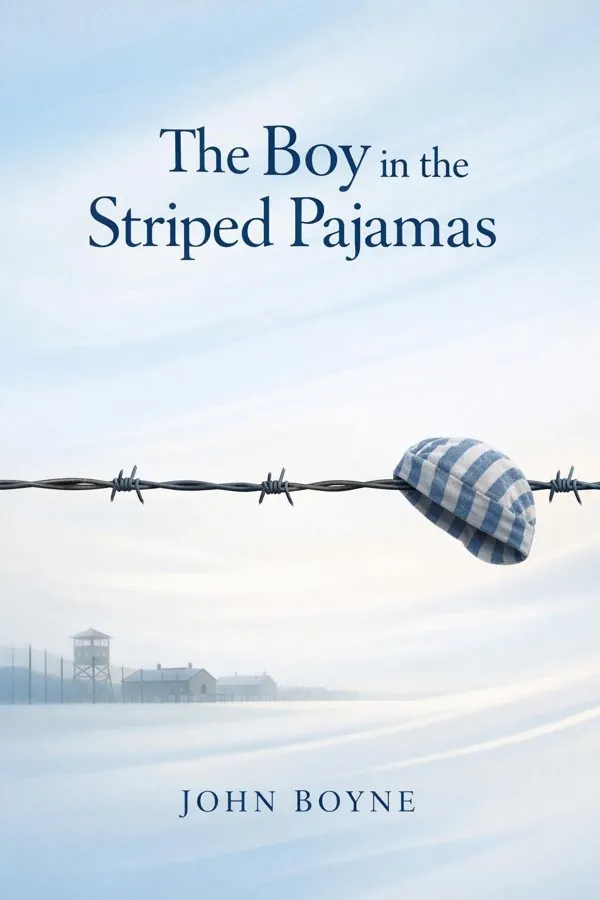
The Boy in the Striped Pajamas: Summary & Key Insights
by John Boyne
 10 min9 chaptersAudio available
Key Takeaways from The Boy in the Striped Pajamas
A child often notices disruption before he understands its cause.
Prejudice rarely appears fully formed; it is taught, repeated, and rewarded.
Friendship can reveal truths that ideology tries to erase.
Not understanding evil does not prevent someone from living alongside it.
A family can remain outwardly orderly even as it rots from moral compromise.
What Is The Boy in the Striped Pajamas About?
The Boy in the Striped Pajamas by John Boyne is a classics book spanning 6 pages. John Boyne’s The Boy in the Striped Pajamas is a modern classic that approaches one of history’s darkest chapters through the limited understanding of a child. Set during World War II, the novel follows eight-year-old Bruno, whose life changes abruptly when his father, a Nazi commandant, is reassigned from Berlin to a lonely house beside a concentration camp. There, Bruno notices a fence stretching endlessly across the landscape and, on the other side, a boy named Shmuel dressed in what Bruno believes are striped pajamas. Their unlikely friendship becomes the emotional center of a story about innocence, blindness, cruelty, and the human cost of ideology. What makes the novel so powerful is not historical explanation but moral contrast: a child’s ordinary needs for companionship and fairness set against a system built on dehumanization. Boyne, an acclaimed Irish novelist known for emotionally resonant historical fiction, crafts a spare, fable-like narrative that invites readers to reflect on prejudice, obedience, family complicity, and the tragic consequences of refusing to see suffering clearly.
This FizzRead summary covers all 9 key chapters of The Boy in the Striped Pajamas in approximately 10 minutes, distilling the most important ideas, arguments, and takeaways from John Boyne's work. Also available as an audio summary and Key Quotes Podcast.
The Boy in the Striped Pajamas
John Boyne’s The Boy in the Striped Pajamas is a modern classic that approaches one of history’s darkest chapters through the limited understanding of a child. Set during World War II, the novel follows eight-year-old Bruno, whose life changes abruptly when his father, a Nazi commandant, is reassigned from Berlin to a lonely house beside a concentration camp. There, Bruno notices a fence stretching endlessly across the landscape and, on the other side, a boy named Shmuel dressed in what Bruno believes are striped pajamas. Their unlikely friendship becomes the emotional center of a story about innocence, blindness, cruelty, and the human cost of ideology. What makes the novel so powerful is not historical explanation but moral contrast: a child’s ordinary needs for companionship and fairness set against a system built on dehumanization. Boyne, an acclaimed Irish novelist known for emotionally resonant historical fiction, crafts a spare, fable-like narrative that invites readers to reflect on prejudice, obedience, family complicity, and the tragic consequences of refusing to see suffering clearly.
Who Should Read The Boy in the Striped Pajamas?
This book is perfect for anyone interested in classics and looking to gain actionable insights in a short read. Whether you're a student, professional, or lifelong learner, the key ideas from The Boy in the Striped Pajamas by John Boyne will help you think differently.
- ✓Readers who enjoy classics and want practical takeaways
- ✓Professionals looking to apply new ideas to their work and life
- ✓Anyone who wants the core insights of The Boy in the Striped Pajamas in just 10 minutes
Want the full summary?
Get instant access to this book summary and 100K+ more with Fizz Moment.
Get Free SummaryAvailable on App Store • Free to download
Key Chapters
A child often notices disruption before he understands its cause. At the beginning of the novel, Bruno lives a comfortable life in Berlin, surrounded by servants, school routines, and familiar streets. That sense of order is shattered when his father receives a promotion and the family must move to a remote place Bruno calls “Out-With,” his childish mishearing of Auschwitz. To Bruno, the transfer feels like an unjust punishment. He does not see his father’s appointment as a career triumph inside a murderous regime; he sees only the loss of home, friends, and freedom.
This contrast is one of the novel’s most important strategies. Boyne places readers inside the limited world of a child so that the setting’s horror emerges indirectly. The new house is bleak, isolated, and lacking the warmth of Berlin. Outside Bruno’s window is a fence, and beyond it are figures in striped clothing moving like shadows. Bruno does not understand that this is a concentration camp, but readers do. The emotional effect comes from that gap in awareness. Bruno’s confusion highlights how systems of violence can be hidden in plain sight when those inside them normalize what they see.
In practical terms, this opening invites readers to think about how privilege can shield people from moral reality. Many harmful systems persist because those who benefit from them experience disruption only when their own comfort changes. Bruno complains about leaving Berlin, but he initially fails to notice the suffering next door.
A useful takeaway is to examine what lies beyond the “fences” in our own lives: what suffering do we ignore because it is inconvenient, distant, or unnamed?
Prejudice rarely appears fully formed; it is taught, repeated, and rewarded. Bruno’s older sister, Gretel, illustrates how ideology enters ordinary life. At first she is merely irritating in the way older siblings often are. But once the family moves to Out-With, she begins to absorb Nazi attitudes more visibly. Her childish interests give way to maps, patriotic symbols, and admiration for Lieutenant Kotler, a young officer whose confidence and authority make hateful ideas seem glamorous rather than monstrous.
Boyne uses Gretel to show that indoctrination does not always rely on deep understanding. Gretel is not a political thinker. She is impressionable, eager to belong, and responsive to status. The adults around her provide a framework in which cruelty is reframed as duty and superiority. This matters because it reveals how prejudice is often sustained not only by fanatics, but by ordinary people who learn what to say, whom to admire, and whom to dismiss.
The novel also contrasts Gretel’s growing hardness with Bruno’s stubborn moral instinct. Bruno remains confused, but he keeps asking basic questions: Who are those people? Why do they wear those clothes? Why can’t they come here? Gretel, by contrast, learns to stop questioning and start repeating. Her transformation suggests that moral failure often begins with intellectual laziness and the desire to fit in.
This dynamic remains highly relevant. Children and adults alike absorb attitudes from families, media, schools, and peer groups. Harmful beliefs often spread through jokes, slogans, stereotypes, and selective silence long before they become explicit policies.
An actionable takeaway is to challenge casual prejudice early. Pay attention to the language, admiration, and social cues that make exclusion feel normal before they harden into belief.
Friendship can reveal truths that ideology tries to erase. Bruno’s meeting with Shmuel at the fence is the emotional heart of the novel. On one side sits a well-fed German commandant’s son; on the other, a starving Jewish boy imprisoned in a concentration camp. Every political and social force in their world insists that they are fundamentally different. Yet when they talk, what emerges first is not difference but similarity: they are the same age, both lonely, both confused by the adult world, and both in need of companionship.
Boyne makes this connection simple on purpose. Bruno and Shmuel do not begin with abstract moral debates. They begin as children who talk about birthdays, homes, families, and daily life. This simplicity is devastating because it exposes the lie at the center of dehumanization. Systems of hatred depend on convincing people that some lives matter less. Bruno’s friendship with Shmuel quietly undermines that claim.
At the same time, their conversations show that innocence is unevenly distributed. Bruno experiences boredom; Shmuel experiences hunger and fear. Bruno can walk away from the fence; Shmuel cannot. Their friendship is genuine, but it is not equal. That imbalance matters because it reminds readers that goodwill alone does not erase injustice. Human connection is essential, yet structures of power still shape what each person risks and what each person suffers.
In everyday life, this idea applies whenever stereotypes collapse through actual contact. Meeting someone across lines of class, race, religion, nationality, or ideology often reveals a shared humanity that labels had concealed. But the novel also cautions us not to romanticize connection while ignoring unequal conditions.
The practical takeaway is to build real relationships across social divisions and let those relationships challenge inherited assumptions, while staying alert to the power differences that shape each person’s reality.
Not understanding evil does not prevent someone from living alongside it. One of the novel’s most unsettling achievements is its portrayal of childhood innocence as both moving and dangerous. Bruno is not cruel in the deliberate way many adults around him are, but neither is he morally clear simply because he is young. He misunderstands what he sees, asks incomplete questions, and often centers his own loneliness over the suffering around him. His innocence protects him from full knowledge, yet it also limits his ability to recognize responsibility.
This distinction matters because readers often mistake innocence for moral purity. Boyne complicates that assumption. Bruno’s ignorance makes him sympathetic, but it also reflects the sheltered environment created by adults who choose what he can see and what he cannot. The child’s perspective allows the novel to present horror indirectly, but it also raises a difficult question: what happens when people remain uninformed inside unjust systems? They may not design cruelty, but their ignorance can help it continue.
The book therefore invites us to think carefully about the ethics of not knowing. In many areas of life, people benefit from arrangements they do not fully understand: exploitative labor, discrimination, exclusion, propaganda, or institutional neglect. Like Bruno, they may not be malicious, but their comfort depends on someone else’s suffering remaining distant or unclear.
A practical application is in education and civic life. We should not assume that good intentions are enough. Children and adults need truthful context, moral language, and historical understanding if they are to recognize injustice when they encounter it.
The actionable takeaway is simple but demanding: do not confuse innocence with virtue. Ask harder questions, seek fuller knowledge, and remember that moral responsibility grows when the truth is available but unexplored.
A family can remain outwardly orderly even as it rots from moral compromise. Bruno’s household at Out-With is marked by increasing tension, and those fractures reveal the different ways people accommodate evil. His father embodies loyalty to authority and career advancement. He presents himself as disciplined and necessary, a man fulfilling his role. Bruno’s mother, by contrast, gradually senses the horror surrounding them, yet her objections remain hesitant and constrained. She is disturbed, but not decisive. Gretel adapts. Bruno questions. The result is a home in which no one fully speaks the truth, and that silence becomes its own form of damage.
Boyne uses these domestic tensions to show that large historical crimes are sustained through private choices. The novel does not depict evil only in dramatic public acts; it shows it in dinner conversations, marital strain, uneasy glances, and what goes unsaid in front of children. The father’s authority depends not just on orders from above, but on emotional compliance within the home. The mother’s discomfort matters, yet her inability to confront the system decisively demonstrates how conscience can fail when it remains purely private.
This idea has practical resonance beyond the novel. In workplaces, communities, and families, people often notice wrongdoing before they openly name it. They may soften language, avoid conflict, or hope someone else will act. Over time, that evasion corrodes trust. Relationships become structured around what must not be acknowledged.
The family in The Boy in the Striped Pajamas reminds us that neutrality is rarely neutral inside an unjust system. Silence protects power. Hesitation enables harm. Even those who are not direct perpetrators can contribute to a moral atmosphere in which truth becomes difficult to speak.
The actionable takeaway is to notice where silence governs your own circles. When something is wrong, name it clearly before denial hardens into routine.
Great evil is often carried out through ordinary humiliations. Two secondary characters, Lieutenant Kotler and Pavel, help Boyne show how oppression works at the level of daily behavior. Kotler is young, polished, and confident. He is not a distant symbol of ideology but its socially acceptable face: impatient, contemptuous, casually brutal. Pavel, a Jewish prisoner reduced to servitude in Bruno’s home, represents the stripping away of identity. Once a doctor, he is now treated as inferior labor, his knowledge and dignity denied by a system that reclassifies human beings according to racist doctrine.
The scenes involving these characters are especially revealing because they show how violence is normalized. Kotler’s cruelty is not presented as an extraordinary eruption; it is embedded in routine interactions. Pavel’s degradation is visible, yet the household largely absorbs it into daily life. Bruno senses discomfort without grasping the full meaning, while readers see the moral obscenity of what is happening.
This is one of the book’s sharpest insights: dehumanization depends on repetition. People become accustomed to seeing someone interrupted, insulted, underfed, overworked, or physically harmed. Once abuse becomes familiar, it begins to disappear into the background. That is true in extreme historical settings, but also in less dramatic modern contexts such as bullying, workplace exploitation, racial profiling, or the mistreatment of vulnerable workers.
A practical application is to pay attention not only to laws and institutions, but to habits of everyday disrespect. Watch how people speak to those with less status. Notice who is ignored, diminished, or treated as disposable. Systems are revealed in small interactions before they are understood in grand theories.
The takeaway is to treat daily cruelty as morally significant. Challenge contempt in ordinary moments, because what becomes routine can become catastrophic.
The most tragic choices are sometimes made in innocence, but innocence does not soften their consequences. Near the end of the novel, Bruno decides to crawl under the fence and join Shmuel inside the camp to help search for Shmuel’s missing father. It is a child’s decision shaped by loyalty, curiosity, and a simplistic faith that friendship can overcome danger. For Bruno, crossing the fence feels like an adventure and a promise fulfilled. For readers, it is almost unbearable because the symbolic barrier has always represented a moral and historical abyss Bruno cannot comprehend.
This scene brings the novel’s themes into a single devastating movement. Bruno has spent the story peering at suffering without understanding it. The moment he enters the camp, the distance disappears. Confusion becomes exposure. The child who had lived beside atrocity is finally consumed by it. Boyne uses this ending not merely for shock, but to demonstrate that no one can remain safely adjacent to dehumanization forever. The systems people build to harm others eventually implicate, deform, or destroy more lives than their architects imagine.
The crossing also deepens the novel’s critique of abstraction. Bruno’s father helped administer the camp as a matter of duty and rank. But ideology becomes personal when his own child vanishes into the machinery he served. That reversal does not erase the victims who were there long before Bruno, yet it exposes the moral blindness of believing one can control evil from a safe distance.
In practical terms, the lesson extends beyond history. Harmful systems are often defended as manageable, temporary, or targeted only at others. The novel rejects that illusion.
The actionable takeaway is to oppose unjust structures before they expand beyond the boundaries people imagine will contain them.
Some losses arrive too late to educate the people who needed to learn earlier. After Bruno disappears, the novel enters a quieter but equally devastating phase. The family is left with absence, uncertainty, and eventually recognition. Bruno’s mother unravels under grief. Gretel changes in ways that suggest guilt and emotional disillusionment. Most importantly, Bruno’s father begins to understand what has happened. The fence, the camp, the uniforms, the vanished child: the machinery of destruction he administered has returned its truth to him in the most personal form possible.
Boyne does not offer comforting redemption. The ending is not about moral repair, because some realities cannot be repaired. Instead, it emphasizes reckoning. The silence after Bruno’s disappearance is heavy not only with grief but with belated understanding. This matters because the novel refuses to frame consequences as clean justice. Bruno’s father’s suffering does not balance the suffering of the camp’s prisoners. It simply reveals the emptiness of power, obedience, and self-deception.
This final movement has a broader application. In public life, organizations and individuals often respond to wrongdoing only after visible catastrophe. They act once reputations collapse, harm becomes undeniable, or personal loss forces a reevaluation. Yet delayed recognition is not wisdom; it is evidence that earlier warnings were ignored.
The novel leaves readers with an uncomfortable but necessary truth: moral clarity is most valuable before tragedy, not after it. Reflection that comes only when the damage is irreversible cannot undo what has been done.
The actionable takeaway is to practice early reckoning. Do not wait for personal consequence to take ethical responsibility seriously. Listen to warning signs while action can still matter.
Sometimes simplicity can expose what complexity helps people avoid. Boyne has said that The Boy in the Striped Pajamas was conceived as a fable, and the novel works best when read with that in mind. Rather than offering a detailed historical explanation of the Holocaust, it narrows the focus to a child’s partial view. Bruno mispronounces names, misunderstands titles, and interprets signs of horror through the logic of ordinary childhood. This stylized perspective strips away political argument and leaves readers confronting basic moral contradictions: a fence dividing children, adults justifying cruelty, friendship surviving where ideology says it should not.
This approach helps explain the book’s enduring appeal. The child’s viewpoint creates emotional immediacy and moral clarity. Readers are not invited to admire sophistication; they are invited to feel the obscenity of a world in which one boy can roam freely while another is imprisoned for who he is. The simplicity is therefore strategic. It makes prejudice look as absurd and cruel as it truly is.
At the same time, this fable-like method encourages responsible reading. The novel should not be treated as a complete historical education about the Holocaust. Its power lies in ethical provocation, not exhaustive historical representation. In classrooms and reading groups, it works best alongside factual study, survivor testimony, and historical context that can deepen understanding of what Bruno himself cannot grasp.
In practical terms, the book demonstrates how storytelling can move people toward empathy and reflection in ways that raw information sometimes cannot. Stories can humanize abstract moral problems and open readers to difficult truths.
The takeaway is to use literature as a doorway, not a substitute: let emotionally powerful stories awaken concern, then follow that concern with deeper learning and honest historical inquiry.
All Chapters in The Boy in the Striped Pajamas
About the Author
John Boyne is an Irish novelist born in Dublin in 1971. He studied English literature at Trinity College Dublin and later pursued creative writing at the University of East Anglia. Boyne is best known for The Boy in the Striped Pajamas, a globally successful novel that brought him widespread recognition for his emotionally direct approach to historical fiction. His writing often examines identity, power, memory, morality, and the impact of large political forces on individual lives. In addition to books for younger readers, he has written numerous acclaimed novels for adults across a range of historical and contemporary settings. Boyne’s work has been translated into many languages and adapted for film and stage, establishing him as one of Ireland’s most widely read contemporary authors.
Get This Summary in Your Preferred Format
Read or listen to the The Boy in the Striped Pajamas summary by John Boyne anytime, anywhere. FizzRead offers multiple formats so you can learn on your terms — all free.
Available formats: App · Audio · PDF · EPUB — All included free with FizzRead
Download The Boy in the Striped Pajamas PDF and EPUB Summary
Key Quotes from The Boy in the Striped Pajamas
“A child often notices disruption before he understands its cause.”
“Prejudice rarely appears fully formed; it is taught, repeated, and rewarded.”
“Friendship can reveal truths that ideology tries to erase.”
“Not understanding evil does not prevent someone from living alongside it.”
“A family can remain outwardly orderly even as it rots from moral compromise.”
Frequently Asked Questions about The Boy in the Striped Pajamas
The Boy in the Striped Pajamas by John Boyne is a classics book that explores key ideas across 9 chapters. John Boyne’s The Boy in the Striped Pajamas is a modern classic that approaches one of history’s darkest chapters through the limited understanding of a child. Set during World War II, the novel follows eight-year-old Bruno, whose life changes abruptly when his father, a Nazi commandant, is reassigned from Berlin to a lonely house beside a concentration camp. There, Bruno notices a fence stretching endlessly across the landscape and, on the other side, a boy named Shmuel dressed in what Bruno believes are striped pajamas. Their unlikely friendship becomes the emotional center of a story about innocence, blindness, cruelty, and the human cost of ideology. What makes the novel so powerful is not historical explanation but moral contrast: a child’s ordinary needs for companionship and fairness set against a system built on dehumanization. Boyne, an acclaimed Irish novelist known for emotionally resonant historical fiction, crafts a spare, fable-like narrative that invites readers to reflect on prejudice, obedience, family complicity, and the tragic consequences of refusing to see suffering clearly.
You Might Also Like




Browse by Category
Ready to read The Boy in the Striped Pajamas?
Get the full summary and 100K+ more books with Fizz Moment.