
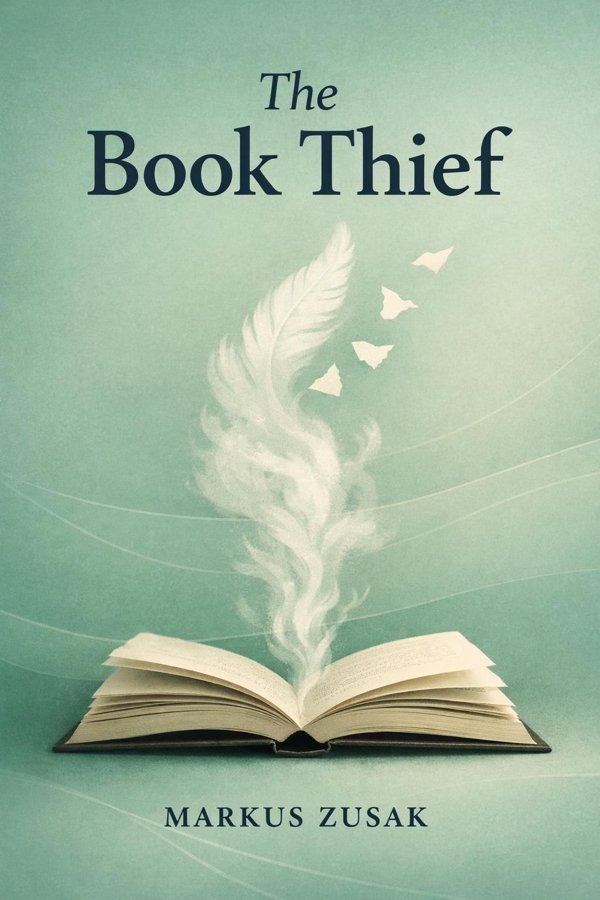
The Book Thief: Summary & Key Insights
by Markus Zusak
 10 min9 chaptersAudio available
Key Takeaways from The Book Thief
One of the novel’s boldest insights is that tragedy can be made clearer, not softer, by an unusual narrator.
A central truth of The Book Thief is that literacy is never just an academic skill; it is a form of power.
Not all bravery looks dramatic.
In oppressive times, friendship is more than companionship; it can become a defense against dehumanization.
Few ideas in The Book Thief are more unsettling than this: survival itself can become a prison.
What Is The Book Thief About?
The Book Thief by Markus Zusak is a classics book spanning 3 pages. Set in Nazi Germany and narrated by Death himself, The Book Thief is a haunting, tender, and unforgettable novel about language, survival, and moral courage. Markus Zusak follows Liesel Meminger, a foster girl sent to live on Himmel Street after family tragedy tears her world apart. In the midst of war, propaganda, hunger, fear, and loss, Liesel discovers an unexpected source of strength: books. She steals them, treasures them, reads them aloud, and gradually learns that words can wound, deceive, comfort, and even save. What makes this novel so powerful is its ability to hold brutality and beauty in the same frame. Zusak explores the ordinary lives caught inside extraordinary evil, showing how small acts of kindness become forms of resistance. Through Liesel’s friendships with Hans and Rosa Hubermann, Rudy Steiner, and Max Vandenburg, the Jewish man hidden in the basement, the novel reveals how love and storytelling preserve humanity when institutions fail it. Markus Zusak, one of Australia’s most acclaimed contemporary novelists, brings lyrical prose, historical sensitivity, and emotional precision to this modern classic. The Book Thief matters because it reminds us that even in history’s darkest hours, words remain powerful enough to destroy—or to heal.
This FizzRead summary covers all 9 key chapters of The Book Thief in approximately 10 minutes, distilling the most important ideas, arguments, and takeaways from Markus Zusak's work. Also available as an audio summary and Key Quotes Podcast.
The Book Thief
Set in Nazi Germany and narrated by Death himself, The Book Thief is a haunting, tender, and unforgettable novel about language, survival, and moral courage. Markus Zusak follows Liesel Meminger, a foster girl sent to live on Himmel Street after family tragedy tears her world apart. In the midst of war, propaganda, hunger, fear, and loss, Liesel discovers an unexpected source of strength: books. She steals them, treasures them, reads them aloud, and gradually learns that words can wound, deceive, comfort, and even save.
What makes this novel so powerful is its ability to hold brutality and beauty in the same frame. Zusak explores the ordinary lives caught inside extraordinary evil, showing how small acts of kindness become forms of resistance. Through Liesel’s friendships with Hans and Rosa Hubermann, Rudy Steiner, and Max Vandenburg, the Jewish man hidden in the basement, the novel reveals how love and storytelling preserve humanity when institutions fail it.
Markus Zusak, one of Australia’s most acclaimed contemporary novelists, brings lyrical prose, historical sensitivity, and emotional precision to this modern classic. The Book Thief matters because it reminds us that even in history’s darkest hours, words remain powerful enough to destroy—or to heal.
Who Should Read The Book Thief?
This book is perfect for anyone interested in classics and looking to gain actionable insights in a short read. Whether you're a student, professional, or lifelong learner, the key ideas from The Book Thief by Markus Zusak will help you think differently.
- ✓Readers who enjoy classics and want practical takeaways
- ✓Professionals looking to apply new ideas to their work and life
- ✓Anyone who wants the core insights of The Book Thief in just 10 minutes
Want the full summary?
Get instant access to this book summary and 100K+ more with Fizz Moment.
Get Free SummaryAvailable on App Store • Free to download
Key Chapters
One of the novel’s boldest insights is that tragedy can be made clearer, not softer, by an unusual narrator. In The Book Thief, Death tells Liesel Meminger’s story, and that choice immediately changes how we read everything that follows. Death is not a monster here. He is weary, observant, and strangely compassionate, especially toward human beings who create suffering and beauty in equal measure. Through his eyes, we meet Liesel as a grieving child traveling to Molching after the death of her brother and the disappearance of her mother.
This opening matters because it frames the novel around loss before it ever becomes a story about hope. Liesel arrives at the Hubermann household carrying trauma she does not yet understand. She is angry, frightened, and illiterate, but she also clings to the first book she steals, The Gravedigger’s Handbook, even though she cannot read it. That act is symbolic: before she has language, she already senses that words hold power over memory and pain.
Death’s perspective also teaches readers to look beyond heroes and villains as simple categories. He sees individuals inside systems, choices inside fear, and tenderness inside catastrophe. In practical terms, this invites us to reconsider how we tell difficult stories in our own lives. Sometimes distance, reflection, or a fresh perspective allows truth to emerge more honestly.
The actionable takeaway: when facing grief or confusion, try changing the frame. Write your experience from another viewpoint, and you may better understand both your pain and your resilience.
A central truth of The Book Thief is that literacy is never just an academic skill; it is a form of power. Liesel’s first stolen book does not matter because of its content alone, but because it becomes the beginning of her relationship with language. At first, she cannot even read it. Hans Hubermann patiently teaches her in the basement, turning letters into refuge and reading into intimacy. What begins as a struggle with vocabulary becomes a pathway to selfhood.
The novel repeatedly shows that words can be used in opposite ways. The Nazi regime weaponizes language through speeches, slogans, and propaganda, shaping what citizens fear and obey. In contrast, Hans uses language to comfort, Max uses it to imagine freedom, and Liesel uses it to connect with others. This tension gives the book much of its force: the same human capacity that spreads lies can also preserve dignity.
In everyday life, this idea remains deeply relevant. We see it in political rhetoric, media narratives, education, and personal relationships. A phrase can stigmatize or encourage. A story can erase someone or help them feel seen. Even private language matters: the way we describe our lives to ourselves influences what we believe is possible.
Liesel’s thefts are not only acts of rebellion; they are acts of reclamation. She takes words out of a culture of control and returns them to human use. Her reading aloud during bomb raids later proves that language can steady terrified people.
The actionable takeaway: pay closer attention to the words you consume and the words you repeat. Choose language that clarifies, dignifies, and strengthens rather than language that manipulates or diminishes.
Not all bravery looks dramatic. One of the novel’s most moving lessons is that decency often appears in small, steady actions rather than grand declarations. Hans Hubermann, Liesel’s foster father, embodies this kind of courage. He is gentle, patient, and flawed, but he repeatedly chooses humanity over comfort. He teaches Liesel to read, plays the accordion to calm her nightmares, and later risks everything by sheltering Max Vandenburg, the Jewish son of a man who once saved his life.
Hans is significant because he resists the moral numbness around him. In Nazi Germany, conformity is rewarded and compassion is dangerous. Yet Hans refuses to let ideology replace conscience. His kindness is not sentimental; it costs him. He loses social standing, faces suspicion, and eventually suffers serious consequences for public acts of empathy.
This matters beyond the novel because most real ethical decisions are not made on battlefields. They happen in homes, workplaces, classrooms, and neighborhoods. We choose whether to speak up when someone is excluded, whether to help a vulnerable person, whether to prioritize safety or principle. Hans reminds us that character is built through repeated, often uncelebrated decisions.
A practical example is standing beside someone who is being treated unfairly even when it is inconvenient. Another is offering patient guidance to a struggling child, student, or colleague. These gestures may seem minor, but they create moral environments where fear has less control.
The actionable takeaway: identify one quiet act of courage you can practice this week—defend, support, teach, or protect someone without needing recognition for it.
In oppressive times, friendship is more than companionship; it can become a defense against dehumanization. Liesel’s bond with Rudy Steiner gives the novel warmth, mischief, and emotional urgency. Rudy is playful, loyal, impulsive, and often hungry, but above all he sees Liesel clearly. Their races through Molching, shared thefts, arguments, and unspoken affection create a pocket of life untouched by official ideology.
What makes their friendship powerful is that it preserves ordinary humanity in a world trying to erase it. The Nazi state demands obedience, hierarchy, and suspicion. Rudy and Liesel answer with jokes, loyalty, and shared risks. They steal potatoes, play soccer, and challenge one another. These acts may seem small, but they reclaim childhood from a culture bent on militarizing it.
The novel also broadens this idea through Liesel’s relationship with Max. Though very different from her bond with Rudy, it is another example of connection resisting fear. Friendship here means seeing another person not as a category but as a full human being.
In modern life, this theme applies whenever systems encourage isolation, competition, or prejudice. Genuine friendship disrupts those pressures by creating trust and empathy. It asks us to show up consistently, especially when someone else is vulnerable.
A practical application is simple but important: check on the friend who seems withdrawn, stand by the peer being mocked, or invest time in relationships that are not transactional. Emotional solidarity has real force.
The actionable takeaway: treat friendship as an active practice. Reach out intentionally, listen deeply, and become the kind of loyal presence that helps another person endure a hard season.
Few ideas in The Book Thief are more unsettling than this: survival itself can become a prison. Max Vandenburg, the Jewish man hidden in the Hubermanns’ basement, lives because others choose courage, yet his existence is marked by confinement, fear, and dependence. Through Max, the novel examines what persecution does not only to bodies but to identity, imagination, and hope.
Max’s presence transforms the household. He is both guest and danger, beloved and burdensome only because the world has made his life illegal. His friendship with Liesel becomes one of the novel’s emotional centers. They exchange stories, dreams, and shared fragility. Max creates handmade books for her, repainting over Mein Kampf pages to produce something humane from something hateful. This is one of the book’s clearest statements about reclaiming language and meaning from violent systems.
The practical relevance is broad. Max’s story encourages readers to think about the hidden lives people may be living around them—those carrying fear, displacement, discrimination, or shame. Not all hiding happens in basements. Some people hide grief, identity, poverty, illness, or trauma because they believe visibility is unsafe.
Supporting such people requires more than sympathy. It demands discretion, empathy, and a willingness to create safe conditions for honesty. In schools and workplaces, that may mean protecting privacy and fostering trust. In communities, it can mean refusing rhetoric that turns vulnerable groups into threats.
The actionable takeaway: look for ways to make your presence safer for others. Ask what someone needs, protect their dignity, and remember that compassion often begins by making room for a hidden person to be seen without fear.
The Book Thief never lets readers forget that words are dangerous when placed in the service of power. Nazi Germany is portrayed not only as a regime of violence but also as a regime of language. Speeches, slogans, school lessons, and public rituals shape what people accept as normal. The book burnings are especially important: they are not just about destroying paper but about controlling imagination, memory, and thought.
Liesel’s life unfolds inside this manipulated verbal landscape. She learns that language can be imposed from above long before she learns how to use it freely herself. This contrast is essential. The state teaches words as tools of obedience; Hans and books teach words as tools of insight and feeling. Zusak is showing that literacy without moral awareness is not enough. People must learn to question narratives, not merely absorb them.
This theme remains urgent today. Propaganda does not disappear when historical periods end; it simply changes form. It may appear in polarizing media, conspiracy theories, misleading headlines, selective storytelling, or emotionally manipulative political messaging. The lesson is not to become cynical about all language, but to become more disciplined in evaluating it.
A practical approach includes asking basic questions: Who benefits from this message? What emotions is it trying to provoke? What facts are omitted? Whose humanity is being denied? These habits create resilience against manipulation.
Liesel’s instinct to steal from a book burning symbolizes intellectual resistance. She senses, even before fully understanding, that destruction of books is also an attack on people.
The actionable takeaway: practice critical reading every day. Slow down before accepting persuasive language, and teach others—especially young readers—to examine how words influence belief and behavior.
Sometimes survival depends less on changing reality than on enduring it together. During air raids and moments of communal fear, Liesel reads aloud to her neighbors, and the effect is profound. The bombs do not stop. Hunger does not disappear. But words organize panic, focus attention, and remind frightened people that they still belong to a human world larger than terror.
This idea is one of the novel’s deepest contributions: storytelling is not an escape from reality but a way of inhabiting reality without being destroyed by it. Liesel’s reading provides structure when everything feels uncertain. It also reveals that stories are social acts. A book read in isolation can comfort, but a story shared aloud can bind a group together.
The same principle applies in many forms today. Families use bedtime stories to create safety. Communities tell collective histories after disasters. Teachers use literature to help students process difficult emotions. Even outside books, a well-told story can restore perspective in moments of confusion or grief.
What matters is not perfection of performance but sincerity of presence. Liesel reads not as an expert but as someone willing to offer steadiness. That is often enough. In workplaces, homes, or friendships, people rarely need a polished speech; they need calm, meaning, and connection.
A practical application might be reading with a child, sharing a meaningful passage with a grieving friend, or using stories to open hard conversations rather than avoiding them. Art can become a shelter when facts alone feel unbearable.
The actionable takeaway: keep one or two stories, poems, or passages close that help create calm and perspective. Use them intentionally when fear, grief, or uncertainty begins to overwhelm you or those around you.
One of the novel’s most painful insights is that people often understand the full value of love only after it is threatened or gone. Death, as narrator, constantly foreshadows loss, and this creates a strange emotional effect: readers are told what is coming, yet they still hope against it. That tension mirrors life itself. We know everything ends, but we continue as if we have endless time to say what matters.
Liesel’s story is marked by repeated separation: from her brother, her mother, moments of safety, and eventually the people who become her true family. Her relationship with Rudy is especially heartbreaking because so much remains unspoken. Their affection lives in gestures, loyalty, teasing, and missed opportunities. By the time the deepest truths are fully felt, time has already narrowed.
This theme is not merely tragic; it is instructive. The novel urges readers to become more deliberate with affection while there is still time. Appreciation delayed too long can turn into regret. We often assume people know how much they matter, but assumption is not expression.
In practical terms, this means saying thank you more clearly, apologizing sooner, and showing care before crisis forces urgency. It can be as simple as writing a note, making a call, or naming what someone has meant to your life. Emotional honesty is a discipline, not just a feeling.
Death’s presence in the novel sharpens this lesson. He does not erase grief; he reveals how precious ordinary days always were.
The actionable takeaway: choose one important person and tell them, specifically and directly, what they mean to you. Do it now, not at some imagined better time.
Near the heart of The Book Thief is a liberating idea: when life feels shaped by forces beyond your control, telling your story can return a measure of power. Liesel is repeatedly acted upon by history—war, ideology, poverty, bereavement. Yet by reading and eventually writing, she becomes more than a victim of events. She becomes an interpreter of them.
Her manuscript, The Book Thief, represents more than memory. It is an act of survival through witness. Writing allows Liesel to organize pain, honor the dead, and preserve the truth of lives that might otherwise be swallowed by destruction. In this sense, storytelling becomes both personal healing and moral record.
This idea matters far beyond the novel. Journaling, memoir, testimony, oral history, and even private reflection can help people process experience. We may not all publish books, but we all create narratives about who we are and what has happened to us. When those narratives remain unexamined, trauma can feel shapeless. When we articulate them, we often discover meaning, connection, and endurance.
A practical example is writing after a major transition or loss. Instead of asking only, “Why did this happen?” try asking, “What did I witness? What changed me? What do I want to carry forward?” These questions move a person from helplessness toward authorship.
Zusak does not claim that writing erases suffering. It does something subtler and equally important: it prevents suffering from having the final word.
The actionable takeaway: begin a simple personal record. Write one page about a difficult experience, focusing not only on what hurt, but on what you learned, protected, or became through it.
All Chapters in The Book Thief
About the Author
Markus Zusak is an Australian author celebrated for his emotionally powerful and stylistically distinctive fiction. Born in Sydney in 1975, he grew up in a working-class family shaped by stories of Europe during and after World War II, influences that later informed The Book Thief. Before becoming internationally known, he published several young adult novels, but it was The Book Thief and I Am the Messenger that established his global reputation. Zusak is especially admired for blending lyrical prose with accessible storytelling, often exploring grief, love, survival, and the moral force of language. His work has been translated into dozens of languages and has reached readers across age groups. He remains one of the most widely discussed contemporary novelists writing at the intersection of literary and crossover fiction.
Get This Summary in Your Preferred Format
Read or listen to the The Book Thief summary by Markus Zusak anytime, anywhere. FizzRead offers multiple formats so you can learn on your terms — all free.
Available formats: App · Audio · PDF · EPUB — All included free with FizzRead
Download The Book Thief PDF and EPUB Summary
Key Quotes from The Book Thief
“One of the novel’s boldest insights is that tragedy can be made clearer, not softer, by an unusual narrator.”
“A central truth of The Book Thief is that literacy is never just an academic skill; it is a form of power.”
“One of the novel’s most moving lessons is that decency often appears in small, steady actions rather than grand declarations.”
“In oppressive times, friendship is more than companionship; it can become a defense against dehumanization.”
“Few ideas in The Book Thief are more unsettling than this: survival itself can become a prison.”
Frequently Asked Questions about The Book Thief
The Book Thief by Markus Zusak is a classics book that explores key ideas across 9 chapters. Set in Nazi Germany and narrated by Death himself, The Book Thief is a haunting, tender, and unforgettable novel about language, survival, and moral courage. Markus Zusak follows Liesel Meminger, a foster girl sent to live on Himmel Street after family tragedy tears her world apart. In the midst of war, propaganda, hunger, fear, and loss, Liesel discovers an unexpected source of strength: books. She steals them, treasures them, reads them aloud, and gradually learns that words can wound, deceive, comfort, and even save. What makes this novel so powerful is its ability to hold brutality and beauty in the same frame. Zusak explores the ordinary lives caught inside extraordinary evil, showing how small acts of kindness become forms of resistance. Through Liesel’s friendships with Hans and Rosa Hubermann, Rudy Steiner, and Max Vandenburg, the Jewish man hidden in the basement, the novel reveals how love and storytelling preserve humanity when institutions fail it. Markus Zusak, one of Australia’s most acclaimed contemporary novelists, brings lyrical prose, historical sensitivity, and emotional precision to this modern classic. The Book Thief matters because it reminds us that even in history’s darkest hours, words remain powerful enough to destroy—or to heal.
You Might Also Like






Browse by Category
Ready to read The Book Thief?
Get the full summary and 100K+ more books with Fizz Moment.