
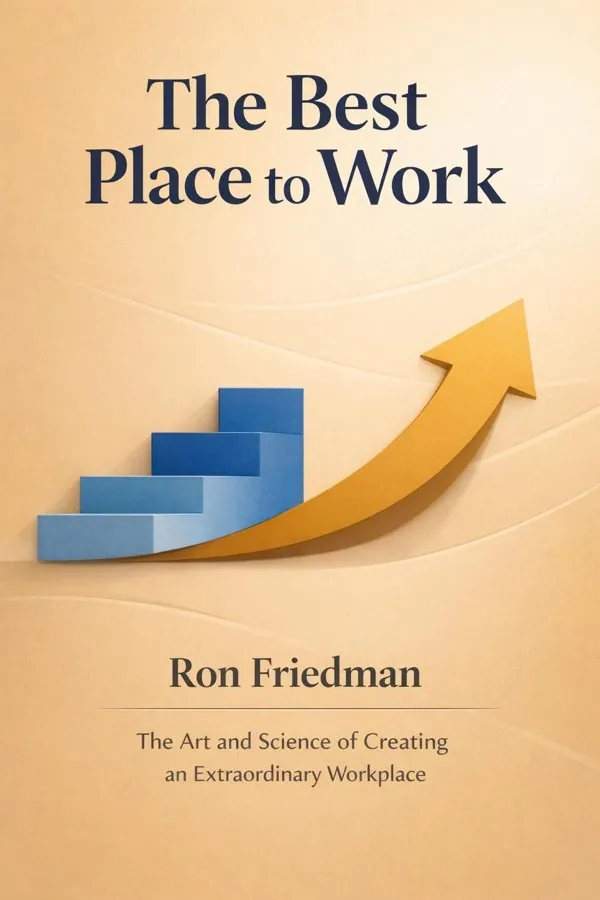
The Best Place to Work: The Art and Science of Creating an Extraordinary Workplace: Summary & Key Insights
by Ron Friedman
 10 min12 chaptersAudio available
What Is The Best Place to Work: The Art and Science of Creating an Extraordinary Workplace About?
The Best Place to Work: The Art and Science of Creating an Extraordinary Workplace by Ron Friedman is a organization book spanning 12 pages. Drawing on the latest research in motivation, creativity, and behavioral economics, Ron Friedman reveals what really makes us happy, productive, and successful at work. The book explores how small changes in environment, management, and culture can dramatically improve employee engagement and performance.
This FizzRead summary covers all 12 key chapters of The Best Place to Work: The Art and Science of Creating an Extraordinary Workplace in approximately 10 minutes, distilling the most important ideas, arguments, and takeaways from Ron Friedman's work. Also available as an audio summary and Key Quotes Podcast.
The Best Place to Work: The Art and Science of Creating an Extraordinary Workplace
Drawing on the latest research in motivation, creativity, and behavioral economics, Ron Friedman reveals what really makes us happy, productive, and successful at work. The book explores how small changes in environment, management, and culture can dramatically improve employee engagement and performance.
Who Should Read The Best Place to Work: The Art and Science of Creating an Extraordinary Workplace?
This book is perfect for anyone interested in organization and looking to gain actionable insights in a short read. Whether you're a student, professional, or lifelong learner, the key ideas from The Best Place to Work: The Art and Science of Creating an Extraordinary Workplace by Ron Friedman will help you think differently.
- ✓Readers who enjoy organization and want practical takeaways
- ✓Professionals looking to apply new ideas to their work and life
- ✓Anyone who wants the core insights of The Best Place to Work: The Art and Science of Creating an Extraordinary Workplace in just 10 minutes
Want the full summary?
Get instant access to this book summary and 100K+ more with Fizz Moment.
Get Free SummaryAvailable on App Store • Free to download
Key Chapters
Most managers believe motivation comes from external rewards—bonuses, promotions, prestige—but science tells us otherwise. In my research, and in the studies I cite throughout this book, motivation is found to be predominantly intrinsic. It stems from within us, from the deep psychological needs for autonomy, mastery, and purpose.
Autonomy is the freedom to choose how we do our work. When we feel trusted to make decisions, our brains interpret that freedom as a form of respect, and we engage more deeply. Micromanagement, by contrast, short-circuits motivation. It erodes ownership and signals distrust. Mastery is our desire to improve, to feel competent, to stretch beyond current abilities. It’s the satisfaction we derive from progress—the thrill of learning something new, of solving a difficult problem, of refining a skill. Purpose ties our efforts to something larger than ourselves. When people understand how their contributions matter, they find meaning even in the mundane.
In high-performing organizations, leaders cultivate these three conditions intentionally. They provide clear goals but flexible methods for achieving them. They design roles that grow with employees’ evolving strengths. They communicate the impact of every project within the broader mission. As a result, work becomes not a transaction, but a source of psychological nourishment.
Understanding motivation at this level transforms the relationship between leader and team. It’s no longer about control; it’s about empowerment. When employees experience autonomy, mastery, and purpose simultaneously, engagement becomes self-sustaining.
The spaces we occupy shape the way we think and behave. Yet too often, workplace design is dictated by cost efficiency rather than cognitive efficiency. In *The Best Place to Work*, I examine how architecture, lighting, color, and sound all affect mood, creativity, and focus.
Open office plans, for instance, promise collaboration but often produce distraction. Research shows that excessive noise reduces productivity and increases stress hormones. On the other hand, modest exposure to ambient sound—like a café’s hum—can boost creative thinking by slightly raising cognitive effort. Lighting matters, too. Natural light improves alertness and emotional health, while poor artificial lighting contributes to fatigue. Even temperature plays a role; a few degrees too hot or cold can sap concentration.
A well-designed space balances stimulation and focus. It offers places to connect and places to retreat. It signals that creativity is valued, that employees are trusted to choose environments that suit their tasks. Organizations that invest in thoughtful design are not simply beautifying their buildings—they are engineering well-being and effectiveness.
+ 10 more chapters — available in the FizzRead app
All Chapters in The Best Place to Work: The Art and Science of Creating an Extraordinary Workplace
About the Author
Ron Friedman, Ph.D., is an award-winning social psychologist specializing in human motivation. He has served on the faculty of the University of Rochester, Nazareth College, and Hobart and William Smith Colleges, and is the founder of ignite80, a consulting firm that helps organizations build extraordinary workplaces.
Get This Summary in Your Preferred Format
Read or listen to the The Best Place to Work: The Art and Science of Creating an Extraordinary Workplace summary by Ron Friedman anytime, anywhere. FizzRead offers multiple formats so you can learn on your terms — all free.
Available formats: App · Audio · PDF · EPUB — All included free with FizzRead
Download The Best Place to Work: The Art and Science of Creating an Extraordinary Workplace PDF and EPUB Summary
Key Quotes from The Best Place to Work: The Art and Science of Creating an Extraordinary Workplace
“Most managers believe motivation comes from external rewards—bonuses, promotions, prestige—but science tells us otherwise.”
“The spaces we occupy shape the way we think and behave.”
Frequently Asked Questions about The Best Place to Work: The Art and Science of Creating an Extraordinary Workplace
The Best Place to Work: The Art and Science of Creating an Extraordinary Workplace by Ron Friedman is a organization book that explores key ideas across 12 chapters. Drawing on the latest research in motivation, creativity, and behavioral economics, Ron Friedman reveals what really makes us happy, productive, and successful at work. The book explores how small changes in environment, management, and culture can dramatically improve employee engagement and performance.
You Might Also Like

A Guide to the Project Management Body of Knowledge (PMBOK® Guide)
Project Management Institute
10 min
Organizational Behavior
Stephen P. Robbins
10 min
Accelerate: The Science of Lean Software and DevOps – Building and Scaling High Performing Technology Organizations
Nicole Forsgren, Jez Humble, Gene Kim
10 min
Awakening Compassion at Work: The Quiet Power That Elevates People and Organizations
Monica C. Worline, Jane E. Dutton
10 min
Building an Inclusive Organization: Leveraging the Power of a Diverse Workforce
Stephen Frost
10 min
Collaborative Intelligence: Thinking with People Who Think Differently
Dawna Markova, Angie McArthur
10 minBrowse by Category
Ready to read The Best Place to Work: The Art and Science of Creating an Extraordinary Workplace?
Get the full summary and 100K+ more books with Fizz Moment.