
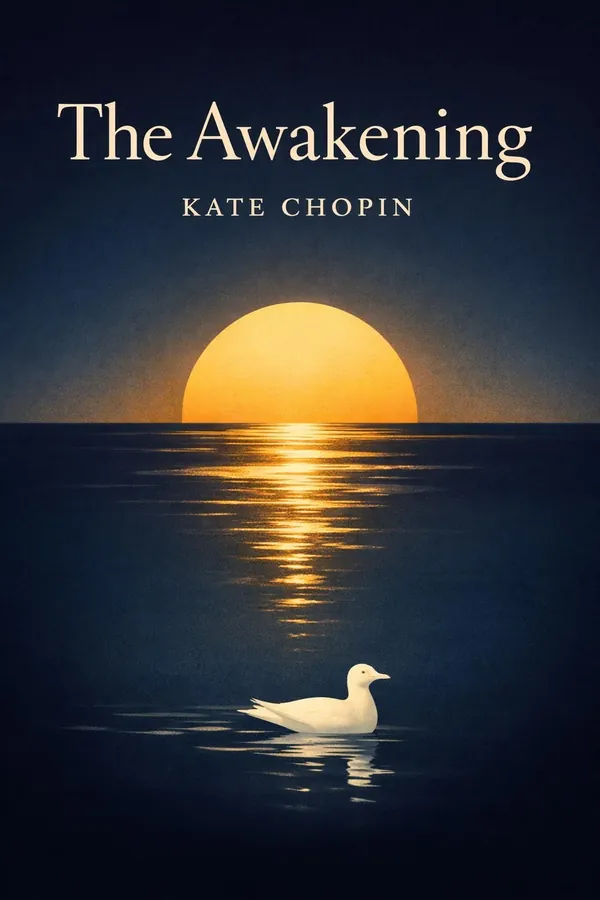
The Awakening: Summary & Key Insights
by Kate Chopin
 10 min8 chaptersAudio available
Key Takeaways from The Awakening
Sometimes the most unsettling prison is the one that looks like a perfectly respectable life.
Transformation often begins not with a dramatic event but with a change in atmosphere.
Awareness becomes most painful when it returns home.
A marriage can be outwardly successful and inwardly suffocating at the same time.
Societies often praise motherhood most fervently when they want to make women disappear inside it.
What Is The Awakening About?
The Awakening by Kate Chopin is a classics book. First published in 1899, The Awakening is Kate Chopin’s daring, elegant novel about a woman who begins to question the life she has been taught to accept. Set in the socially rigid world of late 19th-century Louisiana, the story follows Edna Pontellier as she moves from dutiful wife and mother toward a restless search for identity, desire, freedom, and self-possession. What begins as a subtle dissatisfaction deepens into an emotional, intellectual, and sensual awakening that places her at odds with family, society, and even herself. The novel matters because it confronts questions that remain urgent today: How much of our life is truly chosen? What does independence cost? Can personal truth survive social expectation? Chopin wrote with unusual psychological precision and moral courage, portraying female inner life and sexuality in ways that were scandalous in her time and visionary in ours. Though condemned when it first appeared, The Awakening is now recognized as a foundational work of American literature and an early feminist classic that continues to unsettle, illuminate, and inspire readers.
This FizzRead summary covers all 8 key chapters of The Awakening in approximately 10 minutes, distilling the most important ideas, arguments, and takeaways from Kate Chopin's work. Also available as an audio summary and Key Quotes Podcast.
The Awakening
First published in 1899, The Awakening is Kate Chopin’s daring, elegant novel about a woman who begins to question the life she has been taught to accept. Set in the socially rigid world of late 19th-century Louisiana, the story follows Edna Pontellier as she moves from dutiful wife and mother toward a restless search for identity, desire, freedom, and self-possession. What begins as a subtle dissatisfaction deepens into an emotional, intellectual, and sensual awakening that places her at odds with family, society, and even herself. The novel matters because it confronts questions that remain urgent today: How much of our life is truly chosen? What does independence cost? Can personal truth survive social expectation? Chopin wrote with unusual psychological precision and moral courage, portraying female inner life and sexuality in ways that were scandalous in her time and visionary in ours. Though condemned when it first appeared, The Awakening is now recognized as a foundational work of American literature and an early feminist classic that continues to unsettle, illuminate, and inspire readers.
Who Should Read The Awakening?
This book is perfect for anyone interested in classics and looking to gain actionable insights in a short read. Whether you're a student, professional, or lifelong learner, the key ideas from The Awakening by Kate Chopin will help you think differently.
- ✓Readers who enjoy classics and want practical takeaways
- ✓Professionals looking to apply new ideas to their work and life
- ✓Anyone who wants the core insights of The Awakening in just 10 minutes
Want the full summary?
Get instant access to this book summary and 100K+ more with Fizz Moment.
Get Free SummaryAvailable on App Store • Free to download
Key Chapters
Sometimes the most unsettling prison is the one that looks like a perfectly respectable life. That is the unsettling promise at the heart of The Awakening. Kate Chopin does not present rebellion as a slogan or freedom as a simple reward. Instead, she invites us into the inner life of Edna Pontellier, a woman who gradually realizes that the roles assigned to her as wife, mother, and society lady do not fully contain who she is. Her awakening is emotional, sensual, intellectual, and existential all at once.
What makes the novel enduring is that Edna’s struggle is larger than its historical setting. Most readers know, in some form, what it means to perform a version of themselves that wins approval but feels incomplete. We may not inhabit Creole Louisiana, but we understand scripted identities: the dependable employee, the devoted partner, the pleasing child, the person who never asks too much. Chopin explores what happens when that script begins to crack.
The novel also matters because it resists easy moral lessons. Edna is not a simple heroine, and the world around her is not made of simple villains. Desire brings clarity, but also confusion. Freedom promises fulfillment, but also loneliness. In this sense, The Awakening is not merely about a woman leaving convention behind; it is about the terrifying complexity of becoming conscious of one’s own unmet needs.
A useful way to read the book is to ask yourself: Which parts of my life are chosen, and which are inherited? As you move through Edna’s story, notice where habit, duty, pleasure, and identity collide. Actionable takeaway: use the novel as a mirror—identify one expectation you have accepted uncritically and examine whether it truly belongs to you.
Transformation often begins not with a dramatic event but with a change in atmosphere. On Grand Isle, where much of the novel’s opening unfolds, Edna’s awakening begins almost imperceptibly. The setting is lush, sensuous, and suspended from ordinary routine. Away from the stricter rhythms of urban domestic life, Edna is exposed to new emotional possibilities. The sea, the music, the easy sociability of the resort, and her growing intimacy with Robert Lebrun all work together to loosen the hold of convention.
Grand Isle matters because it becomes the first space in which Edna can feel herself as a person rather than a role. She watches other women, especially Adèle Ratignolle, who embodies the ideal “mother-woman,” and senses both admiration and estrangement. Adèle fits the culture’s expectations beautifully; Edna does not. That difference, once felt, cannot be unfelt. Her learning to swim becomes one of the novel’s most famous moments because it symbolizes self-possession. For the first time, she experiences her own body and will as independent forces.
Chopin is careful to show that awakening is pleasurable and destabilizing. The freedom of Grand Isle does not instantly produce wisdom; it produces sensation, longing, and a new consciousness of possibility. Readers can recognize a similar dynamic in their own lives when travel, friendship, art, or time away from routine suddenly reveals dissatisfactions that had been buried under busyness.
The practical lesson is that environment shapes identity more than we often admit. Sometimes we cannot hear our own thoughts until we step outside familiar expectations. Actionable takeaway: create a small “Grand Isle” in your life—a temporary space, physical or mental, where you can reflect without performing your usual roles.
Awareness becomes most painful when it returns home. After Grand Isle, Edna goes back to New Orleans, but she cannot simply resume her previous existence. The city restores the structures of marriage, motherhood, status, and routine, yet her inner life has changed. Léonce Pontellier continues to judge reality through custom and appearances. To him, Edna’s emotional distance, social irregularity, and indifference to domestic duties look like problems to be corrected. To Edna, they are signs that she can no longer obediently disappear into the role expected of her.
This portion of the novel reveals how conformity is maintained less by overt cruelty than by constant social pressure. Visits must be paid. Homes must be managed. Children must be mothered according to accepted sentiment. Wives must remain pleasing, stable, and legible. Edna’s refusal to perform these rituals consistently becomes a form of dissent, even before she fully understands what she wants instead.
Chopin’s insight here is remarkably modern: once a person has glimpsed a more authentic self, ordinary life can feel strangely unreal. Readers today may experience this after burnout, grief, therapy, or a major life transition. You return to the same office, relationship, or neighborhood, but your tolerance for empty routine has changed. The external world asks for the old version of you; your inner world resists.
Edna’s growing attraction to art, solitude, and independent movement through the city shows that selfhood requires space. Yet space alone does not solve the problem of meaning. Freedom from one script does not automatically supply a new one. Actionable takeaway: when you outgrow an old role, do not mistake discomfort for failure—use it as evidence that your inner life is asking for a more honest structure.
Societies often praise motherhood most fervently when they want to make women disappear inside it. In The Awakening, Chopin addresses one of her culture’s most sacred ideals: the self-sacrificing mother. Through figures like Adèle Ratignolle, the novel shows the beauty and social prestige attached to maternal devotion. But through Edna, it exposes the violence of turning that model into a universal law.
Edna loves her children, yet she does not worship motherhood in the totalizing way her society expects. This makes her appear unnatural within the moral framework of the novel’s world. Chopin’s brilliance lies in refusing sentimental simplification. Edna is neither a monster nor a saint; she is a woman whose identity cannot be exhausted by maternity. That claim was scandalous in 1899 and still unsettles cultures that reward mothers only when they are endlessly self-erasing.
The deeper issue is idealization. When any role is idealized beyond human scale, real people are crushed by it. The perfect mother, perfect spouse, perfect professional, perfect caregiver—these images demand constant sacrifice while punishing ordinary ambivalence, fatigue, and individuality. Edna’s resistance is therefore not merely personal; it reveals the damage caused by impossible standards.
Readers today can see echoes of this in parental guilt, social media performance, and workplace-family balance pressures. The expectation to be wholly available to others often leaves little room for self-development, rest, or complexity.
The novel does not offer an easy solution, but it insists on a crucial truth: care without selfhood becomes spiritual diminishment. Actionable takeaway: if you occupy a caregiving role, list three parts of your identity that exist beyond service to others, and make deliberate time for one of them this week.
Desire is not just about romance; it is often the first language of a buried self. Edna’s awakening is tied to attraction, especially toward Robert Lebrun and later the more overtly sensual Alcée Arobin, but Chopin uses these relationships to explore something deeper than love triangles. Desire awakens Edna to the fact that she possesses an inner life not fully governed by duty. It tells her that she is responsive, imaginative, embodied, and unfinished.
Art plays a parallel role. As Edna turns toward painting, she reaches for a form of expression that does not depend on approval from husband, family, or social code. Creative work gives shape to inwardness. It offers a space where feeling can become visible without first being judged by domestic usefulness. In this sense, art and desire both function as pathways toward self-recognition.
Yet Chopin is too subtle to present either as salvation. Romantic feeling can be projected onto the wrong person. Sensual freedom can become another form of confusion. Artistic aspiration can remain vulnerable to inconsistency and isolation. The point is not that passion solves identity, but that it reveals how impoverished life becomes when passion is denied.
This insight remains practical. Many people discover themselves not through abstract reflection alone but through what intensely moves them—music, writing, attraction, beauty, ambition, spiritual longing. These experiences do not give final answers, but they point toward unlived parts of the self.
A helpful exercise is to track what energizes you and what deadens you. Patterns often reveal values before you can name them. Actionable takeaway: pay attention to one recurring desire—creative, emotional, or sensual—and ask what deeper need for aliveness or expression it may be signaling.
Every vision of freedom carries a warning inside it. Mademoiselle Reisz, the unconventional pianist, is one of the novel’s most important figures because she embodies a life outside feminine respectability. Unlike Adèle Ratignolle, she is not organized around domestic grace, beauty, or maternal warmth. She is solitary, difficult, serious, and artistically committed. To Edna, she represents an alternative existence: one shaped by inner necessity rather than social approval.
But Chopin does not present Reisz as a fantasy of effortless liberation. She is independent, yes, but also isolated. Her life suggests that authenticity may demand sacrifices many admire in theory but resist in practice—loneliness, misinterpretation, instability, and estrangement from the comforting rituals of belonging. This makes her crucial to Edna’s development. She demonstrates that freedom is not simply permission; it is endurance.
Reisz’s famous insistence that “the artist must possess the courageous soul” captures one of the novel’s deepest themes. To live truthfully, especially against dominant expectations, requires resilience. One must withstand ridicule, disappointment, and the temptation to retreat into easier identities. That lesson applies well beyond art. Anyone trying to live differently—changing career paths, leaving a scripted relationship, choosing an unconventional life—must develop tolerance for uncertainty and disapproval.
The practical implication is that longing for freedom is not enough. We must ask whether we are prepared for its psychological costs. Independence without inner strength can become drift.
Actionable takeaway: before making a major life change in pursuit of authenticity, identify the likely costs—social, financial, emotional—and decide which ones you are truly willing to bear.
Some books end by closing questions; The Awakening ends by deepening them. The sea, present from the beginning as a symbol of invitation and dissolution, becomes central to the novel’s final meaning. It represents freedom, sensuality, vastness, and escape from social identity. It is where Edna first experiences bodily autonomy through swimming, and it is where the novel ultimately returns her. The sea’s power lies in its ambiguity: it offers liberation, but also annihilation.
To read the ending well is to resist reducing it to a single message. It is not simply defeat, nor simply triumph. Rather, it reveals the tragic limits of a world that gives Edna no livable form of independence. She cannot comfortably return to convention, but she also cannot fully construct a stable, sustaining life beyond it. Her final act reflects both agency and despair, self-assertion and surrender.
This complexity is why the novel has endured. Chopin refuses to flatter readers with easy emancipation narratives. Becoming conscious is valuable, but consciousness alone does not guarantee survival or belonging. Social structures matter. Material realities matter. Emotional support matters. A person may awaken before society provides room for that awakened self to live.
For modern readers, the ending offers a sobering lesson: freedom must be supported by community, purpose, and practical possibility. Inner truth is essential, but it cannot flourish on symbolism alone.
Actionable takeaway: if you are pursuing a more authentic life, do not focus only on escape—also build the concrete conditions that make freedom sustainable, including relationships, income, structure, and emotional support.
All Chapters in The Awakening
About the Author
Kate Chopin (1850–1904) was an American author whose fiction explored women’s inner lives with a candor that was rare for her time. Born Katherine O’Flaherty in St. Louis, she later lived in Louisiana, an experience that deeply influenced her settings, characters, and attention to Creole culture. Chopin wrote numerous short stories as well as her most famous novel, The Awakening, published in 1899. Although the book was criticized in its own era for its frank treatment of female desire and independence, it was rediscovered in the 20th century and is now considered a classic of American literature. Chopin’s work is celebrated for its psychological insight, elegant prose, and early challenge to the social expectations placed on women, making her a foundational voice in feminist literary history.
Get This Summary in Your Preferred Format
Read or listen to the The Awakening summary by Kate Chopin anytime, anywhere. FizzRead offers multiple formats so you can learn on your terms — all free.
Available formats: App · Audio · PDF · EPUB — All included free with FizzRead
Download The Awakening PDF and EPUB Summary
Key Quotes from The Awakening
“Sometimes the most unsettling prison is the one that looks like a perfectly respectable life.”
“Transformation often begins not with a dramatic event but with a change in atmosphere.”
“Awareness becomes most painful when it returns home.”
“A marriage can be outwardly successful and inwardly suffocating at the same time.”
“Societies often praise motherhood most fervently when they want to make women disappear inside it.”
Frequently Asked Questions about The Awakening
The Awakening by Kate Chopin is a classics book that explores key ideas across 8 chapters. First published in 1899, The Awakening is Kate Chopin’s daring, elegant novel about a woman who begins to question the life she has been taught to accept. Set in the socially rigid world of late 19th-century Louisiana, the story follows Edna Pontellier as she moves from dutiful wife and mother toward a restless search for identity, desire, freedom, and self-possession. What begins as a subtle dissatisfaction deepens into an emotional, intellectual, and sensual awakening that places her at odds with family, society, and even herself. The novel matters because it confronts questions that remain urgent today: How much of our life is truly chosen? What does independence cost? Can personal truth survive social expectation? Chopin wrote with unusual psychological precision and moral courage, portraying female inner life and sexuality in ways that were scandalous in her time and visionary in ours. Though condemned when it first appeared, The Awakening is now recognized as a foundational work of American literature and an early feminist classic that continues to unsettle, illuminate, and inspire readers.
You Might Also Like






Browse by Category
Ready to read The Awakening?
Get the full summary and 100K+ more books with Fizz Moment.