
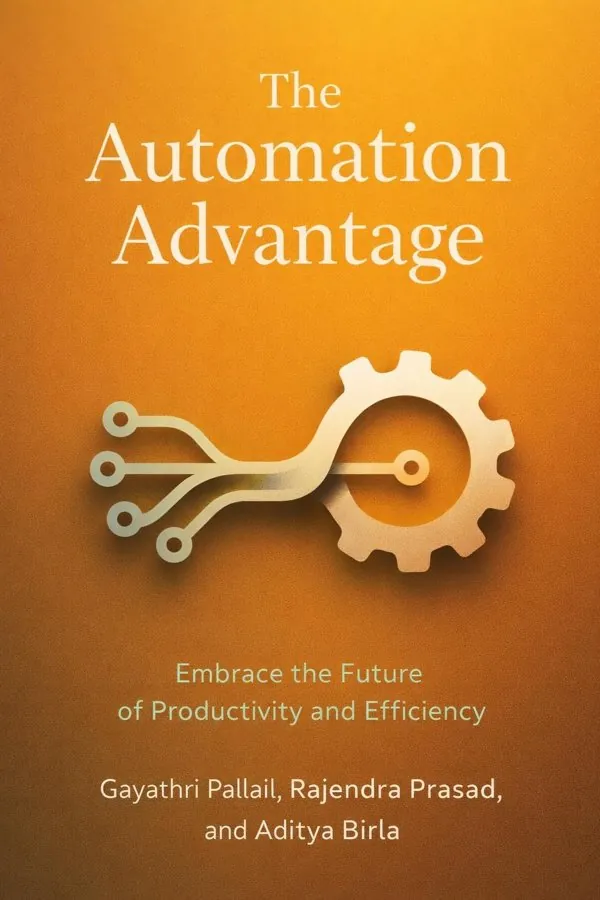
The Automation Advantage: Embrace the Future of Productivity and Efficiency: Summary & Key Insights
by Gayathri Pallail, Rajendra Prasad, and Aditya Birla
 10 min6 chaptersAudio available
What Is The Automation Advantage: Embrace the Future of Productivity and Efficiency About?
The Automation Advantage: Embrace the Future of Productivity and Efficiency by Gayathri Pallail, Rajendra Prasad, and Aditya Birla is a strategy book spanning 6 pages. The Automation Advantage explores how organizations can harness automation technologies to transform business operations, improve efficiency, and drive innovation. The authors, leaders at IBM, provide a practical framework for implementing intelligent automation, integrating AI, and managing change to achieve sustainable competitive advantage.
This FizzRead summary covers all 6 key chapters of The Automation Advantage: Embrace the Future of Productivity and Efficiency in approximately 10 minutes, distilling the most important ideas, arguments, and takeaways from Gayathri Pallail, Rajendra Prasad, and Aditya Birla's work. Also available as an audio summary and Key Quotes Podcast.
The Automation Advantage: Embrace the Future of Productivity and Efficiency
The Automation Advantage explores how organizations can harness automation technologies to transform business operations, improve efficiency, and drive innovation. The authors, leaders at IBM, provide a practical framework for implementing intelligent automation, integrating AI, and managing change to achieve sustainable competitive advantage.
Who Should Read The Automation Advantage: Embrace the Future of Productivity and Efficiency?
This book is perfect for anyone interested in strategy and looking to gain actionable insights in a short read. Whether you're a student, professional, or lifelong learner, the key ideas from The Automation Advantage: Embrace the Future of Productivity and Efficiency by Gayathri Pallail, Rajendra Prasad, and Aditya Birla will help you think differently.
- ✓Readers who enjoy strategy and want practical takeaways
- ✓Professionals looking to apply new ideas to their work and life
- ✓Anyone who wants the core insights of The Automation Advantage: Embrace the Future of Productivity and Efficiency in just 10 minutes
Want the full summary?
Get instant access to this book summary and 100K+ more with Fizz Moment.
Get Free SummaryAvailable on App Store • Free to download
Key Chapters
Automation’s journey mirrors the evolution of technology itself—progressive, cumulative, and profoundly human-driven. In its earliest form, automation was mechanical efficiency. Repetitive, rules-based tasks were delegated to machines or scripted systems, removing manual effort but not changing how decisions were made. We called it robotic process automation (RPA), and while it brought measurable efficiency, its scope was bounded by what was predictable. RPA is where most companies start, but intelligent automation is where transformation truly begins.
Intelligent automation augments traditional RPA with AI, natural language processing, and data analytics. It allows machines to perceive, reason, and learn in real time. Where legacy automation mimicked rules, intelligent automation interprets patterns, makes context-sensitive decisions, and continuously improves. This evolution reflects a philosophical shift: automation is not static execution, but dynamic co-creation with humans.
Consider a bank that once automated loan processing through scripts. With intelligent automation, the same bank can evaluate risk based on unstructured data—emails, social media sentiment, even macroeconomic indicators—producing faster and more personalized decisions. Or imagine a health‑care system deploying virtual assistants not just to schedule appointments but to predict patient needs and optimize care pathways. These examples illustrate the transition from process automation to knowledge automation—a fundamental shift driving competitive advantage.
For organizations, however, the challenge is alignment. Many stumble when they focus on automating processes without transforming the underlying culture or architecture. True automation strategy requires a platform mindset—building ecosystems where data, algorithms, and human judgment interact seamlessly. This is not a technology upgrade; it’s an operating model redesign, setting the foundation for sustainable digital transformation.
The strategic value of automation reveals itself not just in operational speed, but in its compounding impact on innovation. Through our work with enterprises worldwide, we observed a consistent outcome: organizations that embed automation into their core workflows free the cognitive bandwidth of their people. When employees are liberated from repetitive tasks, they can focus on higher-value activities—collaboration, creativity, and customer connection.
In this phase, automation shifts from cost optimization to value creation. It transforms customer experiences—delivering consistency, personalization, and speed at scale. It enables continuous operations across time zones. And, perhaps most importantly, it equips decision-makers with real‑time insights, allowing them to adapt faster than the competition.
Take manufacturing, where predictive automation anticipates equipment failures before they happen. Maintenance shifts from reactive repair to proactive optimization, saving millions in downtime. Or retail, where AI-driven automation personalizes recommendations and supply-chain decisions in microseconds, improving both margins and customer loyalty. Each of these cases demonstrates that automation is not confined to back‑office functions; it is the engine of strategic renewal.
But this only works when automation is governed with clarity. Efficiency gains must be balanced with ethical and operational oversight. Innovation thrives best when data is trusted, processes are transparent, and automation initiatives are aligned with broader organizational goals. When that balance is achieved, automation becomes the catalyst that converts operational work into strategic opportunities.
+ 4 more chapters — available in the FizzRead app
All Chapters in The Automation Advantage: Embrace the Future of Productivity and Efficiency
About the Authors
Gayathri Pallail, Rajendra Prasad, and Aditya Birla are senior executives at IBM with extensive experience in automation, digital transformation, and enterprise technology strategy. They have led global initiatives helping organizations adopt intelligent automation solutions.
Get This Summary in Your Preferred Format
Read or listen to the The Automation Advantage: Embrace the Future of Productivity and Efficiency summary by Gayathri Pallail, Rajendra Prasad, and Aditya Birla anytime, anywhere. FizzRead offers multiple formats so you can learn on your terms — all free.
Available formats: App · Audio · PDF · EPUB — All included free with FizzRead
Download The Automation Advantage: Embrace the Future of Productivity and Efficiency PDF and EPUB Summary
Key Quotes from The Automation Advantage: Embrace the Future of Productivity and Efficiency
“Automation’s journey mirrors the evolution of technology itself—progressive, cumulative, and profoundly human-driven.”
“The strategic value of automation reveals itself not just in operational speed, but in its compounding impact on innovation.”
Frequently Asked Questions about The Automation Advantage: Embrace the Future of Productivity and Efficiency
The Automation Advantage: Embrace the Future of Productivity and Efficiency by Gayathri Pallail, Rajendra Prasad, and Aditya Birla is a strategy book that explores key ideas across 6 chapters. The Automation Advantage explores how organizations can harness automation technologies to transform business operations, improve efficiency, and drive innovation. The authors, leaders at IBM, provide a practical framework for implementing intelligent automation, integrating AI, and managing change to achieve sustainable competitive advantage.
You Might Also Like

Mastery
Robert Greene
10 min
Cut Costs Not Corners: A Practical Guide to Staying Competitive and Improving Profits
Colin Barrow
10 min
Good Strategy/Bad Strategy: The Difference and Why It Matters
Richard P. Rumelt
10 min
On Grand Strategy
John Lewis Gaddis
10 min
The Six Disciplines of Digital Transformation
George Westerman
10 min
7 Powers: The Foundations of Business Strategy
Hamilton Helmer
10 minBrowse by Category
Ready to read The Automation Advantage: Embrace the Future of Productivity and Efficiency?
Get the full summary and 100K+ more books with Fizz Moment.