
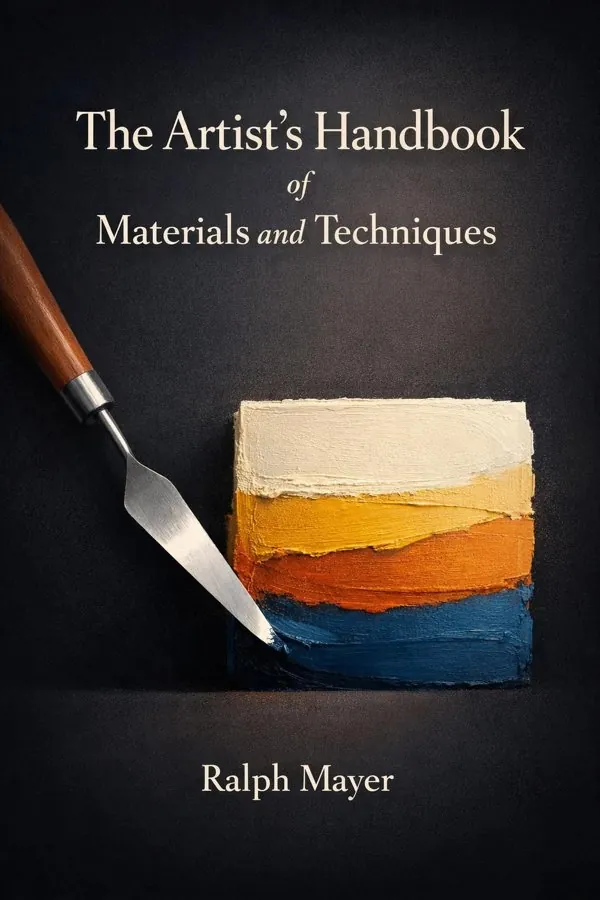
The Artist's Handbook of Materials and Techniques: Summary & Key Insights
by Ralph Mayer
 10 min10 chaptersAudio available
Key Takeaways from The Artist's Handbook of Materials and Techniques
Every artistic material arrives in the studio carrying centuries of trial, error, invention, and failure.
Color in painting is never just visual; it is chemical, structural, and physical.
A pigment without a binder is only colored powder; the binder transforms it into paint and determines much of its behavior.
Many artists think of solvents and painting mediums as harmless helpers, but Mayer shows that they are powerful modifiers whose misuse can compromise an entire painting.
A painting begins long before the first brushstroke, because the support and ground silently govern everything that follows.
What Is The Artist's Handbook of Materials and Techniques About?
The Artist's Handbook of Materials and Techniques by Ralph Mayer is a design book spanning 12 pages. Some art books teach you how to see. Ralph Mayer’s The Artist's Handbook of Materials and Techniques teaches you how to make what you see last. Widely regarded as one of the most authoritative technical references for working artists, the book is a deep, practical guide to the substances and processes behind painting, drawing, and studio practice. Mayer explains what pigments are made of, how oils and resins behave, why one varnish ages well while another fails, and how surfaces, tools, and environment affect the life of a work of art. What makes this handbook so valuable is that it bridges craft and science without losing sight of the artist’s needs. Mayer was not merely a theorist: he was a painter, conservator, and teacher who understood both the demands of studio work and the long-term consequences of poor material choices. His guidance helps artists avoid cracking, fading, discoloration, and structural failure while gaining greater control over texture, color, finish, and permanence. For students, professionals, conservators, and serious hobbyists, this book remains an essential reminder that artistic expression is inseparable from technical knowledge.
This FizzRead summary covers all 10 key chapters of The Artist's Handbook of Materials and Techniques in approximately 10 minutes, distilling the most important ideas, arguments, and takeaways from Ralph Mayer's work. Also available as an audio summary and Key Quotes Podcast.
The Artist's Handbook of Materials and Techniques
Some art books teach you how to see. Ralph Mayer’s The Artist's Handbook of Materials and Techniques teaches you how to make what you see last. Widely regarded as one of the most authoritative technical references for working artists, the book is a deep, practical guide to the substances and processes behind painting, drawing, and studio practice. Mayer explains what pigments are made of, how oils and resins behave, why one varnish ages well while another fails, and how surfaces, tools, and environment affect the life of a work of art.
What makes this handbook so valuable is that it bridges craft and science without losing sight of the artist’s needs. Mayer was not merely a theorist: he was a painter, conservator, and teacher who understood both the demands of studio work and the long-term consequences of poor material choices. His guidance helps artists avoid cracking, fading, discoloration, and structural failure while gaining greater control over texture, color, finish, and permanence. For students, professionals, conservators, and serious hobbyists, this book remains an essential reminder that artistic expression is inseparable from technical knowledge.
Who Should Read The Artist's Handbook of Materials and Techniques?
This book is perfect for anyone interested in design and looking to gain actionable insights in a short read. Whether you're a student, professional, or lifelong learner, the key ideas from The Artist's Handbook of Materials and Techniques by Ralph Mayer will help you think differently.
- ✓Readers who enjoy design and want practical takeaways
- ✓Professionals looking to apply new ideas to their work and life
- ✓Anyone who wants the core insights of The Artist's Handbook of Materials and Techniques in just 10 minutes
Want the full summary?
Get instant access to this book summary and 100K+ more with Fizz Moment.
Get Free SummaryAvailable on App Store • Free to download
Key Chapters
Every artistic material arrives in the studio carrying centuries of trial, error, invention, and failure. Mayer begins from this historical truth: painters do not work with neutral substances, but with materials shaped by traditions of craft, commerce, chemistry, and conservation. Tempera on panel, oil on canvas, fresco on plaster, casein, wax, synthetic polymers—each medium emerged because it solved certain problems and created others. To understand a material fully, an artist must know not only how it performs today but also how it behaved in the hands of earlier makers.
This historical view matters because many technical mistakes come from treating modern supplies as interchangeable. A medieval egg tempera workflow assumes rigid supports and thin, carefully built layers. Traditional oil painting allows richer blending and greater flexibility but introduces issues of drying time, yellowing, and cracking. Industrially manufactured paints made art more accessible, yet they also introduced fillers, extenders, and synthetic substitutes that can change handling and durability. Mayer helps readers see that technique is never abstract; it grows out of the physical properties of real substances.
A practical example is the difference between copying an old-master appearance and copying an old-master method. An artist may desire the luminosity of early panel painting but fail if using unsuitable grounds, flexible supports, or incompatible mediums. Likewise, a restorer who ignores the original material system may cause more damage than repair. Knowing the lineage of a method allows more intelligent adaptation.
The larger lesson is that sound craftsmanship begins with respect for precedent, not blind imitation. Study how materials evolved, compare their strengths and weaknesses, and choose methods that fit both your artistic goal and your working conditions. Actionable takeaway: before starting a major project, identify the historical medium you are emulating and research the support, ground, binder, and finish it was designed to work with.
Color in painting is never just visual; it is chemical, structural, and physical. Mayer treats pigments as the lifeblood of painting, but he insists that artists must understand them as substances with individual temperaments. Two blues may look similar on the palette and behave entirely differently on the canvas. One may be transparent, another opaque; one highly lightfast, another fugitive; one stable in oil, another reactive in certain mixtures. To paint well is partly to know these hidden differences.
Mayer explains that pigments vary in origin, particle size, tinting strength, absorbency, drying influence, toxicity, and permanence. Earth colors often offer reliability and restraint. Cadmiums provide powerful saturation but demand careful handling. Ultramarine can be luminous yet behaves differently from cobalt or phthalo blue in mixtures and transparency. White pigments are especially consequential: lead white, zinc white, and titanium white differ dramatically in flexibility, opacity, and film behavior. These distinctions shape not just hue but cracking tendencies, drying rates, and long-term stability.
Practical application begins with palette design. A disciplined painter might choose fewer pigments but understand them deeply, selecting a limited set that covers warm and cool ranges, glazing options, and durable mixtures. Conservators use similar knowledge to identify why passages have faded or darkened. Even illustrators and designers working traditionally benefit by knowing which colors can survive framing light, humidity, and time.
Mayer’s approach turns color selection into technical judgment. Instead of asking only, “What color do I need?” the artist also asks, “How permanent is it? How opaque? How reactive? In what medium does it perform best?” Actionable takeaway: create a studio chart for every pigment you use, noting lightfastness, transparency, drying behavior, and compatibility, then use that chart to simplify and strengthen your palette.
A pigment without a binder is only colored powder; the binder transforms it into paint and determines much of its behavior. Mayer gives this subject exceptional importance because artists often focus on hue while overlooking the medium that actually forms the paint film. Oil, egg, gum arabic, acrylic polymer, wax, and glue each create a different working experience and a different kind of finished object. The binder affects gloss, flexibility, drying time, saturation, adhesion, and aging.
In oil painting, the choice of drying oil matters: linseed offers strength and durable film formation but may yellow more than poppy or safflower. In watercolor, gum arabic creates delicacy and rewettable transparency, but it depends on absorbent paper and careful handling. In egg tempera, the emulsion dries quickly into precise, matte layers that reward planning rather than improvisation. Acrylics offer versatility and rapid drying but can tempt artists into poor layer management if they mistake speed for simplicity.
Mayer’s key contribution is to show that binders are not merely technical additives; they shape the language of the medium itself. An artist who wants slow blending, deep glazes, and continuous revision will not get the same result from tempera as from oil. A muralist facing environmental stress must think differently from a studio painter making small panels. The binder also governs conservation: a brittle, underbound, or improperly modified paint film may fail regardless of how beautiful the color once appeared.
For practical use, this means matching binder to intention. Portrait painters may value supple oil handling; icon painters may prefer egg tempera’s discipline; designers making flat color studies may rely on gouache or acrylic. Mayer encourages informed choice over habit. Actionable takeaway: when planning a body of work, define the handling qualities and longevity you need first, then choose the binder system that naturally supports those goals rather than forcing one medium to imitate another.
Many artists think of solvents and painting mediums as harmless helpers, but Mayer shows that they are powerful modifiers whose misuse can compromise an entire painting. Turpentine, mineral spirits, resins, oils, driers, and prepared mediums all change viscosity, flow, drying, gloss, and film structure. Used intelligently, they improve control. Used carelessly, they produce weak layers, sunken color, wrinkling, embrittlement, or discoloration. In Mayer’s view, technical sophistication often begins with doing less, not more.
Solvents primarily thin paint and assist cleaning; they do not strengthen the paint film. Excessive dilution can leave underbound passages with poor cohesion. Added oils can increase flexibility and richness, but overuse may slow drying and encourage yellowing. Resinous mediums can enhance gloss and transparency yet become problematic if layered improperly or relied upon for effects they were not designed to support. Fast-drying additives can be useful in specific situations, but indiscriminate use may create brittle surfaces or uneven curing.
A classic practical principle that Mayer reinforces is “fat over lean.” Early layers should generally contain less oil and be relatively leaner, while upper layers may contain more medium and flexibility. This helps later passages move with rather than against earlier ones. Another practical example is glazing: beautiful transparent depth depends not just on color choice but on stable medium formulation and patience between layers.
Mayer’s broader lesson is that mediums are not shortcuts to mastery. They cannot compensate for weak drawing, poor pigment knowledge, or impatience. Their value lies in precise, limited use aligned with a specific technical purpose. Actionable takeaway: reduce your studio medium setup to a few clearly understood mixtures, document how each is used, and avoid adding any solvent, drier, or resin unless you can explain exactly what problem it is solving.
A painting begins long before the first brushstroke, because the support and ground silently govern everything that follows. Mayer emphasizes that canvas, wood panel, paper, board, metal, and plaster are not passive backings but structural partners in the life of a work. Their texture, absorbency, rigidity, and preparation influence adhesion, color brilliance, cracking risk, and the overall character of the image. Artists who ignore the support often blame the paint for problems that actually begin underneath it.
Grounds serve several crucial purposes. They seal the support, create an appropriate painting surface, regulate absorbency, and affect luminosity. A highly absorbent ground may make oil colors appear matte or sunken, while a smoother, less absorbent surface can preserve brilliance and enable fine detail. Flexible canvas offers scale and convenience but moves with humidity and handling. Rigid panel supports meticulous methods such as tempera or detailed oil work but requires careful preparation to avoid warping or delamination.
Practical examples are everywhere in studio life. A painter seeking crisp portrait detail may struggle on coarse unprepared canvas but thrive on a finely sanded, properly primed panel. A mural or decorative artist must think about substrate chemistry and environmental exposure. Even mixed-media designers benefit from understanding which adhesives and grounds can accept layered media without buckling, bleeding, or failure.
Mayer also reminds readers that commercial pre-primed supports are convenient but variable. The artist who learns to test absorbency, tooth, flexibility, and adhesion gains far more control. Surface preparation is not drudgery; it is part of composition by other means. Actionable takeaway: before starting an important work, prepare or test several support-and-ground combinations, then paint a small study on each to evaluate absorbency, texture, color response, and structural suitability.
The final surface of a painting can clarify its beauty or distort it, and Mayer treats varnishing with both respect and caution. Varnish is often imagined as a simple finishing touch, but in reality it performs multiple roles: it can saturate color, even out gloss, offer some protection from dirt and abrasion, and influence how the work is visually perceived. At the same time, an inappropriate varnish can yellow, bloom, crack, become insoluble, or falsely improve a painting in the short term while harming it in the long term.
Mayer distinguishes between temporary and final coatings, natural and synthetic resins, and surfaces intended to remain matte, satin, or glossy. He urges artists to understand drying and curing before applying a final varnish, especially in oil painting, where premature coating can trap instability beneath the surface. He also highlights the reversibility question central to conservation: a good varnish should ideally protect without becoming inseparable from the paint layer.
Practical considerations include the purpose of the finish. A glossy varnish may deepen darks and intensify glazes, making colors appear richer. A matte finish may better suit modern or decorative work but can reduce depth and increase the visibility of certain surface irregularities. Designers creating works for reproduction must remember that surface reflectivity affects photography and display as much as it affects in-person viewing.
Mayer’s wisdom lies in resisting cosmetic impulse. Varnish should not be used to rescue weak color relationships or disguise poor paint handling. It is a technical and aesthetic choice that must respect the nature of the painting beneath it. Actionable takeaway: test any varnish on sample boards made with the same pigments and medium as your finished work, and never apply a final coating until you are certain the paint film has cured sufficiently.
Artists often think of technique as something residing in the hand alone, yet Mayer shows that tools are active collaborators in every mark. Brushes, palette knives, mahlsticks, palettes, containers, stretchers, easels, and storage systems all shape the efficiency and character of studio work. The wrong brush can make paint feel clumsy; the wrong palette can distort judgment of color; poor storage can ruin expensive materials before they ever touch a support. Technical excellence therefore depends not just on recipes and materials, but on practical equipment suited to the medium.
Mayer discusses how different brush hairs, shapes, and stiffness levels affect loading, edge control, blending, and surface texture. A bristle brush may be ideal for robust oil handling, while softer hair suits delicate glazing or watercolor. Palette knives can mix color cleanly and apply paint with decisive force. Even mundane objects such as covered containers matter, because they preserve mediums, reduce contamination, and improve safety. Well-made stretchers and properly tensioned canvas prevent future structural issues that no amount of painting skill can correct later.
Practical application is immediate. An artist struggling with muddy color may discover the problem lies not in theory but in poor mixing habits caused by a cramped or dirty palette. A student frustrated by lifeless strokes may simply be using brushes too worn or too soft for the paint body. Conservation-minded artists also learn that tool maintenance is part of preservation; residue left in brushes, palettes, or jars can alter future mixtures and degrade performance.
Mayer turns studio discipline into a form of artistic freedom. When tools are chosen and cared for intelligently, the hand can respond more directly to vision. Actionable takeaway: audit your studio tools, remove anything damaged or unsuitable, and build a smaller, cleaner set of equipment that matches the specific demands of your preferred medium.
A painting does not age according to appearance alone; it ages according to the logic of how it was built. Mayer repeatedly underscores that application methods matter as much as ingredients. Layer thickness, sequence, drying intervals, overworking, scumbling, glazing, impasto, and edge control all influence not only the immediate result but the structural future of the work. Paintings fail when artists violate the physical needs of the medium in pursuit of speed or effect.
One of Mayer’s recurring concerns is incompatibility between layers. Thick passages over unstable underpainting, fast-drying upper films over slow-drying lower ones, or heavily manipulated surfaces forced before proper setting can all lead to wrinkling, cleavage, or cracking. Conversely, when layers are built with patience and technical logic, even complex surfaces can remain sound. The artist who understands when to leave paint alone often creates stronger work than the one who constantly reworks it.
Practical examples include the use of glaze over well-cured opaque passages, scumbling to create veils of broken color, and impasto applied where support and medium can bear the load. Water-based media demand their own discipline: overbrushing can disturb lower washes, while poorly stretched paper can buckle and distort the intended effect. In design and decorative practice, repeated adhesion tests can prevent peeling or incompatibility when combining materials.
For Mayer, technique is not a bag of effects but a construction method. Every stroke belongs to a sequence, and every sequence should serve both expression and permanence. The best technique feels intuitive only because it rests on sound material understanding. Actionable takeaway: develop a written process order for each medium you use—support, ground, underpainting, body color, glazing, finishing—and follow it consistently until its structural logic becomes second nature.
Preservation is not something that happens after a masterpiece is made; it begins with each decision made while the artwork is being created. Mayer’s conservator’s eye allows him to see finished paintings as future objects subject to dust, light, humidity, movement, pollution, mishandling, and time. This perspective changes the artist’s responsibilities. Instead of treating durability as secondary, Mayer argues that permanence is part of artistic integrity. A work built on unstable materials or careless methods may fail not because of fate, but because of preventable choices.
He discusses common causes of deterioration: fugitive pigments, acidic or weak supports, improper grounds, brittle mediums, poor storage, careless varnishing, and environmental extremes. He also clarifies the limits of restoration. Conservation can stabilize and recover much, but it cannot always reverse fundamental material failure. An artist who assumes a restorer will fix future problems misunderstands both ethics and reality. Good conservation practice starts with restraint, documentation, and compatibility.
Practical implications are broad. Artists should protect works from direct sunlight, extreme heat, dampness, and abrasion. They should label materials where appropriate, maintain records of unusual mixtures, and choose framing and backing systems that shield rather than stress the object. Teachers can use Mayer’s principles to train students in studio habits that reduce damage from the outset. Collectors and curators also gain a framework for evaluating whether a work was responsibly made.
Mayer ultimately reframes permanence as a creative value. To make something enduring is not to reduce spontaneity; it is to honor the viewer, the object, and the labor invested in it. Actionable takeaway: keep a materials log for significant works, including pigments, binders, grounds, and varnishes used, so future care and conservation decisions can be made intelligently.
An artist’s studio can be a place of inspiration, but Mayer reminds us it is also a workspace filled with chemicals, dusts, fumes, and habits that can affect health over decades. His practical attention to safety and reference information may seem less glamorous than pigment lore or glazing recipes, yet it reflects one of the book’s most modern insights: professional practice requires informed caution. Toxicity, ventilation, storage, labeling, fire risk, and disposal are all part of responsible craftsmanship.
Traditional materials can carry serious hazards. Lead pigments, cadmiums, cobalt compounds, powdered colorants, strong solvents, and certain varnish components demand respect. Risk often comes not from occasional careful use but from routine carelessness—eating in the studio, sanding without protection, poor airflow, unlabeled jars, or using hands as cleaning tools. Mayer’s technical mindset encourages artists to replace vague assumptions with procedures. The goal is not fear, but control.
His appendices and reference tables reinforce this discipline. Technical data, drying characteristics, pigment listings, and compatibility notes transform intuition into informed decision-making. For the working artist, these reference tools save time and prevent costly errors. For students, they model how to build a foundation of reliable knowledge rather than relying on myth or workshop hearsay. In contemporary practice, this habit extends to reading manufacturer information and cross-checking archival claims.
The practical value is immediate: safer handling means longer careers, and accurate reference habits lead to more consistent results. Mayer understands that mastery depends not only on creative insight but on orderly information. Actionable takeaway: establish a studio safety system with ventilation, labeled containers, gloves or barrier practices where needed, and a readily accessible reference sheet listing the hazards and best-use notes for your most common materials.
All Chapters in The Artist's Handbook of Materials and Techniques
About the Author
Ralph Mayer (1895–1979) was an American painter, educator, conservator, and one of the twentieth century’s leading authorities on artists’ materials. Best known for The Artist's Handbook of Materials and Techniques, he built his reputation by combining practical studio experience with deep technical knowledge of pigments, binders, varnishes, supports, and conservation methods. Mayer taught at Yale University and became a trusted guide for artists seeking reliable information about how materials behave in use and over time. What set him apart was his ability to translate chemistry and craft into clear advice for working painters. His writings have shaped generations of artists, conservators, and instructors, and his handbook remains a standard reference for anyone serious about the durability, safety, and technical mastery of visual art.
Get This Summary in Your Preferred Format
Read or listen to the The Artist's Handbook of Materials and Techniques summary by Ralph Mayer anytime, anywhere. FizzRead offers multiple formats so you can learn on your terms — all free.
Available formats: App · Audio · PDF · EPUB — All included free with FizzRead
Download The Artist's Handbook of Materials and Techniques PDF and EPUB Summary
Key Quotes from The Artist's Handbook of Materials and Techniques
“Every artistic material arrives in the studio carrying centuries of trial, error, invention, and failure.”
“Color in painting is never just visual; it is chemical, structural, and physical.”
“A pigment without a binder is only colored powder; the binder transforms it into paint and determines much of its behavior.”
“Many artists think of solvents and painting mediums as harmless helpers, but Mayer shows that they are powerful modifiers whose misuse can compromise an entire painting.”
“A painting begins long before the first brushstroke, because the support and ground silently govern everything that follows.”
Frequently Asked Questions about The Artist's Handbook of Materials and Techniques
The Artist's Handbook of Materials and Techniques by Ralph Mayer is a design book that explores key ideas across 10 chapters. Some art books teach you how to see. Ralph Mayer’s The Artist's Handbook of Materials and Techniques teaches you how to make what you see last. Widely regarded as one of the most authoritative technical references for working artists, the book is a deep, practical guide to the substances and processes behind painting, drawing, and studio practice. Mayer explains what pigments are made of, how oils and resins behave, why one varnish ages well while another fails, and how surfaces, tools, and environment affect the life of a work of art. What makes this handbook so valuable is that it bridges craft and science without losing sight of the artist’s needs. Mayer was not merely a theorist: he was a painter, conservator, and teacher who understood both the demands of studio work and the long-term consequences of poor material choices. His guidance helps artists avoid cracking, fading, discoloration, and structural failure while gaining greater control over texture, color, finish, and permanence. For students, professionals, conservators, and serious hobbyists, this book remains an essential reminder that artistic expression is inseparable from technical knowledge.
You Might Also Like

The Design of Everyday Things
Don Norman
10 min
The Better Angels of Our Nature
Steven Pinker
10 min
A Designer's Art
Paul Rand
10 min
Architects' Sketchbooks
Various Editors
10 min
Architectural Graphic Standards
The American Institute of Architects
10 min
Design Is Storytelling
Ellen Lupton
10 minBrowse by Category
Ready to read The Artist's Handbook of Materials and Techniques?
Get the full summary and 100K+ more books with Fizz Moment.