
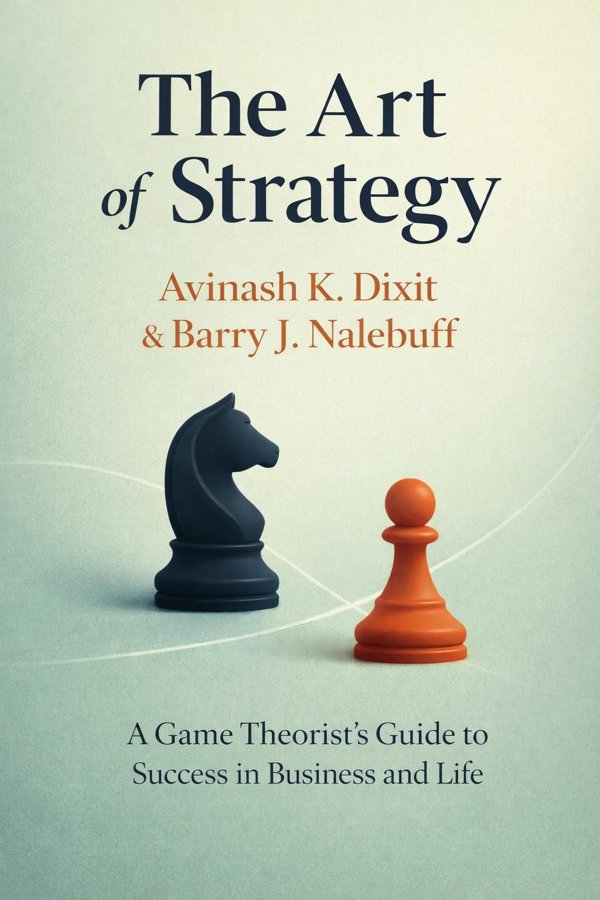
The Art of Strategy: A Game Theorist's Guide to Success in Business and Life: Summary & Key Insights
by Avinash K. Dixit, Barry J. Nalebuff
 10 min10 chaptersAudio available
What Is The Art of Strategy: A Game Theorist's Guide to Success in Business and Life About?
The Art of Strategy: A Game Theorist's Guide to Success in Business and Life by Avinash K. Dixit & Barry J. Nalebuff is a strategy book spanning 10 pages. This book introduces readers to the principles of game theory and demonstrates how strategic thinking can be applied to everyday decisions in business, politics, and personal life. Through real-world examples and accessible explanations, Dixit and Nalebuff show how understanding incentives, competition, and cooperation can lead to smarter choices and better outcomes.
This FizzRead summary covers all 10 key chapters of The Art of Strategy: A Game Theorist's Guide to Success in Business and Life in approximately 10 minutes, distilling the most important ideas, arguments, and takeaways from Avinash K. Dixit & Barry J. Nalebuff's work. Also available as an audio summary and Key Quotes Podcast.
The Art of Strategy: A Game Theorist's Guide to Success in Business and Life
This book introduces readers to the principles of game theory and demonstrates how strategic thinking can be applied to everyday decisions in business, politics, and personal life. Through real-world examples and accessible explanations, Dixit and Nalebuff show how understanding incentives, competition, and cooperation can lead to smarter choices and better outcomes.
Who Should Read The Art of Strategy: A Game Theorist's Guide to Success in Business and Life?
This book is perfect for anyone interested in strategy and looking to gain actionable insights in a short read. Whether you're a student, professional, or lifelong learner, the key ideas from The Art of Strategy: A Game Theorist's Guide to Success in Business and Life by Avinash K. Dixit & Barry J. Nalebuff will help you think differently.
- ✓Readers who enjoy strategy and want practical takeaways
- ✓Professionals looking to apply new ideas to their work and life
- ✓Anyone who wants the core insights of The Art of Strategy: A Game Theorist's Guide to Success in Business and Life in just 10 minutes
Want the full summary?
Get instant access to this book summary and 100K+ more with Fizz Moment.
Get Free SummaryAvailable on App Store • Free to download
Key Chapters
Before mastering strategy, we must first understand the structure of the games we play. In game theory, every situation that involves interdependent decision-making can be described through a few core elements: players, strategies, payoffs, and equilibrium.
Players are the decision-makers—the individuals, firms, voters, or friends whose choices matter. Strategies are the set of possible actions each player can take. Payoffs represent the consequences of those actions, typically measured as gain or loss, satisfaction or regret. Equilibrium, conceptually, is the stable point where no player can improve their outcome by changing their decision alone.
In explaining these foundations, we emphasize that strategic thinking starts with empathy—not moral empathy, but analytical empathy. Understanding what motivates others and how they perceive the game is essential. A competitor’s action isn’t random; it’s a response to their beliefs about your response. When two rivals continually cut prices, for instance, it’s not because they enjoy losing profits, but because each expects the other to do the same.
One of the most instructive examples is the Prisoner’s Dilemma: two suspects face a choice between cooperation and betrayal. Each fears that trusting the other might result in worse consequences, so both defect and end up worse off. This simple model illustrates a recurring pattern in life: without mechanisms to encourage cooperation or credibility, rational decisions can lead to collectively irrational outcomes.
By understanding the basic elements—players, payoffs, and equilibrium—you learn to map complexity into structure. Whether it’s a business negotiation or a family decision, this mental model helps identify not only what outcomes are possible but which ones are likely. Once we grasp this framework, we’re ready to confront more dynamic forms of the game.
In simultaneous-move games, players act at the same time, unaware of others’ current choices. Think of two companies deciding whether to launch a new product, or two students competing for limited resources. The strategic challenge lies in anticipating what others might do without knowing their current move. This is where equilibrium concepts, like Nash Equilibrium, become tools for prediction. It’s the condition where each player’s strategy is the best response to others’ strategies.
Sequential-move games, by contrast, unfold over time. Here, knowledge of prior moves changes the landscape entirely. Chess, negotiations, and price wars all follow this pattern. The ability to think ahead—to anticipate what your opponent will do next—is what defines strategic brilliance. You’re not merely reacting; you’re shaping the game.
Backward induction becomes critical here: if you can foresee future responses, you can make present decisions that steer the game toward beneficial outcomes. For instance, in business entry decisions, an incumbent firm may lower prices to deter new entrants. The entrant, anticipating this predatory tactic, might choose not to enter. The incumbent achieves a strategic win—not by outmaneuvering in the moment, but by influencing expectations.
These two types of games—simultaneous and sequential—reflect the dual nature of human interaction. Some situations demand instant judgment under uncertainty; others reward foresight and patience. Learning to identify which type of game you’re in, and adjusting your strategy accordingly, marks the difference between mere reaction and genuine leadership.
+ 8 more chapters — available in the FizzRead app
All Chapters in The Art of Strategy: A Game Theorist's Guide to Success in Business and Life
About the Authors
Avinash K. Dixit is an economist known for his work in microeconomic theory and game theory, and he has taught at Princeton University. Barry J. Nalebuff is a professor at Yale School of Management specializing in strategy and innovation. Together, they have authored several influential books on strategic thinking and economics.
Get This Summary in Your Preferred Format
Read or listen to the The Art of Strategy: A Game Theorist's Guide to Success in Business and Life summary by Avinash K. Dixit & Barry J. Nalebuff anytime, anywhere. FizzRead offers multiple formats so you can learn on your terms — all free.
Available formats: App · Audio · PDF · EPUB — All included free with FizzRead
Download The Art of Strategy: A Game Theorist's Guide to Success in Business and Life PDF and EPUB Summary
Key Quotes from The Art of Strategy: A Game Theorist's Guide to Success in Business and Life
“Before mastering strategy, we must first understand the structure of the games we play.”
“In simultaneous-move games, players act at the same time, unaware of others’ current choices.”
Frequently Asked Questions about The Art of Strategy: A Game Theorist's Guide to Success in Business and Life
The Art of Strategy: A Game Theorist's Guide to Success in Business and Life by Avinash K. Dixit & Barry J. Nalebuff is a strategy book that explores key ideas across 10 chapters. This book introduces readers to the principles of game theory and demonstrates how strategic thinking can be applied to everyday decisions in business, politics, and personal life. Through real-world examples and accessible explanations, Dixit and Nalebuff show how understanding incentives, competition, and cooperation can lead to smarter choices and better outcomes.
You Might Also Like

Mastery
Robert Greene
10 min
Cut Costs Not Corners: A Practical Guide to Staying Competitive and Improving Profits
Colin Barrow
10 min
Good Strategy/Bad Strategy: The Difference and Why It Matters
Richard P. Rumelt
10 min
On Grand Strategy
John Lewis Gaddis
10 min
The Six Disciplines of Digital Transformation
George Westerman
10 min
7 Powers: The Foundations of Business Strategy
Hamilton Helmer
10 minBrowse by Category
Ready to read The Art of Strategy: A Game Theorist's Guide to Success in Business and Life?
Get the full summary and 100K+ more books with Fizz Moment.