
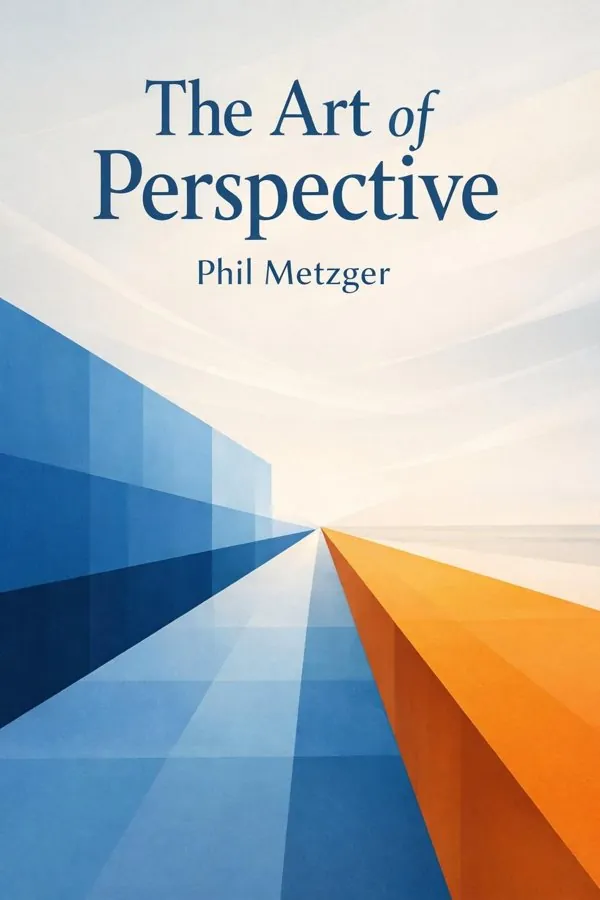
The Art of Perspective: The Ultimate Guide for Artists in Every Medium: Summary & Key Insights
by Phil Metzger
 10 min10 chaptersAudio available
What Is The Art of Perspective: The Ultimate Guide for Artists in Every Medium About?
The Art of Perspective: The Ultimate Guide for Artists in Every Medium by Phil Metzger is a design book spanning 10 pages. This comprehensive guide by artist and instructor Phil Metzger teaches how to master perspective drawing across various artistic media. It covers one-, two-, and three-point perspective, atmospheric perspective, and advanced spatial techniques, helping artists create depth and realism in their work. The book includes step-by-step demonstrations, diagrams, and practical exercises designed for painters, illustrators, and designers.
This FizzRead summary covers all 10 key chapters of The Art of Perspective: The Ultimate Guide for Artists in Every Medium in approximately 10 minutes, distilling the most important ideas, arguments, and takeaways from Phil Metzger's work. Also available as an audio summary and Key Quotes Podcast.
The Art of Perspective: The Ultimate Guide for Artists in Every Medium
This comprehensive guide by artist and instructor Phil Metzger teaches how to master perspective drawing across various artistic media. It covers one-, two-, and three-point perspective, atmospheric perspective, and advanced spatial techniques, helping artists create depth and realism in their work. The book includes step-by-step demonstrations, diagrams, and practical exercises designed for painters, illustrators, and designers.
Who Should Read The Art of Perspective: The Ultimate Guide for Artists in Every Medium?
This book is perfect for anyone interested in design and looking to gain actionable insights in a short read. Whether you're a student, professional, or lifelong learner, the key ideas from The Art of Perspective: The Ultimate Guide for Artists in Every Medium by Phil Metzger will help you think differently.
- ✓Readers who enjoy design and want practical takeaways
- ✓Professionals looking to apply new ideas to their work and life
- ✓Anyone who wants the core insights of The Art of Perspective: The Ultimate Guide for Artists in Every Medium in just 10 minutes
Want the full summary?
Get instant access to this book summary and 100K+ more with Fizz Moment.
Get Free SummaryAvailable on App Store • Free to download
Key Chapters
Before we ever pick up a pencil, we must understand the miraculous way the human eye interprets space. Depth is not an abstract idea; it’s a physiological experience. Your eyes record two slightly different images — your brain merges them into one, producing a sense of depth. But in a drawing, we only have one surface. My task, as an artist and teacher, is to help you translate that binocular world into a two-dimensional illusion.
Perspective provides the grammar for that translation. We perceive depth through overlapping shapes, the relative size of forms, and changes in color and value. In linear perspective, we anchor those perceptions to vanishing points. In atmospheric perspective, we use the subtle play of light, hue, and contrast to let objects recede naturally. Once you’re aware of these cues, you can harness them consciously. When I teach beginners, I emphasize that seeing spatially transforms everything — even simple sketches of cubes or roads become alive with direction and meaning.
The great benefit of understanding how vision works is that you stop copying appearances and start constructing experiences. Every structure you draw becomes not just a flat object but a living participant in space, connected to its surroundings. That shift in perception is the birthplace of true artistry.
One-point perspective is where most artists begin, and for good reason. It’s the most straightforward way to understand space: all lines converge toward a single vanishing point on the horizon. When handled correctly, the world falls into a convincing order. I’ve often referred to it as 'the grammar of visual organization'. Imagine a long hallway or a road stretching into the distance — everything obeys that one central pull.
In the book, I guide you step by step through setting up this system: establishing a horizon line, locating the vanishing point, constructing boxes, and introducing scale. But more importantly, I encourage you to treat it not as a mechanical process but as a creative tool. The key to one-point perspective isn’t precision; it’s intention. You choose where your viewer stands, how far the gaze reaches, what emotion is evoked.
Once you become fluent with this perspective, you gain control over narrative structure. A vanishing point can draw the viewer into a scene or push them away. A simple city street can become a metaphor for discovery or isolation. Mastering one-point perspective teaches you not just spatial truth but emotional direction. That’s what makes it powerful.
+ 8 more chapters — available in the FizzRead app
All Chapters in The Art of Perspective: The Ultimate Guide for Artists in Every Medium
About the Author
Phil Metzger is an American artist, illustrator, and author known for his instructional books on drawing and painting techniques. He has taught art for many years and written several well-regarded guides that simplify complex artistic concepts for students and professionals alike.
Get This Summary in Your Preferred Format
Read or listen to the The Art of Perspective: The Ultimate Guide for Artists in Every Medium summary by Phil Metzger anytime, anywhere. FizzRead offers multiple formats so you can learn on your terms — all free.
Available formats: App · Audio · PDF · EPUB — All included free with FizzRead
Download The Art of Perspective: The Ultimate Guide for Artists in Every Medium PDF and EPUB Summary
Key Quotes from The Art of Perspective: The Ultimate Guide for Artists in Every Medium
“Before we ever pick up a pencil, we must understand the miraculous way the human eye interprets space.”
“One-point perspective is where most artists begin, and for good reason.”
Frequently Asked Questions about The Art of Perspective: The Ultimate Guide for Artists in Every Medium
The Art of Perspective: The Ultimate Guide for Artists in Every Medium by Phil Metzger is a design book that explores key ideas across 10 chapters. This comprehensive guide by artist and instructor Phil Metzger teaches how to master perspective drawing across various artistic media. It covers one-, two-, and three-point perspective, atmospheric perspective, and advanced spatial techniques, helping artists create depth and realism in their work. The book includes step-by-step demonstrations, diagrams, and practical exercises designed for painters, illustrators, and designers.
You Might Also Like
The Design of Everyday Things
Don Norman
10 min
The Better Angels of Our Nature
Steven Pinker
10 min
A Designer's Art
Paul Rand
10 min
Architects' Sketchbooks
Various Editors
10 min
Architectural Graphic Standards
The American Institute of Architects
10 min
Design Is Storytelling
Ellen Lupton
10 minBrowse by Category
Ready to read The Art of Perspective: The Ultimate Guide for Artists in Every Medium?
Get the full summary and 100K+ more books with Fizz Moment.