
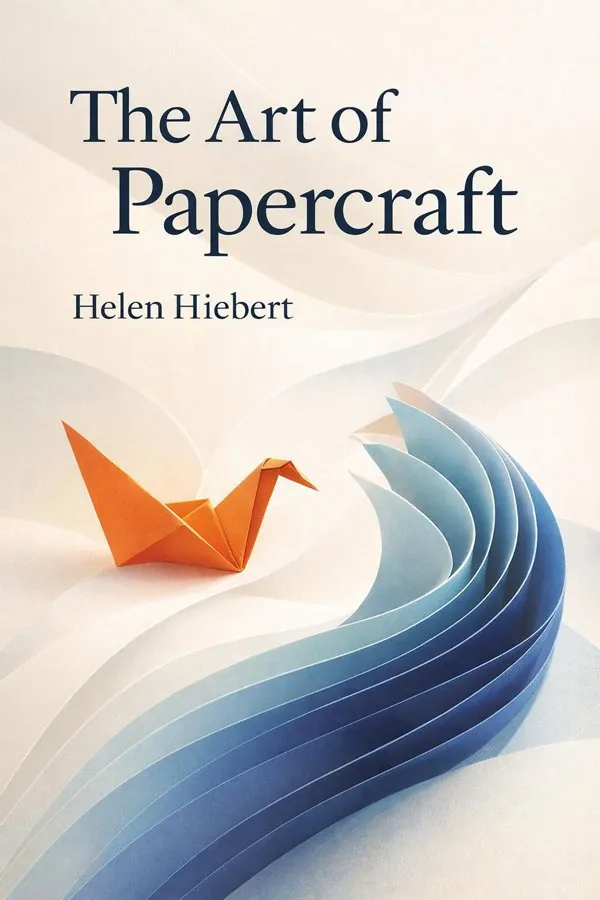
The Art of Papercraft: Summary & Key Insights
 10 min9 chaptersAudio available
Key Takeaways from The Art of Papercraft
Every strong paper project begins long before the first fold.
A fold is not merely a bend; it is a decision that changes space.
The most dramatic transformations often come from subtraction, not addition.
Dimension begins when paper stops being treated as a page and starts being treated as space.
Paper becomes memorable when it invites both the eye and the hand.
What Is The Art of Papercraft About?
The Art of Papercraft by Helen Hiebert is a design book spanning 5 pages. Paper seems ordinary until you begin to shape it. In Helen Hiebert’s The Art of Papercraft, a flat sheet becomes a sculpture, a folded form, a textured surface, or a carefully engineered object that responds to light, space, and touch. This book is both a practical guide and an artistic invitation, showing readers how to move from basic techniques like folding, cutting, scoring, and gluing into more ambitious paper constructions that express design, emotion, and imagination. What makes the book especially valuable is its balance: it is accessible enough for curious beginners, yet thoughtful enough to deepen the practice of artists, designers, teachers, and makers. Hiebert does not treat papercraft as a collection of tricks. She presents it as a discipline grounded in material knowledge, craftsmanship, experimentation, and visual thinking. Her authority comes from years of work as a paper artist, instructor, and author, and that experience shapes every page. The result is a guide that teaches not just how to make things from paper, but how to see paper as a serious and versatile creative medium.
This FizzRead summary covers all 9 key chapters of The Art of Papercraft in approximately 10 minutes, distilling the most important ideas, arguments, and takeaways from Helen Hiebert's work. Also available as an audio summary and Key Quotes Podcast.
The Art of Papercraft
Paper seems ordinary until you begin to shape it. In Helen Hiebert’s The Art of Papercraft, a flat sheet becomes a sculpture, a folded form, a textured surface, or a carefully engineered object that responds to light, space, and touch. This book is both a practical guide and an artistic invitation, showing readers how to move from basic techniques like folding, cutting, scoring, and gluing into more ambitious paper constructions that express design, emotion, and imagination. What makes the book especially valuable is its balance: it is accessible enough for curious beginners, yet thoughtful enough to deepen the practice of artists, designers, teachers, and makers. Hiebert does not treat papercraft as a collection of tricks. She presents it as a discipline grounded in material knowledge, craftsmanship, experimentation, and visual thinking. Her authority comes from years of work as a paper artist, instructor, and author, and that experience shapes every page. The result is a guide that teaches not just how to make things from paper, but how to see paper as a serious and versatile creative medium.
Who Should Read The Art of Papercraft?
This book is perfect for anyone interested in design and looking to gain actionable insights in a short read. Whether you're a student, professional, or lifelong learner, the key ideas from The Art of Papercraft by Helen Hiebert will help you think differently.
- ✓Readers who enjoy design and want practical takeaways
- ✓Professionals looking to apply new ideas to their work and life
- ✓Anyone who wants the core insights of The Art of Papercraft in just 10 minutes
Want the full summary?
Get instant access to this book summary and 100K+ more with Fizz Moment.
Get Free SummaryAvailable on App Store • Free to download
Key Chapters
Every strong paper project begins long before the first fold. The central insight of The Art of Papercraft is that paper is not a neutral surface; it is an active material with its own behavior, limits, and expressive qualities. Helen Hiebert urges readers to understand paper the way a woodworker understands grain or a potter understands clay. Weight, fiber direction, opacity, thickness, texture, and finish all influence what paper can do. A thin, flexible sheet may fold beautifully but collapse under structural demands. A stiff board may hold shape well but resist delicate curves. Even color and surface treatment affect how light lands on an object and how finished work feels to the hand.
This material awareness is what separates frustrating trial and error from intentional making. Hiebert helps readers notice the grain direction so folds crack less and move more predictably. She clarifies why some papers are ideal for scoring, others for cutting, and others for layering or sculptural assembly. She also emphasizes practical tools: a sharp craft knife, a metal ruler, a cutting mat, scoring tools, adhesives suited to the paper, and a clean workspace. Good tools do not replace skill, but they make precision possible.
In practice, this means matching the project to the material. If you are making an accordion book, choose a paper with enough flexibility to bend repeatedly. If you are building a standing paper structure, test a heavier stock that can support itself. If you want a translucent lantern, experiment with vellum or handmade paper that glows under light.
Actionable takeaway: before starting any project, test three paper types for folding, cutting, and gluing, and let the material guide your design choices.
A fold is not merely a bend; it is a decision that changes space. Hiebert presents folding, especially through origami and simple construction, as one of the clearest ways to understand form. Folding teaches patience, sequence, and precision. It shows how a flat sheet can gain strength, rhythm, and geometry without needing extra materials. In this sense, origami is more than a decorative tradition. It becomes a design education in miniature.
The book uses classic folded forms not simply as cultural icons, but as exercises in structural thinking. A box introduces containment and clean edge alignment. A crane or flower explores symmetry, directional movement, and compact transformation. Repeated folded units show how pattern can create complexity from simplicity. Through these examples, Hiebert helps readers see that successful folding depends on careful measuring, crisp creases, and respect for order. One rushed fold can throw off the entire structure.
Folding also builds an intuitive understanding of engineering. Mountain folds, valley folds, and scored lines each create different kinds of movement. As readers repeat forms, they begin to recognize where tension gathers, where paper wants to spring open, and where reinforcement may be needed. These lessons carry into packaging, book arts, product design, and sculpture.
A practical application is to use folding studies as prototypes. Before building a large installation or complex paper object, create small folded mock-ups to test proportion, movement, and stability. This saves material and reveals design problems early.
Actionable takeaway: choose one simple folded form and make it five times, improving accuracy with each version until precision becomes part of your creative habit.
The most dramatic transformations often come from subtraction, not addition. Hiebert shows that cutting and scoring are among the most powerful techniques in papercraft because they allow artists to control line, opening, depth, and movement. A cut can create lace-like delicacy, architectural windows, pop-up mechanisms, or negative space that becomes as important as the paper itself. A score, by contrast, prepares paper to bend where and how you want, bringing order and precision to construction.
What makes these techniques significant is their relationship to intention. Random cutting may create interesting accidents, but thoughtful cutting creates design. Hiebert emphasizes planning shapes, understanding how much support a sheet needs, and anticipating how cuts interact with the remaining structure. Remove too much, and the form weakens. Cut strategically, and the paper gains elegance, openness, and dimensional possibility.
Practical applications are everywhere. Greeting cards gain sophistication from cut apertures. Lampshades become more expressive when perforations cast patterned shadows. Pop-up cards and artist books rely on scores and cuts working together to create motion. Even simple home décor pieces, like garlands or layered wall art, become more refined when cuts are clean and spacing is deliberate.
Hiebert also reinforces craftsmanship: use a sharp blade, replace it often, cut with steady pressure, and work against a metal ruler when straight lines matter. Scoring should be deep enough to guide a fold but not so harsh that it tears the surface. Testing on scraps is essential.
Actionable takeaway: design a small sample sheet using three cuts and three scores, then fold and light it to observe how line, shadow, and structure change together.
Dimension begins when paper stops being treated as a page and starts being treated as space. One of the book’s most exciting ideas is that papercraft can move far beyond cards and folded figures into fully sculptural work. Hiebert encourages readers to think in terms of volume, silhouette, balance, and viewing angle. Once paper is layered, curled, slotted, woven, rolled, or assembled into repeating units, it takes on an architectural quality. The flat sheet does not disappear; it evolves.
This shift matters because it expands what readers believe paper can become. Sculpture with paper is not about imitating heavier materials like wood or metal. It is about using paper’s own strengths: lightness, translucency, flexibility, and capacity for repetition. A curled strip can suggest motion. A cluster of modules can produce organic growth. Layered cut forms can create depth that changes as the viewer moves around them.
Hiebert helps readers approach three-dimensional design with method rather than guesswork. Start with simple maquettes. Consider how pieces connect. Ask whether the form should hang, stand, open, collapse, or interact with light. Think about internal support and whether adhesives, tabs, or slots will best preserve the clean look of the work. These decisions shape both aesthetics and stability.
For example, a beginner might create a layered paper relief mounted in a shadow box. A more advanced maker might build a suspended mobile of cut and folded forms that rotate gently in air. Educators can adapt these ideas into classroom projects that teach geometry and spatial reasoning.
Actionable takeaway: turn one flat design into a 3D study by adding layers, curves, or tabs, and evaluate how depth changes the emotional impact of the piece.
Paper becomes memorable when it invites both the eye and the hand. Hiebert explores texture and interactivity as essential dimensions of papercraft, showing that a successful piece is often one that rewards closer attention. Texture can be visual, tactile, or structural. It can come from crumpling, embossing, piercing, weaving, layering, tearing, stitching, or combining papers with different finishes. These variations prevent paper from feeling flat in the emotional sense, even when it remains physically flat.
Interactivity pushes the medium further. A flap that lifts, a panel that unfolds, a pop-up that expands, or a lantern that changes under illumination all create a relationship between object and viewer. Rather than making something to be looked at only once, Hiebert invites readers to create experiences. This is especially relevant in book arts, educational design, exhibition work, and handmade gifts, where movement and discovery heighten engagement.
The practical lesson is that texture and interaction should support meaning. A rough torn edge may suggest age, fragility, or natural forms. Repeated perforations may evoke breath, rhythm, or data. A hidden fold-out section in a handmade book can create surprise and narrative pacing. By linking technique to expression, paper art becomes more than decoration.
A simple application is to make a sample board of textures: emboss one area, weave another, stitch a third, and cut perforations into a fourth. Then compare how each treatment catches light and changes the viewer’s response. If creating an interactive piece, test the durability of moving parts before final assembly.
Actionable takeaway: add one tactile element and one interactive element to your next project so the paper communicates through movement as well as appearance.
Technique alone can produce competence, but design turns competence into art. Throughout The Art of Papercraft, Hiebert makes clear that making beautiful paper objects is not just about mastering folds or cuts. It is about composition, proportion, contrast, repetition, scale, rhythm, and balance. These design principles help readers move beyond copying projects toward creating original work with intention.
This is an important contribution of the book: it bridges craft instruction and visual thinking. A papercrafter may know how to layer shapes, but design asks which shapes belong together, where negative space should remain, and how a viewer’s eye should travel. Color decisions matter too. A monochrome piece might highlight shadow and form, while contrasting colors can emphasize depth or playfulness. Symmetry can create calm and order; asymmetry can introduce energy and surprise.
Hiebert also encourages iterative experimentation. Good design often emerges through variation. Change the scale of one element. Repeat a pattern more densely. Simplify an overworked composition. Build prototypes and compare them side by side. This process helps readers develop judgment, not just skill.
In practical terms, design principles are useful whether you are making a greeting card, a sculptural installation, a pop-up book, or a window display. Even small decisions, such as leaving more margin around a cut pattern or reducing the number of decorative elements, can dramatically improve the final result.
Actionable takeaway: after completing any paper piece, step back and assess it using five design questions: Is it balanced? Is there enough contrast? Is the focal point clear? Does repetition help? What can be removed to strengthen the design?
The difference between a charming idea and a satisfying finished piece is often patience. Hiebert treats craftsmanship not as perfectionism for its own sake, but as respect for the material and for the viewer. Clean cuts, aligned edges, careful adhesive use, and thoughtful assembly all communicate care. In papercraft, where every crease and seam is visible, process matters enormously.
This idea is especially useful for readers who become discouraged when their first projects look rough. Hiebert frames skill as something built through repetition, observation, and refinement. A slightly uneven fold is not failure; it is feedback. A glue mark is a lesson in restraint. A warped structure reveals the need for better support or drying time. By paying attention to these small issues, makers gradually develop the calm, deliberate habits that papercraft rewards.
The book’s practical spirit encourages good workflow. Measure twice before cutting. Pre-score difficult folds. Use minimal adhesive and apply it precisely. Press joined pieces under weight if flatness matters. Keep hands and workspace clean, since paper records smudges and oils easily. Save prototypes and mistakes; they often reveal useful solutions later.
This mindset applies beyond hobby projects. Teachers can use papercraft to teach perseverance and fine-motor focus. Designers can use it to cultivate prototyping discipline. Artists can use it to sharpen their sensitivity to detail. The broader lesson is that craftsmanship is a way of thinking: attentive, iterative, and honest.
Actionable takeaway: choose one quality standard for your next project, such as cleaner edges or more precise folds, and focus on improving that single aspect rather than trying to perfect everything at once.
Some of the most compelling paper works are useful as well as beautiful. Hiebert demonstrates that papercraft occupies a rich territory between functional design and artistic expression. A handmade book can be a writing object and a sculptural form. Packaging can protect an item while delighting the person opening it. A lampshade can provide light while casting intricate shadow patterns that transform a room. This dual nature makes papercraft unusually adaptable across personal, educational, and professional contexts.
The deeper insight here is that function can sharpen creativity rather than limit it. Constraints such as needing a box to close securely, a pop-up to open smoothly, or a screen to diffuse light push the maker to solve problems elegantly. Paper becomes a medium for design thinking: how can one material carry information, structure, beauty, and experience at the same time?
This approach has many practical applications. Small business owners can develop distinctive paper packaging that communicates brand identity. Teachers can create fold-out learning tools that make abstract concepts tangible. Artists can construct installations that use paper’s translucency to shape atmosphere. Even hobbyists can elevate handmade gifts by designing presentation as thoughtfully as the object itself.
Hiebert’s perspective helps readers see papercraft not as a minor decorative pastime, but as a field where utility, storytelling, and aesthetics intersect. That makes the book valuable not only to crafters, but also to designers and educators.
Actionable takeaway: for your next project, define both an artistic goal and a functional goal, then design the piece so each strengthens the other.
A paper artwork’s life does not end when the glue dries. Hiebert reminds readers that preservation, documentation, and continued experimentation are part of a mature creative practice. Paper is durable in many contexts, but it is also vulnerable to moisture, direct sunlight, mishandling, and poor storage. Understanding how to protect finished work is essential if you want your efforts to last.
This practical concern leads to a larger message about artistic growth. Serious papercraft is not a one-time burst of inspiration; it is an evolving conversation with tools, techniques, and ideas. Preserving work allows you to review your progress. Documenting projects through photographs, notes, and prototypes helps you track what materials worked, which structures failed, and where new possibilities emerged. Over time, this archive becomes a personal design library.
Hiebert’s broader encouragement is to keep exploring. Try unfamiliar papers. Scale projects up or down. Combine papercraft with printmaking, drawing, stitching, or lighting. Revisit old forms with better skills. Share work in workshops or communities where feedback can accelerate growth. Artistic identity develops through sustained making, not through waiting for perfect inspiration.
Preservation can be simple: store flat works in archival sleeves, keep sculptural pieces away from humidity, and frame delicate works behind protective glazing. Documentation can be equally simple: record dimensions, materials, and a few lessons learned after each project. These habits turn scattered creative efforts into an intentional practice.
Actionable takeaway: create a basic papercraft journal where you photograph each finished piece, note the materials used, and write one lesson to apply to your next project.
All Chapters in The Art of Papercraft
About the Author
Helen Hiebert is an American artist, instructor, and author widely recognized for her work in paper art, handmade paper, and book arts. She has built a career around exploring the creative possibilities of paper, from intimate hand-crafted objects to larger sculptural and installation-based works. In addition to producing her own art, she teaches workshops that help students understand paper as a material with unique structural, tactile, and visual qualities. Hiebert is also known for writing accessible, skill-building books that bridge technical instruction and artistic exploration. Her approach combines craftsmanship, experimentation, and design awareness, making her a trusted guide for both beginners and experienced makers. Through her teaching and publications, she has helped expand appreciation for paper as a versatile and expressive medium.
Get This Summary in Your Preferred Format
Read or listen to the The Art of Papercraft summary by Helen Hiebert anytime, anywhere. FizzRead offers multiple formats so you can learn on your terms — all free.
Available formats: App · Audio · PDF · EPUB — All included free with FizzRead
Download The Art of Papercraft PDF and EPUB Summary
Key Quotes from The Art of Papercraft
“Every strong paper project begins long before the first fold.”
“A fold is not merely a bend; it is a decision that changes space.”
“The most dramatic transformations often come from subtraction, not addition.”
“Dimension begins when paper stops being treated as a page and starts being treated as space.”
“Paper becomes memorable when it invites both the eye and the hand.”
Frequently Asked Questions about The Art of Papercraft
The Art of Papercraft by Helen Hiebert is a design book that explores key ideas across 9 chapters. Paper seems ordinary until you begin to shape it. In Helen Hiebert’s The Art of Papercraft, a flat sheet becomes a sculpture, a folded form, a textured surface, or a carefully engineered object that responds to light, space, and touch. This book is both a practical guide and an artistic invitation, showing readers how to move from basic techniques like folding, cutting, scoring, and gluing into more ambitious paper constructions that express design, emotion, and imagination. What makes the book especially valuable is its balance: it is accessible enough for curious beginners, yet thoughtful enough to deepen the practice of artists, designers, teachers, and makers. Hiebert does not treat papercraft as a collection of tricks. She presents it as a discipline grounded in material knowledge, craftsmanship, experimentation, and visual thinking. Her authority comes from years of work as a paper artist, instructor, and author, and that experience shapes every page. The result is a guide that teaches not just how to make things from paper, but how to see paper as a serious and versatile creative medium.
You Might Also Like
The Design of Everyday Things
Don Norman
10 min
The Better Angels of Our Nature
Steven Pinker
10 min
A Designer's Art
Paul Rand
10 min
Architects' Sketchbooks
Various Editors
10 min
Architectural Graphic Standards
The American Institute of Architects
10 min
Design Is Storytelling
Ellen Lupton
10 minBrowse by Category
Ready to read The Art of Papercraft?
Get the full summary and 100K+ more books with Fizz Moment.