
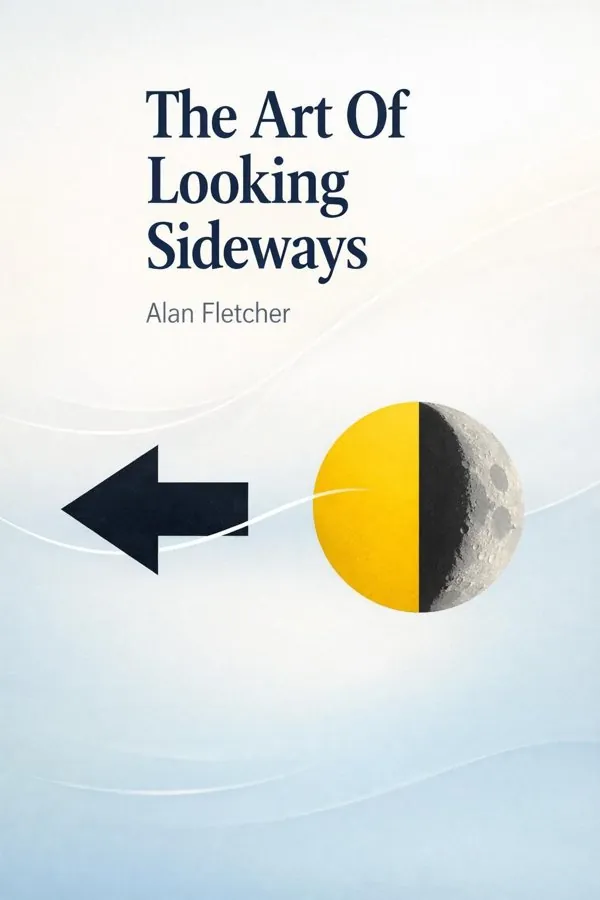
The Art Of Looking Sideways: Summary & Key Insights
 10 min11 chaptersAudio available
What Is The Art Of Looking Sideways About?
The Art Of Looking Sideways by Alan Fletcher is a design book spanning 11 pages. A visual and philosophical exploration of perception, creativity, and design, this book by Alan Fletcher invites readers to question how they see and interpret the world. Through a rich collage of images, quotations, and reflections, Fletcher examines the interplay between words and pictures, logic and imagination, and order and chaos, offering a playful yet profound meditation on the art of seeing.
This FizzRead summary covers all 11 key chapters of The Art Of Looking Sideways in approximately 10 minutes, distilling the most important ideas, arguments, and takeaways from Alan Fletcher's work. Also available as an audio summary and Key Quotes Podcast.
The Art Of Looking Sideways
A visual and philosophical exploration of perception, creativity, and design, this book by Alan Fletcher invites readers to question how they see and interpret the world. Through a rich collage of images, quotations, and reflections, Fletcher examines the interplay between words and pictures, logic and imagination, and order and chaos, offering a playful yet profound meditation on the art of seeing.
Who Should Read The Art Of Looking Sideways?
This book is perfect for anyone interested in design and looking to gain actionable insights in a short read. Whether you're a student, professional, or lifelong learner, the key ideas from The Art Of Looking Sideways by Alan Fletcher will help you think differently.
- ✓Readers who enjoy design and want practical takeaways
- ✓Professionals looking to apply new ideas to their work and life
- ✓Anyone who wants the core insights of The Art Of Looking Sideways in just 10 minutes
Want the full summary?
Get instant access to this book summary and 100K+ more with Fizz Moment.
Get Free SummaryAvailable on App Store • Free to download
Key Chapters
Seeing isn’t passive; it’s a craft. Each time we look at the world, we create an image inside our heads that reflects our own bias, history, and desire. I’ve always found that fact liberating. The eye may be a lens, but the mind is its darkroom, shaping every image with interpretation. What fascinates me is the difference between appearance and understanding—the way one person’s pattern turns into another’s puzzle.
In design, perception decides everything. A good designer doesn’t simply arrange forms and colors; they shape an experience, guiding the viewer’s mind through visual thought. That’s why this book begins with perception—not as a biological function but as an intellectual and emotional act. Once you realize that seeing is subjective, you understand that communication itself rests on uncertainty.
Consider how two people can look at the same picture and see entirely different meanings. One sees harmony; another sees conflict. This variability doesn’t make perception unreliable—it makes it human. The craft of seeing is about acknowledging that diversity: accepting that your interpretations are always partial and your point of view always personal. By doing so, you begin to look more deeply, more curiously, and more empathetically.
Designers, artists, and everyday observers share the same challenge—to stay awake to perception. It’s easy to let familiarity dull the senses, but the act of seeing sideways awakens the inner child constantly asking questions. To look sideways is to ask not just ‘What do I see?’ but ‘Why do I see it that way?’ That simple shift transforms routine observation into creative insight.
Words and pictures are both forms of language—each with its own grammar, each capable of poetry or deceit. I’ve spent my life bridging them, discovering how a single word can change the meaning of an image and how a picture can silence or amplify a sentence. This dialogue between verbal and visual communication lies at the heart of design.
When we compose a poster, an identity, or a book, we are crafting a conversation. Visual language depends as much on rhythm and contrast as written text on syntax. A typeface can whisper or shout; a color can soothe or provoke; a composition can suggest motion or stillness even when nothing moves. Understanding this language is what separates decoration from communication.
In my practice, I often found that images carry ambiguity whereas words demand clarity. Yet clarity without imagination becomes dull, and ambiguity without structure dissolves into confusion. The challenge is to find balance—to weave logic and intuition so that the message breathes. Sometimes a single dot on a blank page can speak louder than a paragraph, simply because it provokes interpretation. The viewer completes the meaning, just as a reader fills the gaps between lines.
Designers must learn to listen to visual language, not just manipulate it. When you stop seeing a logo as a layout and start hearing it as a tone of voice, you begin to think visually in a deeper sense. Communication is born when image and word align—not by blending, but by playing off one another’s contrasts. The most powerful visuals are often those that say little yet suggest everything.
+ 9 more chapters — available in the FizzRead app
All Chapters in The Art Of Looking Sideways
About the Author
Alan Fletcher (1931–2006) was a British graphic designer and co-founder of the design firm Pentagram. Known for his wit, visual intelligence, and innovative approach to communication, Fletcher became one of the most influential figures in modern graphic design. His work spans corporate identity, typography, and visual thinking, leaving a lasting legacy in the design world.
Get This Summary in Your Preferred Format
Read or listen to the The Art Of Looking Sideways summary by Alan Fletcher anytime, anywhere. FizzRead offers multiple formats so you can learn on your terms — all free.
Available formats: App · Audio · PDF · EPUB — All included free with FizzRead
Download The Art Of Looking Sideways PDF and EPUB Summary
Key Quotes from The Art Of Looking Sideways
“Each time we look at the world, we create an image inside our heads that reflects our own bias, history, and desire.”
“Words and pictures are both forms of language—each with its own grammar, each capable of poetry or deceit.”
Frequently Asked Questions about The Art Of Looking Sideways
The Art Of Looking Sideways by Alan Fletcher is a design book that explores key ideas across 11 chapters. A visual and philosophical exploration of perception, creativity, and design, this book by Alan Fletcher invites readers to question how they see and interpret the world. Through a rich collage of images, quotations, and reflections, Fletcher examines the interplay between words and pictures, logic and imagination, and order and chaos, offering a playful yet profound meditation on the art of seeing.
You Might Also Like
The Design of Everyday Things
Don Norman
10 min
The Better Angels of Our Nature
Steven Pinker
10 min
A Designer's Art
Paul Rand
10 min
Architects' Sketchbooks
Various Editors
10 min
Architectural Graphic Standards
The American Institute of Architects
10 min
Design Is Storytelling
Ellen Lupton
10 minBrowse by Category
Ready to read The Art Of Looking Sideways?
Get the full summary and 100K+ more books with Fizz Moment.