
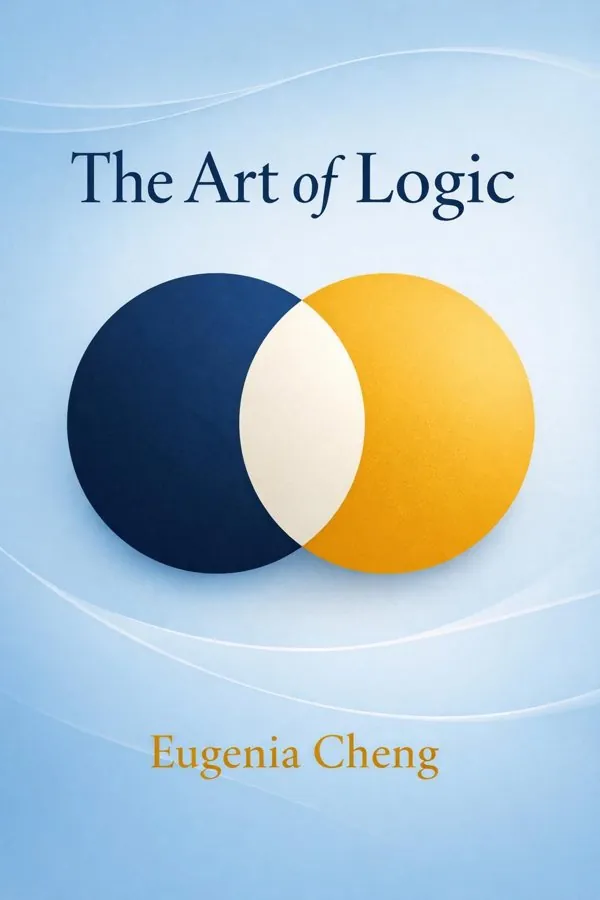
The Art of Logic: How to Make Sense in a World That Doesn’t: Summary & Key Insights
 10 min11 chaptersAudio available
What Is The Art of Logic: How to Make Sense in a World That Doesn’t About?
The Art of Logic: How to Make Sense in a World That Doesn’t by Eugenia Cheng is a logic book spanning 11 pages. In this book, mathematician Eugenia Cheng explores how logical thinking can help us navigate the complexities of modern life. She demonstrates how mathematical reasoning can clarify emotional debates, improve communication, and foster understanding in a polarized world. Through accessible examples and engaging prose, Cheng bridges the gap between logic and emotion, showing that both are essential for making sense of human behavior and society.
This FizzRead summary covers all 11 key chapters of The Art of Logic: How to Make Sense in a World That Doesn’t in approximately 10 minutes, distilling the most important ideas, arguments, and takeaways from Eugenia Cheng's work. Also available as an audio summary and Key Quotes Podcast.
The Art of Logic: How to Make Sense in a World That Doesn’t
In this book, mathematician Eugenia Cheng explores how logical thinking can help us navigate the complexities of modern life. She demonstrates how mathematical reasoning can clarify emotional debates, improve communication, and foster understanding in a polarized world. Through accessible examples and engaging prose, Cheng bridges the gap between logic and emotion, showing that both are essential for making sense of human behavior and society.
Who Should Read The Art of Logic: How to Make Sense in a World That Doesn’t?
This book is perfect for anyone interested in logic and looking to gain actionable insights in a short read. Whether you're a student, professional, or lifelong learner, the key ideas from The Art of Logic: How to Make Sense in a World That Doesn’t by Eugenia Cheng will help you think differently.
- ✓Readers who enjoy logic and want practical takeaways
- ✓Professionals looking to apply new ideas to their work and life
- ✓Anyone who wants the core insights of The Art of Logic: How to Make Sense in a World That Doesn’t in just 10 minutes
Want the full summary?
Get instant access to this book summary and 100K+ more with Fizz Moment.
Get Free SummaryAvailable on App Store • Free to download
Key Chapters
Before we begin applying logic to the turbulence of modern life, we must first understand what logic actually is—and what it isn’t. Too often, logic is imagined as detached, sterile, even adversarial: the weapon of pedants and debaters. In mathematics, however, logic is not a weapon at all; it is a language for clarity. When a mathematician builds a proof, she is not seeking conquest, but mutual comprehension. Logic is the art of making statements precise enough that anyone who follows can reach the same conclusion, regardless of their personal stance. That is why I describe logic as a collaborative tool rather than a competitive one.
In everyday discourse, our misunderstandings of logic often arise from conflating truth with certainty. Logical reasoning can produce conclusions that are consistent and valid even when the premises themselves are uncertain. Recognizing this helps us become humbler thinkers. Logic is not omniscience—it is scaffolding for thought. It does not tell us what to value but helps us understand how our values interlock. This difference is subtle but liberating, because it allows logic to coexist with subjective experience rather than to replace it.
I also contrast formal logic with informal logic—the former consisting of strict systems like propositional calculus, while the latter involves recognizing logical structure in natural language. For our purposes in life, logic’s value lies in the informal arena: learning to notice inconsistencies in our beliefs, examining leaps of thought, and understanding when disagreement stems not from illogic but from differing premises. This distinction underpins the rest of the book.
Our culture loves to imagine logic and emotion as opposites—cold versus warm, brain versus heart. But I want to challenge this dualism. Emotion colors our judgments, yes, but it also signals what matters to us. Logic without emotion may be formally correct, but it lacks relevance; emotion without logic is powerful, but it can mislead. The real art lies in their partnership.
Consider how we form moral judgments. When we see injustice, our response is emotional. Yet to act wisely, we must analyze causes and consequences logically. Likewise, when two people argue passionately about politics, both are often trying to express emotional truths grounded in different experiences. Using logic helps reveal where their reasoning diverges—sometimes not because one is irrational, but because they start from distinct premises shaped by different lives.
In my experience as a mathematician, emotions regularly accompany discovery. Frustration, curiosity, joy—all drive the work. Rather than suppressing emotion, I use it as a diagnostic tool. If I feel anger, I ask what principle has been violated; if confusion, what assumption I might have missed. I invite you to adopt this approach in your own thinking: let emotion highlight the regions that demand deeper logical analysis.
+ 9 more chapters — available in the FizzRead app
All Chapters in The Art of Logic: How to Make Sense in a World That Doesn’t
About the Author
Eugenia Cheng is a British mathematician and pianist. She is a Scientist in Residence at the School of the Art Institute of Chicago and an Honorary Fellow at the University of Sheffield. Cheng is known for her work in category theory and for popularizing mathematics through books and public lectures that connect abstract concepts to everyday life.
Get This Summary in Your Preferred Format
Read or listen to the The Art of Logic: How to Make Sense in a World That Doesn’t summary by Eugenia Cheng anytime, anywhere. FizzRead offers multiple formats so you can learn on your terms — all free.
Available formats: App · Audio · PDF · EPUB — All included free with FizzRead
Download The Art of Logic: How to Make Sense in a World That Doesn’t PDF and EPUB Summary
Key Quotes from The Art of Logic: How to Make Sense in a World That Doesn’t
“Before we begin applying logic to the turbulence of modern life, we must first understand what logic actually is—and what it isn’t.”
“Our culture loves to imagine logic and emotion as opposites—cold versus warm, brain versus heart.”
Frequently Asked Questions about The Art of Logic: How to Make Sense in a World That Doesn’t
The Art of Logic: How to Make Sense in a World That Doesn’t by Eugenia Cheng is a logic book that explores key ideas across 11 chapters. In this book, mathematician Eugenia Cheng explores how logical thinking can help us navigate the complexities of modern life. She demonstrates how mathematical reasoning can clarify emotional debates, improve communication, and foster understanding in a polarized world. Through accessible examples and engaging prose, Cheng bridges the gap between logic and emotion, showing that both are essential for making sense of human behavior and society.
You Might Also Like
Browse by Category
Ready to read The Art of Logic: How to Make Sense in a World That Doesn’t?
Get the full summary and 100K+ more books with Fizz Moment.