
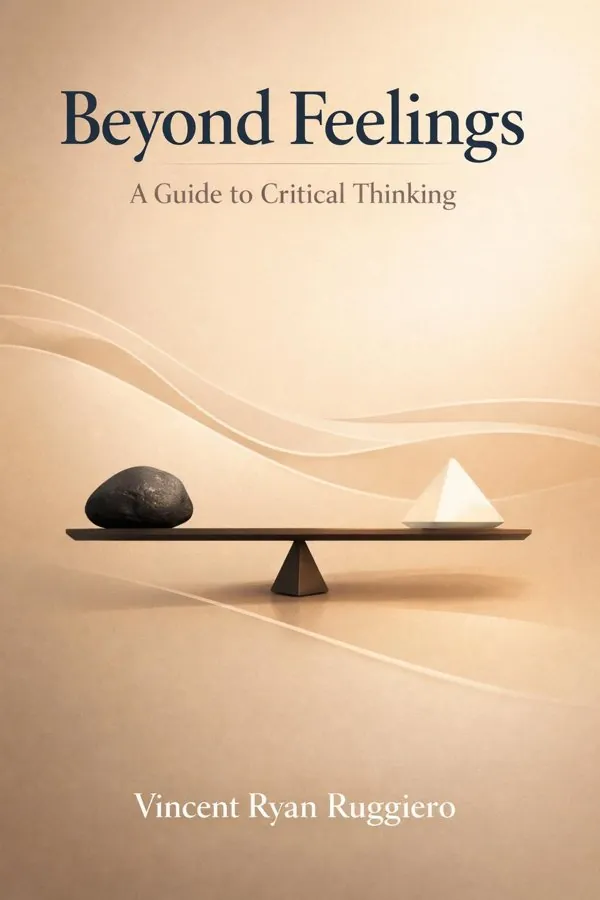
Beyond Feelings: A Guide to Critical Thinking: Summary & Key Insights
 10 min9 chaptersAudio available
Key Takeaways from Beyond Feelings: A Guide to Critical Thinking
Most bad thinking does not begin with ignorance; it begins with emotional certainty.
One of the book's most humbling insights is that people rarely see the world directly; they see it through frameworks inherited from family, school, religion, media, and society.
Confusion often sounds like conviction when ideas are vague.
An opinion becomes an argument only when it is supported.
Some arguments fail openly; others fail cleverly.
What Is Beyond Feelings: A Guide to Critical Thinking About?
Beyond Feelings: A Guide to Critical Thinking by Vincent Ryan Ruggiero is a logic book spanning 6 pages. Beyond Feelings: A Guide to Critical Thinking is a practical and influential guide to thinking more clearly in a world crowded with opinions, emotional appeals, and half-formed arguments. Vincent Ryan Ruggiero begins from a simple but powerful premise: good thinking does not happen automatically. Most people assume they are rational, yet their judgments are often shaped by impulse, habit, social pressure, and unexamined assumptions. This book teaches readers how to slow down that process and replace reaction with reflection. Ruggiero explores how feelings affect thought, how culture frames perception, how arguments are built, and how fallacies distort judgment. He also shows how critical thinking applies to everyday decision-making, ethical questions, and public debate. What makes the book enduringly valuable is its balance of accessibility and depth. Widely used in college classrooms, it does not merely define logic in abstract terms; it trains readers to analyze claims, test evidence, and reach more defensible conclusions. For students, professionals, and anyone seeking intellectual independence, this is a foundational guide to disciplined reasoning.
This FizzRead summary covers all 9 key chapters of Beyond Feelings: A Guide to Critical Thinking in approximately 10 minutes, distilling the most important ideas, arguments, and takeaways from Vincent Ryan Ruggiero's work. Also available as an audio summary and Key Quotes Podcast.
Beyond Feelings: A Guide to Critical Thinking
Beyond Feelings: A Guide to Critical Thinking is a practical and influential guide to thinking more clearly in a world crowded with opinions, emotional appeals, and half-formed arguments. Vincent Ryan Ruggiero begins from a simple but powerful premise: good thinking does not happen automatically. Most people assume they are rational, yet their judgments are often shaped by impulse, habit, social pressure, and unexamined assumptions. This book teaches readers how to slow down that process and replace reaction with reflection. Ruggiero explores how feelings affect thought, how culture frames perception, how arguments are built, and how fallacies distort judgment. He also shows how critical thinking applies to everyday decision-making, ethical questions, and public debate. What makes the book enduringly valuable is its balance of accessibility and depth. Widely used in college classrooms, it does not merely define logic in abstract terms; it trains readers to analyze claims, test evidence, and reach more defensible conclusions. For students, professionals, and anyone seeking intellectual independence, this is a foundational guide to disciplined reasoning.
Who Should Read Beyond Feelings: A Guide to Critical Thinking?
This book is perfect for anyone interested in logic and looking to gain actionable insights in a short read. Whether you're a student, professional, or lifelong learner, the key ideas from Beyond Feelings: A Guide to Critical Thinking by Vincent Ryan Ruggiero will help you think differently.
- ✓Readers who enjoy logic and want practical takeaways
- ✓Professionals looking to apply new ideas to their work and life
- ✓Anyone who wants the core insights of Beyond Feelings: A Guide to Critical Thinking in just 10 minutes
Want the full summary?
Get instant access to this book summary and 100K+ more with Fizz Moment.
Get Free SummaryAvailable on App Store • Free to download
Key Chapters
Most bad thinking does not begin with ignorance; it begins with emotional certainty. Ruggiero argues that before people analyze evidence or weigh alternatives, they usually react. They feel offended, inspired, afraid, loyal, suspicious, or hopeful, and those feelings quietly set the direction of thought. This does not mean emotions are useless. Feelings can alert us to danger, reveal values, and energize action. The problem arises when we mistake emotional intensity for truth. A belief can feel deeply right and still be poorly supported.
The book urges readers to recognize this hidden sequence: first reaction, then interpretation, then justification. For example, a voter may dislike a politician's tone and then search for reasons to reject every policy proposal, even sensible ones. A manager may trust a confident employee and therefore overlook weak evidence in a report. A student may hate criticism and conclude that a teacher is unfair rather than ask whether the criticism is valid. In each case, emotion does not simply accompany thought; it steers it.
Critical thinking starts by acknowledging this reality rather than pretending to be perfectly objective. Ruggiero encourages readers to ask: What am I feeling? Why does this claim attract or repel me? Am I evaluating evidence, or defending a preference? This habit creates distance between response and judgment. It allows people to use feeling as information without surrendering reason to it.
The practical lesson is not to suppress emotion but to examine it. When a topic provokes a strong reaction, pause before deciding. Name the feeling, identify the trigger, and deliberately seek evidence that challenges your first impression. Actionable takeaway: whenever you feel instantly certain, treat that certainty as a signal to think more carefully, not less.
One of the book's most humbling insights is that people rarely see the world directly; they see it through frameworks inherited from family, school, religion, media, and society. Cultural conditioning shapes what feels normal, respectable, offensive, realistic, or even thinkable. Because these assumptions are absorbed gradually, they often feel like common sense rather than learned perspective. Ruggiero shows that critical thinking requires noticing this invisible background.
Culture influences language, values, priorities, and standards of proof. In some settings, obedience to authority is admired; in others, questioning authority is seen as a sign of intelligence. Some communities stress competition, others cooperation. These patterns shape how people judge success, morality, education, gender roles, politics, and truth itself. A person raised to value tradition may distrust new ideas automatically. Someone raised to celebrate personal freedom may dismiss social obligations too quickly. Neither stance is neutral.
Ruggiero does not suggest that culture is merely a source of error. Cultural traditions can preserve wisdom, moral discipline, and shared meaning. The danger comes when cultural assumptions go untested. For instance, a workplace may assume that long hours equal commitment, ignoring evidence that burnout lowers performance. A society may repeat stereotypes so often that they seem factual. Students may absorb one-sided historical narratives and mistake them for complete truth.
Critical thinking means becoming aware of these inherited lenses and comparing them with alternatives. Readers are encouraged to ask: What assumptions does my background encourage? Which viewpoints have I rarely heard presented fairly? What if the opposite of my default position were partly true? Such questions open the mind without demanding cultural self-rejection.
Actionable takeaway: pick one belief you consider obvious and investigate how your upbringing, community, or media environment may have influenced it. Then examine a credible alternative perspective before reaffirming or revising your view.
Confusion often sounds like conviction when ideas are vague. Ruggiero emphasizes that critical thinking depends on clarity: knowing what a claim means, what question is being asked, and what standards should be used to answer it. Many arguments fail not because they are malicious, but because key terms are undefined, evidence is scattered, and conclusions shift midstream. Before deciding whether a statement is true, readers must first understand exactly what is being asserted.
This is why the book pays close attention to concepts, distinctions, and language. Terms like freedom, justice, intelligence, success, and responsibility are emotionally powerful but often used imprecisely. Two people may argue intensely about "fairness" while meaning completely different things. One may mean equal outcomes; the other, equal opportunity. Without defining terms, they cannot reason together productively.
Ruggiero also shows that thoughtful inquiry begins with asking the right question. "Is this policy good?" is too broad to evaluate well. Better questions might include: What problem is the policy trying to solve? What evidence suggests it works? What are its costs, trade-offs, and unintended consequences? The move from broad reaction to structured inquiry is one of the book's most practical contributions.
In everyday life, this skill helps in meetings, relationships, studying, and media consumption. If a headline claims that a new trend is "dangerous," a critical thinker asks: dangerous in what way, for whom, under what conditions, compared to what baseline? If a coworker says a plan is "unrealistic," that judgment becomes useful only when specific constraints are named.
Actionable takeaway: whenever you face a disagreement, stop and define the central terms in writing. Then restate the issue as a precise question. Clarity reduces confusion, exposes weak thinking, and makes better reasoning possible.
An opinion becomes an argument only when it is supported. That distinction is central to Ruggiero's teaching. In public life, people often present preferences as if they were conclusions that no longer need explanation. But critical thinking asks a basic question: what reasons justify this claim? The quality of thought depends not on how strongly something is asserted, but on how carefully it is argued.
Ruggiero breaks argument into understandable parts: a claim, supporting reasons, evidence for those reasons, and a logical connection between evidence and conclusion. If any link is weak, the argument weakens. For example, saying "remote work harms productivity" is only a claim. To make it persuasive, a speaker must show why, provide data or examples, and address cases where productivity may improve instead. Likewise, saying "this school policy should change" requires more than dissatisfaction; it requires criteria, comparison, and likely outcomes.
The book also helps readers distinguish deduction from induction. Deductive reasoning aims at certainty if the premises are true and the form is valid. Inductive reasoning weighs probabilities based on patterns, evidence, and likelihood. Most everyday reasoning is inductive, which means critical thinkers must become comfortable with degrees of confidence rather than absolute certainty. This is especially important in science, journalism, law, and business, where evidence often supports conclusions strongly without proving them beyond all doubt.
A practical strength of the book is its insistence that readers test arguments from both sides. What assumptions does an argument depend on? Are the reasons relevant? Is the evidence sufficient and credible? What objections remain unanswered? These habits make people harder to mislead and better able to persuade responsibly.
Actionable takeaway: the next time you state an opinion, force yourself to list the claim, the top three reasons for it, and the strongest objection against it. If your view survives that test, your thinking is becoming more rigorous.
Some arguments fail openly; others fail cleverly. Ruggiero devotes important attention to common fallacies because poor reasoning often hides behind familiar rhetorical patterns. A fallacy is not simply a wrong conclusion. It is a defective way of reaching a conclusion that can sound persuasive if listeners are inattentive. Learning to spot fallacies helps readers resist manipulation in advertising, politics, social media, and personal disputes.
The book examines errors such as hasty generalization, false cause, either-or thinking, ad hominem attack, appeal to popularity, and straw man distortion. These mistakes are widespread because they simplify complexity and satisfy emotion. A hasty generalization turns a few examples into a sweeping claim: one bad customer service experience becomes "this company never helps anyone." False cause assumes that because one event followed another, the first caused the second. Either-or thinking ignores middle ground, as when a debate is framed as total freedom or total control. Ad hominem attacks shift attention from ideas to personal flaws. Straw man arguments misrepresent an opponent's position so it becomes easier to dismiss.
Ruggiero's larger point is that fallacies are not only intellectual errors but social hazards. They inflame conflict, reward laziness, and punish nuance. In conversations, fallacies often appear when people feel threatened or impatient. Recognizing them allows us to lower the temperature and return to substance.
A practical application is media literacy. When reading a provocative article or watching a viral clip, ask whether the speaker is presenting evidence or merely triggering outrage. In personal life, notice how quickly discussions become distorted when motives are guessed, extremes are invented, or isolated incidents are treated as proof.
Actionable takeaway: choose one fallacy each week and look for it in news, meetings, and conversations. The act of naming bad reasoning weakens its power and strengthens your own judgment.
Many people think of critical thinking as something used only in classrooms or debates, but Ruggiero shows that its real test is decision-making. Everyday life presents choices about careers, money, relationships, health, and priorities. In these moments, people often rely on habit, urgency, or wishful thinking. The result is not always disaster, but it is often avoidable error. Better decisions come from a disciplined process.
Ruggiero encourages readers to define the problem accurately, separate facts from assumptions, identify alternatives, compare consequences, and consider both short-term and long-term effects. This process seems obvious, yet it is surprisingly rare. People frequently leap from discomfort to solution without diagnosing the actual issue. A struggling student may conclude, "I need to study longer," when the real problem is poor study method. A business leader may cut staff to reduce costs without asking whether inefficiency lies elsewhere. A family may move to solve stress only to discover that scheduling, not location, was the main cause.
Critical thinking also improves problem-solving by widening the range of options. Under pressure, people often imagine only two choices: act now or do nothing, stay or leave, spend or save. Ruggiero pushes readers to generate alternatives before choosing among them. This creative dimension matters because the best solution may be one not initially considered.
Another important lesson is that no decision exists in a vacuum. Values matter. Efficiency, fairness, loyalty, safety, autonomy, and sustainability may pull in different directions. Sound judgment requires recognizing these competing goods rather than pretending every problem has a purely technical answer.
Actionable takeaway: for your next significant decision, write down the problem, at least three possible options, the likely consequences of each, and the values each option serves or sacrifices. Thinking on paper reduces impulse and improves judgment.
Ethical disagreement becomes chaotic when people treat morality as nothing more than personal taste. Ruggiero resists that simplification. He argues that moral reasoning, while often difficult and emotionally charged, can be examined critically. People may disagree about right action, but that does not mean every judgment is equally thoughtful. Ethical claims deserve reasons, principles, and careful attention to consequences.
The book invites readers to test moral beliefs by asking what values are at stake, who is affected, what duties apply, and whether a principle could be defended consistently across cases. For example, honesty may be a general duty, but situations involving privacy, safety, or mercy can complicate simple rules. Likewise, decisions about punishment, charity, academic integrity, or workplace loyalty require balancing fairness, harm, rights, and responsibility. Critical thinking does not remove moral tension; it helps us navigate it with greater seriousness.
Ruggiero also warns against the temptation to let group loyalty replace ethical reflection. People often excuse questionable behavior from friends, political allies, or institutions they admire, while condemning the same behavior in opponents. This selective morality is not true judgment but tribal preference. Moral maturity requires consistency.
In practical terms, the book equips readers to think better about real dilemmas: Should a company prioritize profits over employee well-being? Is civil disobedience justified in an unjust system? When does protecting feelings conflict with telling the truth? Such questions cannot be answered by slogans. They require principles, context, and courage.
Actionable takeaway: when facing a moral issue, do not stop at asking "What do I want?" Ask instead: What principle am I using, would I accept it if the roles were reversed, and what are the likely effects on everyone involved? That shift turns preference into ethical reasoning.
Many people claim to be open-minded when they really mean they dislike conflict or have not examined an issue closely. Ruggiero gives the term a more demanding meaning. True open-mindedness is not the absence of belief; it is the willingness to test one's beliefs honestly, consider competing evidence, and revise conclusions when warranted. It is an intellectual discipline, not a personality style.
This matters because critical thinking fails without intellectual character. A person may know the rules of logic and still reason badly if pride, defensiveness, laziness, or fear prevents self-correction. Ruggiero highlights traits such as humility, fairness, courage, and perseverance. Humility reminds us that we can be wrong. Fairness requires presenting opposing views accurately. Courage allows us to follow evidence even when it threatens our identity or social standing. Perseverance helps us stay with complex problems rather than settling for easy answers.
Consider how this applies in ordinary settings. In a team meeting, open-mindedness means engaging a colleague's proposal seriously instead of rejecting it because it was not your idea. In political discussion, it means identifying the strongest form of the opposing argument before criticizing it. In personal relationships, it means asking whether your interpretation of someone's behavior is the only plausible one. These habits improve not only reasoning but also dialogue.
Importantly, open-mindedness does not require endless indecision. The goal is not to suspend judgment forever, but to make judgments responsibly. Once evidence has been weighed, action may still be necessary. The difference is that conclusions are held with proportionate confidence rather than blind certainty.
Actionable takeaway: practice stating one opposing viewpoint in a way its supporters would consider fair before offering your disagreement. If you cannot represent the other side accurately, you are not yet ready to refute it.
Critical thinking is often taught as a personal skill, but Ruggiero makes clear that it also has public importance. Societies depend on citizens who can judge claims, resist manipulation, and deliberate about shared problems. Without these abilities, public discourse becomes vulnerable to propaganda, demagoguery, conspiracy thinking, and emotional contagion. In that sense, learning to think critically is not merely self-improvement; it is civic responsibility.
Modern life makes this especially urgent. People are bombarded by headlines, algorithms, partisan messaging, and viral outrage. Speed is rewarded, nuance is punished, and attention is constantly pulled toward what is dramatic rather than what is true. In such an environment, the untrained mind can be easily directed. Ruggiero's framework helps readers slow down and ask essential questions: Who is making this claim? What evidence supports it? What assumptions are hidden? What alternative explanations exist? What interests are being served?
The book also suggests that disagreement need not destroy community if people share habits of reason. Citizens can differ on policy, morality, and priorities while still engaging one another through evidence and principle. The real danger is not disagreement itself but the collapse of standards for evaluating ideas. When volume replaces argument and identity replaces evidence, conversation becomes power struggle.
In practical terms, this chapter of the book's message applies to voting, news consumption, workplace ethics, education, and online behavior. A critical thinker does not forward sensational claims without checking them. A responsible citizen does not confuse repeated slogans with proof. Intellectual independence is a defense against being used.
Actionable takeaway: adopt a civic thinking rule for all important public claims: verify the source, identify the evidence, and consult at least one credible perspective that challenges your preferred conclusion before sharing or endorsing it.
All Chapters in Beyond Feelings: A Guide to Critical Thinking
About the Author
Vincent Ryan Ruggiero is an American educator, author, and lecturer best known for his work in critical thinking, ethics, and creative problem-solving. He has written several respected textbooks and instructional works designed to help students and general readers think more clearly, argue more responsibly, and make better judgments. Ruggiero's approach combines philosophical rigor with practical application, which has made his books popular in college classrooms and useful beyond academic settings. Rather than presenting reasoning as a narrow technical skill, he treats it as a habit of mind essential to personal growth, ethical reflection, and democratic citizenship. His writing continues to influence readers seeking a clearer, more disciplined approach to thought in an age of distraction, persuasion, and information overload.
Get This Summary in Your Preferred Format
Read or listen to the Beyond Feelings: A Guide to Critical Thinking summary by Vincent Ryan Ruggiero anytime, anywhere. FizzRead offers multiple formats so you can learn on your terms — all free.
Available formats: App · Audio · PDF · EPUB — All included free with FizzRead
Download Beyond Feelings: A Guide to Critical Thinking PDF and EPUB Summary
Key Quotes from Beyond Feelings: A Guide to Critical Thinking
“Most bad thinking does not begin with ignorance; it begins with emotional certainty.”
“One of the book's most humbling insights is that people rarely see the world directly; they see it through frameworks inherited from family, school, religion, media, and society.”
“Confusion often sounds like conviction when ideas are vague.”
“An opinion becomes an argument only when it is supported.”
“Some arguments fail openly; others fail cleverly.”
Frequently Asked Questions about Beyond Feelings: A Guide to Critical Thinking
Beyond Feelings: A Guide to Critical Thinking by Vincent Ryan Ruggiero is a logic book that explores key ideas across 9 chapters. Beyond Feelings: A Guide to Critical Thinking is a practical and influential guide to thinking more clearly in a world crowded with opinions, emotional appeals, and half-formed arguments. Vincent Ryan Ruggiero begins from a simple but powerful premise: good thinking does not happen automatically. Most people assume they are rational, yet their judgments are often shaped by impulse, habit, social pressure, and unexamined assumptions. This book teaches readers how to slow down that process and replace reaction with reflection. Ruggiero explores how feelings affect thought, how culture frames perception, how arguments are built, and how fallacies distort judgment. He also shows how critical thinking applies to everyday decision-making, ethical questions, and public debate. What makes the book enduringly valuable is its balance of accessibility and depth. Widely used in college classrooms, it does not merely define logic in abstract terms; it trains readers to analyze claims, test evidence, and reach more defensible conclusions. For students, professionals, and anyone seeking intellectual independence, this is a foundational guide to disciplined reasoning.
You Might Also Like
Browse by Category
Ready to read Beyond Feelings: A Guide to Critical Thinking?
Get the full summary and 100K+ more books with Fizz Moment.