
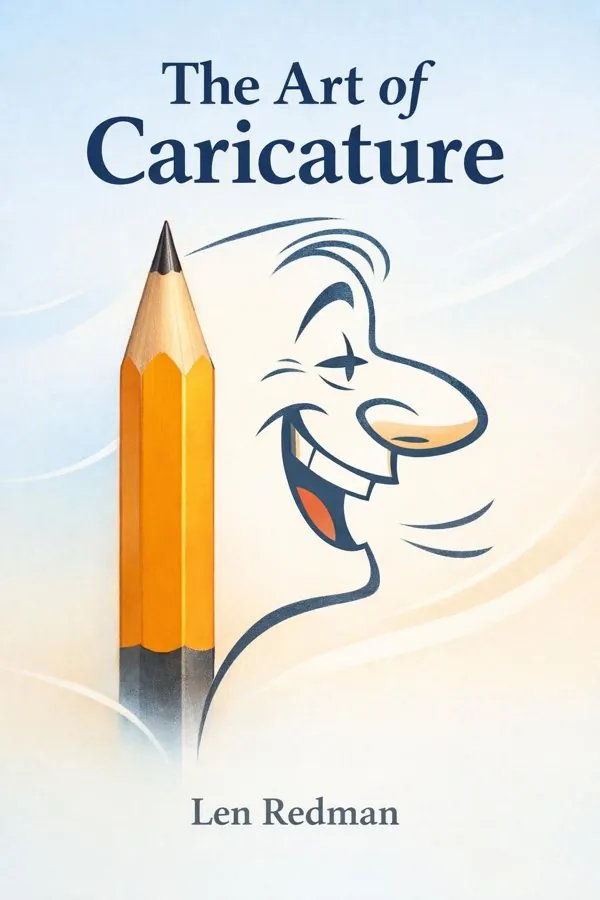
The Art of Caricature: Summary & Key Insights
by Len Redman
 10 min10 chaptersAudio available
Key Takeaways from The Art of Caricature
The first surprise of caricature is that it begins not with exaggeration, but with attention.
Exaggeration works only when it is anchored in structure.
A common beginner mistake is to search for a single “funny” feature and inflate it.
A face without expression may resemble a person, but it rarely feels alive.
Caricature becomes powerful not when everything is exaggerated, but when the right things are.
What Is The Art of Caricature About?
The Art of Caricature by Len Redman is a design book spanning 9 pages. What makes a caricature memorable is not how wildly it distorts a face, but how precisely it reveals a person. In The Art of Caricature, Len Redman shows that caricature is far more than comic exaggeration: it is a disciplined visual language built on observation, anatomy, expression, rhythm, and wit. The book guides artists through the foundations of seeing faces clearly, identifying dominant traits, and exaggerating them without losing likeness or humanity. Redman treats caricature as both craft and communication, teaching readers how humor can sharpen perception rather than replace it. The book matters because caricature sits at the intersection of fine art, cartooning, portraiture, and storytelling. It trains artists to simplify complexity, capture personality quickly, and communicate character with economy and flair. Redman writes with the practical authority of an experienced artist and teacher, offering step-by-step instruction rooted in real drawing problems. His approach helps beginners overcome fear of distortion while giving more advanced illustrators a framework for developing stronger design instincts and a more personal style. For anyone who wants to draw people with more life, insight, and confidence, this book remains a valuable guide.
This FizzRead summary covers all 10 key chapters of The Art of Caricature in approximately 10 minutes, distilling the most important ideas, arguments, and takeaways from Len Redman's work. Also available as an audio summary and Key Quotes Podcast.
The Art of Caricature
What makes a caricature memorable is not how wildly it distorts a face, but how precisely it reveals a person. In The Art of Caricature, Len Redman shows that caricature is far more than comic exaggeration: it is a disciplined visual language built on observation, anatomy, expression, rhythm, and wit. The book guides artists through the foundations of seeing faces clearly, identifying dominant traits, and exaggerating them without losing likeness or humanity. Redman treats caricature as both craft and communication, teaching readers how humor can sharpen perception rather than replace it.
The book matters because caricature sits at the intersection of fine art, cartooning, portraiture, and storytelling. It trains artists to simplify complexity, capture personality quickly, and communicate character with economy and flair. Redman writes with the practical authority of an experienced artist and teacher, offering step-by-step instruction rooted in real drawing problems. His approach helps beginners overcome fear of distortion while giving more advanced illustrators a framework for developing stronger design instincts and a more personal style. For anyone who wants to draw people with more life, insight, and confidence, this book remains a valuable guide.
Who Should Read The Art of Caricature?
This book is perfect for anyone interested in design and looking to gain actionable insights in a short read. Whether you're a student, professional, or lifelong learner, the key ideas from The Art of Caricature by Len Redman will help you think differently.
- ✓Readers who enjoy design and want practical takeaways
- ✓Professionals looking to apply new ideas to their work and life
- ✓Anyone who wants the core insights of The Art of Caricature in just 10 minutes
Want the full summary?
Get instant access to this book summary and 100K+ more with Fizz Moment.
Get Free SummaryAvailable on App Store • Free to download
Key Chapters
The first surprise of caricature is that it begins not with exaggeration, but with attention. Many people assume caricature is simply making a nose bigger or stretching a chin for laughs. Redman argues that this misses the point. Caricature is a form of visual interpretation: the artist studies a face, identifies what is distinctive, and then amplifies those traits to communicate personality, mood, or commentary. In other words, the distortion serves meaning.
This is why caricature has long been useful in editorial art, entertainment, portrait events, and comic storytelling. It condenses a person into a striking visual statement. A politician’s self-importance might be conveyed through a puffed chest and narrowed eyes. A beloved actor’s charm may appear in a sparkling smile and elastic brows. The best caricatures do not merely ridicule; they reveal. They make viewers feel they recognize something true.
Redman encourages artists to think about purpose before drawing. Is the goal affectionate humor, sharp satire, or a lively keepsake? The answer affects every artistic choice: how far to exaggerate, which features to emphasize, and what emotional tone to set. Even two caricatures of the same subject can differ dramatically depending on intention. A stage performer may be drawn with theatrical flourish, while a business leader may be simplified into authority and restraint.
Practically, this means training yourself to ask better questions when observing faces. What feature would still identify this person in silhouette? What expression do they default to? What visual trait best communicates their energy? When artists focus on communication rather than gimmicks, their caricatures gain both humor and depth.
Actionable takeaway: Before drawing any caricature, write a one-sentence intention for the portrait, such as “warm and playful” or “sharp and satirical,” and let that guide what you exaggerate.
Exaggeration works only when it is anchored in structure. Redman emphasizes that caricature is not an escape from drawing fundamentals but a test of them. To alter a face convincingly, you must understand how it is built: the skull mass, placement of eyes, width of cheekbones, length of jaw, shape of nose cartilage, and relationships among forehead, midface, and chin. Without that knowledge, distortion turns arbitrary and likeness disappears.
This is why strong caricaturists often have a solid background in portrait drawing. They know the ordinary rules of proportion well enough to bend them intelligently. A face may have close-set eyes, a high forehead, or a boxy jaw, but those traits make sense only in relation to a normal range. Caricature depends on comparison. You are asking, in effect, what is more prominent, more compressed, more tilted, more angular, or more rounded than expected.
Consider two subjects. One has a tiny lower face and broad cranium; another has a long, tapering head with a narrow brow and powerful chin. If you understand underlying structure, you can push those differences boldly while keeping the face coherent. The artist who lacks anatomical awareness might enlarge a feature randomly and lose the logic that makes the drawing believable.
Redman’s practical lesson is to study the face as a set of interrelated masses rather than isolated parts. A large nose affects how small the mouth appears. Deep-set eyes influence the brow shadow. A broad forehead changes the apparent scale of the jaw. By thinking structurally, the artist exaggerates the whole design, not just one feature.
Actionable takeaway: Spend part of your practice drawing heads in standard proportion, then redraw the same heads by exaggerating one structural relationship at a time, such as forehead-to-jaw or nose-to-mouth.
A common beginner mistake is to search for a single “funny” feature and inflate it. Redman shows that stronger caricature comes from exaggerating relationships across the entire face. Likeness rarely lives in one part alone; it emerges from proportion, spacing, angle, and contrast. A big nose matters because of how it sits between small eyes and a tiny mouth. A long face becomes memorable when paired with a narrow forehead and compact hair shape. Exaggeration is most effective when it reorganizes the face around its dominant visual pattern.
This idea helps explain why some technically neat caricatures still feel generic. If every subject gets enlarged ears or oversized teeth, the artist is imposing a formula rather than reading the individual. Redman pushes readers to identify the face’s governing logic. Is it top-heavy or bottom-heavy? Broad and flat, or narrow and vertical? Softly rounded, or built from sharp angles? Once you identify that overall pattern, individual features can be pushed in harmony.
For example, imagine a person with a large upper skull, delicate chin, and small clustered features. The caricature may become more convincing by expanding the cranium, tightening the facial center, and shrinking the jaw as a unit. Another person with a heavy jaw, low brow, and broad nose may call for the opposite treatment: compress the top, widen the lower half, and emphasize grounded solidity.
This relational approach also creates visual rhythm. The drawing feels designed, not merely altered. Contrast becomes a tool: big against small, long against short, sharp against soft. These pairings make caricatures readable at a glance and far more memorable.
Actionable takeaway: When analyzing a face, list three relationship contrasts first, such as “wide forehead, narrow chin” or “small eyes, big mouth,” before deciding which individual features to enlarge.
A face without expression may resemble a person, but it rarely feels alive. Redman treats expression as central to caricature because personality often appears most clearly in motion: a lifted brow, tightened lips, squinting eyes, or an asymmetrical grin. Expression transforms a static likeness into a statement about who someone is and how they occupy the world.
This matters because caricature is not just about facial geometry. Two people can share similar proportions yet feel entirely different because of habitual expression. One may look amused, another skeptical, another intensely alert. Redman encourages artists to observe these recurring tendencies instead of relying only on neutral reference photos. The emotional truth of a person often lives in the face they make most naturally, not in a posed portrait.
In practical terms, expression affects every feature. A smile changes cheek shape, reveals teeth, narrows the eyes, and shifts the chin line. Surprise lifts the brows, opens the lids, and lengthens the face. Sternness can flatten the mouth and harden the jaw. If the artist exaggerates only one feature without respecting the expression affecting the entire face, the result can feel disconnected.
Expression also determines tone. A friendly caricature for a wedding guestbook might highlight warmth and sparkle. A theatrical caricature of a comedian may push explosive laughter and wide-eyed energy. A satirical public figure might be drawn with self-satisfaction or irritation. These choices communicate instantly and shape the viewer’s response.
Redman’s deeper point is that expression should intensify likeness, not distract from it. The strongest caricatures choose expressions that feel native to the subject. They do not paste on emotion; they uncover it.
Actionable takeaway: Collect three different reference images of the same person and identify the expression that most consistently reflects their personality, then build your caricature around that emotional baseline.
Caricature becomes powerful not when everything is exaggerated, but when the right things are. Redman stresses the importance of balance: push too little and the drawing feels timid; push too much in the wrong direction and the person becomes unrecognizable. This balance is one of caricature’s hardest skills because it requires both courage and judgment.
The key is selective restraint. If you enlarge every feature, you eliminate contrast and therefore weaken the drawing. A huge nose only feels huge next to smaller neighboring forms. A towering forehead needs a counterpoint in the lower face. Redman encourages artists to preserve certain stabilizing landmarks so the viewer still recognizes the subject instantly. These may include eye angle, hairline shape, mouth curvature, or the spacing pattern among features.
Think of likeness as a system of clues. Some clues are essential; others are optional. A skilled caricaturist identifies which traits the face cannot lose. For one person, it may be the low heavy eyelids; for another, the triangular jaw; for another, the wide smile and gap between the teeth. Once those anchors are preserved, exaggeration can become more adventurous elsewhere.
This principle is especially important for beginners, who often mistake boldness for randomness. Redman teaches that distortion should be tested against recognition. Show the sketch to someone who knows the subject. If they recognize the person immediately, your exaggeration is serving likeness. If they only see a generalized funny face, you have likely lost the essential anchors.
Actionable takeaway: In each caricature, identify two features you will exaggerate strongly and two features you will keep relatively stable to preserve recognition and contrast.
In caricature, how you draw matters nearly as much as what you draw. Redman gives careful attention to line quality, shading, and composition because these elements shape personality, mood, and readability. A caricature drawn with nervous, scratchy marks feels different from one built with bold, sweeping contours. Materials and mark-making are not afterthoughts; they are part of the message.
Line can suggest confidence, elegance, tension, softness, or age. Thick-to-thin contours create energy and emphasis. Angular strokes can sharpen a severe face, while rounded lines can enhance a cheerful or childlike character. Redman’s instruction implies that the caricaturist should not use one default line for every subject. The drawing style can echo the subject’s character.
Shading serves a similar purpose. It clarifies form, adds dimension, and directs attention. Heavy shadows under brows can intensify drama or menace. Gentle tonal modeling may create warmth and volume. Even minimal shading can separate planes and keep exaggerated forms believable. Redman does not advocate rendering for its own sake; instead, he shows how controlled simplification keeps the portrait lively.
Composition also plays a role. Caricature is strongest when the page design supports the facial idea. A long face might benefit from vertical placement. A broad, expansive subject may work better in a wide composition. Hair shape, shoulders, clothing, and props can reinforce the dominant visual statement.
The broader lesson is that caricature is a designed image, not just a manipulated head. Every artistic choice should support clarity and character.
Actionable takeaway: Draw the same caricature three times using different line styles—bold, delicate, and angular—and compare how much each version changes the perceived personality of the subject.
Many artists go looking for style too early, as if it were a decorative surface they can apply on top of weak observation. Redman presents a healthier view: style develops from consistent ways of seeing, simplifying, exaggerating, and designing. It is the byproduct of practice and decision-making, not a shortcut around fundamentals.
This is encouraging because it means personal style is not a mystery available only to naturally gifted artists. It emerges gradually as you discover which forms attract you, how far you like to push distortion, what line quality feels natural, and what kind of humor you want your work to express. Some caricaturists favor elegant minimalism with a few decisive lines. Others prefer exuberant exaggeration, dense shadow, or theatrical body language. None of these approaches is inherently superior if the likeness remains clear and the design coherent.
Redman’s practical teaching suggests studying admired artists without imitating them blindly. By analyzing why their work succeeds—perhaps economy of line, strong shape design, or emotional directness—you can borrow principles rather than mannerisms. Over time, your repeated solutions become recognizable as your own voice.
Developing style also means aligning drawing choices with intent. If you love gentle, affectionate caricature, your exaggeration and line will differ from someone drawn to biting political satire. Style, then, is partly aesthetic and partly ethical. It reflects what you notice in people and how you choose to portray them.
The most durable style rests on authenticity. When artists stop chasing novelty and start drawing consistently from careful observation, their individuality becomes more visible.
Actionable takeaway: Review ten of your caricatures and note recurring habits in shape, line, and exaggeration; identify which habits strengthen your work and intentionally refine them into a personal approach.
Progress in caricature depends less on avoiding errors than on learning to diagnose them. Redman treats common mistakes as useful signals. When a caricature fails, it usually fails for specific reasons: weak observation, overworked rendering, generic exaggeration, poor structure, or an expression that contradicts the subject’s personality. Artists improve quickly when they learn to name these problems instead of simply feeling dissatisfied.
One frequent mistake is exaggerating before understanding. Beginners sometimes latch onto a visible feature without studying the head as a whole, producing distortion without likeness. Another is copying a photograph too literally and then adding a single oversized feature, which creates an awkward hybrid of portrait and cartoon. A third is losing clarity with too many lines, especially around wrinkles, hair, or teeth. In caricature, excess detail can flatten impact rather than increase realism.
Redman’s teaching encourages a cycle of analysis and revision. Compare your drawing with the subject and ask: Did I exaggerate the dominant idea or just random features? Does the silhouette feel distinctive? Are the eyes and mouth carrying the right emotional signal? Is the head shape stronger than the details inside it? These questions sharpen judgment.
Practical improvement also comes from iteration. Drawing the same subject multiple ways helps you discover which exaggeration reads best. One version may emphasize head shape, another expression, another nose-to-mouth spacing. Through comparison, the most convincing solution becomes obvious.
Mistakes lose their sting when treated as information. In a field that combines precision and risk, unsuccessful attempts are not evidence of lack of talent; they are part of the method.
Actionable takeaway: After each caricature session, write down one thing that captured likeness and one thing that weakened it, then redraw the same subject immediately with that diagnosis in mind.
A face may be the center of caricature, but it is not the whole story. Redman shows that clothing, posture, gesture, props, and context can all strengthen characterization. A successful caricature often becomes more complete when the head is connected to a body language or environment that supports the subject’s identity.
This is especially useful when drawing public figures, entertainers, athletes, or themed commissions. A chef can be shown with a tasting spoon, a conductor with raised baton, a scientist with thoughtful stoop and notebook, a performer leaning into the spotlight. These additions do more than decorate the page. They reinforce recognition and invite narrative. Viewers do not simply see a face; they understand a role.
Body exaggeration can also echo facial design. A long, lanky face may pair naturally with a stretched torso and narrow limbs. A compact, dense head shape may be supported by squat posture and broad gestures. This visual unity makes the caricature feel intentional. It also opens possibilities for humor. A tiny body under an oversized authoritative head can satirize ego. An exaggerated stride can communicate confidence or vanity.
Redman’s broader point is that caricature belongs to illustration as much as portraiture. It can comment, tell stories, and create visual scenes. Artists who think beyond the head gain expressive power and more professional versatility, whether in editorial work, event drawing, animation design, or publishing.
Actionable takeaway: For your next caricature, add one body pose and one contextual prop that communicate the subject’s role or personality without needing any written explanation.
Caricature thrives on play, and Redman never lets technique become so rigid that it kills the joy of drawing. Beneath all the instruction lies a simple truth: caricature improves through frequent practice, experimentation, and a willingness to stay playful. Humor matters because it loosens fear. Artists who are terrified of making a bad drawing often become stiff and overcautious. Caricature, by contrast, rewards bold searching.
This does not mean every drawing must be funny in an obvious way. Humor can be lightness, surprise, wit, or affectionate insight. It is the energy that keeps caricature from becoming merely distorted portraiture. When an artist enjoys discovering visual truths, that spirit often appears in the work.
Redman’s method points toward deliberate repetition. Draw many faces. Work from life when possible, because live observation reveals gesture, expression, and changing angles that photos flatten. Fill pages with quick studies of noses, eyes, profiles, and head shapes. Try multiple versions of the same person. Some attempts will fail, but each one builds visual memory and confidence.
A practical routine might include five-minute head-shape sketches, expression studies from television interviews, and finished caricatures from magazine portraits. Over time, the artist begins to recognize patterns faster: who is defined by forehead, who by jaw, who by smile, who by posture. This speed of recognition is one of the real marks of progress.
The book ultimately frames caricature as a lifelong craft fueled by curiosity and amusement. The more you draw, the more clearly you see; the more clearly you see, the more inventive your exaggeration becomes.
Actionable takeaway: Create a weekly practice system with short daily caricature sketches and one longer finished piece, focusing each week on a specific skill such as head shape, expression, or line economy.
All Chapters in The Art of Caricature
About the Author
Len Redman was an American artist, cartoonist, and teacher best known for his expertise in caricature and instructional drawing. He built a reputation for translating complex visual ideas into practical lessons that artists could apply immediately, especially in the areas of facial construction, exaggeration, and cartoon expression. Redman’s books and teaching materials helped generations of illustrators, hobbyists, and aspiring cartoonists understand that caricature is not careless distortion but a disciplined art rooted in observation and design. His work stands out for its clarity, accessibility, and respect for the craft of drawing. By treating caricature as both entertaining and technically serious, he left a lasting mark on art education and on the broader tradition of cartoon and portrait illustration.
Get This Summary in Your Preferred Format
Read or listen to the The Art of Caricature summary by Len Redman anytime, anywhere. FizzRead offers multiple formats so you can learn on your terms — all free.
Available formats: App · Audio · PDF · EPUB — All included free with FizzRead
Download The Art of Caricature PDF and EPUB Summary
Key Quotes from The Art of Caricature
“The first surprise of caricature is that it begins not with exaggeration, but with attention.”
“Exaggeration works only when it is anchored in structure.”
“A common beginner mistake is to search for a single “funny” feature and inflate it.”
“A face without expression may resemble a person, but it rarely feels alive.”
“Caricature becomes powerful not when everything is exaggerated, but when the right things are.”
Frequently Asked Questions about The Art of Caricature
The Art of Caricature by Len Redman is a design book that explores key ideas across 10 chapters. What makes a caricature memorable is not how wildly it distorts a face, but how precisely it reveals a person. In The Art of Caricature, Len Redman shows that caricature is far more than comic exaggeration: it is a disciplined visual language built on observation, anatomy, expression, rhythm, and wit. The book guides artists through the foundations of seeing faces clearly, identifying dominant traits, and exaggerating them without losing likeness or humanity. Redman treats caricature as both craft and communication, teaching readers how humor can sharpen perception rather than replace it. The book matters because caricature sits at the intersection of fine art, cartooning, portraiture, and storytelling. It trains artists to simplify complexity, capture personality quickly, and communicate character with economy and flair. Redman writes with the practical authority of an experienced artist and teacher, offering step-by-step instruction rooted in real drawing problems. His approach helps beginners overcome fear of distortion while giving more advanced illustrators a framework for developing stronger design instincts and a more personal style. For anyone who wants to draw people with more life, insight, and confidence, this book remains a valuable guide.
You Might Also Like

The Design of Everyday Things
Don Norman
10 min
The Better Angels of Our Nature
Steven Pinker
10 min
A Designer's Art
Paul Rand
10 min
Architects' Sketchbooks
Various Editors
10 min
Architectural Graphic Standards
The American Institute of Architects
10 min
Design Is Storytelling
Ellen Lupton
10 minBrowse by Category
Ready to read The Art of Caricature?
Get the full summary and 100K+ more books with Fizz Moment.