
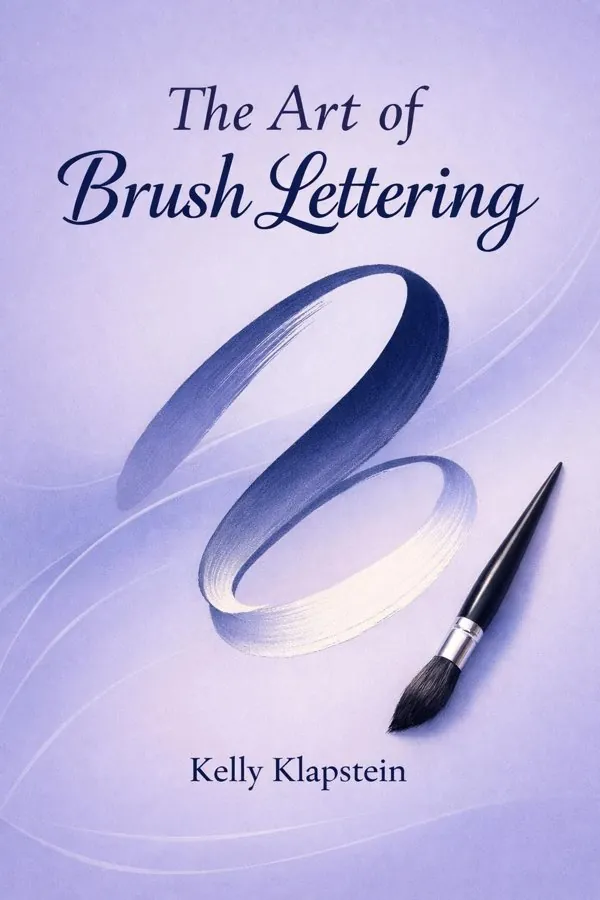
The Art of Brush Lettering: A Stroke-by-Stroke Guide to the Practice and Techniques of Creative Lettering and Calligraphy: Summary & Key Insights
 10 min9 chaptersAudio available
Key Takeaways from The Art of Brush Lettering: A Stroke-by-Stroke Guide to the Practice and Techniques of Creative Lettering and Calligraphy
Great lettering often begins long before the first stroke touches the page.
Beautiful brush lettering is really a controlled dance between pressure and release.
Complex alphabets become less intimidating when you realize they are built from a small set of repeatable parts.
A beautiful alphabet is not enough if the letters do not belong together.
Many lettering problems are actually spacing problems in disguise.
What Is The Art of Brush Lettering: A Stroke-by-Stroke Guide to the Practice and Techniques of Creative Lettering and Calligraphy About?
The Art of Brush Lettering: A Stroke-by-Stroke Guide to the Practice and Techniques of Creative Lettering and Calligraphy by Kelly Klapstein is a design book spanning 5 pages. The Art of Brush Lettering is both a practical workbook and an invitation into a slower, more attentive form of creativity. In this accessible guide, Kelly Klapstein teaches readers how to build modern brush calligraphy from the ground up, beginning with tools, posture, and pressure control before moving into letterforms, words, layouts, and finished projects. Rather than treating lettering as a mysterious talent reserved for naturally artistic people, she breaks it into learnable parts: strokes, repetition, rhythm, spacing, and composition. That makes the book valuable not only for complete beginners but also for hobbyists and designers who want cleaner technique and a more confident visual style. What gives the book its strength is Klapstein’s authority as a teacher. As a widely respected lettering artist and workshop instructor, she understands the exact problems learners face, from shaky upstrokes to crowded word layouts. Her guidance is calm, encouraging, and highly practical. The result is a book that helps readers do more than copy pretty alphabets. It teaches them how to think like letterers, practice with intention, and gradually develop a style that feels personal, polished, and expressive.
This FizzRead summary covers all 9 key chapters of The Art of Brush Lettering: A Stroke-by-Stroke Guide to the Practice and Techniques of Creative Lettering and Calligraphy in approximately 10 minutes, distilling the most important ideas, arguments, and takeaways from Kelly Klapstein's work. Also available as an audio summary and Key Quotes Podcast.
The Art of Brush Lettering: A Stroke-by-Stroke Guide to the Practice and Techniques of Creative Lettering and Calligraphy
The Art of Brush Lettering is both a practical workbook and an invitation into a slower, more attentive form of creativity. In this accessible guide, Kelly Klapstein teaches readers how to build modern brush calligraphy from the ground up, beginning with tools, posture, and pressure control before moving into letterforms, words, layouts, and finished projects. Rather than treating lettering as a mysterious talent reserved for naturally artistic people, she breaks it into learnable parts: strokes, repetition, rhythm, spacing, and composition. That makes the book valuable not only for complete beginners but also for hobbyists and designers who want cleaner technique and a more confident visual style. What gives the book its strength is Klapstein’s authority as a teacher. As a widely respected lettering artist and workshop instructor, she understands the exact problems learners face, from shaky upstrokes to crowded word layouts. Her guidance is calm, encouraging, and highly practical. The result is a book that helps readers do more than copy pretty alphabets. It teaches them how to think like letterers, practice with intention, and gradually develop a style that feels personal, polished, and expressive.
Who Should Read The Art of Brush Lettering: A Stroke-by-Stroke Guide to the Practice and Techniques of Creative Lettering and Calligraphy?
This book is perfect for anyone interested in design and looking to gain actionable insights in a short read. Whether you're a student, professional, or lifelong learner, the key ideas from The Art of Brush Lettering: A Stroke-by-Stroke Guide to the Practice and Techniques of Creative Lettering and Calligraphy by Kelly Klapstein will help you think differently.
- ✓Readers who enjoy design and want practical takeaways
- ✓Professionals looking to apply new ideas to their work and life
- ✓Anyone who wants the core insights of The Art of Brush Lettering: A Stroke-by-Stroke Guide to the Practice and Techniques of Creative Lettering and Calligraphy in just 10 minutes
Want the full summary?
Get instant access to this book summary and 100K+ more with Fizz Moment.
Get Free SummaryAvailable on App Store • Free to download
Key Chapters
Great lettering often begins long before the first stroke touches the page. One of Kelly Klapstein’s most useful lessons is that brush lettering is not only about artistic instinct; it is also about choosing tools that make control possible. Pens, paper, ink flow, and even the surface beneath your page all shape the quality of your results. Beginners often blame themselves for frayed lines or inconsistent strokes when the real problem is poor paper or the wrong pen size. Klapstein removes that confusion by explaining how different brush pens behave, why smoother paper preserves pen tips, and how basic supplies can either support or sabotage practice.
This matters because the right materials reduce friction and help learners focus on technique instead of fighting avoidable problems. A small brush pen may be easier for compact writing and tighter control, while a larger pen encourages looser movement and visible contrast between thick and thin strokes. Tracing paper, guide sheets, and quality practice pads can also improve consistency because they create clear visual boundaries and preserve pen life. Even a simple choice such as sitting at a desk with proper arm support can affect fluidity.
Klapstein’s broader point is empowering: you do not need a studio full of expensive materials, but you do need a deliberate setup. If your tools suit your current skill level, practice becomes more rewarding and less discouraging. A smart starting kit helps create early wins, and early wins keep people practicing.
Actionable takeaway: assemble a simple, reliable lettering kit with one beginner-friendly brush pen, smooth paper, a pencil, eraser, ruler, and guideline sheets, then commit to using the same setup for your first weeks of practice so you can isolate and improve technique.
Beautiful brush lettering is really a controlled dance between pressure and release. Klapstein emphasizes that the signature look of modern calligraphy comes from contrast: light, delicate upstrokes paired with heavier downstrokes. That contrast is not decorative fluff; it is the structural principle that gives brush lettering its elegance. Many beginners assume that if their letters look awkward, they simply lack talent. Klapstein shows that the issue is usually mechanical. The hand has not yet learned how much pressure to apply, when to lift, and how to keep angle and speed consistent.
Her teaching breaks brush control into trainable habits. Instead of jumping straight into words, readers practice isolated marks such as thin entrance strokes, thick downward pulls, underturns, overturns, loops, and curves. This approach is effective because it develops muscle memory before complexity increases. For example, a learner who struggles with a wobbly lowercase “m” often does not have a letter problem at all; they have an underturn consistency problem. By practicing the component stroke repeatedly, the letter improves naturally.
Klapstein also underscores patience. Pressure control develops through repetition, not force. Pressing too hard can damage the pen and produce clumsy shapes, while rushing tends to erase the distinction between thick and thin. Small adjustments in grip, slower pacing, and mindful breathing can produce better results than trying to “draw prettier.”
The deeper lesson is that control creates freedom. Once the hand understands pressure, lettering becomes less stressful and more expressive. You stop guessing and begin shaping letters intentionally.
Actionable takeaway: spend ten minutes a day practicing only basic thick-and-thin strokes, focusing on smooth transitions rather than speed, until pressure changes feel predictable in your hand.
Complex alphabets become less intimidating when you realize they are built from a small set of repeatable parts. Klapstein teaches brush lettering stroke by stroke, helping readers see that letters are not isolated drawings but combinations of foundational forms. Entrance strokes, descenders, oval shapes, loops, underturns, and compound curves recur across the alphabet. Once these elements become familiar, the mystery of lettering starts to disappear.
This shift in perspective is crucial for learners who freeze when faced with an entire alphabet chart. Instead of trying to memorize twenty-six separate designs, readers can focus on mastering a handful of recurring movements. The lowercase “a,” “d,” “g,” and “q,” for instance, all rely on control of the oval form. Letters like “n,” “m,” and “h” share structural rhythms built from entrance strokes and underturns. Uppercase letters may feel more decorative, but even they rely on repeated principles of proportion, contrast, and movement.
Klapstein’s stroke-first method also teaches diagnostic thinking. If a word looks uneven, you can identify whether the issue lies in slant, spacing, oval consistency, or stroke weight. That is far more useful than simply knowing that the word “looks wrong.” For anyone developing a practice routine, this creates a smarter feedback loop: target the weak stroke, and many letters improve at once.
In practical use, this means practice can be organized more efficiently. One session might focus on oval-based letters, another on ascending loops, another on capitals with similar structures. The student progresses through systems rather than random repetition.
Actionable takeaway: group your alphabet practice by shared stroke families instead of practicing letters in alphabetical order, and master one family at a time before moving to the next.
A beautiful alphabet is not enough if the letters do not belong together. Klapstein highlights an often-overlooked truth: strong lettering depends on harmony across the whole word or phrase. Lowercase and uppercase letters should feel as if they come from the same visual world, sharing rhythm, stroke contrast, slant, and personality. When capitals are overly ornate or lowercase letters are too rigid, the result can feel disjointed even if each individual character looks attractive on its own.
This is where proportion becomes especially important. X-height, ascender length, descender depth, and capital scale all influence readability and style. If capitals are too large, they dominate the line. If lowercase letters vary too wildly in width or slant, words lose their rhythm. Klapstein teaches readers to see lettering not as a row of separate symbols but as a coordinated composition where each form influences the next.
Practical improvements come from comparing letter relationships. A flourishing uppercase “B” might look elegant in isolation, but paired with compact, plain lowercase letters it can feel like it belongs to a different script. Similarly, narrow lowercase forms set against broad capitals can create awkward spacing. Through guided examples and practice, Klapstein encourages balance rather than perfectionism. The goal is not rigid uniformity but visual cohesion.
This concept matters even more in real projects such as quotes, greeting cards, or place cards, where a mix of capitals and lowercase appears frequently. Harmony makes the overall piece feel polished and intentional.
Actionable takeaway: when practicing words, judge letters in relation to one another rather than one by one, checking whether your capitals, lowercase forms, and overall slant create a consistent visual rhythm.
Many lettering problems are actually spacing problems in disguise. Klapstein shows that even well-formed letters can look clumsy when the gaps between them are uneven. Beginners often focus intensely on shaping each character while ignoring the negative space around it, but in calligraphy, what happens between letters is as important as the letters themselves. Good spacing creates flow, readability, and elegance. Poor spacing makes words feel cramped, disjointed, or unstable.
The challenge is that spacing in script is not measured by identical physical distance. Because letters have different shapes, equal-looking space is often more important than equal actual space. A round letter like “o” creates a different visual gap than a narrow letter like “i,” and combinations such as “av” or “lo” require special attention. Klapstein helps readers train their eyes to notice these relationships and make subtle adjustments that improve the whole word.
She also connects spacing to rhythm. In brush lettering, letters should feel linked by a natural movement rather than squeezed together mechanically. This applies to word spacing as well. If words are too close, a phrase feels tangled. If they are too far apart, the composition loses unity. Practicing drills with repeated letter combinations, common joins, and simple words helps sharpen this visual sensitivity.
For real-world application, spacing is often the difference between a handmade piece that looks amateur and one that looks refined. Greeting cards, wall quotes, menus, and social media graphics all benefit from careful letter and word spacing. Once you learn to see negative space, you begin editing your work more intelligently.
Actionable takeaway: after lettering a word, stop looking at the letters themselves and evaluate only the spaces between them, adjusting any gap that appears noticeably tighter or looser than the others.
Lettering becomes memorable when it moves beyond individual letters and starts functioning as composition. Klapstein teaches that a successful piece is not merely legible writing; it is an arrangement of hierarchy, balance, movement, and emphasis. This is where brush lettering meets design. A quote on a page, a name on an envelope, or a phrase in a print must guide the eye intentionally. Without composition, even skillful lettering can feel flat.
One of the book’s major strengths is showing readers how to think about layout before they start inking. Decisions about where the focal word goes, how large it should be, what style it should use, and how supporting words should relate all affect the final impact. For example, a short inspirational phrase can become far more dynamic when the key word is enlarged, curved, or given a contrasting style, while the rest of the text remains simpler and more supportive. Centering, alignment, line breaks, and spacing between lines all help shape the emotional tone of the piece.
Klapstein also encourages experimentation with bounce, flourishes, banners, and decorative accents, but always in service of readability and visual balance. Decoration should strengthen the message, not compete with it. This helps learners avoid a common trap: adding flourishes too early without understanding structure.
In practice, composition skills expand what lettering can do. They make it possible to create posters, cards, signs, journal pages, and digital graphics that feel designed rather than merely written. Readers learn to plan, sketch thumbnails, and revise instead of relying on luck.
Actionable takeaway: before creating any finished lettering piece, make two or three quick pencil layout thumbnails to test hierarchy, word placement, and balance before committing to ink.
Improvement in lettering does not come from mindless repetition; it comes from focused repetition with feedback. Klapstein repeatedly reinforces the idea that consistent, deliberate practice matters more than occasional bursts of enthusiasm. This is an important message because brush lettering can tempt beginners into chasing finished pieces too soon. They want to make a beautiful quote for social media or a gift tag for a friend before they have built the core skills that make those projects successful. The result is often frustration.
Her method encourages learners to separate skill-building from performance. A productive practice session may include warm-ups, a review of one foundational stroke, drills for a troublesome letter family, and a short application exercise using a simple word or phrase. This structure prevents practice from becoming vague. Instead of saying, “I practiced for thirty minutes,” the learner can say, “I improved my oval consistency and spacing between rounded letters.” That kind of specificity leads to visible progress.
Klapstein also normalizes plateaus. Some days the strokes feel smooth; other days they do not. Progress is rarely linear, especially in a discipline that depends on fine motor control. Keeping practice sheets, dating work, and comparing results over time helps reveal growth that may be invisible day to day. Small projects can then serve as milestones, showing how technical drills translate into finished art.
This philosophy applies beyond lettering. It teaches patience, observation, and the value of process. By approaching practice as training rather than proof of talent, readers build resilience and confidence.
Actionable takeaway: create a weekly lettering routine with short, repeatable sessions focused on one specific goal at a time, and keep your dated practice pages so you can measure progress objectively.
Skill deepens when it is used, not just rehearsed. Klapstein includes projects because she understands that learners need more than drills to stay motivated. Applying lettering to cards, gift tags, quotes, envelopes, journals, and decorative pieces transforms technique into purpose. Projects reveal what practice alone cannot: how letters behave in real compositions, how spacing changes in longer phrases, and how design choices affect mood. They also give learners the satisfaction of making something shareable, which is often what keeps a creative habit alive.
Projects serve another function as well: they help personal style emerge. A student may start by imitating exemplar alphabets, but once they begin creating actual pieces, choices multiply. Should the layout be formal or playful? Should the capitals be restrained or expressive? Should flourishes be minimal or dramatic? Through repeated experimentation, preferences become visible. Klapstein does not push readers toward a single aesthetic. Instead, she encourages technical competence as the foundation from which individuality can grow.
This is especially useful for people who worry that their work looks too derivative. In lettering, originality rarely appears all at once. It develops through accumulated decisions shaped by practice, taste, and experience. A few favored letterforms, a consistent sense of spacing, a preference for certain compositions, or a distinctive use of embellishment can slowly become a recognizable voice.
Real projects also teach practical constraints. Writing on a small tag is different from creating a large quote print. Addressing envelopes demands clarity; making a wall piece allows more expressive layout. These variations sharpen adaptability.
Actionable takeaway: complete one small finished lettering project each week using the techniques you are practicing, and note which stylistic choices feel most natural so you can begin identifying your own visual voice.
At its deepest level, brush lettering is not just a decorative skill but a way of training attention. Klapstein’s approach carries a quiet but important message: the practice asks you to slow down, observe closely, and accept imperfection as part of learning. In a culture that often prizes speed and polished outcomes, lettering offers a different rhythm. Every stroke requires presence. You cannot rush a delicate upstroke or a controlled downstroke without seeing the result immediately. That makes the craft both demanding and calming.
This mindset helps readers relate to mistakes differently. A shaky curve or awkward spacing choice does not have to be interpreted as failure; it can be treated as useful information. Which stroke broke down? Was the pressure inconsistent? Did the layout need more planning? By replacing self-criticism with curiosity, learners become more resilient and improve faster. Klapstein’s encouraging tone supports this shift. She frames progress as a journey of refinement rather than a test of innate artistic worth.
Play is part of this too. Once the basics are established, experimenting with bounce, flourishes, color, embellishments, or layout variations keeps the practice lively. Structure and play are not opposites; they support each other. Technical skill gives experimentation stability, and experimentation keeps technical practice from becoming stale.
For many readers, this may become the book’s most lasting contribution. Beyond teaching calligraphy, it models a creative process grounded in patience, discipline, and joy. That combination is why brush lettering often becomes a lasting hobby rather than a short-lived trend.
Actionable takeaway: approach each practice session with one technical goal and one spirit of curiosity, allowing yourself to study mistakes calmly and to experiment freely once the core exercise is complete.
All Chapters in The Art of Brush Lettering: A Stroke-by-Stroke Guide to the Practice and Techniques of Creative Lettering and Calligraphy
About the Author
Kelly Klapstein is a Canadian artist, educator, and author specializing in modern calligraphy and brush lettering. She is widely known through her Love Letters brand, where she has helped popularize approachable, expressive hand lettering for beginners and enthusiasts alike. In addition to creating her own artwork, Klapstein has taught workshops internationally, building a reputation for clear instruction, technical precision, and an encouraging teaching style. Her work bridges art and education, making creative lettering feel accessible rather than intimidating. Through books, classes, and community engagement, she has inspired a global audience to explore brush pens, calligraphy, and visual composition. Her practical, step-by-step approach is a major reason her lettering resources are trusted by learners at many different skill levels.
Get This Summary in Your Preferred Format
Read or listen to the The Art of Brush Lettering: A Stroke-by-Stroke Guide to the Practice and Techniques of Creative Lettering and Calligraphy summary by Kelly Klapstein anytime, anywhere. FizzRead offers multiple formats so you can learn on your terms — all free.
Available formats: App · Audio · PDF · EPUB — All included free with FizzRead
Download The Art of Brush Lettering: A Stroke-by-Stroke Guide to the Practice and Techniques of Creative Lettering and Calligraphy PDF and EPUB Summary
Key Quotes from The Art of Brush Lettering: A Stroke-by-Stroke Guide to the Practice and Techniques of Creative Lettering and Calligraphy
“Great lettering often begins long before the first stroke touches the page.”
“Beautiful brush lettering is really a controlled dance between pressure and release.”
“Complex alphabets become less intimidating when you realize they are built from a small set of repeatable parts.”
“A beautiful alphabet is not enough if the letters do not belong together.”
“Many lettering problems are actually spacing problems in disguise.”
Frequently Asked Questions about The Art of Brush Lettering: A Stroke-by-Stroke Guide to the Practice and Techniques of Creative Lettering and Calligraphy
The Art of Brush Lettering: A Stroke-by-Stroke Guide to the Practice and Techniques of Creative Lettering and Calligraphy by Kelly Klapstein is a design book that explores key ideas across 9 chapters. The Art of Brush Lettering is both a practical workbook and an invitation into a slower, more attentive form of creativity. In this accessible guide, Kelly Klapstein teaches readers how to build modern brush calligraphy from the ground up, beginning with tools, posture, and pressure control before moving into letterforms, words, layouts, and finished projects. Rather than treating lettering as a mysterious talent reserved for naturally artistic people, she breaks it into learnable parts: strokes, repetition, rhythm, spacing, and composition. That makes the book valuable not only for complete beginners but also for hobbyists and designers who want cleaner technique and a more confident visual style. What gives the book its strength is Klapstein’s authority as a teacher. As a widely respected lettering artist and workshop instructor, she understands the exact problems learners face, from shaky upstrokes to crowded word layouts. Her guidance is calm, encouraging, and highly practical. The result is a book that helps readers do more than copy pretty alphabets. It teaches them how to think like letterers, practice with intention, and gradually develop a style that feels personal, polished, and expressive.
You Might Also Like
The Design of Everyday Things
Don Norman
10 min
The Better Angels of Our Nature
Steven Pinker
10 min
A Designer's Art
Paul Rand
10 min
Architects' Sketchbooks
Various Editors
10 min
Architectural Graphic Standards
The American Institute of Architects
10 min
Design Is Storytelling
Ellen Lupton
10 minBrowse by Category
Ready to read The Art of Brush Lettering: A Stroke-by-Stroke Guide to the Practice and Techniques of Creative Lettering and Calligraphy?
Get the full summary and 100K+ more books with Fizz Moment.