
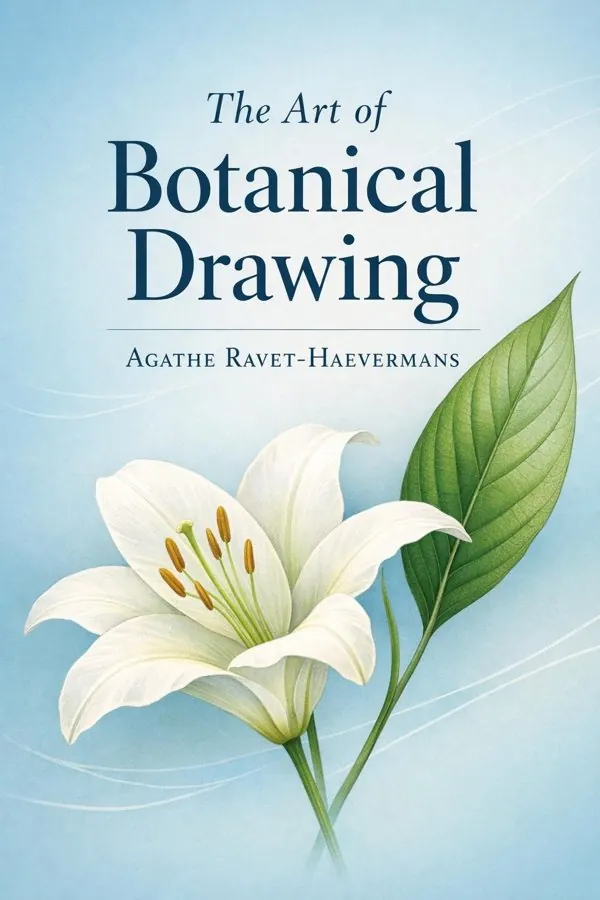
The Art of Botanical Drawing: Summary & Key Insights
 10 min6 chaptersAudio available
What Is The Art of Botanical Drawing About?
The Art of Botanical Drawing by Agathe Ravet-Haevermans is a design book spanning 6 pages. This book is a comprehensive guide to learning how to draw plants and flowers with both scientific accuracy and artistic sensitivity. The author, a botanical illustrator at the National Museum of Natural History in Paris, presents drawing, observation, and coloring techniques that allow readers to faithfully reproduce the beauty and structure of plants.
This FizzRead summary covers all 6 key chapters of The Art of Botanical Drawing in approximately 10 minutes, distilling the most important ideas, arguments, and takeaways from Agathe Ravet-Haevermans's work. Also available as an audio summary and Key Quotes Podcast.
The Art of Botanical Drawing
This book is a comprehensive guide to learning how to draw plants and flowers with both scientific accuracy and artistic sensitivity. The author, a botanical illustrator at the National Museum of Natural History in Paris, presents drawing, observation, and coloring techniques that allow readers to faithfully reproduce the beauty and structure of plants.
Who Should Read The Art of Botanical Drawing?
This book is perfect for anyone interested in design and looking to gain actionable insights in a short read. Whether you're a student, professional, or lifelong learner, the key ideas from The Art of Botanical Drawing by Agathe Ravet-Haevermans will help you think differently.
- ✓Readers who enjoy design and want practical takeaways
- ✓Professionals looking to apply new ideas to their work and life
- ✓Anyone who wants the core insights of The Art of Botanical Drawing in just 10 minutes
Want the full summary?
Get instant access to this book summary and 100K+ more with Fizz Moment.
Get Free SummaryAvailable on App Store • Free to download
Key Chapters
A successful botanical drawing begins long before the first line touches paper. In my years of work, I have seen many drawings fail not for lack of talent but for poor choice of materials. This is why I stress the importance of understanding your tools—their possibilities and their limits. We will start with pencils, because they are the core instrument for accurate observation. Different hardness grades—from 2B to 2H—allow you to control subtle transitions between contour and shadow. Equally important is the paper you use; it must be of high quality, strong enough to handle erasure and, later, watercolor washes. Textured paper can evoke certain natural surfaces, while smooth paper gives the finest detail required for scientific accuracy.
Ink drawing represents another world of precision. Fineliners and nib pens offer crisp lines that define morphology clearly. They are vital when preparing illustrations for scientific plates. Alongside these, watercolor plays its part in bringing life to the study. Its light transparency allows the delicate tones of leaves and petals to appear lifelike. Choosing pigments carefully ensures fidelity—botanical artists have always valued natural hues reminiscent of real growth.
Preparing your workspace matters as much as selecting materials. A stable desk, neutral lighting, and proper arrangement foster concentration. I always advise working near a natural light source, as artificial illumination can distort color perception and timing during observation. Each tool—eraser, ruler, magnifying lens—serves a clear function. This discipline might seem demanding, but it mirrors the exactness required in scientific work. A botanical artist learns to see every detail as part of a greater structure—the interplay of a controlled environment and lively expression.
Botanical drawing begins not with the hand, but with the eye. You must learn to observe as a botanist and feel as an artist. In my practice, observation means asking silent questions of the plant: How is the leaf attached? What rhythm does the vein follow? How does the petal curve toward the light? These are not superficial inquiries—they form the grammar of your drawing.
Accurate observation starts with understanding plant morphology. A plant is an organized structure governed by geometry and growth. When you analyze it, notice proportions before details: overall silhouette, balance of parts, repetition of elements. The flower head, leaf arrangement, stem branching—all follow measurable, reproducible patterns. This analytical view trains your perception beyond ordinary vision.
Once you have understood morphology, you learn to translate it into line. Outlines represent not merely boundaries but form logic. A contour that captures tension, curve, and rhythm will make the living structure visible. Contour drawing is a form of meditation—it teaches patience and clarity. The temptation to jump into shading too soon must be resisted; only when structure is sound do we build detail. When you understand morphology, shading stops being decoration and becomes explanation.
Observation also involves proportion and scale. You will need to measure relationships between parts—a leaf’s length compared with its width, a flower’s diameter relative to its stem. Accurate proportion maintains credibility; even when artistic style leans toward expression, structure grounds it in reality. Through repeated practice, your eyes will internalize ratios and your drawing will become fluid yet faithful.
+ 4 more chapters — available in the FizzRead app
All Chapters in The Art of Botanical Drawing
About the Author
Agathe Ravet-Haevermans is a scientific illustrator specializing in botany. She works at the National Museum of Natural History in Paris and teaches naturalist drawing. Her work is distinguished by its scientific rigor and artistic finesse.
Get This Summary in Your Preferred Format
Read or listen to the The Art of Botanical Drawing summary by Agathe Ravet-Haevermans anytime, anywhere. FizzRead offers multiple formats so you can learn on your terms — all free.
Available formats: App · Audio · PDF · EPUB — All included free with FizzRead
Download The Art of Botanical Drawing PDF and EPUB Summary
Key Quotes from The Art of Botanical Drawing
“A successful botanical drawing begins long before the first line touches paper.”
“Botanical drawing begins not with the hand, but with the eye.”
Frequently Asked Questions about The Art of Botanical Drawing
The Art of Botanical Drawing by Agathe Ravet-Haevermans is a design book that explores key ideas across 6 chapters. This book is a comprehensive guide to learning how to draw plants and flowers with both scientific accuracy and artistic sensitivity. The author, a botanical illustrator at the National Museum of Natural History in Paris, presents drawing, observation, and coloring techniques that allow readers to faithfully reproduce the beauty and structure of plants.
You Might Also Like

The Design of Everyday Things
Don Norman
10 min
The Better Angels of Our Nature
Steven Pinker
10 min
A Designer's Art
Paul Rand
10 min
Architects' Sketchbooks
Various Editors
10 min
Architectural Graphic Standards
The American Institute of Architects
10 min
Design Is Storytelling
Ellen Lupton
10 minBrowse by Category
Ready to read The Art of Botanical Drawing?
Get the full summary and 100K+ more books with Fizz Moment.