
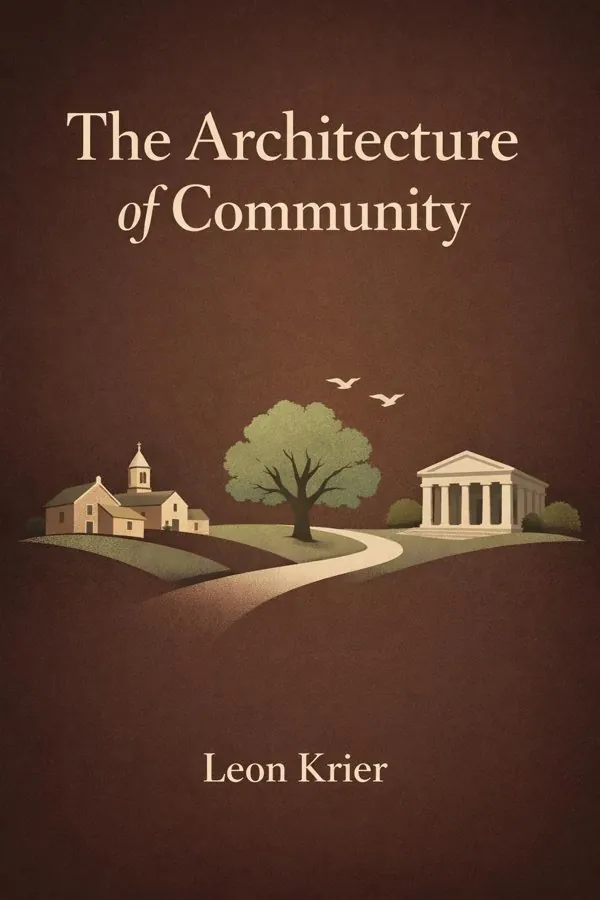
The Architecture of Community: Summary & Key Insights
by Leon Krier
 10 min9 chaptersAudio available
Key Takeaways from The Architecture of Community
A city fails the moment it becomes too large to understand with the body and the eye.
The more strictly a city separates activities, the less fully it functions as a city.
A community is not created by buildings alone, but by the spaces between them.
Buildings speak, even when architects pretend they do not.
Innovation becomes harmful when it forgets what older solutions already solved well.
What Is The Architecture of Community About?
The Architecture of Community by Leon Krier is a design book. What if the crisis of modern cities is not simply traffic, housing costs, or sprawl, but a deeper failure of form? In The Architecture of Community, architect and urban theorist Leon Krier argues that the built environment shapes civic life, social stability, and human dignity far more than most planners admit. This book is both a critique of modernist planning and a manifesto for rebuilding towns, neighborhoods, and public spaces according to principles that are legible, walkable, beautiful, and scaled to human life. Rather than treating architecture as isolated objects, Krier examines how streets, squares, blocks, monuments, homes, and workplaces must work together to create coherent communities. His ideas matter because they challenge assumptions that bigger, faster, and more technologically advanced automatically mean better. Krier writes with unusual authority: he is one of the most influential critics of postwar urbanism, a leading voice in traditional architecture, and a longtime advocate of mixed-use, compact settlements. The Architecture of Community offers not nostalgia, but a provocative framework for designing places where people can truly belong.
This FizzRead summary covers all 9 key chapters of The Architecture of Community in approximately 10 minutes, distilling the most important ideas, arguments, and takeaways from Leon Krier's work. Also available as an audio summary and Key Quotes Podcast.
The Architecture of Community
What if the crisis of modern cities is not simply traffic, housing costs, or sprawl, but a deeper failure of form? In The Architecture of Community, architect and urban theorist Leon Krier argues that the built environment shapes civic life, social stability, and human dignity far more than most planners admit. This book is both a critique of modernist planning and a manifesto for rebuilding towns, neighborhoods, and public spaces according to principles that are legible, walkable, beautiful, and scaled to human life. Rather than treating architecture as isolated objects, Krier examines how streets, squares, blocks, monuments, homes, and workplaces must work together to create coherent communities. His ideas matter because they challenge assumptions that bigger, faster, and more technologically advanced automatically mean better. Krier writes with unusual authority: he is one of the most influential critics of postwar urbanism, a leading voice in traditional architecture, and a longtime advocate of mixed-use, compact settlements. The Architecture of Community offers not nostalgia, but a provocative framework for designing places where people can truly belong.
Who Should Read The Architecture of Community?
This book is perfect for anyone interested in design and looking to gain actionable insights in a short read. Whether you're a student, professional, or lifelong learner, the key ideas from The Architecture of Community by Leon Krier will help you think differently.
- ✓Readers who enjoy design and want practical takeaways
- ✓Professionals looking to apply new ideas to their work and life
- ✓Anyone who wants the core insights of The Architecture of Community in just 10 minutes
Want the full summary?
Get instant access to this book summary and 100K+ more with Fizz Moment.
Get Free SummaryAvailable on App Store • Free to download
Key Chapters
A city fails the moment it becomes too large to understand with the body and the eye. One of Leon Krier’s central convictions is that architecture and urbanism should serve human beings as social, physical, and civic creatures, not abstract systems of efficiency. Human scale means more than small buildings. It refers to proportions, distances, street widths, block sizes, and public spaces that people can comfortably navigate, recognize, and inhabit. When urban environments are oversized, fragmented by highways, or dominated by giant isolated structures, people lose orientation and connection. They may still live in the city, but they no longer experience it as a coherent place.
Krier argues that traditional towns provide a better model because they evolved around walking, gathering, and shared public life. Streets connect naturally to squares, homes sit near workplaces, and civic buildings have a visible role in the urban composition. In contrast, many modern developments separate life into disconnected zones and rely on machines to bridge the distance. The result is dependency, alienation, and visual disorder.
You can see Krier’s point in everyday experience. A neighborhood where shops, schools, housing, and parks sit within a short walk feels safer and more alive than one where every need requires a car trip. A square framed by well-proportioned facades encourages lingering, while an oversized plaza surrounded by blank towers often feels empty, even when crowded.
The practical lesson is simple: judge places by whether they can be comfortably understood and used on foot. Whether designing a district, a street, or a single building, prioritize dimensions and relationships that support everyday human interaction.
The more strictly a city separates activities, the less fully it functions as a city. Krier strongly opposes modern zoning systems that divide residential, commercial, industrial, and civic uses into isolated sectors. He sees this not as rational planning, but as one of the main causes of sprawl, car dependence, and civic fragmentation. A real community is not a set of specialized compartments. It is a complex, mixed fabric where different uses coexist in close proximity and reinforce each other.
In Krier’s view, the historic town succeeded because it integrated the rhythms of daily life. People could live near work, buy goods nearby, meet neighbors in public spaces, and access institutions without crossing vast distances. This mixture created a richer public realm and made settlements resilient. Modern functional zoning, by contrast, empties districts at different times of day. Office parks die after work hours. Residential subdivisions lack commerce and public activity. Retail strips become purely transactional environments with no civic depth.
Consider a typical suburban arrangement: homes in one district, schools in another, offices elsewhere, shopping concentrated along arterial roads, and recreation tucked into leftover land. Every trip requires transport, and every place is defined by one narrow purpose. Compare that with a mixed neighborhood where apartments sit over shops, small offices occupy side streets, schools are embedded in residential blocks, and a public square anchors local life. The second model generates both convenience and identity.
Krier’s takeaway is practical and radical: when evaluating urban plans, ask whether they mix uses in a way that supports a complete daily life. Build neighborhoods where living, working, shopping, learning, and gathering happen close together.
A community is not created by buildings alone, but by the spaces between them. Krier places enormous importance on streets, squares, and other public spaces because they are the true stages of civic life. Private buildings matter, but they only become part of urban culture when they contribute to a coherent public realm. For Krier, the street is not merely a traffic corridor, and the square is not leftover open space. Both are deliberate architectural forms that shape how people meet, move, celebrate, protest, trade, and belong.
He criticizes modern planning for neglecting this principle. Too often, roads are designed primarily for vehicle throughput, while open space is treated as abstract green area rather than defined urban room. The result is neither urban vitality nor meaningful nature, but emptiness. Traditional urbanism, by contrast, gives form to public space through building fronts, edges, proportions, and visible landmarks. Streets have enclosure. Squares have shape and purpose. Public institutions occupy recognizable places.
This difference is easy to observe. A narrow main street lined with doors, windows, shops, and upper-floor housing invites strolling and spontaneous contact. A plaza enclosed by cafes, civic buildings, and shaded seating naturally becomes a social center. But a windswept open expanse next to disconnected towers often feels anonymous, even if it is technically public.
Krier’s larger point is that social life needs architecture. If planners want stronger communities, they must stop treating public space as secondary. The actionable takeaway: design every building as part of a street or square, and evaluate public space by whether people can comfortably gather, orient themselves, and feel represented there.
Buildings speak, even when architects pretend they do not. Krier insists that architecture is not just shelter or technical problem-solving; it is also a language of form that conveys hierarchy, use, permanence, and cultural values. He rejects the modernist claim that ornament, classical form, and typological continuity are merely nostalgic residues. For him, coherent form helps people read the city. A courthouse should look civic. A house should feel domestic. A monument should possess dignity. When all structures are reduced to abstract novelty or industrial standardization, the urban environment becomes illegible.
Krier does not argue that every building must imitate the past. Instead, he argues that architecture should use enduring principles such as proportion, symmetry where appropriate, recognizable types, and materials that age well. He believes that these elements help create places that are both beautiful and understandable. Meaning in architecture arises when form corresponds to function and public importance.
Think of the difference between a town hall placed prominently on a square, with a facade that signals public authority, and a municipal office buried inside a generic glass box in an office complex. Both may perform the same administrative tasks, but only one contributes to civic identity. Likewise, a school designed with clear entrances, courtyards, and durable materials communicates care and stability in a way that disposable construction rarely does.
Krier’s practical lesson is to ask what a building says before asking only what it costs or how efficiently it performs. Designers, officials, and citizens should insist that architecture communicate purpose, respect context, and reinforce the shared order of the city.
Innovation becomes harmful when it forgets what older solutions already solved well. Krier argues that traditional urban and architectural typologies endure not because societies lacked imagination, but because certain forms repeatedly proved their usefulness. Streets, courtyards, perimeter blocks, townhouses, mixed-use main streets, civic squares, and clearly defined neighborhoods are not obsolete patterns. They remain effective tools for organizing density, privacy, climate response, social interaction, and public life.
Modern planning often treats historical forms as irrelevant to contemporary needs, preferring isolated towers, superblocks, megastructures, and dispersed suburban layouts. Krier believes this obsession with novelty has produced many failures. Traditional types work because they create intelligible relationships between public and private space. They also allow adaptation over time. A shop can become a cafe, a townhouse can hold an office, a square can host a market or festival. The urban framework remains stable even as uses evolve.
A perimeter block offers a clear example. It can enclose a quiet courtyard for residents while defining active streets around its edges. This type supports density without sacrificing enclosure or walkability. Likewise, a mixed-use high street can absorb changing businesses while preserving the neighborhood’s central spine. These are not romantic relics; they are flexible, field-tested urban technologies.
Krier encourages readers to judge forms by performance across generations, not by whether they appear new. The actionable takeaway is to begin projects with proven urban types rather than abstract diagrams. Study which street patterns, block structures, and building forms have historically produced durable, adaptable, and socially successful places, then reinterpret them intelligently for present-day needs.
A city designed around machines eventually stops working well for people. Krier does not reject technology, but he firmly opposes allowing transportation systems, industrial methods, or engineering capabilities to determine urban form. In his view, modern planning too often starts with the car, the highway, the elevator, or the large-scale infrastructure network, and only afterward asks how people might fit into the result. This reverses the proper order. Technology should support human settlement, not define it.
Krier is particularly critical of automobile dependence. Once roads, parking, and traffic engineering become the primary generators of urban design, distances expand, public spaces weaken, and architecture loses coherence. The city becomes a collection of destinations linked by movement systems rather than a lived environment. Even buildings change: entrances shift toward parking lots, ground floors become dead zones, and streets lose their pedestrian character.
This principle applies beyond cars. Industrialized construction can help reduce costs, but if it produces monotonous, placeless structures, its efficiency comes at too high a civic price. High-rise technology makes tall buildings possible, but that does not mean towers are appropriate everywhere. Krier asks a fundamental question: does a technical capability improve the quality of communal life, or merely impose a new pattern of dependence?
A practical application might be planning a neighborhood around a walkable center first, then fitting transit and roads around that structure. It might mean using modern materials in ways that preserve local character rather than erase it.
Krier’s takeaway is direct: treat technology as a tool with limits. Before adopting any innovation, ask whether it strengthens human-scale urban form, public life, and long-term civic coherence.
When everything is treated as equal, nothing receives the dignity it deserves. Krier believes that cities require hierarchy, not in the sense of oppression, but in the sense of legible importance. Civic institutions, religious buildings, cultural centers, and monuments should occupy positions and forms that reflect their public role. A city without hierarchy becomes visually and socially flat. If a courthouse, museum, school, market hall, and apartment block are all placed without order, the urban landscape cannot communicate shared values.
Traditional towns often solved this through placement and typology. Churches stood on prominent sites. Town halls addressed the square. markets occupied central nodes. Streets aligned with monuments or terminated in significant buildings. Krier sees this not as ceremonial excess, but as a practical way of making collective life visible. The city becomes understandable because public importance is expressed in space.
Modern development often neglects this principle. Important institutions are set back behind parking, hidden in campuses, or inserted into generic office buildings. Public architecture loses symbolic presence, and citizens lose landmarks of common identity. Even very expensive buildings can feel strangely insignificant when their urban position is weak.
Imagine the difference between a library fronting a civic square with steps, trees, and surrounding shops, versus a library buried inside a shopping complex. The first becomes a public anchor. The second becomes just another service point.
Krier’s practical lesson is to restore urban hierarchy intentionally. When planning a district, identify which buildings carry civic meaning and give them prominent sites, formal distinction, and relationships to public space. Communities become stronger when their shared institutions are both accessible and visibly honored.
Bigness is often mistaken for progress, yet excessive scale can quietly destroy the city. Krier repeatedly warns against superblocks, megastructures, oversized infrastructure, and settlements that grow beyond the limits of coherent community life. His argument is not anti-density. Instead, he distinguishes between compact, walkable density and scale so large that orientation, diversity, and civic intimacy collapse. For Krier, a healthy town is made of identifiable quarters, manageable distances, and repeated urban forms that ordinary people can understand.
This concern applies to both buildings and settlements. A giant complex that combines housing, offices, retail, and parking in a single inward-looking structure may seem efficient, but it often removes life from the surrounding street network. Likewise, a metropolitan region that expands endlessly through low-density sprawl loses the clear edge and internal structure that traditional towns possessed. Krier favors polycentric organization: multiple distinct neighborhoods or towns, each with its own center and institutions, rather than one boundless urban field.
There are practical implications for development. Instead of assembling vast tracts for single-phase mega-projects, planners can build incremental blocks and streets. Instead of one regional shopping complex, local centers can distribute commerce. Instead of giant campuses, institutions can integrate with surrounding neighborhoods. These choices preserve variety and allow communities to evolve over time.
Krier’s key insight is that form and scale shape governance, memory, and belonging. People care for places they can grasp. The actionable takeaway: whenever a proposal grows so large that it erases streets, local identity, or everyday walkability, break it down into smaller, connected pieces that can function as real parts of a town.
People flourish in places they love, not merely in places that function. One of Krier’s most provocative claims is that beauty is not a decorative extra added after practical needs are met. It is a civic necessity. Beautiful environments encourage care, attachment, continuity, and respect. Ugly or indifferent environments may still be usable, but they often weaken emotional investment and social responsibility. Krier argues that architecture and urbanism should aspire to delight as well as utility.
His understanding of beauty is not superficial glamour or stylistic fashion. It comes from order, proportion, craftsmanship, harmony with context, and the meaningful shaping of public space. A beautiful street is one where facades form a coherent whole, materials age gracefully, trees and paving support comfort, and the proportions feel balanced. A beautiful square invites lingering because its boundaries, monuments, and edges create dignity and pleasure.
The practical importance of beauty appears in everyday behavior. People are more likely to walk, gather, maintain property, and protect public spaces when those spaces feel valued. A well-designed neighborhood can foster civic pride; a neglectfully designed one can signal that no one expects much from communal life. Beauty therefore has economic, social, and political consequences.
Krier pushes against the idea that aesthetic judgment is purely subjective or elitist. While tastes vary, many places are widely loved because they support human senses and social needs in consistent ways.
The actionable takeaway is to treat beauty as a design requirement from the beginning. Whether shaping a facade, a block, or a town plan, ask not only whether it works, but whether it will be cherished, remembered, and worth preserving.
All Chapters in The Architecture of Community
About the Author
Leon Krier is a Luxembourg-born architect, urban planner, and architectural theorist renowned for his critique of modernism and his defense of traditional urban form. Born in 1946, he became one of the most important intellectual voices arguing for compact, walkable, mixed-use communities shaped by streets, squares, and coherent civic architecture. Rather than pursuing fame through spectacle buildings, Krier built his reputation through essays, drawings, lectures, and master plans that challenged postwar planning orthodoxy. He is closely associated with the revival of classical and traditional architecture and has influenced movements such as new urbanism. Krier is also widely known for his involvement in the planning of Poundbury in England. Across his career, he has argued that architecture must serve community, beauty, public life, and human dignity rather than abstract ideology or technological excess.
Get This Summary in Your Preferred Format
Read or listen to the The Architecture of Community summary by Leon Krier anytime, anywhere. FizzRead offers multiple formats so you can learn on your terms — all free.
Available formats: App · Audio · PDF · EPUB — All included free with FizzRead
Download The Architecture of Community PDF and EPUB Summary
Key Quotes from The Architecture of Community
“A city fails the moment it becomes too large to understand with the body and the eye.”
“The more strictly a city separates activities, the less fully it functions as a city.”
“A community is not created by buildings alone, but by the spaces between them.”
“Buildings speak, even when architects pretend they do not.”
“Innovation becomes harmful when it forgets what older solutions already solved well.”
Frequently Asked Questions about The Architecture of Community
The Architecture of Community by Leon Krier is a design book that explores key ideas across 9 chapters. What if the crisis of modern cities is not simply traffic, housing costs, or sprawl, but a deeper failure of form? In The Architecture of Community, architect and urban theorist Leon Krier argues that the built environment shapes civic life, social stability, and human dignity far more than most planners admit. This book is both a critique of modernist planning and a manifesto for rebuilding towns, neighborhoods, and public spaces according to principles that are legible, walkable, beautiful, and scaled to human life. Rather than treating architecture as isolated objects, Krier examines how streets, squares, blocks, monuments, homes, and workplaces must work together to create coherent communities. His ideas matter because they challenge assumptions that bigger, faster, and more technologically advanced automatically mean better. Krier writes with unusual authority: he is one of the most influential critics of postwar urbanism, a leading voice in traditional architecture, and a longtime advocate of mixed-use, compact settlements. The Architecture of Community offers not nostalgia, but a provocative framework for designing places where people can truly belong.
You Might Also Like

The Design of Everyday Things
Don Norman
10 min
The Better Angels of Our Nature
Steven Pinker
10 min
A Designer's Art
Paul Rand
10 min
Architects' Sketchbooks
Various Editors
10 min
Architectural Graphic Standards
The American Institute of Architects
10 min
Design Is Storytelling
Ellen Lupton
10 minBrowse by Category
Ready to read The Architecture of Community?
Get the full summary and 100K+ more books with Fizz Moment.