
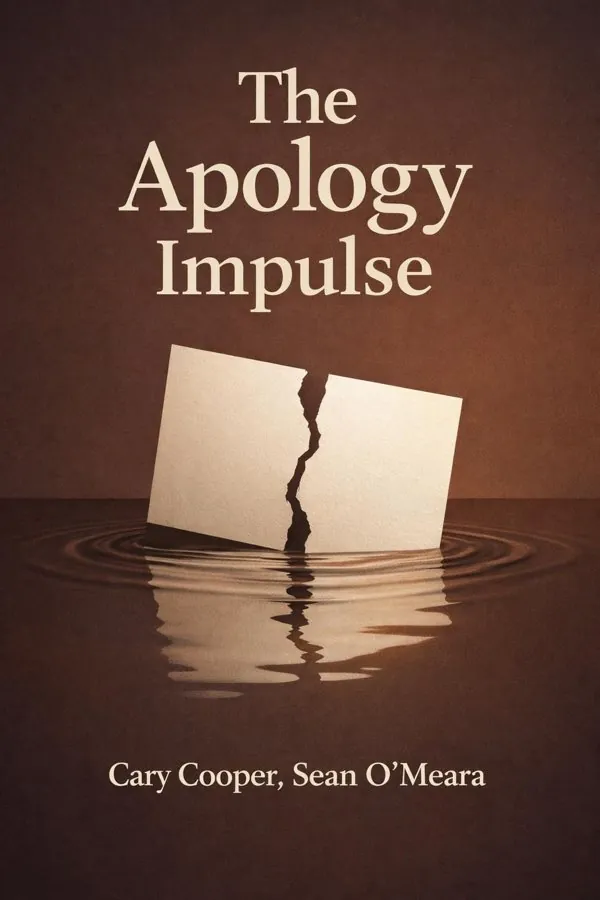
The Apology Impulse: How the Business World Ruined Sorry and Why We Can't Stop Saying It: Summary & Key Insights
 10 min9 chaptersAudio available
Key Takeaways from The Apology Impulse: How the Business World Ruined Sorry and Why We Can't Stop Saying It
A real apology used to be less about image and more about moral repair.
The moment apology entered the world of corporate communication, it stopped being purely moral and became strategic.
An apology that is designed mainly to be seen will usually fail to be believed.
People do not want apologies only because they like politeness.
The digital media environment has dramatically changed both the timing and the meaning of apology.
What Is The Apology Impulse: How the Business World Ruined Sorry and Why We Can't Stop Saying It About?
The Apology Impulse: How the Business World Ruined Sorry and Why We Can't Stop Saying It by Cary Cooper, Sean O'Meara is a organization book spanning 11 pages. Why does the word "sorry" feel so common and yet so hollow? In The Apology Impulse, Cary Cooper and Sean O'Meara explore how apology—once a deeply human act of remorse, accountability, and repair—has been reshaped by corporate culture, media pressure, legal caution, and reputation management. The result is a world in which individuals and organizations apologize constantly, but often without the honesty, responsibility, or change that true reconciliation requires. The book argues that modern business has turned apology into a strategic communication tool. Companies apologize to calm markets, leaders apologize to survive scandals, and public figures apologize to satisfy online outrage. Yet these carefully scripted responses often fail because people are remarkably skilled at detecting insincerity. Cooper and O'Meara show that apology is not just a moral issue but an organizational one, tied to leadership, trust, culture, and power. Cooper brings decades of expertise in organizational psychology, while O'Meara contributes deep experience in corporate communications and crisis reputation. Together, they offer a sharp, timely examination of why we keep saying sorry—and why it so often no longer means what it should.
This FizzRead summary covers all 9 key chapters of The Apology Impulse: How the Business World Ruined Sorry and Why We Can't Stop Saying It in approximately 10 minutes, distilling the most important ideas, arguments, and takeaways from Cary Cooper, Sean O'Meara's work. Also available as an audio summary and Key Quotes Podcast.
The Apology Impulse: How the Business World Ruined Sorry and Why We Can't Stop Saying It
Why does the word "sorry" feel so common and yet so hollow? In The Apology Impulse, Cary Cooper and Sean O'Meara explore how apology—once a deeply human act of remorse, accountability, and repair—has been reshaped by corporate culture, media pressure, legal caution, and reputation management. The result is a world in which individuals and organizations apologize constantly, but often without the honesty, responsibility, or change that true reconciliation requires.
The book argues that modern business has turned apology into a strategic communication tool. Companies apologize to calm markets, leaders apologize to survive scandals, and public figures apologize to satisfy online outrage. Yet these carefully scripted responses often fail because people are remarkably skilled at detecting insincerity. Cooper and O'Meara show that apology is not just a moral issue but an organizational one, tied to leadership, trust, culture, and power.
Cooper brings decades of expertise in organizational psychology, while O'Meara contributes deep experience in corporate communications and crisis reputation. Together, they offer a sharp, timely examination of why we keep saying sorry—and why it so often no longer means what it should.
Who Should Read The Apology Impulse: How the Business World Ruined Sorry and Why We Can't Stop Saying It?
This book is perfect for anyone interested in organization and looking to gain actionable insights in a short read. Whether you're a student, professional, or lifelong learner, the key ideas from The Apology Impulse: How the Business World Ruined Sorry and Why We Can't Stop Saying It by Cary Cooper, Sean O'Meara will help you think differently.
- ✓Readers who enjoy organization and want practical takeaways
- ✓Professionals looking to apply new ideas to their work and life
- ✓Anyone who wants the core insights of The Apology Impulse: How the Business World Ruined Sorry and Why We Can't Stop Saying It in just 10 minutes
Want the full summary?
Get instant access to this book summary and 100K+ more with Fizz Moment.
Get Free SummaryAvailable on App Store • Free to download
Key Chapters
A real apology used to be less about image and more about moral repair. Before institutions and brands learned to manage public outrage, apology was rooted in face-to-face relationships. In families, villages, workplaces, and religious communities, saying sorry meant admitting wrongdoing, expressing remorse, accepting consequences, and trying to restore damaged trust. The point was not to control the narrative. It was to mend a relationship.
Cooper and O'Meara show that this older understanding matters because it reveals what has been lost. Traditional apology carried risk. The person apologizing could be judged, forgiven, rejected, or asked to make restitution. That vulnerability gave the act meaning. In contrast, many modern apologies are designed to reduce liability, calm criticism, or move the news cycle forward. They imitate the language of remorse while avoiding the emotional and ethical substance that makes apology believable.
This historical shift helps explain why people are so dissatisfied with many public apologies today. We may not articulate it this way, but we still expect apology to include truth, humility, and change. When a company says, "We regret that some customers were disappointed," people feel manipulated because the statement avoids ownership. It sounds like communication, not conscience.
In practical terms, leaders can learn from the older model of apology by restoring its key ingredients: name the harm clearly, acknowledge responsibility directly, show understanding of the impact, and offer concrete repair. For example, a manager who publicly admits a failed decision, explains how employees were affected, and details what will change is far more likely to rebuild credibility than one who issues a vague statement of regret.
Actionable takeaway: Before offering any apology, ask whether it is designed to repair a relationship or merely protect a reputation. If it is the latter, people will probably sense it.
The moment apology entered the world of corporate communication, it stopped being purely moral and became strategic. As public relations functions expanded, especially in the late twentieth century, organizations learned to treat language as risk management. Every public statement was assessed for legal exposure, shareholder reaction, media framing, and brand impact. In that environment, apology was no longer a straightforward admission of wrong. It became a calculated message.
The book argues that this shift transformed the meaning of "sorry." Communication teams began crafting statements that looked apologetic without conceding too much. Phrases like "mistakes were made," "we regret any inconvenience," or "this does not reflect our values" became common because they created distance between the organization and the harm. These statements are carefully engineered to appear responsive while minimizing responsibility.
There is logic to this from a business perspective. Companies fear lawsuits, investor panic, regulatory action, and reputational damage. But the authors show the paradox: the more polished and defensive the apology becomes, the less trustworthy it sounds. Audiences often interpret over-managed language as evidence that the organization is still thinking about itself first.
Consider the difference between two responses to a data breach. One company says, "We regret concern caused by this incident." Another says, "We failed to protect customer data, and that failure created real risk and stress. Here is what happened, what we are doing now, and what support affected customers will receive." The second statement is riskier, but also more credible.
For leaders, the lesson is not to abandon communication strategy. It is to ensure that strategy does not erase accountability. Strong apology requires legal awareness and emotional honesty, not one at the expense of the other.
Actionable takeaway: Remove hedging phrases from apologies and test whether the statement includes a clear subject, action, and responsibility: "We did this, it caused harm, and we are fixing it."
An apology that is designed mainly to be seen will usually fail to be believed. One of the book's central insights is that many modern apologies are performative: they are delivered for audiences, optics, and immediate pressure relief rather than genuine repair. The goal is often to be seen responding quickly, not to engage honestly with what happened.
Performative apology flourishes in a culture of visibility. Executives issue video statements, celebrities post notes on social media, and corporations release carefully branded messages within hours of a controversy. Speed becomes proof of concern. Yet quick public contrition often lacks the reflection, specificity, and action that sincerity requires. It may satisfy a communications timetable while doing little to address the actual harm.
The authors note that performative apologies usually share recognizable features: passive language, emotional vagueness, self-protective framing, and an emphasis on how difficult the situation has been for the speaker. A leader says they are "sorry if anyone was offended" or asks for understanding during a "challenging time." These phrases center discomfort without fully recognizing wrongdoing.
People respond badly because they hear the mismatch between tone and substance. If a company pollutes a river, underpays staff, or ignores safety warnings, audiences expect more than empathy theater. They want responsibility, remedy, and evidence of change. A heartfelt expression can help, but only if it is tied to meaningful action.
This applies beyond high-profile scandals. In everyday management, employees can tell when a supervisor apologizes simply to end a difficult conversation. Compare "Sorry you feel that way" with "I dismissed your concern in front of the team, and that undermined your credibility. I was wrong." The second creates the possibility of trust.
Actionable takeaway: Never treat visibility as the same thing as accountability. If an apology cannot name the harm and the repair, it is probably still performance.
People do not want apologies only because they like politeness. They want them because apologies help restore moral order. Cooper, as an organizational psychologist, helps explain why apology is so emotionally powerful. When someone harms us, we experience more than inconvenience. We feel disrespected, unsafe, ignored, or devalued. A meaningful apology acknowledges that our experience matters and that the normal rules of fairness still apply.
Psychologically, apology serves several functions. It confirms that a wrong occurred, reduces uncertainty about intent, signals that the offender recognizes social norms, and opens the door to forgiveness or at least coexistence. Without apology, victims often remain stuck in rumination: Did they understand what they did? Do they care? Will it happen again? A real apology can answer those questions.
The authors also explain why so many people resist apologizing. Apology threatens the ego. It can trigger shame, fear of punishment, loss of status, and anxiety about appearing weak. In organizations, these pressures intensify because leaders often equate authority with infallibility. The higher the role, the harder it can feel to say, "I was wrong." Yet avoiding apology often causes greater damage because silence appears arrogant or indifferent.
A practical example is workplace conflict. If a senior manager publicly criticizes a team member unfairly, the employee may not simply want the criticism withdrawn. They may need acknowledgment that their reputation was harmed. A private apology might not be enough if the damage was public. Psychological repair often requires the apology to match the scope of the offense.
Understanding these dynamics helps leaders apologize more effectively. A good apology is not merely an emotional release for the speaker. It is a message designed around the needs of the harmed party.
Actionable takeaway: When apologizing, focus less on how exposed you feel and more on what the other person needs to hear in order to feel seen, respected, and safe again.
The digital media environment has dramatically changed both the timing and the meaning of apology. In the past, organizations might have had days to investigate, consult, and respond. Today, outrage can spread globally in minutes, and silence is often interpreted as guilt, arrogance, or incompetence. This creates intense pressure to apologize quickly, sometimes before the facts are clear.
The book shows how media and social platforms amplify apology culture in two ways. First, they create visibility for mistakes that might once have remained local or contained. Second, they reward emotionally satisfying narratives of blame, confession, and punishment. In this environment, an apology can become part of a public ritual in which audiences expect immediate acknowledgment, visible humility, and signs of consequence.
But speed comes with trade-offs. Premature apologies can be incomplete, inaccurate, or overly generic. They may satisfy online demands temporarily while later appearing evasive or inconsistent. At the same time, delayed apologies can look cold and defensive. Organizations therefore face a difficult balancing act: respond fast enough to show concern, but thoughtfully enough to remain credible.
A useful distinction is between immediate acknowledgment and full apology. After a crisis, a company can quickly say, "We are aware of the issue, we take it seriously, and our priority is those affected." That is not the same as issuing a complete apology before understanding what happened. Once facts are established, a fuller statement can follow with clear responsibility and remedies.
This principle matters for leaders as much as for brands. In social-media-driven workplaces, internal controversies can become external stories. Executives need communication discipline without becoming emotionally robotic.
Actionable takeaway: In high-pressure situations, separate your response into stages—immediate acknowledgment, fact-finding, then full apology and repair—rather than forcing one rushed statement to do everything.
Organizations do not apologize well by accident. They do so when their culture makes accountability normal rather than exceptional. Cooper and O'Meara argue that the quality of an apology often reveals the deeper character of leadership. Where leaders are defensive, hierarchical, and image-obsessed, apologies tend to be evasive. Where leaders value learning, transparency, and psychological safety, apologies are more likely to be direct and meaningful.
This matters because employees take cues from the top. If executives never admit mistakes, managers learn to conceal problems, shift blame, and avoid difficult conversations. Over time, this creates a culture where errors are denied until they become crises. By contrast, when leaders model responsible apology, they signal that honesty is compatible with authority.
A strong organizational apology culture does not mean saying sorry for everything. It means creating systems where people can report problems early, discuss harm openly, and correct mistakes without endless defensiveness. For example, a hospital unit, airline team, or manufacturing plant may reduce serious incidents if staff feel safe speaking up before a failure escalates. Apology then becomes part of a broader accountability process, not just an emergency speech.
The authors also connect apology to trust inside organizations. Employees are more likely to stay engaged when leaders acknowledge poor decisions, broken promises, or harmful restructurings honestly. A manager who says, "We handled this change badly, and communication was inadequate," may not erase frustration, but they can preserve credibility. Silence or spin tends to deepen disengagement.
The practical implication is clear: apology should be treated as a leadership competency. It belongs in executive development, crisis training, and performance culture.
Actionable takeaway: Build a culture where admitting mistakes is seen as strength. Start by having leaders publicly own one concrete error and explain what the organization learned from it.
Not every apology restores trust. In fact, too much apologizing can weaken credibility. The book explores a revealing tension: while institutions often resist meaningful apology, individuals in everyday life can fall into the opposite pattern of over-apologizing. Both distortions reflect insecurity rather than accountability.
Over-apologizing happens when people use "sorry" to manage tension, avoid disapproval, soften requests, or fill social discomfort. In workplaces, this is common in emails, meetings, and leadership interactions: "Sorry to bother you," "Sorry, just a thought," or "Sorry, I may be wrong." These phrases can signal politeness, but they can also communicate low confidence and unnecessary self-blame. In organizational settings, especially for those with less power, habitual apologizing may reflect cultures where people feel they must constantly justify their presence.
At the public level, repeated apologies can create backlash when they appear theatrical, excessive, or disconnected from change. Audiences start to suspect that apology has become a substitute for responsibility. A brand that keeps apologizing for similar failures without fixing systems teaches people not to take its remorse seriously.
The key distinction is between apology and appeasement. A healthy apology responds to specific wrongdoing. Unhealthy over-apologizing responds to anxiety. For example, an employee who made a clear error should apologize plainly and propose a fix. But if they say sorry five times in one conversation for asking a reasonable question, they are not repairing harm; they are shrinking themselves.
Leaders can improve this by rewarding clarity over excessive deference. Teams should distinguish between courtesy, accountability, and self-erasure.
Actionable takeaway: Use apology only when responsibility is real. Replace reflexive phrases like "sorry to ask" with direct, respectful alternatives such as "thank you for your time" or "here is my request."
The most important lesson in the book is that apology alone is never enough. Words matter, but trust is rebuilt through evidence. Cooper and O'Meara argue that the public has become skeptical of apologies precisely because too many are not followed by meaningful repair. Without action, even eloquent remorse feels manipulative.
A complete apology has several parts: acknowledgment of harm, acceptance of responsibility, expression of remorse, explanation without excuse, concrete restitution where possible, and visible steps to prevent recurrence. Remove the final elements and the apology remains emotionally incomplete. People may appreciate the gesture, but they will not feel safe trusting again.
This is especially true in organizations, where harm is often systemic rather than personal. If a company apologizes for discrimination but leaves leadership structures unchanged, employees will conclude that the statement was symbolic. If a business apologizes for a customer service failure but invests nothing in staffing, training, or process improvement, the same problem will return. Repair requires operational follow-through.
The authors suggest that organizations should treat apology as the beginning of accountability, not the end of crisis communication. That means reporting progress, updating affected groups, and showing what has changed. A sincere apology can open the door to forgiveness, but only consistent behavior keeps that door open.
For individuals, the principle is similar. If you apologize for interrupting, then continue interrupting, your words lose value. If you apologize for missing deadlines, then build a new system to meet them, trust can grow again. Apology earns a second chance only when conduct supports it.
Actionable takeaway: After apologizing, define one visible repair action, one preventive change, and one follow-up date. Trust rebuilds through what happens after the word "sorry," not during it.
All Chapters in The Apology Impulse: How the Business World Ruined Sorry and Why We Can't Stop Saying It
About the Authors
Sir Cary Cooper is one of Britain's best-known organizational psychologists, with a distinguished academic career focused on workplace stress, leadership, wellbeing, and organizational culture. He has held senior roles at the University of Manchester and has written widely on how institutions shape behavior and health. His work often bridges academic research and practical management challenges. Sean O'Meara is a communications consultant and founder of Essential Content, with deep expertise in corporate messaging, crisis response, and reputation management. His professional background gives him firsthand insight into how organizations craft public apologies under pressure. Together, Cooper and O'Meara combine psychological scholarship with real-world communications experience, making The Apology Impulse both analytically sharp and highly relevant to leaders, managers, and anyone interested in public trust.
Get This Summary in Your Preferred Format
Read or listen to the The Apology Impulse: How the Business World Ruined Sorry and Why We Can't Stop Saying It summary by Cary Cooper, Sean O'Meara anytime, anywhere. FizzRead offers multiple formats so you can learn on your terms — all free.
Available formats: App · Audio · PDF · EPUB — All included free with FizzRead
Download The Apology Impulse: How the Business World Ruined Sorry and Why We Can't Stop Saying It PDF and EPUB Summary
Key Quotes from The Apology Impulse: How the Business World Ruined Sorry and Why We Can't Stop Saying It
“A real apology used to be less about image and more about moral repair.”
“The moment apology entered the world of corporate communication, it stopped being purely moral and became strategic.”
“An apology that is designed mainly to be seen will usually fail to be believed.”
“People do not want apologies only because they like politeness.”
“The digital media environment has dramatically changed both the timing and the meaning of apology.”
Frequently Asked Questions about The Apology Impulse: How the Business World Ruined Sorry and Why We Can't Stop Saying It
The Apology Impulse: How the Business World Ruined Sorry and Why We Can't Stop Saying It by Cary Cooper, Sean O'Meara is a organization book that explores key ideas across 9 chapters. Why does the word "sorry" feel so common and yet so hollow? In The Apology Impulse, Cary Cooper and Sean O'Meara explore how apology—once a deeply human act of remorse, accountability, and repair—has been reshaped by corporate culture, media pressure, legal caution, and reputation management. The result is a world in which individuals and organizations apologize constantly, but often without the honesty, responsibility, or change that true reconciliation requires. The book argues that modern business has turned apology into a strategic communication tool. Companies apologize to calm markets, leaders apologize to survive scandals, and public figures apologize to satisfy online outrage. Yet these carefully scripted responses often fail because people are remarkably skilled at detecting insincerity. Cooper and O'Meara show that apology is not just a moral issue but an organizational one, tied to leadership, trust, culture, and power. Cooper brings decades of expertise in organizational psychology, while O'Meara contributes deep experience in corporate communications and crisis reputation. Together, they offer a sharp, timely examination of why we keep saying sorry—and why it so often no longer means what it should.
You Might Also Like

A Guide to the Project Management Body of Knowledge (PMBOK® Guide)
Project Management Institute
10 min
Organizational Behavior
Stephen P. Robbins
10 min
Accelerate: The Science of Lean Software and DevOps – Building and Scaling High Performing Technology Organizations
Nicole Forsgren, Jez Humble, Gene Kim
10 min
Awakening Compassion at Work: The Quiet Power That Elevates People and Organizations
Monica C. Worline, Jane E. Dutton
10 min
Building an Inclusive Organization: Leveraging the Power of a Diverse Workforce
Stephen Frost
10 min
Collaborative Intelligence: Thinking with People Who Think Differently
Dawna Markova, Angie McArthur
10 minBrowse by Category
Ready to read The Apology Impulse: How the Business World Ruined Sorry and Why We Can't Stop Saying It?
Get the full summary and 100K+ more books with Fizz Moment.