
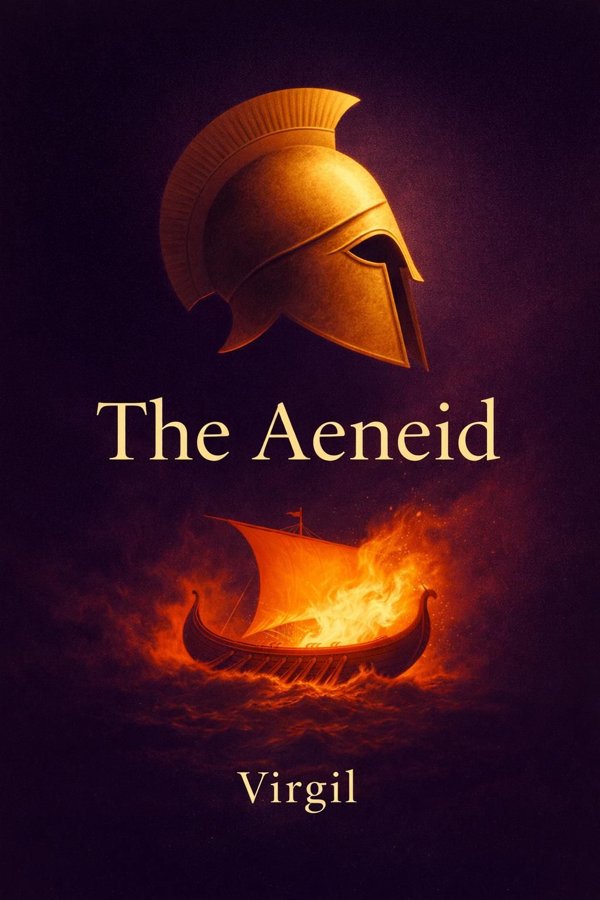
The Aeneid: Summary & Key Insights
by Virgil
 10 min10 chaptersAudio available
What Is The Aeneid About?
The Aeneid by Virgil is a classics book spanning 10 pages. The Aeneid is the Latin epic poem by Virgil that tells the story of Aeneas, a Trojan hero who escapes the fall of Troy and journeys to Italy, where he becomes the ancestor of the Romans. Blending myth, history, and Augustan ideology, the poem explores themes of duty, fate, and the founding of Rome. This Penguin Classics edition presents the Latin text with an English translation and scholarly commentary.
This FizzRead summary covers all 10 key chapters of The Aeneid in approximately 10 minutes, distilling the most important ideas, arguments, and takeaways from Virgil's work. Also available as an audio summary and Key Quotes Podcast.
The Aeneid
The Aeneid is the Latin epic poem by Virgil that tells the story of Aeneas, a Trojan hero who escapes the fall of Troy and journeys to Italy, where he becomes the ancestor of the Romans. Blending myth, history, and Augustan ideology, the poem explores themes of duty, fate, and the founding of Rome. This Penguin Classics edition presents the Latin text with an English translation and scholarly commentary.
Who Should Read The Aeneid?
This book is perfect for anyone interested in classics and looking to gain actionable insights in a short read. Whether you're a student, professional, or lifelong learner, the key ideas from The Aeneid by Virgil will help you think differently.
- ✓Readers who enjoy classics and want practical takeaways
- ✓Professionals looking to apply new ideas to their work and life
- ✓Anyone who wants the core insights of The Aeneid in just 10 minutes
Want the full summary?
Get instant access to this book summary and 100K+ more with Fizz Moment.
Get Free SummaryAvailable on App Store • Free to download
Key Chapters
I begin in the twilight after Troy’s destruction. Smoke drifts through the shattered gates, and the groans of the dying echo through the ruins. Here stands Aeneas—a warrior and a son—torn between the duty to fight and the command of fate to flee. I wanted this moment to speak to every human who must abandon the familiar for the unknown. As tears blur his vision, he hoists his aged father Anchises on his shoulders, clasps his young son Ascanius’s hand, and carries the household gods that embody Troy’s spirit. This image, for me, symbolizes the continuity of faith amid catastrophe. The Trojans’ gods are exiles, too; they travel within Aeneas toward the promise of a new Rome.
Their flight through the shadows of burning Troy represents humanity’s urge to preserve meaning even when the world collapses. I showed that heaven itself has decreed Aeneas’s journey—he is ‘pius Aeneas,’ the man of devotion. His obedience to divine command is both his burden and his blessing. The Greeks may have destroyed his city, but not his resolve. That is the meaning I wanted readers to feel: destiny is relentless, but when embraced with reverence, it transforms defeat into foundation.
When the exiles take to sea, they become fugitives pursued by divine tempests. Juno, resentful of Troy’s legacy, sends storms that batter their ships against alien shores. I wanted the sea itself to act as divine language—the world’s chaos testing human resilience. Finally, the Trojans find haven in Carthage, a city radiant with youth and power. Here, Queen Dido receives them not as vagabonds but as honored guests. I wrote this encounter as a moment of respite, a dreamlike suspension between suffering and destiny.
Through Aeneas’s retelling of Troy’s fall, I invited my readers to relive the anguish of deception—the Wooden Horse, the slaughter within the walls, and the futility of valor when divine decree has already condemned a city. Dido listens and loves; in her compassion, I captured how sympathy becomes the seed of tragedy. When Aeneas speaks of wandering across Thrace and Delos, his voice carries the exhaustion of a man whose faith clings to prophecy alone. To readers, this scene reveals the dual power of narrative: to heal by confession and to bind souls through shared sorrow. Yet within this intimacy lies peril, for love born of pity challenges the line between fate and desire.
+ 8 more chapters — available in the FizzRead app
All Chapters in The Aeneid
About the Author
Get This Summary in Your Preferred Format
Read or listen to the The Aeneid summary by Virgil anytime, anywhere. FizzRead offers multiple formats so you can learn on your terms — all free.
Available formats: App · Audio · PDF · EPUB — All included free with FizzRead
Download The Aeneid PDF and EPUB Summary
Key Quotes from The Aeneid
“I begin in the twilight after Troy’s destruction.”
“When the exiles take to sea, they become fugitives pursued by divine tempests.”
Frequently Asked Questions about The Aeneid
The Aeneid by Virgil is a classics book that explores key ideas across 10 chapters. The Aeneid is the Latin epic poem by Virgil that tells the story of Aeneas, a Trojan hero who escapes the fall of Troy and journeys to Italy, where he becomes the ancestor of the Romans. Blending myth, history, and Augustan ideology, the poem explores themes of duty, fate, and the founding of Rome. This Penguin Classics edition presents the Latin text with an English translation and scholarly commentary.
You Might Also Like






Browse by Category
Ready to read The Aeneid?
Get the full summary and 100K+ more books with Fizz Moment.