
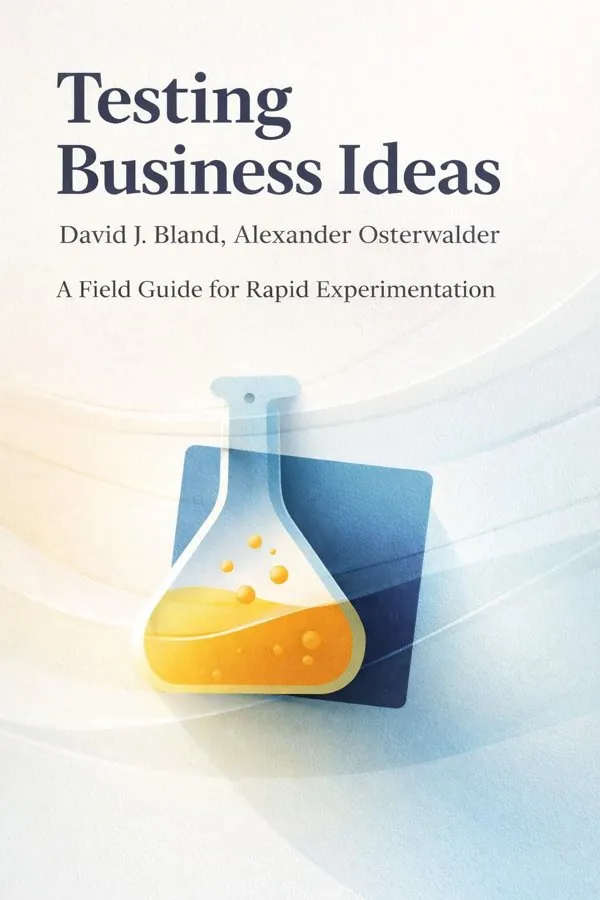
Testing Business Ideas: A Field Guide for Rapid Experimentation: Summary & Key Insights
by David J. Bland, Alexander Osterwalder
 10 min4 chaptersAudio available
What Is Testing Business Ideas: A Field Guide for Rapid Experimentation About?
Testing Business Ideas: A Field Guide for Rapid Experimentation by David J. Bland, Alexander Osterwalder is a entrepreneurship book spanning 4 pages. Testing Business Ideas ofrece un enfoque práctico para validar ideas de negocio mediante experimentos rápidos y sistemáticos. Los autores presentan un marco de trabajo que ayuda a los emprendedores y equipos de innovación a reducir el riesgo de fracaso, aprender de los clientes y mejorar sus modelos de negocio antes de invertir grandes recursos.
This FizzRead summary covers all 4 key chapters of Testing Business Ideas: A Field Guide for Rapid Experimentation in approximately 10 minutes, distilling the most important ideas, arguments, and takeaways from David J. Bland, Alexander Osterwalder's work. Also available as an audio summary and Key Quotes Podcast.
Testing Business Ideas: A Field Guide for Rapid Experimentation
Testing Business Ideas ofrece un enfoque práctico para validar ideas de negocio mediante experimentos rápidos y sistemáticos. Los autores presentan un marco de trabajo que ayuda a los emprendedores y equipos de innovación a reducir el riesgo de fracaso, aprender de los clientes y mejorar sus modelos de negocio antes de invertir grandes recursos.
Who Should Read Testing Business Ideas: A Field Guide for Rapid Experimentation?
This book is perfect for anyone interested in entrepreneurship and looking to gain actionable insights in a short read. Whether you're a student, professional, or lifelong learner, the key ideas from Testing Business Ideas: A Field Guide for Rapid Experimentation by David J. Bland, Alexander Osterwalder will help you think differently.
- ✓Readers who enjoy entrepreneurship and want practical takeaways
- ✓Professionals looking to apply new ideas to their work and life
- ✓Anyone who wants the core insights of Testing Business Ideas: A Field Guide for Rapid Experimentation in just 10 minutes
Want the full summary?
Get instant access to this book summary and 100K+ more with Fizz Moment.
Get Free SummaryAvailable on App Store • Free to download
Key Chapters
When we first introduced the *Business Model Canvas*, it gave innovators a common language to describe how they create, deliver, and capture value. The *Value Proposition Canvas* then helped teams dive deeper into understanding customers’ jobs, pains, and gains. But even with these tools, one dangerous assumption persisted—the belief that a well-designed canvas automatically meant a good business. In reality, a canvas is still a set of untested guesses.
That’s where *Testing Business Ideas* begins: with the recognition that every new venture starts with uncertainty. Whether you’re forming a startup in your garage or launching a new product inside a global corporation, you’re walking into the unknown. Traditional business planning doesn’t solve this—it hides it behind spreadsheets and forecasts. Experimentation brings it into the open.
Using the Strategyzer framework, we show how innovation should be treated as a process of evidence-based discovery. The new logic is simple: before building, you test; before scaling, you validate. Execution comes only after learning. This philosophy turns innovation into a disciplined search for truth, rather than a gamble on vision.
With this mindset, the Strategyzer system works as an integrated toolkit. You start by mapping your idea using the Business Model and Value Proposition Canvases. Then, you identify key assumptions embedded in those maps—the building blocks that, if wrong, will sink your idea. Finally, you systematically test them through experiments that are quick, cheap, and designed to generate insight. The result? You make better decisions based on evidence, not wishful thinking.
Every grand business idea starts with assumptions—about who the customers are, what they value, how they’ll use your product, how you’ll reach them, and what they’ll pay. The problem is that most innovators fall in love with these assumptions. In our approach, we do the opposite: we fall in love with discovering which of them are wrong.
Testing business ideas means surfacing these assumptions deliberately. We ask teams to break their business model down into smaller parts and identify what must be true for it to succeed. Does the customer truly have the problem you’re solving? Will they pay to solve it? Can the product even be built as imagined? Each question becomes a hypothesis to be tested.
Once surfaced, you can prioritize your assumptions by risk. Some are mission-critical—you can’t afford to be wrong about them. Others are secondary, introducing refinements rather than existential threats. The riskiest assumptions require evidence first. Testing them early can save months or years of misdirected effort.
Then comes the heart of the book: running experiments. From simple interviews to landing pages, concierge tests, or prototypes, each experiment generates a learning outcome. If you learn that your assumption was correct, you gain confidence. If you learn it wasn’t, you gain direction. Either outcome moves you forward. The key is to structure each experiment as a learning cycle: define a hypothesis, set measurable criteria, conduct the test, and interpret the data honestly.
Evidence-based entrepreneurship thrives on this rhythm. It transforms uncertainty from a source of fear into a source of energy. With each test, your team not only strengthens its idea but also its collective mindset—becoming more agile, curious, and humble in the face of unknowns.
+ 2 more chapters — available in the FizzRead app
All Chapters in Testing Business Ideas: A Field Guide for Rapid Experimentation
About the Authors
David J. Bland es consultor de innovación y fundador de Precoil, especializado en ayudar a las empresas a probar nuevas ideas de negocio. Alexander Osterwalder es cofundador de Strategyzer y creador del Business Model Canvas, reconocido internacionalmente por su trabajo en innovación empresarial.
Get This Summary in Your Preferred Format
Read or listen to the Testing Business Ideas: A Field Guide for Rapid Experimentation summary by David J. Bland, Alexander Osterwalder anytime, anywhere. FizzRead offers multiple formats so you can learn on your terms — all free.
Available formats: App · Audio · PDF · EPUB — All included free with FizzRead
Download Testing Business Ideas: A Field Guide for Rapid Experimentation PDF and EPUB Summary
Key Quotes from Testing Business Ideas: A Field Guide for Rapid Experimentation
“When we first introduced the *Business Model Canvas*, it gave innovators a common language to describe how they create, deliver, and capture value.”
“Every grand business idea starts with assumptions—about who the customers are, what they value, how they’ll use your product, how you’ll reach them, and what they’ll pay.”
Frequently Asked Questions about Testing Business Ideas: A Field Guide for Rapid Experimentation
Testing Business Ideas: A Field Guide for Rapid Experimentation by David J. Bland, Alexander Osterwalder is a entrepreneurship book that explores key ideas across 4 chapters. Testing Business Ideas ofrece un enfoque práctico para validar ideas de negocio mediante experimentos rápidos y sistemáticos. Los autores presentan un marco de trabajo que ayuda a los emprendedores y equipos de innovación a reducir el riesgo de fracaso, aprender de los clientes y mejorar sus modelos de negocio antes de invertir grandes recursos.
You Might Also Like
Lean Analytics
Alistair Croll, Benjamin Yoskovitz
10 min
21 Days To A Big Idea: Creating Breakthrough Business Concepts
Bryan Mattimore
10 min
Sam Walton: Made in America: My Story
Sam Walton
10 min
10x Is Easier Than 2x: How World-Class Entrepreneurs Achieve More by Doing Less
Dan Sullivan, Benjamin Hardy
10 min
12 Months to $1 Million: How to Pick a Winning Product, Build a Real Business, and Become a Seven-Figure Entrepreneur
Ryan Daniel Moran
10 min
24 Assets: Create a Digital, Scalable, Valuable Business
Daniel Priestley
10 minBrowse by Category
Ready to read Testing Business Ideas: A Field Guide for Rapid Experimentation?
Get the full summary and 100K+ more books with Fizz Moment.