
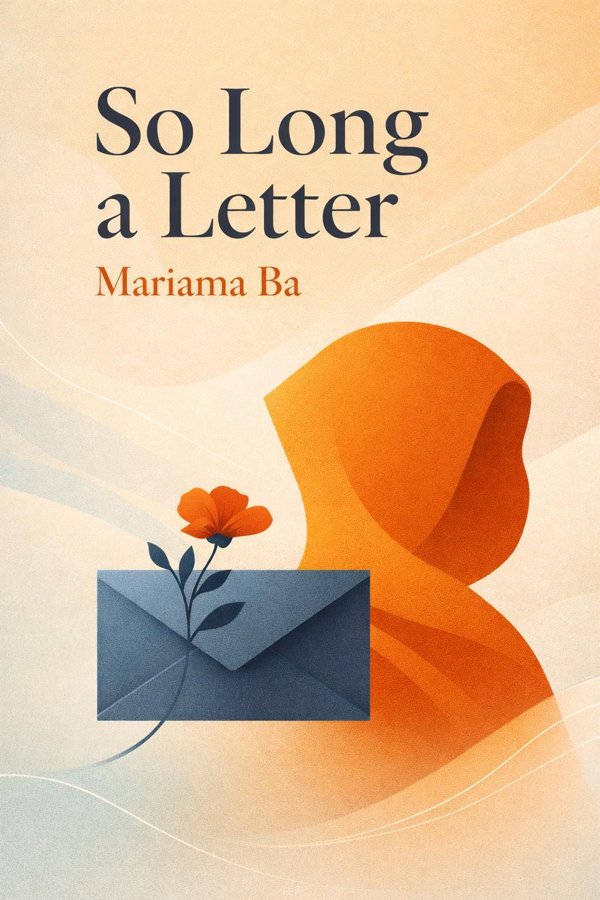
So Long a Letter: Summary & Key Insights
by Mariama Ba
 10 min9 chaptersAudio available
Key Takeaways from So Long a Letter
The most painful disillusionments often begin with our brightest hopes.
What breaks the heart is not always the custom itself, but the way power is exercised through silence.
Sometimes the bravest act is refusing to accept what everyone else tells you to endure.
Loss does not only reveal what we loved; it reveals the world waiting to define us after that love is gone.
When institutions fail women, friendship can become a form of shelter, memory, and resistance.
What Is So Long a Letter About?
So Long a Letter by Mariama Ba is a classics book spanning 5 pages. So Long a Letter is a quietly devastating novel that turns private grief into a powerful social critique. Written by Senegalese author Mariama Ba, the book takes the form of a long letter from Ramatoulaye, a recently widowed schoolteacher, to her lifelong friend Aissatou. As Ramatoulaye reflects on her marriage, motherhood, widowhood, and the wounds of polygamy, her personal story opens onto larger questions about faith, custom, education, gender, and freedom in postcolonial Senegal. The result is both intimate and political: a portrait of one woman’s pain that reveals the structure of an unequal society. What makes the novel enduring is its balance of tenderness and clarity. Ba does not simply condemn tradition or celebrate modernity. Instead, she shows how women are forced to negotiate between inherited expectations and emerging possibilities, often at great emotional cost. Through elegant, direct prose, she explores how friendship, education, and self-respect can become forms of resistance. Mariama Ba writes with rare authority as a Senegalese educator and feminist deeply engaged with the realities of women’s lives. This landmark classic remains essential reading for anyone interested in African literature, women’s autonomy, and the moral complexity of social change.
This FizzRead summary covers all 9 key chapters of So Long a Letter in approximately 10 minutes, distilling the most important ideas, arguments, and takeaways from Mariama Ba's work. Also available as an audio summary and Key Quotes Podcast.
So Long a Letter
So Long a Letter is a quietly devastating novel that turns private grief into a powerful social critique. Written by Senegalese author Mariama Ba, the book takes the form of a long letter from Ramatoulaye, a recently widowed schoolteacher, to her lifelong friend Aissatou. As Ramatoulaye reflects on her marriage, motherhood, widowhood, and the wounds of polygamy, her personal story opens onto larger questions about faith, custom, education, gender, and freedom in postcolonial Senegal. The result is both intimate and political: a portrait of one woman’s pain that reveals the structure of an unequal society.
What makes the novel enduring is its balance of tenderness and clarity. Ba does not simply condemn tradition or celebrate modernity. Instead, she shows how women are forced to negotiate between inherited expectations and emerging possibilities, often at great emotional cost. Through elegant, direct prose, she explores how friendship, education, and self-respect can become forms of resistance. Mariama Ba writes with rare authority as a Senegalese educator and feminist deeply engaged with the realities of women’s lives. This landmark classic remains essential reading for anyone interested in African literature, women’s autonomy, and the moral complexity of social change.
Who Should Read So Long a Letter?
This book is perfect for anyone interested in classics and looking to gain actionable insights in a short read. Whether you're a student, professional, or lifelong learner, the key ideas from So Long a Letter by Mariama Ba will help you think differently.
- ✓Readers who enjoy classics and want practical takeaways
- ✓Professionals looking to apply new ideas to their work and life
- ✓Anyone who wants the core insights of So Long a Letter in just 10 minutes
Want the full summary?
Get instant access to this book summary and 100K+ more with Fizz Moment.
Get Free SummaryAvailable on App Store • Free to download
Key Chapters
What breaks the heart is not always the custom itself, but the way power is exercised through silence. One of the central wounds in So Long a Letter is Modou’s decision to take a much younger second wife, Binetou. Ramatoulaye does not experience this merely as a legal or cultural fact. She experiences it as humiliation, abandonment, and exclusion from her own life. The injury lies in the secrecy, the disrespect, and the ease with which her years of loyalty are discarded.
Ba’s treatment of polygamy is especially powerful because it moves beyond abstract debate. She does not offer a detached sociological argument. Instead, she reveals the emotional mechanics of the practice when it is shaped by male selfishness. Modou effectively withdraws from his first family, leaving Ramatoulaye to bear the burden of parenting, dignity, and endurance alone. The novel exposes how customs presented as legitimate can become tools of emotional violence when women are denied voice, consultation, and reciprocity.
At the same time, Ba complicates the issue by showing that tradition is often entangled with class pressure, vanity, and social ambition. Binetou’s marriage to Modou is influenced by her mother’s material aspirations, suggesting that patriarchy is sustained not only by men but by systems of dependency that push women into painful compromises.
This dynamic still resonates in any relationship where one partner makes life-altering decisions unilaterally, then expects the other to absorb the consequences quietly. The form may differ, but the pattern is familiar: betrayal dressed up as entitlement.
The actionable takeaway is clear: do not minimize exclusion. In any intimate bond, respect requires transparency, shared decision-making, and acknowledgment of the other person’s full humanity. When those disappear, the relationship has already been morally broken, whatever its outward form.
Sometimes the bravest act is refusing to accept what everyone else tells you to endure. Aissatou, Ramatoulaye’s closest friend, offers the novel’s clearest example of decisive resistance. When her husband Mawdo takes a second wife under pressure from his aristocratic mother, Aissatou does not remain within a system that asks her to preserve dignity by swallowing pain. Instead, she leaves the marriage, writes a letter rejecting the logic of ownership, and builds an independent life for herself and her children.
Her choice stands in deliberate contrast to Ramatoulaye’s. Where Ramatoulaye stays and struggles internally, Aissatou acts externally and immediately. Ba does not simplify either woman into right or wrong. Rather, she presents two different responses to betrayal, each shaped by personality, circumstance, and moral calculation. Still, Aissatou’s path carries a radical force. She refuses the argument that education should make women more adaptable to injustice. For her, education must create freedom, not better manners for suffering.
Aissatou’s story also reveals that autonomy is not merely emotional. It is practical. She gains training, secures work, and reconstructs a life beyond the failed marriage. This matters because independence is often romanticized as a feeling when in reality it requires resources, planning, and resilience. Ba suggests that liberation is sustained not by defiance alone but by competence and economic self-possession.
Readers today can apply this lesson in many settings, from intimate relationships to workplaces and family structures. There are moments when compromise preserves peace, and others when compromise destroys the self. Knowing the difference is a moral skill.
Takeaway: build the conditions that make freedom possible before a crisis arrives. Invest in education, financial literacy, supportive friendships, and self-trust. Aissatou teaches that dignity is strongest when it is backed by the ability to stand on your own.
Loss does not only reveal what we loved; it reveals the world waiting to define us after that love is gone. The novel opens during Ramatoulaye’s period of mourning after Modou’s death, and widowhood becomes more than a private state of grief. It is a social ordeal. She must navigate rituals, expectations, visitors, and opportunists who descend upon her at a vulnerable moment. Through these scenes, Ba shows that widowhood in her society is heavily regulated, especially for women, whose sorrow is often made public property.
Ramatoulaye’s mourning is complex because she grieves a man who hurt her deeply. She remembers tenderness, betrayal, disappointment, and habit all at once. This emotional complexity gives the novel much of its realism. Ba refuses the comforting idea that death purifies memory. Instead, she shows a woman trying to honor truth rather than sentimentality. Widowhood becomes a space in which Ramatoulaye reclaims her narrative. She is no longer only Modou’s wife or victim; she becomes the interpreter of what their life meant.
The surrounding social rituals also expose how women can be rendered secondary even in matters central to their own lives. Others debate inheritance, propriety, and future arrangements as though her body, home, and feelings belong to a communal script. Yet within this pressure, Ramatoulaye slowly rediscovers self-respect. Reflection itself becomes an act of resistance.
This theme is useful for anyone facing major life transitions such as divorce, bereavement, illness, or sudden role change. Vulnerable moments often invite outside voices to define what you should do next. Ba reminds us that grief should not cancel judgment.
Actionable takeaway: when life is fractured, make space to name your experience in your own words. Journaling, trusted conversation, and deliberate reflection can help restore agency before you make decisions under pressure.
When institutions fail women, friendship can become a form of shelter, memory, and resistance. The entire structure of So Long a Letter rests on this truth. Ramatoulaye writes not to a judge, priest, or public audience, but to Aissatou, the friend who knows her history and can receive her without distortion. This choice is not incidental. It reveals that women’s friendships provide a space where experience can be narrated honestly, outside the demands of performance and social respectability.
Aissatou is more than a correspondent. She is witness, example, and emotional anchor. Through her, the novel demonstrates that solidarity does not require identical choices. Aissatou leaves her marriage; Ramatoulaye stays in hers. Yet their bond endures because it is grounded in recognition rather than conformity. They allow each other complexity. In a world where women are often judged according to how well they endure sacrifice, this mutual respect becomes profoundly liberating.
Ba also suggests that friendship carries political significance. Personal letters can challenge social silence by preserving women’s interpretations of events that public narratives often distort or erase. In this sense, intimacy becomes archival. Friendship keeps alive a counter-history of what women have suffered, chosen, and survived.
This insight remains deeply practical today. Many people underestimate the importance of relationships that are not romantic or familial. Yet in times of crisis, a trusted friend may offer clearer moral support than those more formally tied to us. A strong friendship can help us test our assumptions, restore perspective, and remember who we are.
Takeaway: treat sustaining friendships as essential, not optional. Invest in the people who can tell you the truth with compassion. A life with one or two deeply honest allies is far more resilient than one built only on appearances, obligation, or status.
Social change is rarely a clean replacement of old values with new ones; more often, it is a tense coexistence full of contradiction. One of Mariama Ba’s greatest achievements is showing postcolonial Senegal as a society suspended between inherited structures and emerging ideals. Education expands possibilities, urban life reshapes family patterns, and independence creates new political hopes. Yet older customs regarding marriage, lineage, religion, and gender continue to shape everyday behavior. The result is not simple progress but conflict.
Ramatoulaye embodies this tension. She respects aspects of faith and tradition, but she also believes women deserve education, consent, and dignity. She is neither wholly traditional nor naively modern. Her life becomes a laboratory of compromise, where some values nourish her and others constrain her. Ba’s point is not that tradition is inherently oppressive or that modernity is inherently liberating. Rather, both can be used selectively, often by those with power. Men may invoke religion to justify privilege while embracing modern comforts for themselves. Families may praise education for daughters yet still expect obedience when crucial decisions arise.
This dynamic appears across societies. People frequently claim progressive ideals in theory while preserving traditional hierarchies in practice. Workplaces celebrate inclusion while rewarding conformity. Families encourage ambition but only within approved boundaries.
The practical application is to look beyond labels. Instead of asking whether a custom is old or new, ask whether it fosters justice, consent, and reciprocity. Not every inherited practice deserves rejection, and not every modern choice deserves admiration.
Actionable takeaway: evaluate social norms by their human consequences. Keep what deepens dignity and community. Challenge what relies on silence, coercion, or unequal sacrifice. Ba teaches that maturity lies not in choosing sides rhetorically, but in discerning what truly serves a humane life.
Education in So Long a Letter is not merely schooling; it is the foundation of consciousness. Again and again, Ba links women’s education to their ability to think critically, earn independently, raise children differently, and imagine lives beyond inherited submission. Ramatoulaye and Aissatou belong to a generation of educated women shaped by the promises of a changing Senegal. Their literacy, professional training, and intellectual seriousness distinguish them from women trapped more completely by social dependency.
Yet Ba is too honest to romanticize education as a cure-all. Ramatoulaye is educated and still wounded by patriarchy. Aissatou is educated and still betrayed. Education does not protect women from pain, but it changes what they can do with that pain. It gives language to suffering, alternatives to dependence, and the confidence to judge custom rather than merely obey it. In the novel, writing itself becomes evidence of that power. Ramatoulaye’s long letter is an act education has made possible: a disciplined, reflective account of a life that refuses erasure.
The book also highlights education’s generational impact. Women who are educated influence how children understand gender, responsibility, and aspiration. Their example can interrupt cycles of resignation. This matters because structural change often begins not with dramatic revolution but with altered expectations inside homes and classrooms.
For modern readers, the theme extends beyond formal degrees. Education includes financial knowledge, legal awareness, emotional vocabulary, and historical understanding. These forms of learning increase practical freedom.
Takeaway: treat education as a lifelong resource for dignity, not just a stage of youth. Keep building the knowledge that lets you make informed choices, recognize manipulation, and support others. Ba shows that when women learn deeply, they do more than advance themselves; they widen the horizon for everyone around them.
To care for others is noble, but when care becomes a woman’s only permitted identity, it can become another form of captivity. Ramatoulaye’s role as a mother is one of the most grounding and demanding dimensions of the novel. She raises many children, manages a household, and bears emotional burdens intensified by Modou’s withdrawal after his second marriage. Her maternal responsibility is immense, yet Ba refuses to reduce her to saintly endurance. Ramatoulaye is loving, but she is also tired, reflective, wounded, and intellectually alive.
This matters because literature and society often praise mothers in ways that conceal the cost of their labor. In So Long a Letter, motherhood is both meaningful and exhausting. It gives Ramatoulaye purpose, but it also locks her into practical obligations that affect what choices feel available. While men may pursue desire with social tolerance, women remain tied to continuity, respectability, and the daily work of keeping life together. Ba’s portrayal makes visible the imbalance between symbolic praise for motherhood and real support for mothers.
The novel also shows motherhood as a site of ethical influence. Ramatoulaye worries about her daughters, their futures, their autonomy, and the values they inherit. She understands that parenting is not just provision but transmission. How a mother interprets her own suffering may shape what the next generation accepts or resists.
Today, this theme speaks to anyone balancing caregiving with selfhood. Whether in parenting, elder care, or emotional labor, many people feel pressure to disappear into usefulness. Ba suggests that genuine care should not require self-erasure.
Actionable takeaway: honor caregiving while protecting the person who gives it. Ask what support, boundaries, and recognition are needed so responsibility does not become silent depletion. Ramatoulaye’s example reminds us that strength is not infinite, and dignity includes caring for the caregiver too.
All Chapters in So Long a Letter
About the Author
Mariama Ba (1929–1981) was a pioneering Senegalese novelist, teacher, and feminist whose work helped define modern African women’s writing. Born in Dakar, she was educated at the Ecole Normale for girls and later worked as a teacher and school inspector. Her fiction drew on the social realities of postcolonial Senegal, especially the pressures faced by women within marriage, motherhood, religion, and patriarchal tradition. Ba wrote with unusual clarity about polygamy, female education, and the struggle for dignity in a changing society. Her debut novel, So Long a Letter, received the inaugural Noma Award for Publishing in Africa in 1980 and became an international classic. Though she published only a small body of work, Mariama Ba remains one of the most influential voices in African feminist literature.
Get This Summary in Your Preferred Format
Read or listen to the So Long a Letter summary by Mariama Ba anytime, anywhere. FizzRead offers multiple formats so you can learn on your terms — all free.
Available formats: App · Audio · PDF · EPUB — All included free with FizzRead
Download So Long a Letter PDF and EPUB Summary
Key Quotes from So Long a Letter
“The most painful disillusionments often begin with our brightest hopes.”
“What breaks the heart is not always the custom itself, but the way power is exercised through silence.”
“Sometimes the bravest act is refusing to accept what everyone else tells you to endure.”
“Loss does not only reveal what we loved; it reveals the world waiting to define us after that love is gone.”
“When institutions fail women, friendship can become a form of shelter, memory, and resistance.”
Frequently Asked Questions about So Long a Letter
So Long a Letter by Mariama Ba is a classics book that explores key ideas across 9 chapters. So Long a Letter is a quietly devastating novel that turns private grief into a powerful social critique. Written by Senegalese author Mariama Ba, the book takes the form of a long letter from Ramatoulaye, a recently widowed schoolteacher, to her lifelong friend Aissatou. As Ramatoulaye reflects on her marriage, motherhood, widowhood, and the wounds of polygamy, her personal story opens onto larger questions about faith, custom, education, gender, and freedom in postcolonial Senegal. The result is both intimate and political: a portrait of one woman’s pain that reveals the structure of an unequal society. What makes the novel enduring is its balance of tenderness and clarity. Ba does not simply condemn tradition or celebrate modernity. Instead, she shows how women are forced to negotiate between inherited expectations and emerging possibilities, often at great emotional cost. Through elegant, direct prose, she explores how friendship, education, and self-respect can become forms of resistance. Mariama Ba writes with rare authority as a Senegalese educator and feminist deeply engaged with the realities of women’s lives. This landmark classic remains essential reading for anyone interested in African literature, women’s autonomy, and the moral complexity of social change.
You Might Also Like

Browse by Category
Ready to read So Long a Letter?
Get the full summary and 100K+ more books with Fizz Moment.