
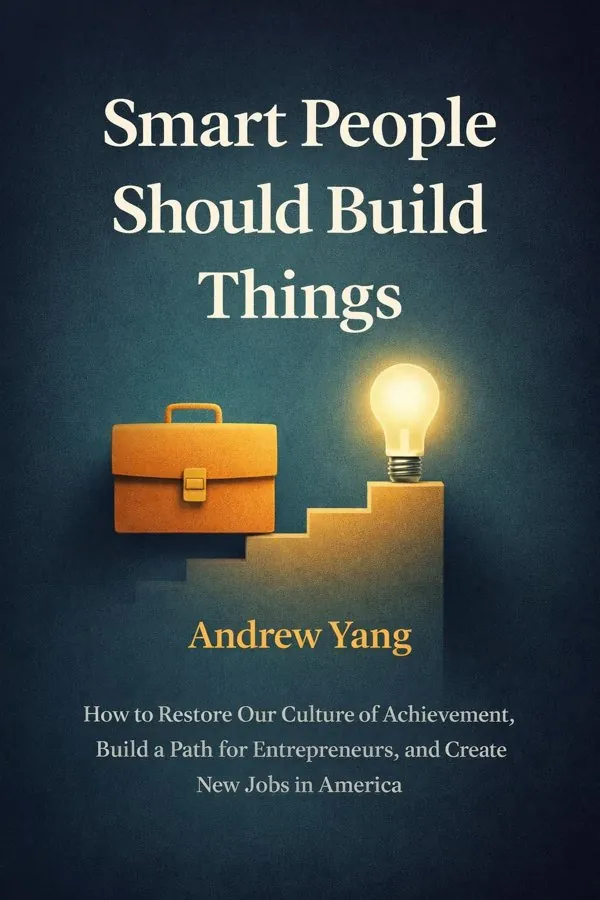
Smart People Should Build Things: How to Restore Our Culture of Achievement, Build a Path for Entrepreneurs, and Create New Jobs in America: Summary & Key Insights
by Andrew Yang
 10 min9 chaptersAudio available
What Is Smart People Should Build Things: How to Restore Our Culture of Achievement, Build a Path for Entrepreneurs, and Create New Jobs in America About?
Smart People Should Build Things: How to Restore Our Culture of Achievement, Build a Path for Entrepreneurs, and Create New Jobs in America by Andrew Yang is a entrepreneurship book spanning 9 pages. In this book, Andrew Yang argues that the United States has steered its most talented young people toward finance, consulting, and law, rather than entrepreneurship and innovation. Drawing on his experience as founder of Venture for America, Yang outlines how this misallocation of talent has weakened the economy and proposes a plan to redirect smart, ambitious graduates toward building companies that create real value and jobs. The book combines social commentary, economic analysis, and practical advice for aspiring entrepreneurs.
This FizzRead summary covers all 9 key chapters of Smart People Should Build Things: How to Restore Our Culture of Achievement, Build a Path for Entrepreneurs, and Create New Jobs in America in approximately 10 minutes, distilling the most important ideas, arguments, and takeaways from Andrew Yang's work. Also available as an audio summary and Key Quotes Podcast.
Smart People Should Build Things: How to Restore Our Culture of Achievement, Build a Path for Entrepreneurs, and Create New Jobs in America
In this book, Andrew Yang argues that the United States has steered its most talented young people toward finance, consulting, and law, rather than entrepreneurship and innovation. Drawing on his experience as founder of Venture for America, Yang outlines how this misallocation of talent has weakened the economy and proposes a plan to redirect smart, ambitious graduates toward building companies that create real value and jobs. The book combines social commentary, economic analysis, and practical advice for aspiring entrepreneurs.
Who Should Read Smart People Should Build Things: How to Restore Our Culture of Achievement, Build a Path for Entrepreneurs, and Create New Jobs in America?
This book is perfect for anyone interested in entrepreneurship and looking to gain actionable insights in a short read. Whether you're a student, professional, or lifelong learner, the key ideas from Smart People Should Build Things: How to Restore Our Culture of Achievement, Build a Path for Entrepreneurs, and Create New Jobs in America by Andrew Yang will help you think differently.
- ✓Readers who enjoy entrepreneurship and want practical takeaways
- ✓Professionals looking to apply new ideas to their work and life
- ✓Anyone who wants the core insights of Smart People Should Build Things: How to Restore Our Culture of Achievement, Build a Path for Entrepreneurs, and Create New Jobs in America in just 10 minutes
Want the full summary?
Get instant access to this book summary and 100K+ more with Fizz Moment.
Get Free SummaryAvailable on App Store • Free to download
Key Chapters
To understand how we arrived at today’s troubling talent distribution, you have to look back at the evolution of the American economy. For much of the twentieth century, our growth was driven by manufacturing and innovation. Engineers built products, and entrepreneurs turned ideas into thriving industries—from automobiles to consumer electronics. In those days, ambition meant making something tangible. College graduates joined industrial firms, helped expand new sectors, and saw their efforts directly reflected in national prosperity.
But as global economic structures shifted, so did our educational values. Deregulation and financialization transformed Wall Street into a magnet for talent. Service industries grew more lucrative than production. It became common wisdom that the secure, prestigious route to success was through finance, consulting, or law. The factory floor gave way to the trading floor, and creativity became subordinated to analysis.
This shift may have seemed benign—after all, these were high-paying, intellectually demanding jobs—but beneath the surface it eroded our economic fabric. Manufacturing communities hollowed out while elite institutions celebrated abstract achievements detached from real-world impact. The American economy started rewarding transaction over transformation.
In writing this section, I wanted readers to see how historic forces—automation, globalization, the rise of capital markets—became intertwined with cultural ideals. A generation raised on standardized tests and prestige rankings learned to prize predictability and status. By tracing this transformation, I aimed to show that our current imbalance didn’t happen by accident; it was the result of decades of shifting incentives. Recognizing that history helps us confront it. We once valued builders. It’s time to reclaim that spirit.
When I speak at universities, I often ask students where they’re headed after graduation. The most common answers are Goldman Sachs, McKinsey, or a top law school. At first glance, these paths seem admirable—smart choices within a meritocratic system. But the deeper truth is that this system funnels extraordinary talent into narrow purposes. What we’re witnessing is not just preference but systemic misallocation.
Elite education has become increasingly risk-averse. Students are told that the highest validation of their ability is placement at prestigious corporate institutions. Meanwhile, our recruiting infrastructure reinforces this hierarchy. Finance and consulting firms spend lavishly to attract young talent, offering structured advancement and comfort. Startup founders, on the other hand, can barely pay interns. The result is a talent drain from innovation into administration.
I often describe this as America’s great paradox: our smartest people spend their twenties perfecting spreadsheets instead of building companies. Our universities prepare brilliant analysts but few creators. What’s worse is that this system perpetuates itself—students compete for credentials that will appeal to employers who value conformity. Creativity becomes an extracurricular activity rather than a career foundation.
Behind this misallocation is a fear of risk that has been programmed into our culture. The most talented young people avoid uncertainty because debt, societal expectation, and institutional prestige all reward safety. But economies thrive on experimentation. When talent avoids risk, innovation stalls. Through Venture for America, I’ve seen how unleashing that talent—placing it in scrappy startups where every decision matters—can reignite both personal and regional growth. The misallocation problem is not irreversible, but it demands courage to step off the well-trodden path and build something new.
+ 7 more chapters — available in the FizzRead app
All Chapters in Smart People Should Build Things: How to Restore Our Culture of Achievement, Build a Path for Entrepreneurs, and Create New Jobs in America
About the Author
Andrew Yang is an American entrepreneur, author, and former presidential candidate. He founded Venture for America, a nonprofit organization that helps recent graduates start businesses in emerging cities. Yang is known for his advocacy of economic innovation, universal basic income, and policies addressing the future of work.
Get This Summary in Your Preferred Format
Read or listen to the Smart People Should Build Things: How to Restore Our Culture of Achievement, Build a Path for Entrepreneurs, and Create New Jobs in America summary by Andrew Yang anytime, anywhere. FizzRead offers multiple formats so you can learn on your terms — all free.
Available formats: App · Audio · PDF · EPUB — All included free with FizzRead
Download Smart People Should Build Things: How to Restore Our Culture of Achievement, Build a Path for Entrepreneurs, and Create New Jobs in America PDF and EPUB Summary
Key Quotes from Smart People Should Build Things: How to Restore Our Culture of Achievement, Build a Path for Entrepreneurs, and Create New Jobs in America
“To understand how we arrived at today’s troubling talent distribution, you have to look back at the evolution of the American economy.”
“When I speak at universities, I often ask students where they’re headed after graduation.”
Frequently Asked Questions about Smart People Should Build Things: How to Restore Our Culture of Achievement, Build a Path for Entrepreneurs, and Create New Jobs in America
Smart People Should Build Things: How to Restore Our Culture of Achievement, Build a Path for Entrepreneurs, and Create New Jobs in America by Andrew Yang is a entrepreneurship book that explores key ideas across 9 chapters. In this book, Andrew Yang argues that the United States has steered its most talented young people toward finance, consulting, and law, rather than entrepreneurship and innovation. Drawing on his experience as founder of Venture for America, Yang outlines how this misallocation of talent has weakened the economy and proposes a plan to redirect smart, ambitious graduates toward building companies that create real value and jobs. The book combines social commentary, economic analysis, and practical advice for aspiring entrepreneurs.
More by Andrew Yang

You Might Also Like

Lean Analytics
Alistair Croll, Benjamin Yoskovitz
10 min
21 Days To A Big Idea: Creating Breakthrough Business Concepts
Bryan Mattimore
10 min
Sam Walton: Made in America: My Story
Sam Walton
10 min
10x Is Easier Than 2x: How World-Class Entrepreneurs Achieve More by Doing Less
Dan Sullivan, Benjamin Hardy
10 min
12 Months to $1 Million: How to Pick a Winning Product, Build a Real Business, and Become a Seven-Figure Entrepreneur
Ryan Daniel Moran
10 min
24 Assets: Create a Digital, Scalable, Valuable Business
Daniel Priestley
10 minBrowse by Category
Ready to read Smart People Should Build Things: How to Restore Our Culture of Achievement, Build a Path for Entrepreneurs, and Create New Jobs in America?
Get the full summary and 100K+ more books with Fizz Moment.