
Slaughterhouse-Five: Or, The Children's Crusade: A Duty-Dance with Death: Summary & Key Insights
 10 min4 chaptersAudio available
What Is Slaughterhouse-Five: Or, The Children's Crusade: A Duty-Dance with Death About?
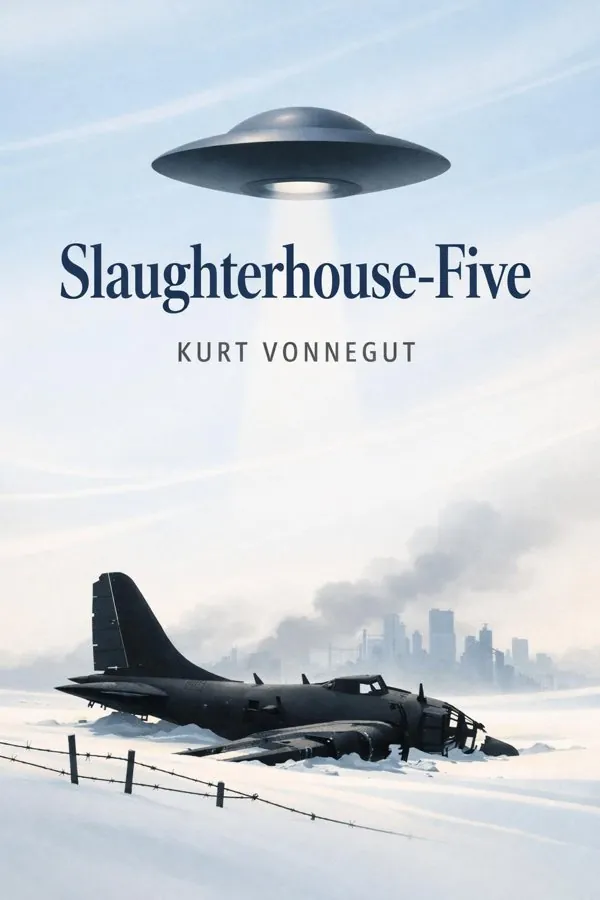
Slaughterhouse-Five: Or, The Children's Crusade: A Duty-Dance with Death by Kurt Vonnegut is a classics book spanning 4 pages. Slaughterhouse-Five is a satirical anti-war novel that follows Billy Pilgrim, a soldier who becomes 'unstuck in time' after surviving the bombing of Dresden during World War II. The narrative moves nonlinearly through his experiences as a prisoner of war, his postwar life in America, and his abduction by aliens from the planet Tralfamadore. Through dark humor and science fiction elements, Vonnegut explores the absurdity of war, the illusion of free will, and the fragility of human existence.
This FizzRead summary covers all 4 key chapters of Slaughterhouse-Five: Or, The Children's Crusade: A Duty-Dance with Death in approximately 10 minutes, distilling the most important ideas, arguments, and takeaways from Kurt Vonnegut's work. Also available as an audio summary and Key Quotes Podcast.
Slaughterhouse-Five: Or, The Children's Crusade: A Duty-Dance with Death
Slaughterhouse-Five is a satirical anti-war novel that follows Billy Pilgrim, a soldier who becomes 'unstuck in time' after surviving the bombing of Dresden during World War II. The narrative moves nonlinearly through his experiences as a prisoner of war, his postwar life in America, and his abduction by aliens from the planet Tralfamadore. Through dark humor and science fiction elements, Vonnegut explores the absurdity of war, the illusion of free will, and the fragility of human existence.
Who Should Read Slaughterhouse-Five: Or, The Children's Crusade: A Duty-Dance with Death?
This book is perfect for anyone interested in classics and looking to gain actionable insights in a short read. Whether you're a student, professional, or lifelong learner, the key ideas from Slaughterhouse-Five: Or, The Children's Crusade: A Duty-Dance with Death by Kurt Vonnegut will help you think differently.
- ✓Readers who enjoy classics and want practical takeaways
- ✓Professionals looking to apply new ideas to their work and life
- ✓Anyone who wants the core insights of Slaughterhouse-Five: Or, The Children's Crusade: A Duty-Dance with Death in just 10 minutes
Want the full summary?
Get instant access to this book summary and 100K+ more with Fizz Moment.
Get Free SummaryAvailable on App Store • Free to download
Key Chapters
Billy Pilgrim is my creation and my mirror. He is an optometrist—a man who once made a profession of correcting sight—but his own vision of life is hopelessly fractured. He survived the same bombing of Dresden that I did, and afterward, he became unstuck in time. That phrase means exactly what it sounds like. Billy no longer experiences his life as a sequence; he drifts from his childhood to his death, from his marriage bed to the depths of a German prison, without any control. He is a man condemned to witness existence as one unbroken whole—every moment alive at once, every joy inseparable from its corresponding agony.
Billy’s temporal dislocation isn’t simply science fiction; it is a metaphor for trauma. War shatters one’s perception of continuity. A survivor cannot tell where youth ended and guilt began. Time loses its comforting rhythm of before and after. When Billy stands in Ilium, New York, looking out his window while his life flickers between decades, we understand he is not mad—he is truthful in a way the rest of us cannot afford to be. Every moment coexists: his capture by Germans, his marriage to Valencia, his laughter at an optometry convention. All are parts of the same record, looping endlessly.
Through Billy, I challenge the reader’s need for order. We love to say that events lead to consequences, that one can learn, that history moves forward. But Billy shows that some experiences are irreversible ruptures; they live forever in the mind. His non-linear existence exposes the core idea of fatalism—the belief that everything simply is. He can see his death, his daughter’s life, and Dresden’s rubble all at once, and in each case, he repeats the same response taught by the Tralfamadorians: 'so it goes.' This phrase is neither defeat nor comfort; it's the only available stance when existence reveals itself as immutable, indifferent, and perfectly circular.
Billy’s capture and imprisonment are the pivot around which the entire moral axis of the novel spins. You follow him, together with arrogant boys like Roland Weary and the other doomed soldiers, through winter landscapes where glory dissolves into exhaustion. The Germans are almost secondary figures here; the true enemy is absurdity itself. The prisoners end up in Dresden—one of the loveliest cities in Europe, soon to be erased from the map—and their cell is a slaughterhouse. Imagine that irony: human beings stored like livestock, waiting for a catastrophe they don’t know is coming.
That slaughterhouse becomes both literal and symbolic. It shelters Billy during the bombing; being underground in the meat locker saves his life while above ground the city melts into ash. When he emerges, Dresden is no longer a city. It is a lunar surface made of corpses. I wanted readers to feel that the so-called victories of war lead only to landscapes of silence. We survivors were instructed not to talk about it—what can one possibly say about the sight of charred babies and shimmering ashes that used to be homes?
Through these scenes, my anti-war message crystallizes. Dresden was not a military necessity; it was an act of mechanical revenge. Billy’s horror is quiet, not hysterical. His muteness speaks more loudly than political outrage ever could. When you see tragedy repeated from a detached perspective, perhaps even with grim humor, you begin to recognize the complete bankruptcy of all the romantic myths of combat. The slaughterhouse stands as humanity’s own monument to its self-destruction.
+ 2 more chapters — available in the FizzRead app
All Chapters in Slaughterhouse-Five: Or, The Children's Crusade: A Duty-Dance with Death
About the Author
Kurt Vonnegut (1922–2007) was an American novelist known for his blend of satire, black comedy, and science fiction. His works often critique modern society, war, and human folly. Among his most famous novels are 'Cat’s Cradle', 'Breakfast of Champions', and 'Slaughterhouse-Five', which established him as one of the most influential voices in 20th-century American literature.
Get This Summary in Your Preferred Format
Read or listen to the Slaughterhouse-Five: Or, The Children's Crusade: A Duty-Dance with Death summary by Kurt Vonnegut anytime, anywhere. FizzRead offers multiple formats so you can learn on your terms — all free.
Available formats: App · Audio · PDF · EPUB — All included free with FizzRead
Download Slaughterhouse-Five: Or, The Children's Crusade: A Duty-Dance with Death PDF and EPUB Summary
Key Quotes from Slaughterhouse-Five: Or, The Children's Crusade: A Duty-Dance with Death
“Billy Pilgrim is my creation and my mirror.”
“Billy’s capture and imprisonment are the pivot around which the entire moral axis of the novel spins.”
Frequently Asked Questions about Slaughterhouse-Five: Or, The Children's Crusade: A Duty-Dance with Death
Slaughterhouse-Five: Or, The Children's Crusade: A Duty-Dance with Death by Kurt Vonnegut is a classics book that explores key ideas across 4 chapters. Slaughterhouse-Five is a satirical anti-war novel that follows Billy Pilgrim, a soldier who becomes 'unstuck in time' after surviving the bombing of Dresden during World War II. The narrative moves nonlinearly through his experiences as a prisoner of war, his postwar life in America, and his abduction by aliens from the planet Tralfamadore. Through dark humor and science fiction elements, Vonnegut explores the absurdity of war, the illusion of free will, and the fragility of human existence.
You Might Also Like


Browse by Category
Ready to read Slaughterhouse-Five: Or, The Children's Crusade: A Duty-Dance with Death?
Get the full summary and 100K+ more books with Fizz Moment.